
Understanding dental procedures can feel overwhelming, especially when faced with terminology like endodontics. Patients frequently ask: why root canal treatment is done? At its core, root canal treatment is done to preserve a natural tooth whose inner nerve tissue (pulp) has become badly damaged or infected. Instead of extracting the tooth and leaving an empty gap in the jaw, root canal therapy cleanses the infected internal canals, sterilizes the chamber, and hermetically seals the roots. This restores full chewing power, protects jawbone structure, and eliminates painful bacterial infections.
Key Takeaways:
- Preserves Natural Bite: A root canal allows you to keep your natural tooth, avoiding the long-term bone loss and bite shifts associated with extractions.
- Eliminates Infection: It removes diseased, necrotic pulp tissue and neutralizes deep bacteria that cause throbbing toothaches and periapical abscesses.
- Pain-Free Modern Process: Advanced local anesthesia and rotary files ensure modern root canal therapy is quick, gentle, and painless.
- Step-by-Step Procedure: The treatment involves gentle access, canal disinfection, 3D bio-inert sealing, and placement of a supportive protective crown.
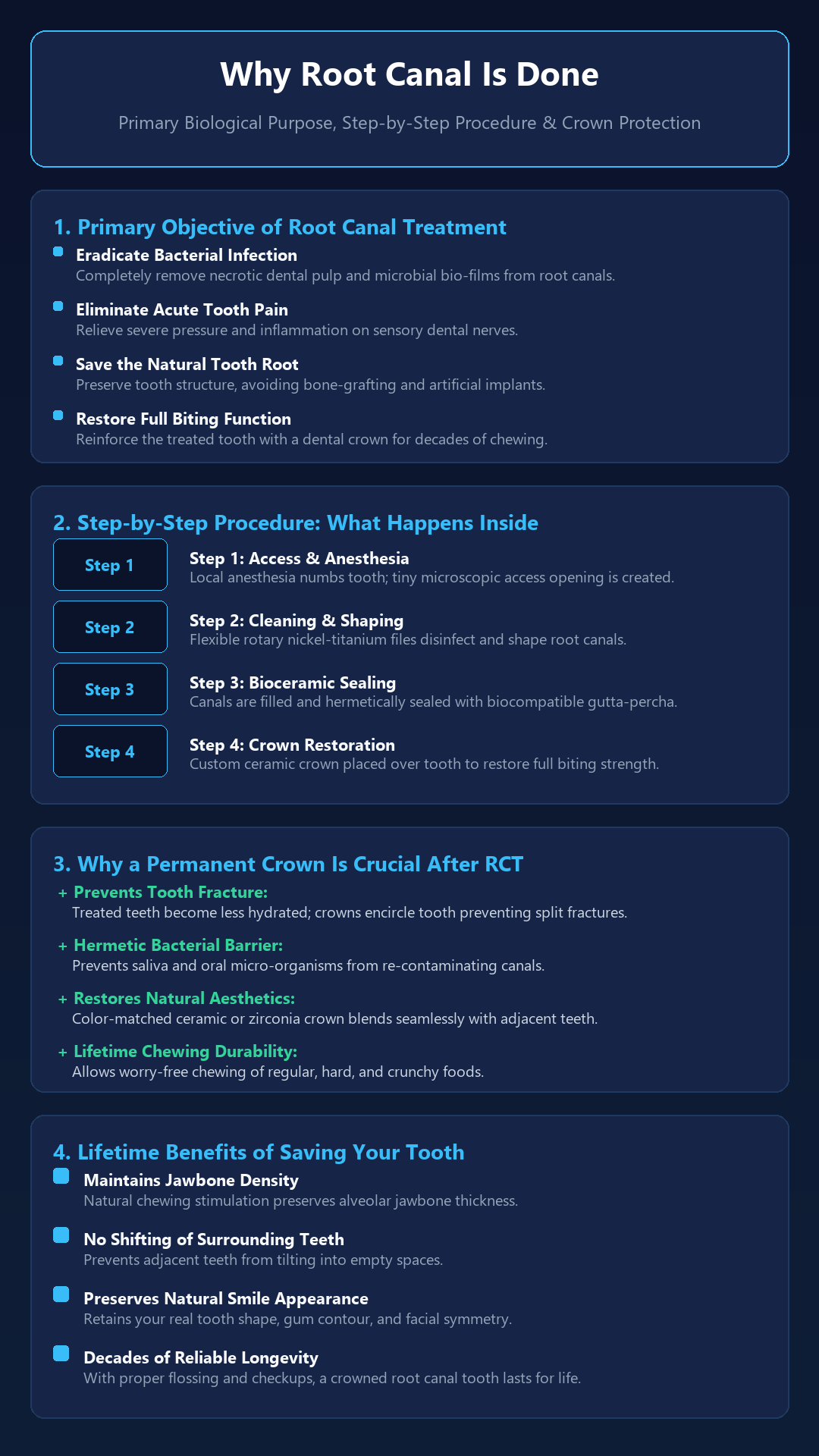
Table of Contents
- The Core Purpose: Why Root Canal Treatment Is Done
- Tooth Anatomy: Enamel, Dentin, and the Living Pulp
- Step-by-Step: How a Modern Root Canal Is Performed
- Top Clinical Benefits of Root Canal Therapy
- Root Canal vs. Dental Implants: Why Saving the Tooth Comes First
- Post-Procedure Recovery and Long-Term Crown Protection
- Expert Endodontic Care with Dr. Saurabh Pakhale
- Frequently Asked Questions (FAQs)
The Core Purpose: Why Root Canal Treatment Is Done
The primary clinical goal of root canal therapy (also termed endodontic therapy) is straightforward: to save a diseased tooth from extraction while permanently eliminating oral bacteria.
Every natural tooth has an outer layer of enamel, a middle layer of dentin, and a hollow interior canal system housing the dental pulp. When deep cavities, trauma, or cracks penetrate into this hollow canal, bacteria invade the pulp tissue. Left alone, the infection destroys the nerve and spreads into the jawbone, triggering swelling, bone destruction, and severe toothaches. A root canal removes the diseased contents of this canal system while leaving the structural root securely anchored in the jawbone.
Tooth Anatomy: Enamel, Dentin, and the Living Pulp
To grasp why this procedure is so effective, consider the layers of a tooth:
- Enamel: The hardest biological substance in the human body, protecting the crown against chewing forces and acids.
- Dentin: The supportive yellow layer beneath enamel, containing microscopic tubules leading directly to the pulp.
- Dental Pulp: The soft core containing blood vessels, nerves, and fibroblasts. In a fully mature adult tooth, the pulp’s primary job (growing the tooth during childhood) is complete; a tooth can function perfectly without living internal pulp.
- Periodontal Ligament (PDL): The elastic fibers anchoring the root to the jawbone, providing sensory feedback for chewing force. Root canal therapy preserves these vital external ligaments.
Step-by-Step: How a Modern Root Canal Is Performed
Modern endodontic treatment is typically completed in 1 or 2 smooth appointments:
| Step | Clinical Action | Purpose & Patient Experience |
|---|---|---|
| 1. Anesthesia & Isolation | Local anesthetic is administered; a rubber dam is placed. | Total numbness ensures zero pain; dam keeps the canal completely sterile and dry. |
| 2. Access & Pulp Removal | A microscopic access hole is created in the tooth chewing surface. | Exposes the pulp chamber; infected tissue and nerve remnants are gently cleared. |
| 3. Shaping & Disinfection | Rotary NiTi files shape canals while warm antimicrobial irrigants flush debris. | Dissolves remaining bacteria in complex microscopic canal branches. |
| 4. 3D Hermetic Obturation | Canals are packed with biocompatible gutta-percha and bioceramic cement. | Permanently locks out bacteria and seals the root canal space completely. |
| 5. Crown Restoration | A custom ceramic or zirconia crown is bonded over the tooth. | Protects treated tooth from vertical fractures and restores natural chewing function. |
Top Clinical Benefits of Root Canal Therapy
Choosing to treat the tooth rather than extracting it delivers significant physiological and aesthetic benefits:
- Maintains Natural Biting Force: Natural teeth possess sensory proprioceptors in the periodontal ligament, allowing you to regulate biting force seamlessly.
- Prevents Bone Loss: When a tooth is removed, the alveolar bone in the jaw naturally deteriorates. Saving the root keeps bone density intact.
- Protects Adjacent Teeth: Missing teeth cause adjacent teeth to tip forward and opposing teeth to grow downward into the gap, causing severe bite misalignment and temporomandibular joint (TMJ) pain.
- Cost Efficiency: Endodontic treatment paired with a crown is substantially more economical than tooth extraction followed by a bone graft and dental implant.
Root Canal vs. Dental Implants: Why Saving the Tooth Comes First
While modern dental implants are an excellent solution for teeth that cannot be saved, preserving your biological tooth root should always be the primary treatment choice. Implants require surgical bone drilling, several months of osseointegration healing, and potential bone augmentation. In contrast, a root canal preserves your own biological tooth within 1 or 2 comfortable visits.
Post-Procedure Recovery and Long-Term Crown Protection
Following a root canal, slight tenderness upon biting is normal for 24 to 48 hours as the surrounding periodontal tissue recovers. Standard pain relievers provide complete comfort. Because root canal therapy devitalizes the tooth, placing a permanent crown is crucial—uncrowned molar teeth are significantly more susceptible to fractures under heavy chewing loads.
If a previously treated tooth ever experiences recurrent infection due to microscopic complex channels or broken fillings, advanced root canal retreatment can reopen and reseal the root system effectively.
Expert Endodontic Care with Dr. Saurabh Pakhale
Saving your natural teeth requires clinical precision and compassionate care. At Elite Dermadent, Dr. Saurabh Pakhale utilizes high-precision rotary endodontics, digital apex locators, and painless techniques for root canal treatment in Thane.
Whether you require emergency relief from a severe toothache or a comprehensive smile restoration, our clinical team delivers gentle, long-lasting outcomes.
Frequently Asked Questions (FAQs)
1. Why is root canal treatment done instead of a tooth extraction?
Root canal treatment is done to preserve your natural tooth root and crown, which maintains jawbone volume, normal chewing efficiency, and proper tooth alignment. Extracting the tooth leads to bone resorption and requires expensive dental replacements like implants or bridges.
2. Can a tooth function normally without its pulp?
Yes. In fully developed adult teeth, the pulp’s main purpose (tooth formation) is complete. The tooth continues to receive nutrition and support from the surrounding periodontal ligament and jawbone, functioning just like any other healthy tooth.
3. How long does a root canal treatment take?
With modern rotary endodontic equipment, most uncomplicated root canals can be finished in a single sitting lasting approximately 30 to 50 minutes. Complex cases with severe infection or curved canals may require two short visits.
4. Does root canal treatment hurt during or after?
No, the procedure itself is pain-free because the tooth and surrounding area are completely anesthetized with local anesthetic. Afterward, mild tenderness when chewing may persist for 1 to 2 days, which responds quickly to standard over-the-counter painkillers.
5. Why is a crown necessary after a root canal?
Removing the pulp and clearing deep decay hollows out the tooth’s core, leaving the outer enamel brittle. A custom dental crown completely covers and protects the remaining tooth structure from cracking under biting forces.
No responses yet