
When planning dental treatment, many patients naturally wonder: why is a root canal expensive? Compared to a routine filling, endodontic therapy represents a higher upfront financial investment. However, when you understand the precision micro-technology, specialized endodontic equipment, multiple sterile steps, and the cost of the protective crown required to preserve your tooth, the pricing becomes clear. More importantly, when compared to the true alternative—tooth extraction followed by bone grafting and a dental implant—a root canal is the most cost-effective way to preserve your natural smile for life.
Key Takeaways:
- Advanced Clinical Technology: Root canal costs reflect high-precision rotary nickel-titanium instruments, digital apex locators, sterile bioceramic sealers, and specialized imaging.
- Tooth Complexity: Front teeth have one canal, while back molars feature three to four curved, microscopic canals requiring significantly more time and precision.
- Crown Restoration: The total expense includes not just the root canal cleaning, but also the permanent protective crown (metal, PFM, or zirconia) that safeguards the tooth against fracture.
- Far Cheaper Than an Implant: Extracting a tooth and replacing it with an implant and bone graft can cost 3 to 5 times more than saving the tooth with a root canal.
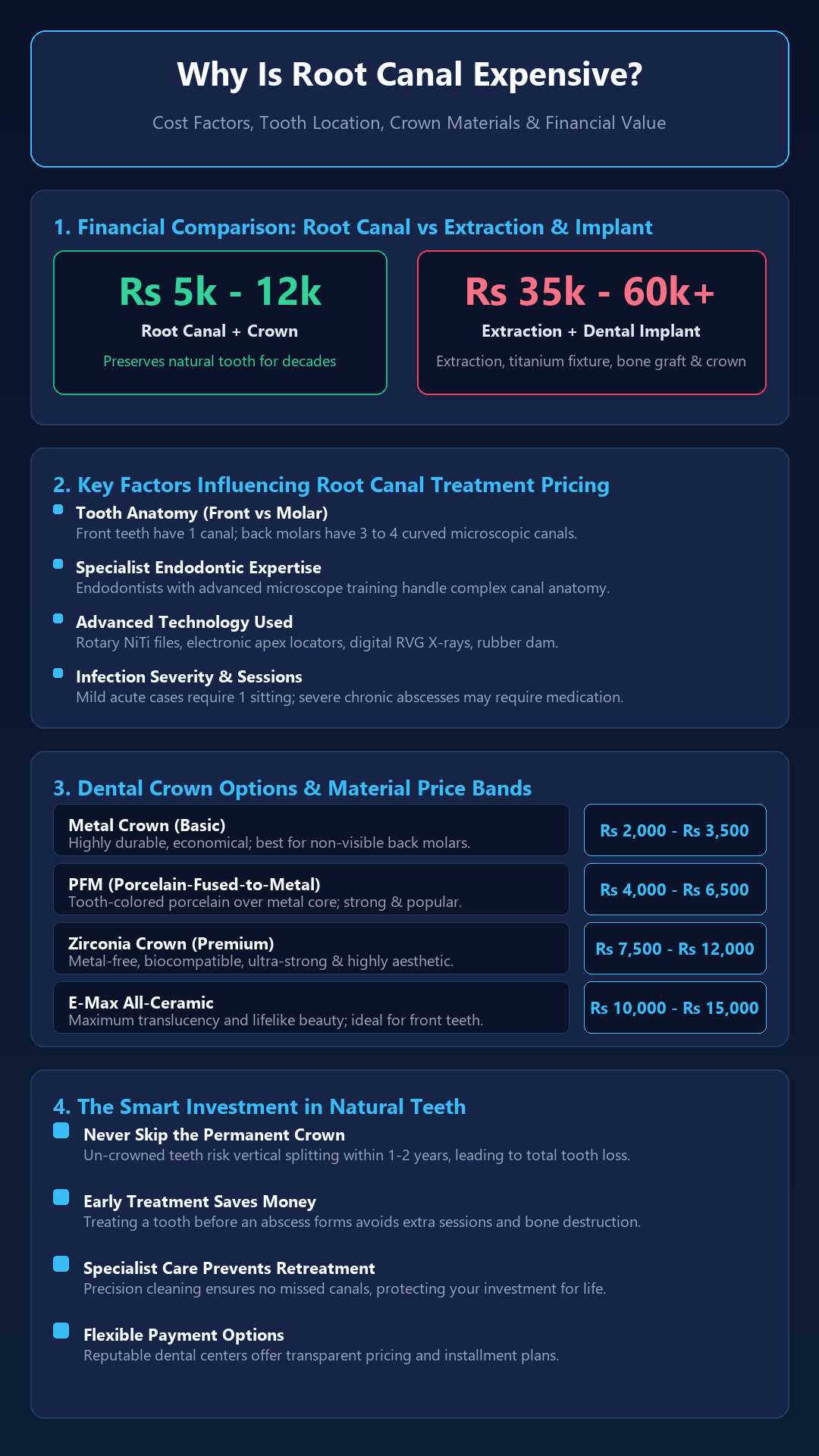
Table of Contents
- The Key Factors: Why Is a Root Canal Expensive?
- Tooth Location & Canal Complexity: Anterior vs. Molar
- Specialized Technology & Materials Behind the Procedure
- The Role of the Dental Crown in Total Treatment Cost
- Financial Comparison: Root Canal vs. Tooth Extraction & Implant
- How to Maximize the Value of Your Endodontic Investment
- Affordable, Transparent Dental Care with Dr. Saurabh Pakhale
- Frequently Asked Questions (FAQs)
The Key Factors: Why Is a Root Canal Expensive?
A root canal is not simply a deeper filling—it is a meticulous microsurgical procedure performed inside tooth roots that are narrower than a human hair. The cost of root canal therapy is determined by four primary elements:
- Anatomical Complexity: Number of root canals present inside the tooth (ranging from 1 in front incisors to 4 or 5 in upper molars).
- Severity of Infection: Severe periapical abscesses or previous failed treatments requiring medication placement across multiple sittings.
- Clinician Expertise: Treatment by an experienced endodontist or specialist who navigates tortuous, calcified canals without perforations.
- Post-Endodontic Restoration: A core build-up and a custom-milled crown (such as porcelain or zirconia) necessary to restore chewing strength.
Tooth Location & Canal Complexity: Anterior vs. Molar
The position of the infected tooth directly impacts the time, skill, and specialized instruments required for treatment:
| Tooth Type | Canal Anatomy | Clinical Complexity | Approximate Cost Range |
|---|---|---|---|
| Anterior (Front Teeth) | 1 straight canal | Direct access; lowest clinical complexity | ₹2,500 – ₹4,500 |
| Premolars (Mid Teeth) | 1 to 2 canals | Moderate access; occasionally branching canals | ₹3,500 – ₹5,500 |
| Molars (Back Chewing Teeth) | 3 to 4 curved canals | Deep posterior access; curved, calcified roots | ₹4,500 – ₹7,500 |
Note: Estimates represent procedure costs; permanent crowns are budgeted separately depending on material selected.
Specialized Technology & Materials Behind the Procedure
Modern clinics invest heavily in cutting-edge instruments that make root canals painless and predictable:
- Rotary Nickel-Titanium (NiTi) Files: High-precision flexible engine-driven files that safely negotiate 90-degree root curves without breaking. Single-use safety protocols protect against cross-contamination.
- Digital Apex Locators: Acoustic and electronic sensors that measure the root tip position to within 0.1 mm, preventing over-instrumentation into surrounding bone.
- Ultrasonic Irrigators: Cavitational energy that drives antibacterial chemicals deep into micro-tubules to dissolve stubborn bacterial colonies.
- Bioceramic Sealers & Gutta-Percha: Premium biocompatible filling materials that form an impenetrable barrier against bacterial re-entry.
The Role of the Dental Crown in Total Treatment Cost
When patients receive an estimate for root canal therapy, the total figure almost always combines the root canal procedure and the protective crown. A crown is essential for back teeth because devitalized teeth lose moisture and become prone to vertical splitting under 200+ pounds of bite force.
Crown options vary to suit different aesthetic needs and budgets:
- Metal / Nickel-Chromium Crowns: Economical and extremely durable; ideal for non-visible back molars (₹2,000 – ₹3,500).
- Porcelain-Fused-to-Metal (PFM): Strong metal core coated with tooth-colored porcelain; popular balance of strength and aesthetics (₹4,000 – ₹6,500).
- CAD/CAM Zirconia Crowns: Ultra-strong, metal-free, biocompatible ceramic with exceptional lifelike aesthetics and 10-15 year warranties (₹7,500 – ₹12,000).
- E-Max All-Ceramic: Maximum translucency and premium cosmetic beauty; best suited for visible front smiles (₹10,000 – ₹15,000).
Financial Comparison: Root Canal vs. Tooth Extraction & Implant
Some patients consider tooth extraction thinking it will save money. However, pulling a tooth without replacing it leads to jawbone loss, tilting of neighboring teeth, and bite collapse. Replacing an extracted tooth with an implant involves:
- Surgical tooth extraction: ₹1,500 – ₹3,500
- Bone grafting & membrane: ₹8,000 – ₹15,000
- Titanium dental implant fixture: ₹25,000 – ₹40,000
- Implant abutment & crown: ₹10,000 – ₹18,000
In total, an implant restoration costs anywhere from ₹45,000 to ₹75,000+, compared to ₹8,000 to ₹16,000 for a complete root canal and premium zirconia crown. Preserving your natural tooth is biologically and financially the smarter path.
Even if an older root canal fails due to secondary decay or missed canals years later, specialized root canal retreatment can renew and preserve the tooth at a fraction of the cost of extraction and implants.
How to Maximize the Value of Your Endodontic Investment
You can optimize your dental expenditure by keeping these guidelines in mind:
- Treat Early: Addressing tooth pain as soon as decay nears the nerve prevents bone loss and avoids expensive emergency surgical drainage.
- Never Skip the Crown: Postponing the crown risks splitting the root, turning an easily restorable tooth into an unavoidable extraction.
- Maintain Hygiene: Brush twice daily and floss regularly to protect the tooth margins around the crown from secondary cavities.
Affordable, Transparent Dental Care with Dr. Saurabh Pakhale
At Elite Dermadent, we believe high-quality dental care should be transparent, painless, and accessible. Under the direction of Dr. Saurabh Pakhale, our clinic provides comprehensive root canal treatment in Thane with transparent upfront pricing and flexible payment options.
We combine advanced rotary technology with custom crown restorations to give your natural tooth the best possible chance at a lifetime of healthy function.
Frequently Asked Questions (FAQs)
1. Why does a molar root canal cost more than a front tooth?
Front teeth have a single, relatively straight root canal that is straightforward to access and clean. Molars have 3 to 4 narrow, curved canals located deep at the back of the mouth, requiring significantly more time, specialized micro-instruments, and advanced clinical skill to treat safely.
2. Is it cheaper to pull a tooth instead of getting a root canal?
Initial extraction is cheaper in the short term, but leaving the space empty causes severe long-term problems, including bone resorption, adjacent teeth shifting, and chewing difficulty. Replacing the missing tooth later with a dental bridge or implant costs 3 to 5 times more than the root canal procedure.
3. Does insurance or dental schemes cover root canal treatment in India?
Many comprehensive health insurance policies with OPD dental riders or corporate dental benefits cover root canal treatments and related diagnostic X-rays. Inquire with your provider or our clinic desk for details on cashless and reimbursement assistance.
4. Can I skip the crown after a root canal to save money?
Skipping a crown on a molar or premolar is risky. Without a crown, root-treated teeth become dehydrated and brittle. Chewing normal hard foods can cause the tooth to split vertically down into the root, at which point the tooth cannot be saved and must be extracted.
5. How long does a root-canal-treated tooth last?
When performed with precision rotary instruments and protected with a well-fitting crown, a root-canal-treated tooth has a success rate over 95% and can easily last 15 to 25+ years or even a lifetime with good oral hygiene.
No responses yet