
If you have searched online or spoken to misinformed friends about dental procedures, you may have encountered the claim: why root canal is not good. Rumors and internet misconceptions often suggest that root canals cause systemic illnesses, fail easily, or are harmful to your overall health. But what does clinical endodontic science actually say? In modern evidence-based dentistry, a root canal is an exceptionally safe, highly effective, and tooth-saving procedure with a success rate exceeding 95%. Understanding the origins of these outdated myths versus modern clinical reality helps you make confident, informed choices about your oral health.
Key Takeaways:
- The “Focal Infection” Myth Debunked: Claims linking root canals to cancer or heart disease stem from flawed 1920s research by Dr. Weston Price, thoroughly refuted by the American Dental Association (ADA) and global medical bodies.
- 95%+ Success Rate: Modern endodontics using bioceramic sealers, digital apex locators, and rotary cleaning delivers reliable, long-lasting clinical success.
- Extraction Is Not Better: Pulling a tooth causes bone resorption, adjacent tooth movement, chewing imbalance, and requires expensive implants or bridges.
- Crowning Ensures Strength: Placing a high-grade dental crown over a treated tooth protects it from fracture and restores normal chewing power.
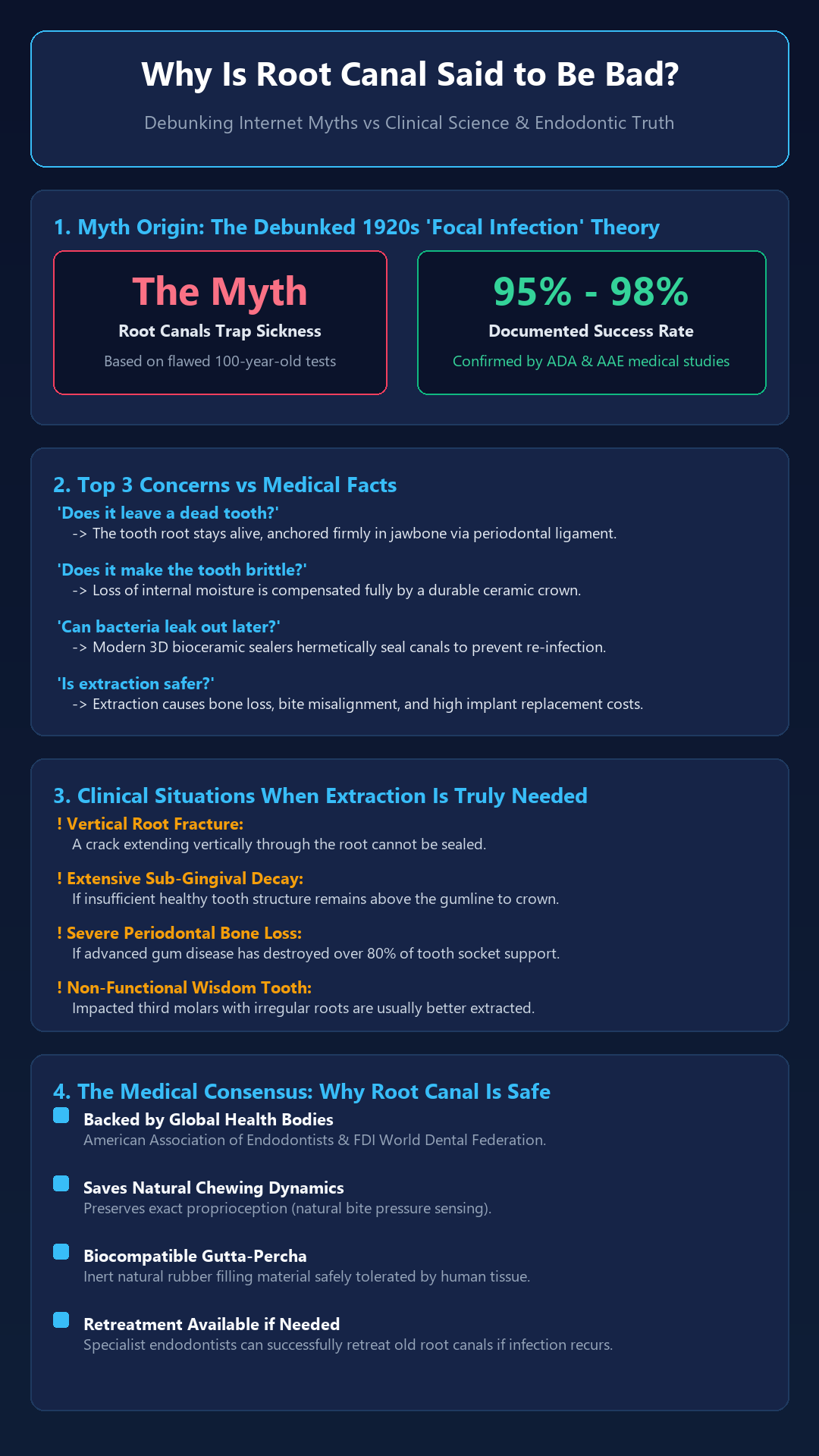
Table of Contents
- Where Did the Rumor That “Root Canals Are Not Good” Come From?
- Debunking the Top 4 Misconceptions About Root Canals
- Real Clinical Risks vs. Imagined Health Hazards
- Why Saving Your Natural Tooth Is Clinically Superior to Extraction
- Modern Sterilization & Technology: Ensuring Safe Treatments
- What Happens If a Root Canal Fails?
- Evidence-Based Dental Care with Dr. Saurabh Pakhale
- Frequently Asked Questions (FAQs)
Where Did the Rumor That “Root Canals Are Not Good” Come From?
The misconception that root canal therapy is “toxic” or “bad for the body” originates from flawed research conducted over a century ago in the early 1920s by Dr. Weston A. Price. His controversial hypothesis, known as the “Focal Infection Theory,” claimed that bacteria trapped in dead teeth leaked toxins throughout the bloodstream, causing systemic diseases such as arthritis, heart problems, and cancer.
However, modern scientific reviews by the Journal of the American Dental Association (JADA) and independent medical researchers found that Dr. Price’s experiments were deeply flawed—lacking control groups, performed under unsterile conditions, and published decades before modern antibacterial medicine. Countless rigorous epidemiological studies conducted over the past 70 years have verified that people with root canals have no higher risk of systemic diseases than anyone else.
Debunking the Top 4 Misconceptions About Root Canals
Here is how modern endodontic science dismantles the common myths circulating on social media:
| Common Myth | What People Fear | Clinical Scientific Reality |
|---|---|---|
| “Root canals cause systemic cancer or illness” | Bacteria leaking into bloodstream causing chronic illness. | Complete scientific myth. A 2013 JAMA study showed root canal patients have a 45% lower risk of cancer due to infection eradication. |
| “Extracting the tooth is safer and healthier” | Pulling the tooth completely rids the body of “dead” tissue. | Extraction creates an open wound, bone loss, teeth tilting, and requires complex, expensive implants or bridges. |
| “Root canals always fail within a few years” | Fear of repeated failure and wasted financial expense. | Endodontic therapy has an established clinical success rate above 95% when protected with a high-grade dental crown. |
| “A dead tooth turns toxic inside your jaw” | Treated teeth rot quietly under the gums. | The canal is completely sterilized and hermetically sealed with biocompatible gutta-percha and bioceramic cement. |
Real Clinical Risks vs. Imagined Health Hazards
While internet claims about systemic illness are unfounded, what are the actual clinical challenges of a root canal? A root canal is a delicate microsurgical procedure, and like any medical treatment, it requires high clinical expertise:
- Hidden or Curved Canals: Molars often have complex anatomy (such as a fourth canal or calcified roots). If a canal is missed by an inexperienced practitioner, residual bacteria can cause ongoing discomfort.
- Tooth Brittleness: Once the blood supply inside the tooth is removed, dentin dries out and becomes more brittle under strong biting forces. Skipping the recommended permanent crown leaves the tooth prone to vertical fracture.
- Micro-Leakage: If the temporary filling or crown leaks over time, oral bacteria can re-enter the canal system.
Why Saving Your Natural Tooth Is Clinically Superior to Extraction
Some people who believe root canals “are not good” conclude that having the tooth pulled is a better choice. However, biological tooth preservation is almost always superior to replacement:
- Preservation of Alveolar Bone: Tooth roots stimulate jawbone density. Once extracted, the jawbone in that area resorbs by up to 40% within the first year.
- Natural Chewing Sensation: Natural tooth roots are surrounded by the periodontal ligament, which contains microscopic pressure receptors that allow you to sense chew force naturally. Implants lack these sensory receptors.
- Prevents Malocclusion: Leaving an empty gap causes neighboring teeth to drift, tilt, and opposing teeth to over-erupt, leading to bite collapse and TMJ pain.
- Cost Efficiency: A root canal and crown are far more cost-effective than an extraction followed by bone grafting and an implant restoration.
Modern Sterilization & Technology: Ensuring Safe Treatments
In modern dental practice, root canal therapy is performed under stringent aseptic conditions:
- Rubber Dam Isolation: Isolates the tooth from saliva and mouth bacteria, ensuring complete sterility.
- Warm Sonic & Ultrasonic Irrigation: Actively flushes disinfectants deep into microscopic lateral dentinal tubules that hand files cannot reach.
- Biocompatible Bioceramic Materials: Highly stable, non-toxic materials seal root tips and promote jawbone healing without inflammatory reactions.
What Happens If a Root Canal Fails?
In the small percentage of cases where a treated tooth fails to heal due to complex canal anatomy or delayed crowning, the tooth does not automatically need to be extracted. Specialized root canal retreatment can reopen the tooth, dissolve old filling materials, thoroughly sterilize previously missed branches, and reseal the root system to give the tooth a second life.
Evidence-Based Dental Care with Dr. Saurabh Pakhale
Do not let outdated internet myths compromise your natural smile. Led by Dr. Saurabh Pakhale, the dental team at Elite Dermadent provides state-of-the-art, evidence-based root canal treatment in Thane.
We prioritize patient comfort, microscopic precision, and natural tooth preservation, restoring your smile safely and permanently.
Frequently Asked Questions (FAQs)
1. Why do some holistic health websites claim root canals are not good?
Some alternative health platforms rely on debunked theories from the 1920s claiming trapped bacteria cause distant illnesses. These claims have been repeatedly disproven by modern medical research. Major health organizations, including the American Dental Association and the American Association of Endodontists, confirm root canals are safe and do not cause systemic disease.
2. Is having a tooth pulled healthier than getting a root canal?
No. Tooth extraction causes irreversible jawbone loss, shifting of adjacent teeth, and altered bite alignment. Replacing a pulled tooth with a dental implant or bridge is far more invasive, time-consuming, and expensive than saving your natural tooth with a root canal.
3. Can a root-canal-treated tooth get infected again?
Yes, but it is uncommon (less than 5% of cases). Re-infection typically occurs if a crown is delayed or damaged, allowing new bacteria to leak inside, or if the tooth had unusually narrow, hidden canals. In such cases, endodontic retreatment can successfully eliminate the infection.
4. What materials are used to fill root canals, and are they safe?
The standard root canal filling material is gutta-percha, a natural, biocompatible polymer derived from the palaquium gutta tree, paired with modern bioceramic sealers. These materials are non-toxic, hypoallergenic, and have been safely used in millions of patients worldwide for over a century.
5. How do I make sure my root canal lasts a lifetime?
To maximize longevity, ensure a custom permanent crown is placed promptly after treatment, maintain good oral hygiene by brushing twice daily and flossing, and visit your dentist for routine bi-annual cleanings and evaluations.
No responses yet