
When a dentist recommends endodontic therapy, patients often wonder: why is a root canal required? Put simply, a root canal is required when the soft inner pulp of a tooth—which contains living nerves, blood vessels, and connective tissue—becomes irreversibly inflamed, infected, or dead. Without timely intervention, this infection spreads down the root canals into the surrounding jawbone, causing severe pain, bone destruction, and abscesses. A root canal is the only clinical procedure that can eliminate the deep infection while preserving your natural tooth structure for life.
Key Takeaways:
- Preserves Natural Tooth: Root canal therapy eliminates infection from within the tooth chamber, preventing the need for extraction and costly implants.
- Primary Causes: Deep untreated cavities, traumatic tooth fractures, cracked enamel, and repeated extensive restorations are the primary reasons root canals become necessary.
- Stops Infection Spread: Bacteria trapped inside a necrotic pulp chamber can spread past the root apex, dissolving jawbone and creating facial abscesses.
- Symptom Warning Signals: Persistent throbbing pain, lingering thermal sensitivity, localized gum swelling, or darkened tooth enamel indicate irreversible pulp damage.
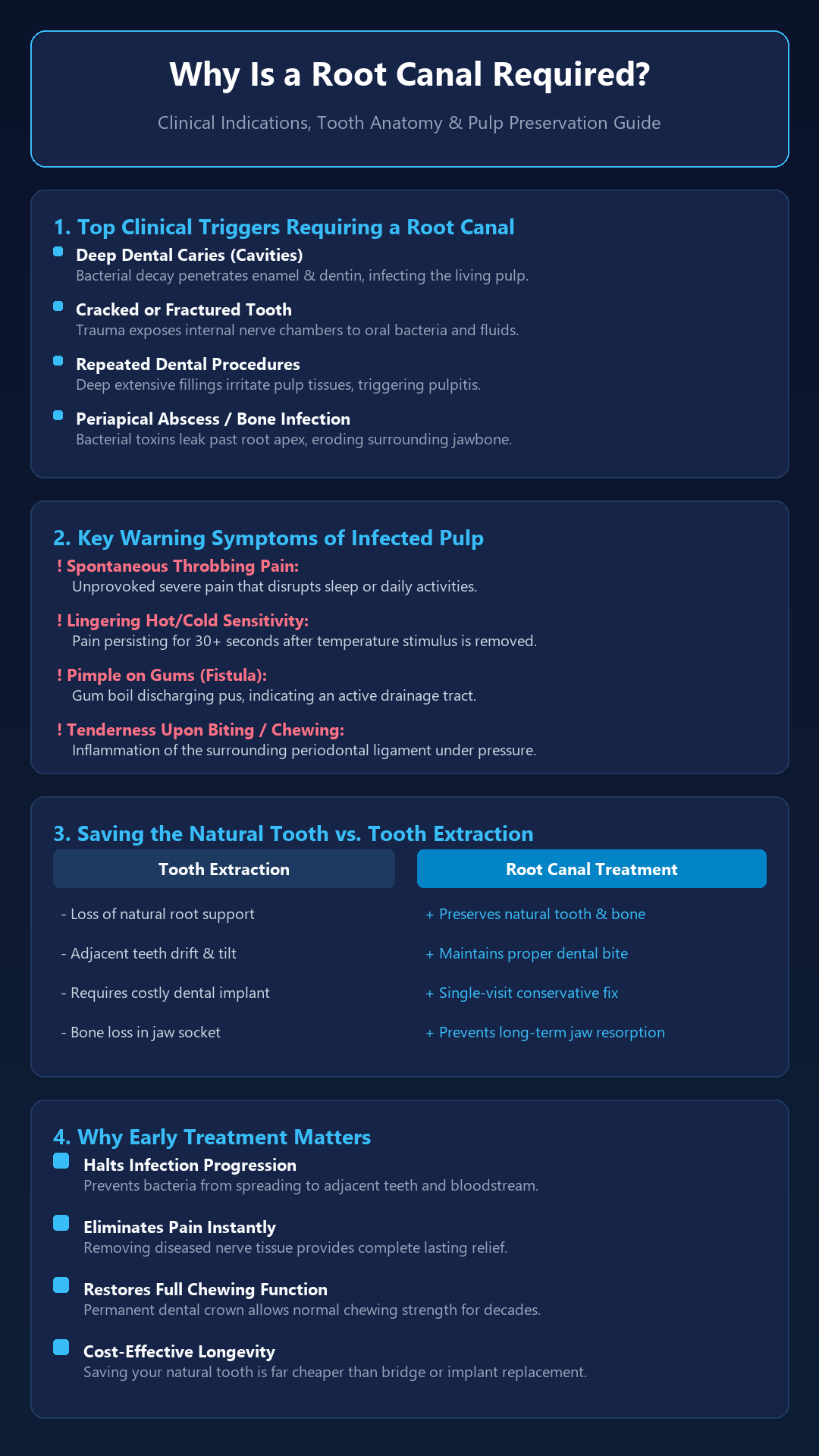
Table of Contents
- The Biological Necessity: Why Pulp Tissue Cannot Heal on Its Own
- Top 4 Clinical Reasons Why a Root Canal Is Required
- Warning Signs You Need a Root Canal Immediately
- What Happens If You Delay or Ignore Root Canal Treatment?
- Root Canal vs. Tooth Extraction: Why Saving the Tooth Matters
- How Root Canal Therapy Saves Your Tooth
- Gentle, Precision Endodontics with Dr. Saurabh Pakhale
- Frequently Asked Questions (FAQs)
The Biological Necessity: Why Pulp Tissue Cannot Heal on Its Own
Unlike other tissues in the human body that can heal after a cut or infection through abundant blood circulation, the dental pulp is tightly enclosed inside hard enamel and dentin walls. When oral bacteria penetrate these protective outer shields, the body launches an inflammatory defense response known as pulpitis.
Because the rigid walls of the tooth prevent tissue swelling, the rush of inflammatory fluid causes crushing internal pressure on the pulp’s delicate capillaries and nerve fibers. This intense pressure cuts off blood circulation, causing pulp tissue to suffocate and die (necrosis). Once necrotic, the tooth loses its internal immune defense, turning the canal into an incubator for anaerobic bacteria that will inevitably migrate into the surrounding jawbone.
Top 4 Clinical Reasons Why a Root Canal Is Required
A root canal is recommended when clinical and radiographic examinations reveal that the dental pulp has suffered irreversible trauma. The four most frequent causes include:
| Clinical Condition | Mechanism of Damage | Why a Root Canal Is Essential |
|---|---|---|
| Deep Dental Decay | Cariogenic bacteria breach outer enamel and dentin, colonizing the pulp chamber. | Simple fillings cannot seal bacteria that have entered the pulp; canals must be decontaminated. |
| Cracked or Fractured Tooth | Trauma or micro-cracks from grinding expose internal nerves to saliva and food debris. | Seals microscopic leakage pathways and stabilizes tooth structure with an endodontic crown. |
| Repeated Restorations | Multiple fillings or replacements close to the nerve space cause cumulative pulpal stress. | Relieves chronic pulp irritation that has transitioned into irreversible pulpitis. |
| Periapical Abscess / Bone Loss | Bacterial toxins exit the root apex, eroding surrounding bone and forming a pus pocket. | Cleans the infected root canal system, allowing surrounding jawbone to regenerate fully. |
Warning Signs You Need a Root Canal Immediately
While an infected tooth can occasionally remain asymptomatic during early nerve death, most patients experience distinct warning symptoms:
- Spontaneous Throbbing Toothache: Sharp or throbbing pain that occurs unexpectedly, often worsening when lying down at night.
- Lingering Sensitivity: Heightened pain when drinking hot coffee or cold water that persists for 30 seconds or longer after the beverage is finished.
- Pain When Biting or Chewing: Tenderness localized to a specific tooth upon light biting pressure, signaling periapical ligament inflammation.
- A Pimple or Fistula on the Gums: A persistent gum boil that discharges pus, releasing pressure but confirming active infection.
- Discoloration of the Tooth: Enamel turning grey, brown, or dark yellow, indicating internal nerve breakdown and blood pigment staining.
- Swelling and Facial Puffiness: Swelling in the adjacent gum tissue, cheek, or neck lymph nodes, representing a spreading infection.
What Happens If You Delay or Ignore Root Canal Treatment?
Some patients mistake a temporary lull in pain as a sign that the tooth has “healed.” In reality, when the tooth stops hurting, it simply means the nerve fibers inside the tooth have completely died. The bacterial colony remains active and begins multiplying unchecked.
Without treatment, the bacterial toxins seep into the alveolar bone, dissolving bone structure around the root apex. In severe cases, the infection can escalate into cellulitis or spread to deeper facial spaces, requiring emergency hospitalization. Ultimately, untreated teeth fracture beyond repair and must be extracted.
Root Canal vs. Tooth Extraction: Why Saving the Tooth Matters
Patients sometimes ask whether it is simpler and cheaper to pull the tooth instead. Natural teeth are biologically superior to any artificial replacement. When a tooth is extracted, the empty socket triggers continuous jawbone resorption, causing adjacent teeth to shift, bite collapse, and aesthetic deterioration.
Replacing an extracted tooth with an implant, bridge, or partial denture requires multiple appointments, bone grafting in many cases, and significantly higher lifetime expenses. A root canal saves your natural roots, maintains jawbone volume, and preserves natural chewing efficiency.
How Root Canal Therapy Saves Your Tooth
Modern root canal therapy is straightforward, predictable, and virtually pain-free:
- Anesthesia & Isolation: The tooth is numbed completely with modern local anesthetics and isolated with a dental dam to maintain a sterile working environment.
- Micro-Access & Canal Cleaning: A tiny access hole is created in the crown. Flexible rotary nickel-titanium files gently shape the canals while warm antibacterial irrigants dissolve debris and bacteria.
- 3D Hermetic Sealing: Once disinfected, the canal space is sealed with gutta-percha and bioceramic sealer, preventing future bacterial contamination.
- Protective Crown Restoration: Because devitalized teeth become brittle over time, a custom crown (such as zirconia or ceramic) is placed to restore 100% biting strength.
In rare instances where a previously treated tooth re-develops infection due to micro-leakage or complex root anatomy, specialized root canal retreatment can reopen, disinfect, and reseal the canals successfully.
Gentle, Precision Endodontics with Dr. Saurabh Pakhale
If you are experiencing persistent tooth discomfort, early diagnosis is key to saving your natural tooth. Under the clinical leadership of Dr. Saurabh Pakhale, Elite Dermadent offers cutting-edge, single-visit root canal treatment in Thane.
Utilizing high-definition digital radiography, electronic apex locators, and painless rotary technology, we ensure your treatment is fast, gentle, and designed for lifelong tooth preservation.
Frequently Asked Questions (FAQs)
1. Why is a root canal required instead of just a filling?
A filling is only effective when tooth decay is confined to the outer enamel and dentin layers. Once bacteria penetrate the pulp chamber and infect the internal nerves, a filling cannot eliminate the bacteria inside the roots. A root canal is required to decontaminate the root system completely before sealing it.
2. Can antibiotics cure an infected tooth without a root canal?
No. Antibiotics travel through the bloodstream, but an infected or necrotic tooth has lost its internal blood supply. While oral antibiotics can temporarily reduce localized swelling in surrounding gums, they cannot reach bacteria living inside the empty tooth canals. The physical source of infection must be mechanically removed via root canal treatment.
3. Why is a root canal needed if my tooth has stopped hurting?
When severe toothache suddenly vanishes without dental treatment, it usually indicates that the nerve fibers inside the pulp have completely necrotized (died). However, the bacterial infection is still thriving and expanding into the surrounding jawbone. Without treatment, this leads to bone erosion and painful abscess formation.
4. Is a dental crown always required after a root canal?
For premolars and molars (back teeth that bear intense chewing loads), a dental crown is strongly recommended. Removing the pulp and prior extensive decay makes the remaining tooth structure brittle. A full-coverage crown encases the tooth, preventing vertical fractures and ensuring long-term function.
5. How long can a tooth last after a root canal?
With modern endodontic techniques, proper canal filling, and a well-fitted protective crown, a root-canal-treated tooth can last for several decades or a lifetime with regular brushing, flossing, and dental checkups.
No responses yet