
For generations, the phrase “root canal” has been synonymous with severe discomfort, prompting many nervous patients to ask: why is a root canal considered painful? The clinical reality is surprising: a root canal treatment itself is not painful—it is the procedure that relieves excruciating pain. The intense pain people associate with root canals actually stems from the severe, untreated pulp infection and nerve inflammation inside the diseased tooth. Thanks to modern local anesthetics, rotary endodontics, and precision digital apex locators, having a root canal performed today is no more uncomfortable than getting a routine dental filling.
Key Takeaways:
- The Infection Hurts, Not the Procedure: Bacterial infection inside the enclosed tooth pulp builds intense pressure on nerve endings, causing the agonizing throbbing toothache.
- 100% Numb During Treatment: Computer-controlled local anesthesia completely desensitizes the tooth, surrounding gums, and jawbone, making the procedure pain-free.
- Modern Rotary Tech: Flexible nickel-titanium (NiTi) rotary files clean curved root canals quickly and smoothly in a single visit without vibration.
- Post-Op Tenderness Is Normal: Mild ligament soreness for 24 to 48 hours is easily managed with routine pain relievers like ibuprofen or paracetamol.
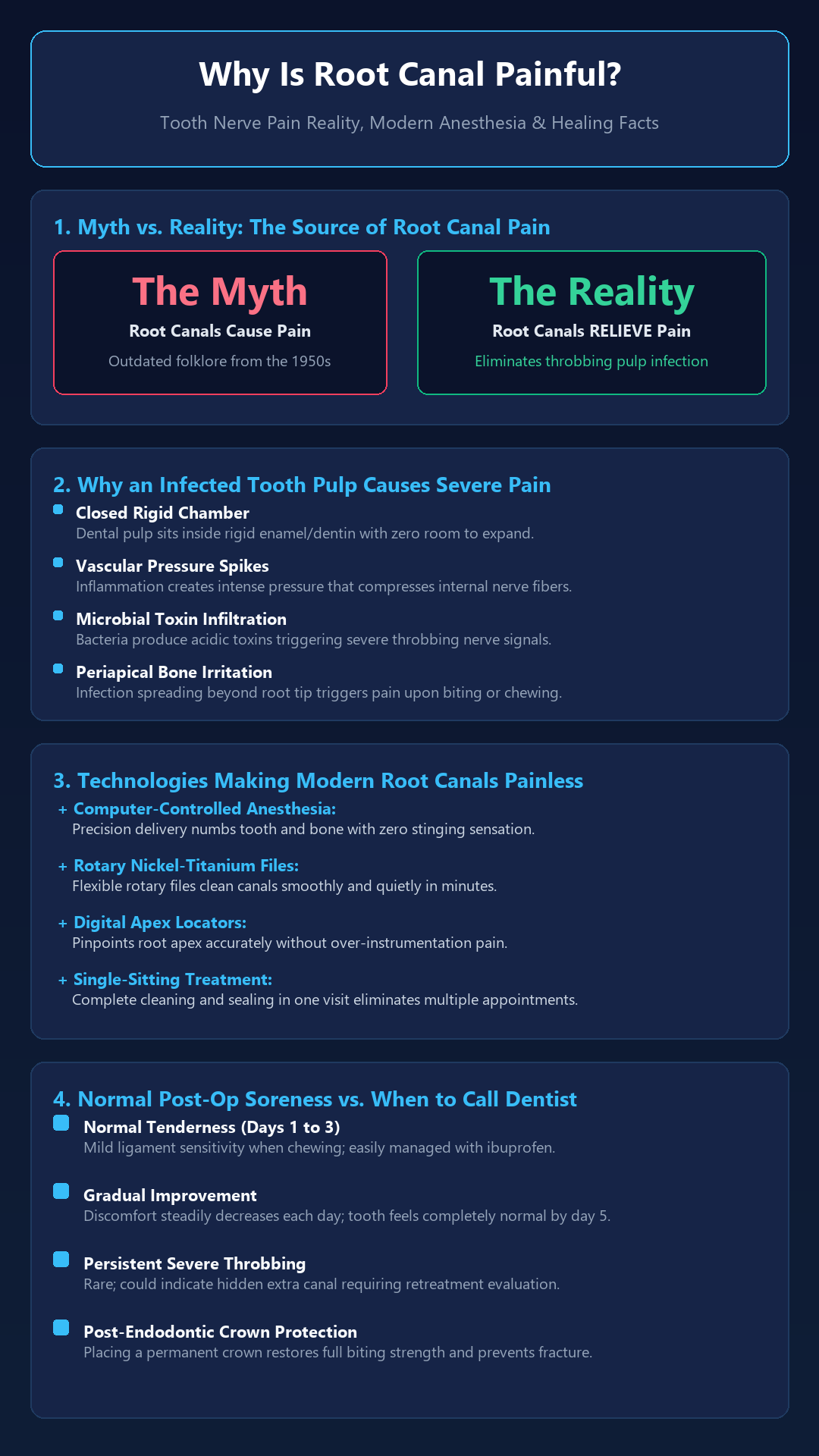
Table of Contents
- Root Canal Pain: The Historic Myth vs. Modern Reality
- The Biological Mechanism: Why an Infected Tooth Pulp Causes Agony
- How Modern Dentistry Eliminates Pain During Treatment
- Single-Sitting Root Canals: Fast, Gentle Relief
- What to Expect After the Numbness Wears Off
- What Does Lingering Pain After a Root Canal Mean?
- Gentle Endodontic Care with Dr. Saurabh Pakhale
- Frequently Asked Questions (FAQs)
Root Canal Pain: The Historic Myth vs. Modern Reality
The persistent belief that root canals are agonizing originated decades ago, before the advent of advanced local anesthetics and motorized endodontic equipment. In the mid-20th century, dental techniques were slower, and anesthesia formulations were less potent.
Today, according to the American Association of Endodontists (AAE), patients who undergo modern root canal therapy are six times more likely to describe the procedure as completely painless compared to patients who have a tooth extracted. The procedure simply cleans away necrotic nerve tissue that is actively sending distress signals to the brain.
The Biological Mechanism: Why an Infected Tooth Pulp Causes Agony
To understand why an infected tooth hurts so intensely before dental intervention, examine the tooth’s anatomy:
- The Rigid Closed Chamber: Unlike soft tissues in the body that can expand and swell when inflamed, the dental pulp (containing nerves, blood vessels, and connective tissue) is trapped inside hard enamel and dentin walls.
- Extreme Intrapulpal Pressure: When bacteria from deep decay infiltrate the pulp chamber, the immune response rushes blood and fluids to the area. Because the tooth cannot expand, pressure skyrockets, crushing nerve fibers against the inner walls.
- Thermal Hypersensitivity: Fluid expansion caused by hot foods or cold beverages triggers sharp, lingering nerve shocks.
- Periapical Abscess: If left untreated, bacteria escape through the microscopic root tip into surrounding jawbone tissue, causing severe throbbing upon chewing or biting.
How Modern Dentistry Eliminates Pain During Treatment
At advanced dental centers, three key technological advancements ensure zero procedural pain:
| Modern Technology | Clinical Function | Patient Benefit |
|---|---|---|
| Buffered Local Anesthetics | Neutral pH anesthetic delivery via ultra-fine needles | No injection sting; instant deep pulpal anesthesia |
| Rotary Nickel-Titanium (NiTi) Files | Flexible motorized instruments navigating curved root canals | Smooth, quiet cleaning in 15–20 minutes without scraping |
| Electronic Apex Locators | Digital micro-currents measuring exact canal length to 0.1mm | Prevents instruments from poking bone; zero post-op soreness |
Single-Sitting Root Canals: Fast, Gentle Relief
Gone are the days when a root canal required three or four agonizing appointments with temporary cotton pellets. At Elite Dermadent, most root canal procedures are completed in a single 45-minute sitting.
In one visit, the infected pulp is removed, canals are disinfected with warm antimicrobial irrigants, and the root is sealed three-dimensionally with biocompatible gutta-percha, permanently preventing bacterial re-entry.
What to Expect After the Numbness Wears Off
Once your local anesthesia dissipates after 2 to 3 hours, it is normal to experience mild tenderness or a bruised feeling when biting down. This is not nerve pain—the nerve inside the tooth is gone. Rather, it is mild inflammation in the periodontal ligament surrounding the root tip where infection previously lingered.
This mild tenderness peaks within 24 hours and subsides rapidly over 2 to 3 days. Standard over-the-counter anti-inflammatory tablets (like ibuprofen or paracetamol) provide complete relief.
What Does Lingering Pain After a Root Canal Mean?
If severe throbbing pain continues beyond 5 to 7 days, it could indicate an anatomical anomaly, such as an untreated calcified canal, a microscopic root crack, or persistent periapical bacteria. In such rare instances, an endodontic evaluation for root canal retreatment can reopen, clean, and reseal the canals to preserve the natural tooth.
Gentle Endodontic Care with Dr. Saurabh Pakhale
Fear of dental pain should never prevent you from preserving your natural smile. Led by Dr. Saurabh Pakhale, Elite Dermadent is known for delivering gentle, painless, and precise root canal treatment in Thane.
With digital imaging, rotary endodontics, and custom ceramic crown restorations, we ensure your tooth is saved comfortably and restored to full chewing strength.
Frequently Asked Questions (FAQs)
1. Does getting a root canal hurt during the procedure?
No. During modern root canal treatment, you are thoroughly anesthetized with potent local anesthesia. You will feel zero pain, cutting, or drilling sensation. Most patients report feeling only gentle touch or vibration, and many fall asleep in the chair.
2. Why does a tooth need a root canal if it doesn’t hurt right now?
Sometimes deep bacterial decay completely destroys the tooth nerve, causing nerve necrosis (nerve death). When the nerve dies, the pain temporarily stops, but bacteria continue multiplying inside the empty canal, eventually forming a silent, bone-destroying abscess or jaw cyst if left untreated.
3. How long does soreness last after a root canal?
Mild tenderness upon biting typically lasts between 24 and 72 hours as the tissues surrounding the root tip heal. This is normal and is easily managed with prescribed mild painkillers.
4. Is tooth extraction less painful than a root canal?
No. Tooth extraction involves removing the entire tooth and socket bone, which typically causes more post-operative pain, bleeding, and prolonged recovery. Saving the natural tooth through a root canal is faster, gentler, and biologically far superior.
5. Can a root canal be done in one sitting without pain?
Yes. With modern rotary instruments, apex locators, and potent anesthesia, single-visit root canals are completed in 30 to 45 minutes comfortably and safely, avoiding the need for multiple painful dental visits.
No responses yet