
Hair loss affects millions of men and women worldwide, often causing emotional distress and lowered self-confidence. While non-surgical treatments like Minoxidil, Finasteride, and Platelet-Rich Plasma (PRP) therapy are effective in the early stages of androgenetic alopecia, there comes a point where non-invasive medical management can no longer restore lost hair density. Knowing when hair transplant is needed is crucial to achieving natural, permanent results while safeguarding your donor area.
📌 Key Takeaways
- Norwood Stage 3 or Above: Hair transplant is recommended when pattern baldness reaches visible recession or vertex thinning that medical therapies cannot reverse.
- Stable Hair Loss: Candidates should have stabilized hair loss patterns to prevent unnatural gaps as non-transplanted hair continues to shed.
- Donor Site Integrity: Adequate donor hair density in the occipital (back and sides) scalp is mandatory for viable grafting.
- Advanced PFI Technique: Modern techniques like Precise Follicle Implantation (PFI) using the Scarfree Pen offer incision-free, high-density placement with minimal downtime.
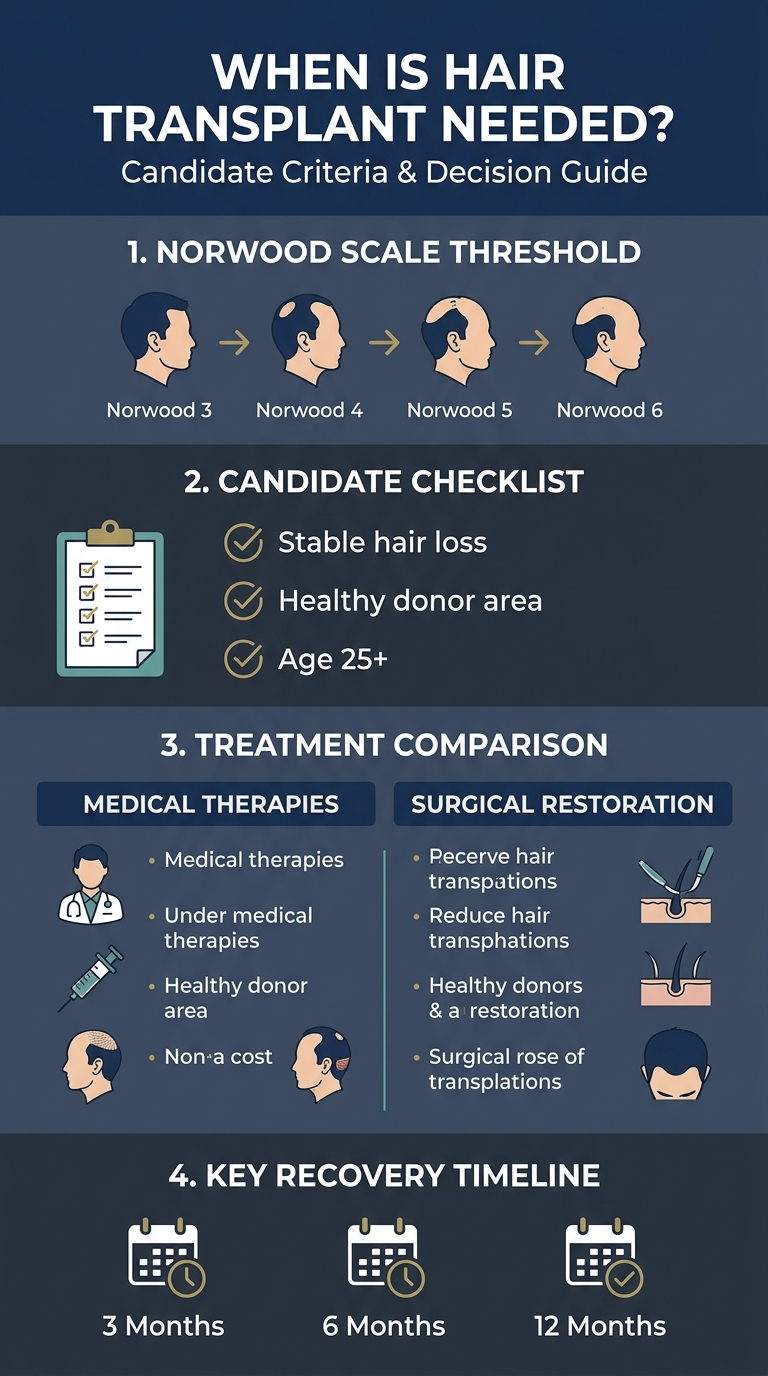
Table of Contents
- Understanding When Hair Loss Requires Surgical Intervention
- 5 Key Signs You Need a Hair Transplant
- The Norwood Scale: Which Stage Requires Surgery?
- Advanced PFI Hair Transplant Technique with Scarfree Pen
- Medical Therapy vs. Hair Transplant: A Decision Guide
- When You Should Delay or Avoid a Hair Transplant
- Post-Transplant Growth & Recovery Timeline
- Frequently Asked Questions
Understanding When Hair Loss Requires Surgical Intervention
Androgenetic alopecia (pattern baldness) is driven by dihydrotestosterone (DHT), a hormone that miniaturizes genetically susceptible hair follicles. In early stages, medical treatments act by reducing DHT levels or increasing blood flow to struggling follicles. However, once a hair follicle miniaturizes completely and stops producing hair for several years, the follicle dies and becomes fibrotic.
At this stage, topicals and serums cannot regenerate dead hair follicles. A surgical hair transplant service becomes necessary because it physically relocates DHT-resistant follicles from the permanent donor zone (back and sides of the head) to balding recipient areas.
5 Key Signs You Need a Hair Transplant
Determining candidate suitability involves both anatomical and medical factors. Under the expert evaluation of Dr Arefa Patel, Trichologist and Skin Specialist at Elite Dermadent, an ideal hair transplant candidate meets the following criteria:
- Visible Hair Follicle Expiry: Receding hairline, M-shaped temples, or a distinct bald spot on the crown where smooth scalp is visible.
- Failure of Non-Surgical Therapies: Consistent use of Minoxidil, Finasteride, or PRP therapy for 6 to 12 months without regrowth in completely bare zones.
- Stabilized Hair Shedding: Hair loss rate has slowed down or stabilized. Operating during rapid, active shedding can result in isolated transplanted patches as surrounding native hair retreats.
- Healthy Donor Hair Supply: Sufficient follicular unit density in the donor region to cover the recipient zone without over-harvesting.
- Age 25 or Older: While younger patients experience distress from early hair thinning, hair loss patterns under age 25 are often unpredictable, making premature surgery risky.
The Norwood Scale: Which Stage Requires Surgery?
The Norwood Scale classifies male pattern baldness into 7 distinct stages. Understanding your stage helps pinpoint when hair transplant is needed:
- Norwood Stage 1-2: Mild hairline recession at temples. Transplant rarely indicated; medical management recommended.
- Norwood Stage 3: Deep temporal recession forming an ‘M’ or ‘V’ shape. This is the earliest stage where a hairline restoration transplant is indicated.
- Norwood Stage 3 Vertex: Recession accompanied by thinning at the crown (vertex). Transplant recommended for density restoration.
- Norwood Stage 4-5: Severe frontal recession and expanding vertex baldness with a thin band separating them. Transplant strongly recommended.
- Norwood Stage 6-7: Extensive baldness with only a horseshoe band of donor hair remaining. Requires careful donor preservation and strategic coverage planning.
Advanced PFI Hair Transplant Technique with Scarfree Pen
Modern hair restoration has evolved significantly beyond traditional FUT strip harvesting and basic FUE methods. Elite Dermadent specializes in the Precise Follicular Implantation (PFI) Hair Transplant Technique utilizing the state-of-the-art Scarfree Pen.
How the Scarfree Pen Elevates Surgical Precision
Unlike standard FUE where slit channels are pre-cut into the scalp before inserting grafts with forceps, the Scarfree Pen loads individual hair grafts into a ultra-fine hollow needle. This allows simultaneous channel creation and graft insertion in a single, smooth motion.
Key advantages of PFI Hair Transplant include:
- Natural Hair Direction & Depth: Allows meticulous control over graft insertion angle, depth, and orientation to perfectly match natural growth patterns.
- Zero Pre-Made Incisions: Eliminates large channel cuts, reducing scalp trauma, bleeding, and post-procedure swelling.
- Maximum Graft Survival Rate: Minimal out-of-body time and direct implanter placement protect fragile bulb roots from handling damage.
- Minimal Visible Scarring: Leaves micro-punctures that heal rapidly, making the treatment ideal for patients who prefer short hairstyles.
Medical Therapy vs. Hair Transplant: A Decision Guide
To help determine whether non-surgical or surgical intervention is right for your current hair status, review the comparison below:
| Factor | Medical Management (Minoxidil / Finasteride / PRP) | PFI Hair Transplant Surgery |
|---|---|---|
| Primary Goal | Slow hair loss & thicken thinning hair | Permanently restore hair in completely bald areas |
| Target Condition | Early to moderate hair thinning (Norwood 1-3) | Established baldness (Norwood 3-6) |
| Follicle Viability | Requires active, living follicles | Works over dead, fibrotic follicle zones |
| Permanence | Requires ongoing continuous application | Permanent (transplanted DHT-resistant follicles) |
| Downtime | Zero downtime | 3-5 days minimal recovery with Scarfree Pen |
When You Should Delay or Avoid a Hair Transplant
While hair transplantation offers permanent restoration, it is not recommended for everyone. A thorough consultation will identify contraindications such as:
- Diffused Unpatterned Alopecia (DUPA): Thinning across the entire scalp, including the donor region, leaving insufficient healthy grafts.
- Alopecia Areata or Autoimmune Hair Loss: Active autoimmune attack on hair follicles will destroy newly transplanted grafts.
- Uncontrolled Scalp Conditions: Active severe seborrheic dermatitis or psoriasis must be treated prior to surgery.
- Unrealistic Density Expectations: Hair transplant redistributes existing donor hair; it does not generate brand new hair follicles.
Post-Transplant Growth & Recovery Timeline
Understanding the post-procedure recovery journey ensures realistic expectations during your hair restoration process:
- Days 1–7: Micro-scabs form around transplanted grafts. Mild redness and slight swelling subside within 5 days.
- Weeks 2–4 (Shock Loss): Temporary shedding of transplanted hair shafts occurs. This is a completely normal physiological response while follicle roots remain securely anchored.
- Months 3–4: Fine new hair sprouts begin breaking through the scalp surface.
- Months 6–9: Noticeable increase in hair length and density (approx 60-70% of final growth achieved).
- Months 12–15: Full hair density, natural texture, and complete maturity achieved.
Frequently Asked Questions
Is hair transplant permanent?
Yes. Hair grafts harvested from the donor zone (back and sides of the scalp) are genetically resistant to dihydrotestosterone (DHT). When transplanted into balding areas, they retain their DHT resistance and continue growing naturally for a lifetime.
At what age is it best to get a hair transplant?
Most trichologists recommend waiting until age 25 or older. Prior to age 25, hair loss patterns may still be developing, making it difficult to plan a sustainable hairline design.
How painful is a PFI hair transplant?
The procedure is performed under local anesthesia and is virtually painless. Post-procedure discomfort is minimal and easily managed with prescribed mild analgesics for 1 to 2 days.
Can women undergo hair transplant surgery?
Yes. Female pattern hair loss candidates with localized thinning or a high hairline and stable donor density can achieve excellent results with PFI hair transplantation.
No responses yet