
Deciding when to undergo a hair transplant is one of the most critical choices in hair restoration. While hair thinning and receding hairlines can cause significant concern, surgical intervention is not always the immediate first step. Knowing when hair transplant is needed—and when medical therapy should come first—ensures long-lasting, natural-looking results.
Key Takeaways
- Stabilization First: A hair transplant is most effective when progressive hair loss has stabilized (typically age 25+).
- Norwood Scale Stage 3+: Surgical restoration is ideal for established hairline recession or crown thinning rather than early diffuse thinning.
- Donor Capacity: Sufficient healthy hair follicles in the donor zone (back and sides of the scalp) are mandatory.
- PFI Scarfree Technology: Modern techniques like Precise Follicle Implantation (PFI) offer seamless, scarless follicle placement with zero pre-made scalp slots.
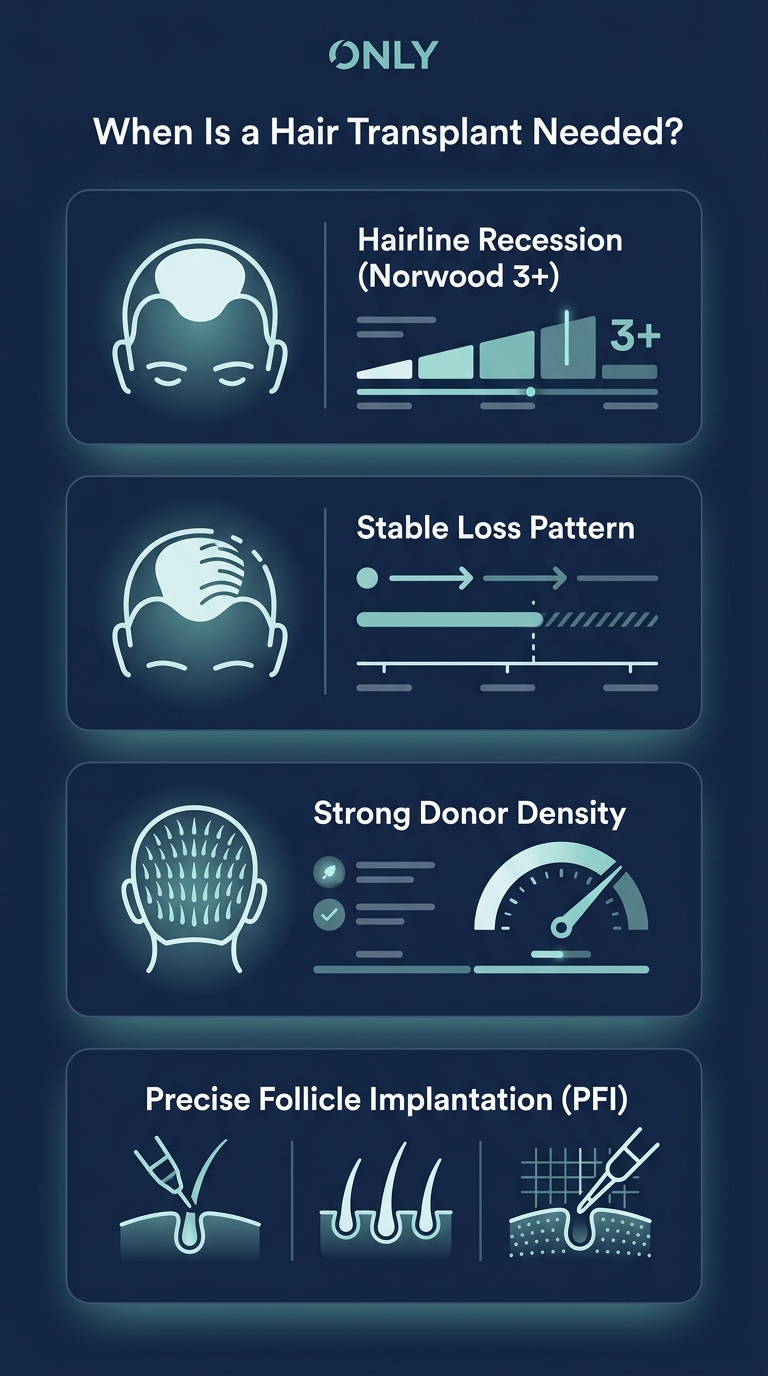
Table of Contents
- Understanding Hair Loss Progression & Timing
- Key Signs You Need a Hair Transplant
- Norwood Scale: Evaluating Your Stage
- Advanced Solution: PFI Hair Transplant with Scarfree Pen
- Medical Therapy vs. PFI Hair Transplant
- Frequently Asked Questions
Understanding Hair Loss Progression & Timing
Hair loss affects millions of men and women worldwide, primarily driven by androgenetic alopecia (pattern baldness). However, jumping into surgery at the first sign of a receding temple can be premature. Hair loss is progressive; if a transplant is performed while native surrounding hair is rapidly shedding, future thinning can leave unnatural patches.
Dermatologists and trichologists evaluate patients based on hair loss stability, age, graft availability, and underlying scalp health before recommending surgical restoration.
Key Signs You Need a Hair Transplant
Determining when hair transplant is needed relies on several clinical markers:
- Visible Permanent Follicle Loss: When hair follicles shrink (miniaturize) completely, they stop producing new shafts. Non-surgical treatments cannot revive dead follicles.
- Ineffective Medical Therapy: If 6 to 12 months of evidence-based medical therapy (such as Minoxidil, Finasteride, or PRP sessions) fail to regrow hair in bare areas, surgical transplant becomes the primary solution to restore density.
- Stabilized Hair Shedding: Candidates over 25 years old whose hair loss pattern has slowed down or stabilized produce predictable, long-term surgical outcomes.
- Adequate Donor Density: Sufficient healthy, DHT-resistant hair follicles on the occipital scalp (back of the head) are required for extraction and transplantation.
Norwood Scale: Evaluating Your Stage
The Norwood Scale is the standard classification system used by hair restoration experts to measure male pattern baldness:
- Stages 1 & 2: Mild hairline maturation. Medical therapy and scalp maintenance are recommended over surgery.
- Stage 3 & 3 Vertex: Deep temporal recession or early vertex thinning. This is usually the earliest stage where a targeted hair transplant is clinically appropriate.
- Stages 4 & 5: Moderate to severe loss across the front, top, and crown. Ideal candidates for high-density graft restoration.
- Stages 6 & 7: Extensive hair loss with limited donor supply. Strategic graft placement is necessary to maximize coverage.
Advanced Solution: PFI Hair Transplant with Scarfree Pen
When surgical restoration is indicated, choosing the right technique is essential for natural density and rapid healing. At Elite Dermadent, Dr. Arefa Patel, leading Trichologist and Skin Specialist, specializes in the cutting-edge Precise Follicular Implantation (PFI) technique utilizing the advanced Scarfree Pen.
Why PFI with Scarfree Pen Leads Modern Hair Restoration
Traditional FUE and strip methods require cutting channels into the scalp prior to inserting grafts. PFI revolutionizes this process through direct implantation:
- No Pre-Made Slits: The Scarfree Pen creates the microscopic insertion site and implants the healthy follicle simultaneously, reducing scalp trauma and bleeding.
- 360-Degree Directional Control: Enables precise control over depth, angle, and direction to match your natural hair growth pattern seamlessly.
- Scarfree & Minimal Discomfort: Leaves virtually no visible linear scarring or macro-punctures, ensuring rapid recovery and minimal post-procedure downtime.
- Maximum Graft Survival: Minimizes handling of delicate root bulbs, maximizing follicle survival rates.
If you are exploring permanent restoration options, learn more about our specialized Hair Transplant Treatment tailored to your individual scalp condition.
Medical Therapy vs. PFI Hair Transplant
Here is a clear comparison to help determine which approach suits your current hair loss stage:
| Feature | Medical & Non-Surgical Therapy | PFI Hair Transplant |
|---|---|---|
| Primary Goal | Slow down shedding & thicken miniaturized hair | Permanently restore hair in bald or receded areas |
| Best Candidates | Early thinning (Norwood 1-2), active shedding phase | Established hair loss (Norwood 3+), stable donor area |
| Permanence | Requires ongoing application/medication | Permanent results (DHT-resistant donor follicles) |
| Technique | Topical solutions, oral pills, PRP injections | Precise Follicle Implantation via Scarfree Pen |
| Recovery Time | Immediate / None | Fast recovery (3-5 days for micro-healed punctures) |
Frequently Asked Questions
At what age is a hair transplant recommended?
Most specialists recommend waiting until age 25 or older. Prior to age 25, hair loss patterns are often still evolving, which can result in unnatural-looking density patterns over time if a transplant is performed too early.
Can you get a hair transplant if you are completely bald?
A hair transplant requires a healthy donor supply from the back or sides of your scalp. If total hair loss extends to the donor regions, body hair transplant (BHT) or scalp micropigmentation may be evaluated, but traditional scalp transplants require adequate donor density.
How do I know if my donor hair is sufficient?
A trichologist performs a digital trichoscopy evaluation to measure hair density (follicles per square centimeter) in your donor zone. If donor density is strong and elastic, you are a suitable candidate for PFI hair transplantation.
Is a PFI hair transplant painful?
No. The procedure is performed under local anesthesia. Patients report minimal to no pain during implantation, and the Scarfree Pen technique reduces post-procedural soreness significantly compared to older strip or traditional slit-creation techniques.
No responses yet