
Follicular Unit Extraction (FUE) hair transplant surgery is the gold-standard surgical method for treating permanent hair loss and pattern baldness. Unlike older techniques that required harvesting strips of scalp, FUE extracts individual hair follicles directly from the donor area, resulting in natural-looking hair density with minimal discomfort and no linear scars.
Key Takeaways
- Minimally Invasive: FUE harvests individual follicular units (1 to 4 hairs) using micro-punch instruments under local anesthesia.
- No Linear Scarring: Leaves tiny micro-dots in the donor zone that heal rapidly and become undetectable under short hair.
- PFI Advanced Implantation: Modern variations like Precise Follicle Implantation (PFI) use specialized tools like the Scarfree Pen for simultaneous channel creation and direct graft insertion.
- Permanent Results: Transplanted follicles are harvested from DHT-resistant donor regions, maintaining life-long growth potential.
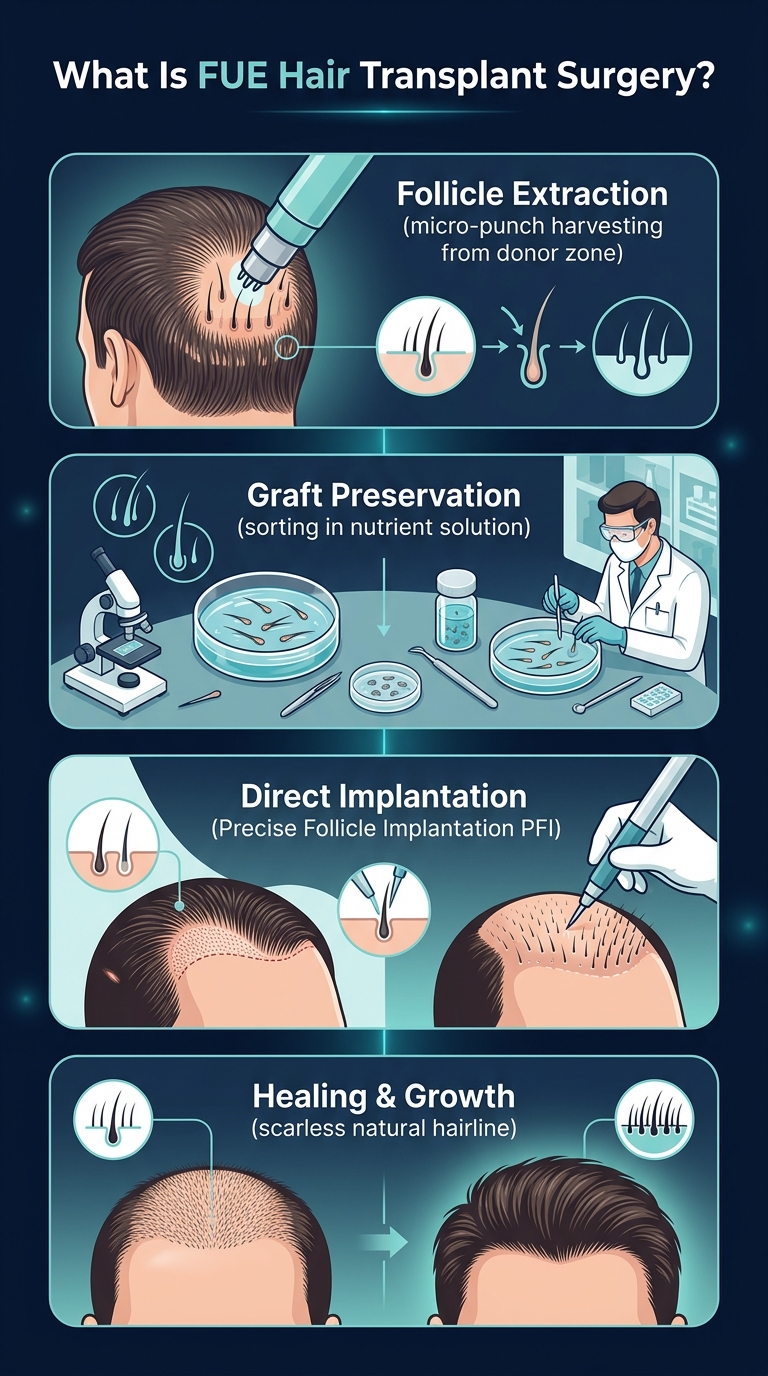
Table of Contents
- What Is FUE Hair Transplant Surgery?
- Step-by-Step FUE Surgical Procedure
- Advanced FUE: PFI Technique with Scarfree Pen
- FUE vs. FUT (Strip Method) Comparison
- Recovery & Growth Timeline
- Frequently Asked Questions
What Is FUE Hair Transplant Surgery?
FUE stands for Follicular Unit Extraction. It is an advanced hair restoration procedure where individual hair groups—known as follicular units—are harvested one by one from areas of dense hair growth (typically the back or sides of the scalp, known as the donor zone) and relocated to thinning or balding areas (the recipient zone).
Because hair naturally grows in small clusters of 1, 2, 3, or 4 hairs, extracting and placing these natural groupings allows hair transplant surgeons to recreate undetectable hairlines and achieve dense, authentic coverage.
Step-by-Step FUE Surgical Procedure
Understanding how FUE surgery works step by step demystifies the procedure for prospective patients:
1. Consultation & Hairline Design
The surgeon evaluates donor hair density, scalp elasticity, and hair loss progression, drawing a custom hairline tailored to your facial structure and age.
2. Local Anesthesia & Donor Harvesting
Local anesthesia is administered to ensure a painless experience. Using a microscopic punch tool (ranging from 0.7mm to 0.9mm in diameter), individual follicular units are gently separated from surrounding tissue and extracted.
3. Graft Sorting & Preservation
Harvested follicles are placed in a chilled, nutrient-rich solution to maintain cellular vitality while technicians count and sort grafts by hair count (singles for the hairline, doubles/triples for crown volume).
4. Follicle Implantation
Grafts are meticulously placed into the recipient area, ensuring exact alignment with your scalp’s natural hair angle, depth, and direction.
Advanced FUE: PFI Technique with Scarfree Pen
While standard FUE marked a huge leap forward from legacy strip surgery, modern medical innovation has refined the implantation phase even further. At Elite Dermadent, Dr. Arefa Patel, Trichologist and Skin Specialist, specializes in the Precise Follicular Implantation (PFI) Hair Transplant Technique utilizing the specialized Scarfree Pen.
How PFI Enhances FUE Outcomes
Standard FUE requires two separate steps for implantation: pre-cutting microscopic slits in the scalp with a blade, followed by manually placing grafts with forceps. PFI streamlines this into a single, high-precision step:
- Direct Implantation Without Pre-Made Slits: The Scarfree Pen loads individual follicles into a hollow needle, creating the micro-site and inserting the graft simultaneously. This reduces scalp trauma, bleeding, and tissue swelling.
- Total Angle & Depth Control: Allows the specialist to adjust the implantation angle (from 10 to 45 degrees) and depth precisely, ensuring new hair emerges in complete harmony with natural surrounding hair.
- Higher Graft Survival Rate: Eliminates excessive handling of the root bulb with forceps, protecting delicate root tissue and maximizing graft viability.
- Virtually Scarless Healing: Micro-punctures close and heal within days, allowing patients to wear short hairstyles without visible linear scars.
Discover more about our comprehensive PFI Hair Transplant Treatment options and personalized scalp consultations.
FUE vs. FUT (Strip Method) Comparison
Here is how modern FUE (including PFI) compares to traditional Follicular Unit Transplantation (FUT):
| Feature | FUE / PFI Technique | FUT (Strip Surgery) |
|---|---|---|
| Extraction Method | Individual micro-punch harvesting | Surgical strip removal of scalp tissue |
| Donor Scarring | Tiny micro-dots (virtually invisible) | Permanent linear scar across donor scalp |
| Post-Op Discomfort | Minimal, fast micro-healing | Moderate tightness due to scalp sutures |
| Recovery Downtime | 3 to 7 days | 14 to 21 days (suture removal required) |
| Hairstyle Flexibility | Supports short fades and buzz cuts | Requires longer hair to cover linear scar |
Recovery & Growth Timeline
What can you expect after undergoing an FUE hair transplant?
- Days 1–7 (Initial Healing): Tiny scabs form around transplanted grafts and fall off naturally within 7 to 10 days. Donor micro-punctures heal rapidly.
- Weeks 2–4 (Shock Loss Phase): The transplanted hair shafts shed temporarily. This is a completely normal physiological response—the root bulb remains healthy beneath the scalp.
- Months 3–4 (New Growth Begins): Fine, new hair shafts emerge from the scalp surface.
- Months 6–9 (Density Building): Hair grows thicker and longer, allowing you to cut and style your new hair naturally.
- Months 12–15 (Final Result): Full density and mature hairline design are fully realized.
Frequently Asked Questions
Is FUE hair transplant surgery permanent?
Yes. Hair grafts are extracted from the donor region located on the back and sides of the head. These follicles are genetically resistant to Dihydrotestosterone (DHT)—the hormone responsible for pattern baldness—allowing them to grow permanently in their new location.
Does FUE hair transplant surgery hurt?
No. The procedure is performed under local anesthesia, ensuring you remain comfortable throughout. Most patients report feeling only mild pressure during graft placement and manage post-op recovery easily with standard mild pain relievers.
How many grafts are typically needed in an FUE procedure?
The graft count depends on the degree of hair loss. Receding hairline restoration usually requires 1,500 to 2,500 grafts, while advanced crown and top restoration may require 3,000 to 4,500 grafts across single or split sessions.
How long does an FUE procedure take?
An FUE session generally lasts between 4 to 8 hours depending on the total graft count. Because individual follicles are harvested and placed with extreme precision, the process is thorough and unhurried to ensure maximum graft survival.
No responses yet