

Understanding what FUE hair transplant price entails is one of the most important considerations for anyone planning hair restoration. Unlike generic cosmetic procedures, FUE (Follicular Unit Extraction) pricing depends on the number of grafts required, the complexity of your hair loss pattern, and the advanced implantation technique used by your medical specialist.
Key Takeaways
- Per-Graft Pricing Model: FUE procedures are primarily calculated based on the total number of follicular units (grafts) transplanted.
- Graft Range: Minor hairline touch-ups require 1,000–1,500 grafts, while extensive crown and hairline restoration may require 3,000–4,000+ grafts.
- Technique Impact: Advanced direct implantation techniques like PFI (Precise Follicle Implantation) offer superior density, faster micro-healing, and zero linear scars.
- Long-Term Value: Choosing experienced medical specialists prevents donor over-harvesting and costly corrective procedures down the road.
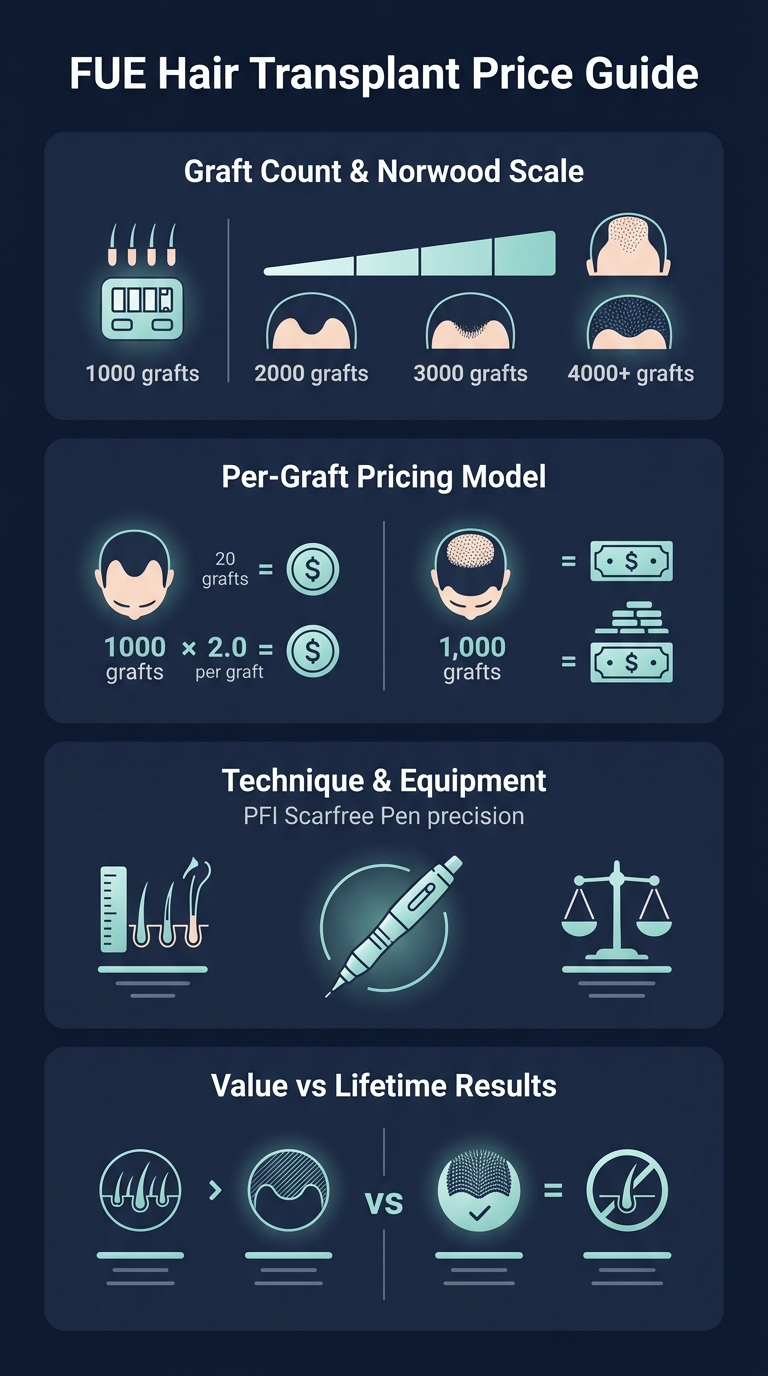
Table of Contents
- How FUE Hair Transplant Pricing Works
- Key Factors Influencing FUE Price
- Graft Requirements & Cost Breakdown
- Advanced PFI Technique: Is It Worth the Investment?
- The Hidden Cost of Budget Hair Transplants
- Frequently Asked Questions
How FUE Hair Transplant Pricing Works
When asking what is FUE hair transplant price, it is essential to know that surgical costs are tailored specifically to your degree of hair loss. Medical clinics generally evaluate cost through two main models:
- Per-Graft Pricing: Cost is calculated by multiplying the exact number of harvested follicular units (grafts) by a fixed rate per graft. This model ensures you pay only for the coverage you actually need.
- Session-Based Pricing: Offered for mega-sessions requiring extensive 3,000+ graft transplantations across a full day or multi-day procedure.
Each graft typically contains 1 to 4 individual hair follicles. Therefore, a 2,000-graft FUE procedure successfully relocates between 4,000 and 5,000 healthy hairs to your recipient zone.
Key Factors Influencing FUE Price
Several clinical and technical variables directly impact the final cost of FUE hair transplant surgery:
- Degree of Hair Loss (Norwood Scale Stage): Hairline recession (Norwood Stage 2–3) requires fewer grafts than extensive crown baldness (Norwood Stage 5–6).
- Surgeon Expertise & Qualifications: Procedures performed by certified trichologists and board-certified hair restoration surgeons ensure higher graft survival and natural hairline aesthetics.
- Harvesting & Implantation Technology: Advanced tools such as the Scarfree Pen for direct follicle implantation require specialized surgical skill compared to basic manual slit-creation.
- Donor Hair Quality & Scalp Characteristics: Curly, fine, or previously scarred scalps require specialized extraction care to protect root integrity.
Graft Requirements & Cost Breakdown
The table below outlines typical graft requirements based on hair loss severity and the corresponding restoration goals:
| Norwood Stage | Restoration Area | Estimated Grafts | Expected Density Goal |
|---|---|---|---|
| Stage 2 – 3 | Receding Temples & Hairline Refinement | 1,000 – 1,800 Grafts | High-density hairline redesign |
| Stage 3 Vertex – 4 | Frontal Third + Mid-Scalp Thinning | 2,000 – 2,800 Grafts | Full frontal coverage & transition zone |
| Stage 5 – 6 | Extensive Frontal, Mid-Scalp & Crown Baldness | 3,000 – 4,000+ Grafts | Maximum graft distribution for global coverage |
Advanced PFI Technique: Is It Worth the Investment?
Investing in hair restoration is a permanent decision. At Elite Dermadent, Dr. Arefa Patel, Trichologist and Skin Specialist, performs the advanced Precise Follicular Implantation (PFI) Hair Transplant Technique utilizing the specialized Scarfree Pen.
Why PFI Delivers Maximum Return on Investment
Unlike standard FUE methods that rely on pre-made scalp slits, PFI combines site creation and graft insertion into a single seamless step:
- High Follicle Survival Rate: Eliminates root bulb trauma caused by forceps handling, ensuring that virtually every transplanted graft takes root and grows.
- Zero Linear Scarring: Puncture sites are microscopic, leaving no visible linear scars and promoting rapid scalp recovery within days.
- Natural Directional Control: Total control over depth, angle, and direction creates a hairline that flows naturally with your native hair.
Learn more about customized pricing plans and consult with our specialists for a personalized PFI Hair Transplant Assessment.
The Hidden Cost of Budget Hair Transplants
Choosing an uncertified clinic based solely on the lowest price often leads to severe complications, including:
- Donor Over-Harvesting: Aggressive extraction by unqualified technicians can permanently thin out the back of your scalp.
- Low Graft Survival: Poor handling of follicles outside the body leads to poor growth yield, wasting precious donor hair.
- Unnatural Pluggy Hairlines: Incorrect placement angles result in doll-like hair growth that requires costly corrective revision surgery.
Frequently Asked Questions
How is FUE hair transplant price calculated?
FUE price is calculated primarily by multiplying the required number of grafts (follicular units) by the per-graft rate, along with the surgical technique used (such as direct PFI Scarfree implantation) and the expertise of the attending trichologist.
Are there any hidden costs after FUE surgery?
A transparent clinic includes post-operative care, specialized washing instructions, and routine follow-up consultations in the initial quote. Optional post-op treatments like PRP hair therapy may be recommended to accelerate growth.
Is an FUE hair transplant covered by health insurance?
Hair transplant surgery is typically classified as an elective cosmetic procedure and is generally not covered by standard health insurance unless hair loss is directly caused by trauma, burns, or reconstructive medical necessity.
Is a PFI hair transplant more cost-effective than standard FUE?
Yes. Because PFI achieves significantly higher graft survival rates and causes minimal scalp trauma, patients get superior density and long-term results from fewer total grafts, making it a highly cost-effective investment.
Comments are closed