
After undergoing a successful root canal and having a durable dental crown placed, many patients assume the treated tooth is permanently shielded from future dental problems. However, a common and surprising question frequently arises: can root canal teeth get cavities, and can a tooth without a nerve still decay?
The definitive clinical answer is yes, root canal teeth can definitely get cavities. While a root canal treatment removes the living nerve tissue and blood supply from inside the pulp chamber—rendering the tooth incapable of feeling hot or cold sensitivity—the external enamel, dentin, and underlying root structure remain natural biological tooth tissue. Plaque bacteria can still produce acids that demineralize this natural tooth structure, especially along the vulnerable margin where the crown meets the gumline. Because the tooth has no internal nerve, decay develops silently without triggering a warning toothache.
Key Takeaways: Cavities on Root-Canaled Teeth
- Nerves Are Gone, But Tooth Structure Remains: A root canal sterilizes the interior of the tooth, but the natural tooth shell beneath a dental crown can still rot if exposed to plaque and acids.
- The “Silent Threat”: Without active sensory nerve fibers, you will not feel temperature sensitivity or typical cavity pain, allowing recurrent decay to spread unnoticed without regular dental exams.
- The Crown Margin Is Vulnerable: The microscopic junction where your porcelain or zirconia crown meets the natural tooth root at the gumline is the primary entry point for bacterial microleakage.
- Advanced Retreatment Solutions: If decay breaches the core and reinfects sealed root canals, modern endodontic retreatment can disinfect and save the tooth before structural loss necessitates extraction.
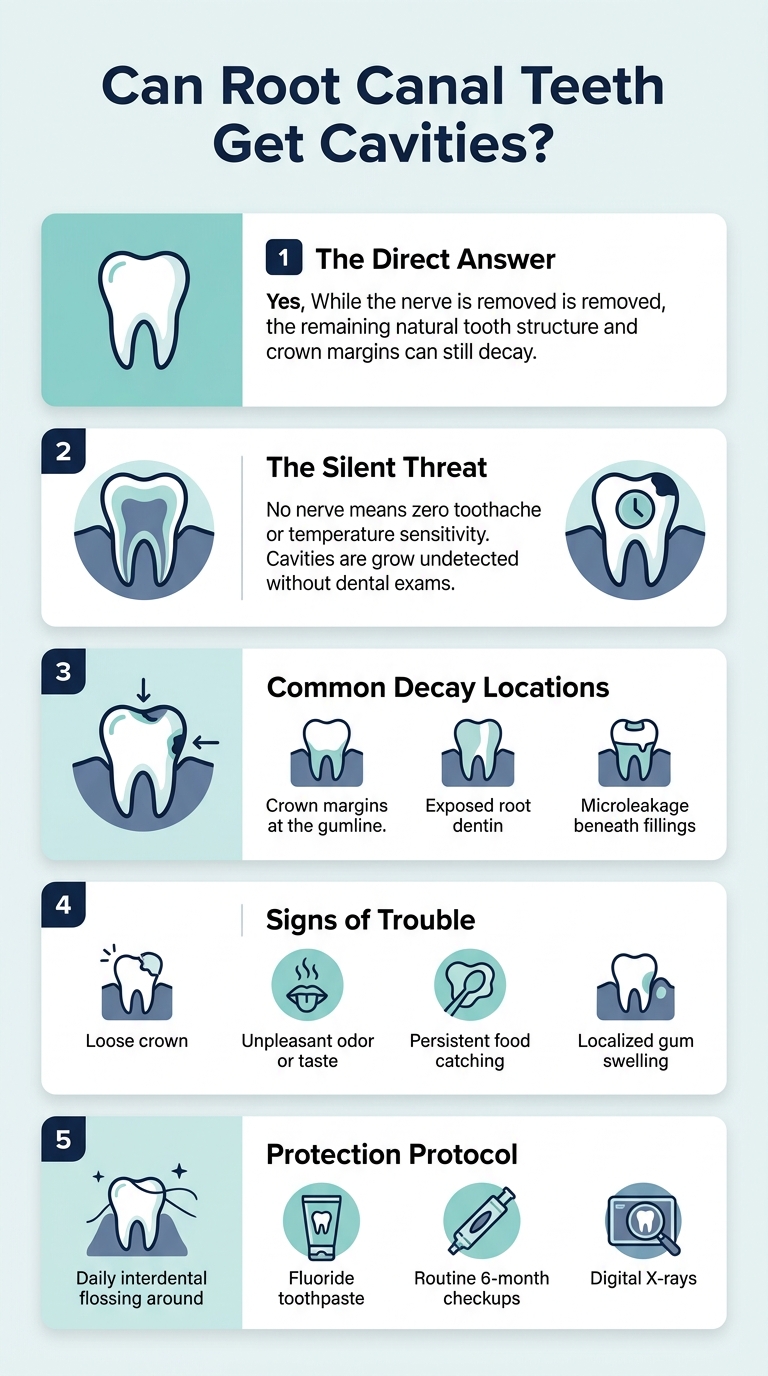
Table of Contents
- The Anatomy of a Treated Tooth: What Decays and What Doesn’t?
- Why Decay on Root-Canaled Teeth Is a “Silent Threat”
- Warning Signs You Have Decay Under a Crown or Root Canal
- Comparison: Cavity on a Living Tooth vs. Root-Canaled Tooth
- How Dentists Detect Hidden Decay Beneath Crowns
- Treatment Options: From Crown Replacement to Retreatment
- How to Protect Root-Canaled Teeth from Recurrent Cavities
- Specialized Restorative Care at Elite Dermadent
- Frequently Asked Questions
The Anatomy of a Treated Tooth: What Decays and What Doesn’t?
To grasp why a treated tooth remains vulnerable to cavities, it helps to understand what changes—and what stays the same—after endodontic therapy:
- The Dental Crown or Filling Cannot Decay: Artificial materials such as porcelain, ceramic, zirconia, or composite resin cannot be eaten away by bacteria or acids.
- The Internal Pulp Chamber Is Sealed: The living nerve fibers, capillaries, and connective tissues have been removed, disinfected, and sealed with inert biocompatible gutta-percha.
- The Natural Tooth Root and Margins CAN Decay: Your crown sits on top of your natural tooth structure. The seam where the crown edge meets the tooth (the cervical margin) is exposed to oral bacteria, saliva, and food debris. If plaque accumulates along the gumline, bacteria dissolve the natural dentin and cementum underneath the restoration.
Why Decay on Root-Canaled Teeth Is a “Silent Threat”
On a healthy, living tooth, a developing cavity triggers noticeable early warning signs: sharp twinges when eating sweets, sensitivity to ice water, or throbbing pain with hot coffee. These signals are transmitted by sensory A-delta and C nerve fibers inside the pulp, prompting you to visit your dentist before extensive structural loss occurs.
When you ask can root canal teeth get cavities, the most dangerous reality is that a root-canaled tooth has no nerve to sound the alarm. Decay can quietly eat away the natural core supporting your crown for months or even years. Often, patients only realize there is a problem when the entire crown falls off, the tooth snaps off at the gumline, or bacteria reach the surrounding jawbone to cause a periapical abscess.
Warning Signs You Have Decay Under a Crown or Root Canal
Because nerve pain is absent, you must look for subtle physical and functional clues that indicate recurrent decay beneath a treated tooth:
- Floss Shredding or Snagging: If dental floss consistently catches, frays, or shreds when cleaning around the crown margin, a microscopic ledge or cavity hole has likely formed.
- Persistent Food Packing: Food continually lodging in the space between the crowned tooth and neighboring teeth indicates that the contact point or margin has deteriorated.
- Unpleasant Odor or Taste: Anaerobic bacteria trapped beneath a leaking crown margin produce foul-smelling sulfur compounds that resist regular brushing and mouthwash.
- Dark Line or Shadow Along the Gumline: While some metal-ceramic crowns have a dark metal collar, a new or expanding brown/black discoloration along the tooth margin often signals rotting dentin.
- Crown Looseness or Chewing Discomfort: If the crown feels mobile, or if biting down produces dull pressure in the jaw, the underlying cement seal has washed out and bacteria have compromised the tooth structure or surrounding periodontal ligament.
- Gum Swelling or a “Pimple” on the Gums: A localized bump (fistula) on the gum next to the treated tooth indicates that bacteria have penetrated down to the root tip, forming an active abscess.
Comparison: Cavity on a Living Tooth vs. Root-Canaled Tooth
The differences between dental decay on a vital tooth versus a root-canaled tooth are critical to recognize:
| Feature / Metric | Cavity on a Living (Vital) Tooth | Cavity on a Root-Canaled Tooth |
|---|---|---|
| Early Pain & Sensitivity | Sharp sensitivity to cold, heat, sweets, or pressure | Zero pain or sensitivity (silent progression) |
| Primary Site of Decay | Chewing grooves, fissures, and interdental contacts | Crown margins, gumline roots, cement junctions |
| Early Detection Ease | High (patient notices discomfort early) | Low (requires routine dental X-rays & probing) |
| Treatment If Caught Early | Simple composite resin filling | Crown removal, decay excavation, and new crown |
| Risk of Delayed Treatment | Pulp death requiring root canal therapy | Total tooth fracture requiring extraction and implant |
How Dentists Detect Hidden Decay Beneath Crowns
Because physical symptoms are masked, detecting recurrent decay requires expert diagnostic tools during routine examinations:
- Digital Bitewing Radiographs: Digital X-rays reveal “radiolucent” dark shadows beneath crown margins where bacterial demineralization has occurred.
- Tactile Marginal Probing: Using specialized dental explorers, the dentist methodically checks the full circumference of the crown edge to detect softness, stickiness, or microscopic gaps.
- Cone Beam CT (CBCT) 3D Imaging: If bacteria have leaked deep into the root canals or created an apical abscess in the jawbone, 3D CBCT scans provide slice-by-slice views of the root system.
Treatment Options: From Crown Replacement to Retreatment
If recurrent decay is discovered on a root-canaled tooth, treatment depends on how deep the bacteria have penetrated:
- Minor Marginal Decay: If the cavity is small and localized right at the gumline without compromising the crown’s internal retention, the dentist can remove the decay and place a precision tooth-colored resin or glass ionomer filling.
- Moderate Decay Beneath Crown: If decay has spread beneath the crown, the old crown must be safely removed. The decayed tooth structure is cleared, a solid core buildup is placed, and a new custom crown is fabricated with an airtight seal.
- Deep Bacterial Reinfection (Endodontic Revision): If bacteria have leaked past the core buildup into the sealed root canal system, a new crown alone is not enough. The tooth requires specialized root canal retreatment in Thane. An endodontist opens the tooth, dissolves old gutta-percha, thoroughly disinfects accessory canals with ultrasonic irrigants, and reseals the canals before placing a new restoration.
- Extensive Structural Destruction: If decay has extended deep below the bone level or fractured the root vertically, the tooth cannot be predictably saved and will require gentle extraction followed by a dental implant.
How to Protect Root-Canaled Teeth from Recurrent Cavities
A root-canaled tooth protected by a well-fitting crown can last a lifetime with the right daily preventive habits:
- Floss the Crown Margin Daily: Plaque builds up where the crown meets the tooth. Curve dental floss around the neck of the tooth in a “C” shape and clean gently beneath the gumline. Interdental brushes or water flossers are highly beneficial.
- Use Fluoride Toothpaste: Fluoride remineralizes exposed root surfaces and strengthens natural dentin against bacterial acid attacks.
- Never Skip 6-Month Checkups: Since you cannot feel pain in a root-canaled tooth, routine dental cleanings and periodic X-rays are your primary defense against silent decay.
- Avoid Chewing Hard Objects: Chewing ice, hard candy, or unpopped popcorn kernels can create micro-fractures in the crown seal, inviting bacteria inside.
Specialized Restorative Care at Elite Dermadent
Safeguarding treated teeth requires endodontic mastery and meticulous restorative precision. At Elite Dermadent, restorative and endodontic treatments are guided by Dr. Saurabh Pakhale, an accomplished dental surgeon renowned for his conservative, precision-focused approach.
Dr. Pakhale utilizes high-magnification loupes, digital apex locators, and CAD/CAM custom crowns to ensure marginal margins fit with microscopic accuracy, preventing bacterial microleakage from taking root. Whether you require a new custom crown, preventive evaluation, or advanced root canal treatment in Thane, our team ensures your smile remains strong, functional, and cavity-free for years to come.
Frequently Asked Questions
Can a tooth with a crown still get a cavity?
Yes. While the artificial crown material cannot decay, the natural tooth underneath and around the gumline margin remains susceptible to bacterial plaque and acidic demineralization.
How do I know if my root-canaled tooth has a cavity if it doesn’t hurt?
Common signs include a foul smell or bad taste when flossing around the tooth, floss tearing or catching on the crown margin, food packing between teeth, a loose crown, or a dark shadow along the gumline. Routine dental X-rays provide definitive diagnosis.
Can decay under a crown be fixed without removing the crown?
If the decay is very superficial and confined strictly to the accessible outer root margin, a minor filling can sometimes be placed. However, if decay extends underneath the crown, the restoration must be removed to clear all bacteria and prevent catastrophic structural failure.
What happens if a cavity under a root canal is left untreated?
Untreated decay will consume the natural tooth core supporting the crown. Eventually, the tooth will fracture off at the gumline, or bacteria will reinfect the root canals and spread into the jawbone, causing an abscess and necessitating tooth extraction.
How long does a root-canaled tooth typically last?
With high-quality endodontic treatment, a well-sealed crown, daily flossing, and regular dental cleanings, a root-canaled tooth can last 15 to 20 years—and often a lifetime.
No responses yet