
For patients suffering from severe dental anxiety, needle phobia (trypanophobia), or health concerns regarding medication allergies, the thought of receiving a dental injection can feel more intimidating than the procedure itself. Consequently, a question dentists hear frequently is: can root canal be done without anesthesia, and what happens if you refuse local numbing?
The straightforward medical answer is that while a root canal can theoretically be performed without anesthesia in rare cases where the tooth nerve is 100% necrotic (completely dead), endodontists and dental surgeons strongly advise against it for the overwhelming majority of patients. If even microscopic vital nerve tissue remains—or as instruments clean the sensitive periodontal tissues surrounding the tip of the root—undergoing a root canal without anesthesia will cause unbearable pain. Fortunately, modern gentle dentistry provides multiple pain-free alternatives, including needle-free numbing gels, epinephrine-free formulas, and sedation options.
Key Takeaways: Anesthesia & Root Canal Treatment
- When It Is Theoretically Feasible: Only when an electric pulp test and thermal testing confirm that the inner tooth pulp is completely necrotic (dead) with zero nerve sensation.
- The Periapical Trap: Even in a “dead” tooth, cleaning files must reach the root apex. The surrounding periodontal ligament and jawbone are packed with active nerves that feel severe pressure and pain without anesthesia.
- Safety Risks of Skipping Numbing: Sudden involuntary flinching from acute pain can cause instrument fracture, canal perforation, or incomplete bacterial disinfection.
- Gentle Solutions for Needle Anxiety: High-potency topical pre-numbing gels, micro-fine needles, epinephrine-free anesthetics for heart conditions, and conscious sedation make modern root canals virtually imperceptible.
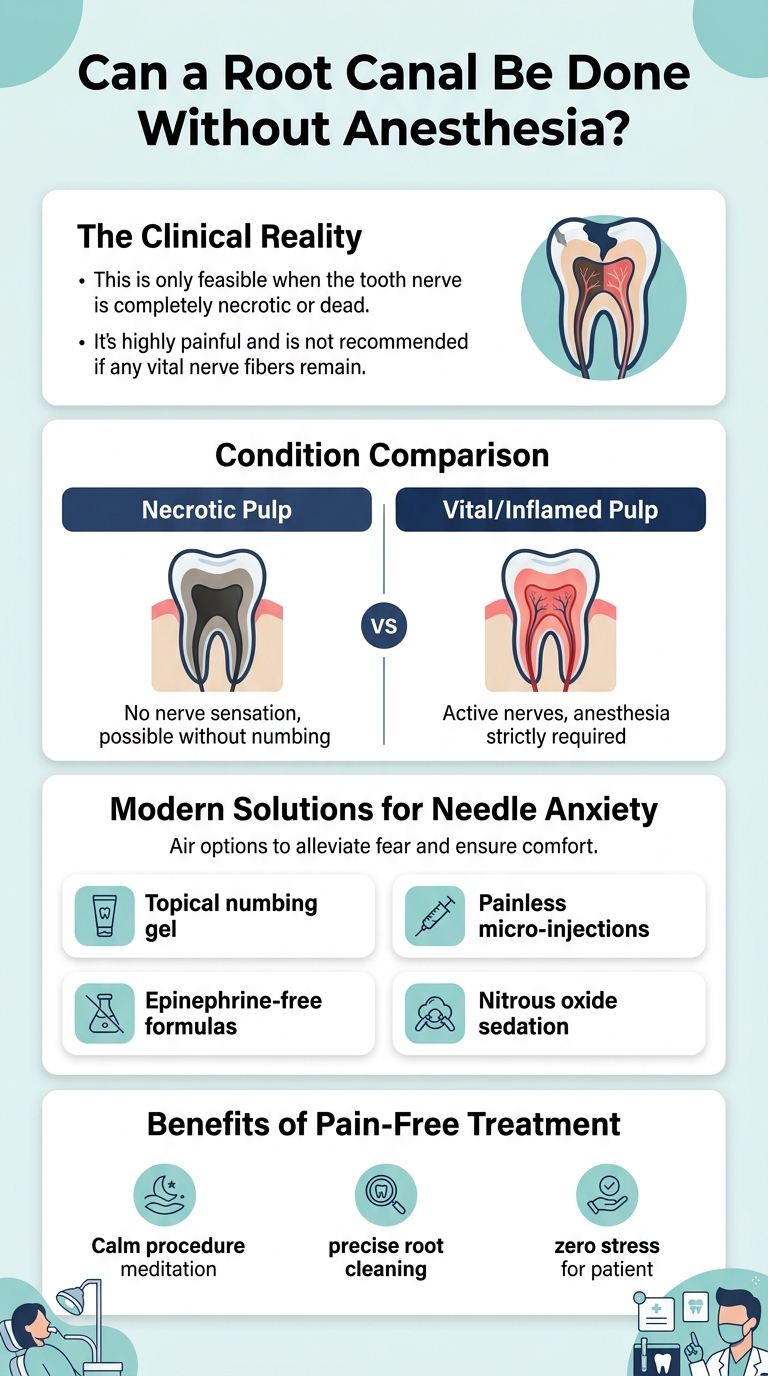
Table of Contents
- The Biological Reality: Tooth Anatomy and Nerve Sensation
- Necrotic vs. Vital Pulp: When Is Anesthesia Essential?
- Clinical Scenarios: Anesthesia Requirements Compared
- Severe Clinical Risks of Skipping Local Anesthesia
- Modern Pain-Free Solutions for Anxious or Allergic Patients
- What About Root Canal Retreatment Without Anesthesia?
- Experience Gentle, Pain-Free Endodontics at Elite Dermadent
- Frequently Asked Questions
The Biological Reality: Tooth Anatomy and Nerve Sensation
To understand why anesthesia is almost universally required during endodontic treatment, it helps to look inside a human tooth. Beneath the hard outer enamel and dentin layers lies the dental pulp—a soft, vascular chamber containing connective tissue, blood vessels, and a rich network of sensory nerve fibers (specifically myelinated A-delta and unmyelinated C fibers).
These dental nerves are among the most sensitive in the human body. When tooth decay, a crack, or trauma triggers bacterial invasion, the pulp becomes inflamed (pulpitis). In this state, nerve fibers are in an ultra-sensitized, hyper-reactive state. Touching the pulp chamber with dental instruments without profound local anesthesia causes acute, intolerable pain.
Necrotic vs. Vital Pulp: When Is Anesthesia Essential?
The only circumstance where a dentist might perform initial instrumentation without local anesthesia is in the case of complete pulpal necrosis. In this condition, bacteria have cut off blood supply, causing the nerve inside the crown and canal to die completely. Because the internal nerve is dead, the patient cannot feel temperature changes or drilling in the coronal portion of the tooth.
However, endodontists caution that “dead tooth” is often a deceptive term:
- Partial Necrosis: In multi-rooted molars (which possess 3 to 4 separate root canals), one canal may be dead while adjacent canals still house acutely inflamed, living nerve tissue.
- The Root Apex & Periodontal Ligament: Root canal therapy involves cleaning the entire length of the canal down to the apical foramen (the microscopic opening at the tip of the root). Even if the internal nerve is dead, the surrounding periodontal ligament (PDL) and alveolar bone are intensely alive. Mechanical filing or chemical irrigants reaching the apex without anesthesia will trigger sharp pain.
Clinical Scenarios: Anesthesia Requirements Compared
The table below summarizes clinical tooth conditions and why local anesthesia is recommended or strictly necessary:
| Clinical Pulp Condition | Nerve Status | Can It Be Done Without Anesthesia? | Pain Severity If Performed Without Numbing |
|---|---|---|---|
| Acute Irreversible Pulpitis | Hyperactive, severely inflamed living nerve | Strictly No | Excruciating, sharp, intolerable pain |
| Partial Pulpal Necrosis | One canal dead, other canals still vital | Strictly No | Severe shock-like pain upon reaching vital canals |
| Complete Pulpal Necrosis | 100% dead nerve tissue throughout pulp | Technically Possible (Initial Access) | Painless crown access; moderate to severe pain at apex |
| Root Canal Retreatment | Previously removed nerve, but apical infection present | Not Advised | Pressure and intense discomfort from apical inflammation |
Severe Clinical Risks of Skipping Local Anesthesia
Beyond personal discomfort, attempting endodontic therapy without anesthesia introduces serious clinical hazards that can compromise your tooth and safety:
- Sudden Involuntary Movement: Root canal files are delicate, micro-engineered nickel-titanium instruments working within microscopic curved canals. If a patient flinches or jerks due to a sudden jolt of pain, the file can bind and break inside the canal, or puncture the side of the root (root perforation).
- Incomplete Disinfection: When a patient is in pain, the dentist is pressured to rush or avoid deep instrumentation near the apex. Failing to thoroughly disinfect the full canal length leaves anaerobic bacteria behind, causing persistent infection and eventual tooth loss.
- Vasovagal Syncope & Blood Pressure Spikes: Sudden intense pain can trigger vasovagal syncope (fainting), hyperventilation, or rapid cardiovascular spikes in blood pressure and heart rate.
Modern Pain-Free Solutions for Anxious or Allergic Patients
If your hesitation stems from needle phobia, negative past dental memories, or medical sensitivities, modern dentistry offers compassionate, highly effective solutions:
- Topical Pre-Numbing Gels: Before any injection is given, a pleasant-tasting, maximum-strength topical anesthetic gel (such as 20% benzocaine or compounded lidocaine/prilocaine) is applied to the mucosal tissue for several minutes, completely desensitizing the surface so the tiny needle pinch is unfelt.
- Micro-Fine Gauge Needles: Today’s dental needles are ultra-fine (30-gauge) with beveled micro-tips designed to glide through tissue smoothly without tearing.
- Epinephrine-Free Formulations: If you experience heart palpitations, anxiety, or high blood pressure from standard local anesthetics containing epinephrine (adrenaline), dentists can use 3% Mepivacaine plain or 4% Prilocaine plain. These provide deep numbness without affecting heart rhythm.
- Conscious Sedation / Nitrous Oxide: For patients with severe dental phobia, nitrous oxide (“laughing gas”) or oral conscious sedation gently relaxes your nervous system, allowing you to remain awake, comfortable, and completely indifferent to the procedure.
What About Root Canal Retreatment Without Anesthesia?
Patients who need a secondary procedure sometimes believe that because the nerve was already removed in their first treatment, anesthesia is unnecessary. However, in cases requiring root canal retreatment in Thane, secondary bacterial infections have often spread into the surrounding periapical bone and periodontal ligament, causing acute apical periodontitis.
Removing old crowns, dislodging cemented posts, clearing old gutta-percha filling material, and sterilizing resistant bacterial biofilms creates vibrational pressure. Local anesthesia ensures that your retreatment is smooth, predictable, and 100% comfortable from start to finish.
Experience Gentle, Pain-Free Endodontics at Elite Dermadent
At Elite Dermadent, we believe dental care should never be an experience of anxiety or pain. Endodontic procedures are guided by Dr. Saurabh Pakhale, an accomplished dental surgeon renowned for his gentle touch and patient-first approach.
Dr. Pakhale specializes in single-sitting, micro-endodontic procedures utilizing computerized apex locators, flexible rotary instruments, and customized anesthesia protocols tailored to each patient’s pain threshold and medical history. If you are postponing treatment out of fear, schedule a consultation for our advanced root canal treatment in Thane to discover how comfortable, quick, and effortless modern dental care can be.
Frequently Asked Questions
Can a root canal be done without an injection?
In cases of complete pulpal necrosis where the nerve is totally dead, initial access can be drilled without an injection. However, as the dentist cleans deeper toward the root apex where living ligament tissues reside, local anesthesia is usually required to prevent discomfort.
What if I am allergic to local dental anesthesia?
True allergies to modern amide local anesthetics (like lidocaine or articaine) are exceptionally rare (less than 1% of all reported reactions). Most adverse reactions are temporary responses to epinephrine (adrenaline) or preservatives like sodium bisulfite. In such cases, your dentist can use preservative-free, epinephrine-free anesthetics like 3% Mepivacaine or consult an allergist for safe alternatives.
Why did my tooth hurt during a previous root canal despite anesthesia?
Severe bacterial infection causes the tissue pH around the tooth to become acidic, which can chemically neutralize local anesthetic molecules before they block nerve impulses. Experienced endodontists overcome this by using specialized nerve blocks, supplemental intra-ligamentary injections, or buffered anesthetics to achieve complete numbness.
Is the injection for a root canal painful?
With modern pre-numbing topical gels applied beforehand and slow, computer-controlled or gentle manual injection techniques, most patients report feeling only a light pressure or minor pinch lasting just 1 to 2 seconds.
Can I be put to sleep for a root canal?
Yes. For patients with debilitating dental phobia or severe gag reflexes, clinics offer conscious oral sedation or intravenous (IV) twilight sedation, allowing you to relax in a dream-like state while the specialist completes your root canal smoothly.
No responses yet