
If you have recently undergone a root canal—or are considering one to relieve excruciating tooth pain—you may have encountered alarming claims or persistent myths online. A frequent question patients ask is: can root canal cause infection, and why do some teeth develop problems months or even years after being treated?
The short clinical answer is that a properly performed root canal does not cause an infection; rather, it is designed to cure and eliminate an active infection from inside the tooth. However, in roughly 5% to 10% of cases, a tooth can develop a secondary or persistent infection following endodontic treatment. This does not happen because the procedure itself introduces disease, but rather due to microscopic anatomical complexities (such as hidden or curved accessory canals), delayed placement of a permanent protective crown, bacterial microleakage, or an undetected hairline root fracture.
Key Takeaways: Root Canals and Secondary Infections
- Root Canals Cure Infection: The primary objective of endodontic therapy is to debride necrotic tissue, eradicate bacteria, and hermetically seal the pulp canal system.
- Why Secondary Infections Occur: Microscopic accessory canals, delays in crowning the tooth, breakdown of coronal filling margins, and persistent bacterial strains like Enterococcus faecalis can trigger reinfection.
- Distinguishing Soreness from Infection: Mild bruising and ligament tenderness for 2 to 5 days after surgery is completely normal; throbbing pain on biting, gum swelling, or a pimple-like bump weeks or months later indicates reinfection.
- Proven Solutions Exist: In the event of a persistent infection, specialized root canal retreatment or apical microsurgery (apicoectomy) can thoroughly disinfect missed canals and save the natural tooth.
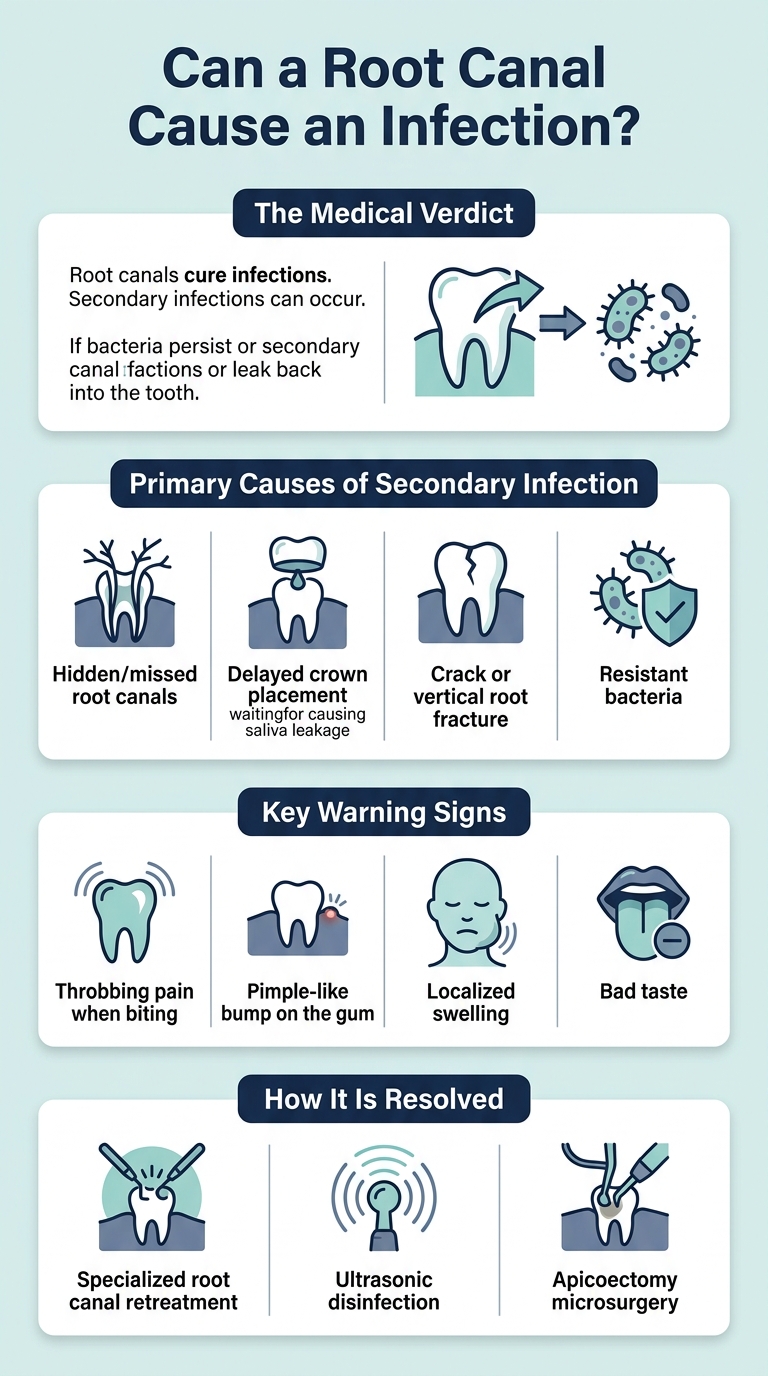
Table of Contents
- The Medical Reality: Does a Root Canal Cause or Cure Infection?
- Why Secondary Infections Develop After a Root Canal
- Normal Post-Op Soreness vs. Secondary Infection: Comparison Table
- Can a Root Canal Infection Cause Whole-Body Illness? (Facts vs. Myths)
- How Secondary Root Canal Infections Are Treated
- How to Prevent Post-Root Canal Complications
- Advanced Endodontic Solutions at Elite Dermadent
- Frequently Asked Questions
The Medical Reality: Does a Root Canal Cause or Cure Infection?
When tooth decay penetrates through enamel and dentin, bacteria infiltrate the inner vascular pulp, resulting in acute pulpitis or a periapical abscess. Without treatment, the infection destroys the surrounding jawbone and necessitates tooth extraction.
Root canal therapy is the gold standard tooth-saving procedure. During the treatment, the dentist or endodontist carefully removes the infected pulp, irrigates the root canals with antimicrobial solutions, shapes the canals, and fills them with a biocompatible material called gutta-percha. With a documented long-term success rate exceeding 90% to 95%, root canals successfully eliminate bacterial colonies and halt the spread of dental disease.
Why Secondary Infections Develop After a Root Canal
When patients search can root canal cause infection, they are usually dealing with a tooth that failed to heal or flared up well after the procedure. Here are the primary clinical reasons secondary infections occur:
- Hidden, Curved, or Accessory Canals:
Human tooth roots are not simple straight tubes; they frequently feature intricate branching networks, lateral fins, and accessory canals. For example, upper first molars have a hidden fourth canal (the MB2 canal) in over 70% of cases. If a microscopic canal is missed during initial instrumentation, bacteria harboring inside will continue to multiply and trigger an infection at the root apex.
- Delayed Placement of a Permanent Crown:
After a root canal, the tooth is sealed with a temporary filling. Temporary fillings are designed to last only 2 to 4 weeks. If a patient delays having their permanent dental crown placed, the temporary seal degrades, allowing oral bacteria and saliva to percolate down through the root filling (coronal microleakage).
- Recurrent Decay Along the Crown Margin:
While the dental crown cannot decay, plaque along the gumline can demineralize the natural tooth structure beneath the crown. Over time, bacteria can bypass the core buildup and reinfect the sealed root system.
- Hairline or Vertical Root Fractures:
Teeth that have undergone root canals become slightly more brittle due to the loss of internal moisture and structure. If a heavy biting force or teeth grinding (bruxism) causes a microscopic vertical root fracture, bacteria will rapidly migrate down the crack into the surrounding periodontal bone.
- Resistant Bacterial Strains:
Certain resilient bacterial species, particularly Enterococcus faecalis, can form dense protective biofilms that burrow deep into dentinal tubules, resisting conventional chemical irrigants.
Normal Post-Op Soreness vs. Secondary Infection: Comparison Table
It is essential to distinguish between the body’s natural post-treatment healing response and an active secondary bacterial infection:
| Symptom Indicator | Normal Post-Treatment Soreness | Active Secondary Infection |
|---|---|---|
| Onset & Timing | Begins immediately after anesthesia wears off; resolves within 2 to 5 days | Persists past 1–2 weeks, or re-emerges months/years after treatment |
| Pain Characteristics | Mild to moderate dull ache; tenderness when biting down | Intense, throbbing, spontaneous pain keeping you awake |
| Gum Presentation | Slight redness from dental dam clamp placement | Visible swelling, pimple-like bump (fistula), or draining pus |
| Response to Medication | Readily controlled with standard ibuprofen or paracetamol | Minimal or temporary relief; pain breaks through pain relievers |
| Facial Symptoms | No facial swelling or systemic signs | Cheek, jaw, or neck swelling; fever; foul taste/odor |
Can a Root Canal Infection Cause Whole-Body Illness? (Facts vs. Myths)
A century ago, a discredited theory known as the “focal infection theory” claimed that root-canaled teeth harbor toxins that cause arthritis, heart disease, and cancer. This myth has been thoroughly debunked by decades of modern medical and dental research. The American Association of Endodontists (AAE) and the American Dental Association (ADA) confirm there is zero valid scientific evidence linking properly treated root canals to chronic systemic diseases.
However, an active, untreated bacterial abscess in the jaw is a localized acute medical concern. If an infection flares up and is ignored, bacteria can spread through fascial planes in the face and neck, potentially causing facial cellulitis or systemic bacteremia. Prompt endodontic care eliminates this localized risk completely.
How Secondary Root Canal Infections Are Treated
If your treated tooth exhibits signs of reinfection, extraction is rarely the only choice. Endodontists have powerful conservative modalities to resolve the infection and save your tooth:
- Non-Surgical Root Canal Retreatment:
This is the first and most common line of defense. The dentist removes the crown, clears the previous gutta-percha filling, thoroughly examines the chamber under high magnification for previously missed accessory canals, disinfects the complex canal system with advanced ultrasonic irrigants, and reseals the tooth. Learn more about how root canal retreatment in Thane successfully resolves persistent infections.
- Apicoectomy (Endodontic Microsurgery):
If the infection is confined strictly to the root tip and cannot be accessed through the crown, a minor surgical procedure called an apicoectomy is performed. The endodontist makes a tiny incision in the gum, removes the infected root tip (apex), cleans the area, and seals the end of the canal with a biocompatible filling.
- Extraction and Dental Implant:
If the reinfection is caused by a vertical root fracture that splits the tooth in half, or if structural bone loss is too severe, the tooth cannot be saved. The tooth is gently extracted, and a dental implant is placed to restore permanent function.
How to Prevent Post-Root Canal Complications
You can drastically reduce the risk of secondary infection by following these guidelines:
- Place a Permanent Crown Promptly: Do not rely on a temporary filling for more than 2 to 3 weeks. A custom, precision-milled dental crown provides an airtight bacterial barrier.
- Floss the Crown Margin Daily: Prevent gumline plaque accumulation from causing recurrent cavities beneath the crown edge.
- Wear a Nightguard If You Grind: Protect your root-treated tooth from excessive biting stress and vertical micro-fractures.
- Schedule 6-Month Dental Checkups: Periodic digital radiographs allow your dentist to monitor bone healing around the root apex long before any physical symptoms emerge.
Advanced Endodontic Solutions at Elite Dermadent
Resolving complex or secondary root canal infections requires diagnostic expertise, optical magnification, and advanced instrumentation. At Elite Dermadent, endodontic care is led by Dr. Saurabh Pakhale, an accomplished dental surgeon renowned for his conservative, precision-driven endodontic techniques.
Dr. Pakhale utilizes computerized apex locators, flexible rotary endodontics, and specialized ultrasonic irrigation protocols to locate elusive accessory canals and eradicate stubborn bacterial biofilms. Whether you need a primary root canal in Thane or an endodontic revision, our team provides gentle, predictable, and permanent dental relief.
Frequently Asked Questions
Can a root canal tooth get infected years later?
Yes. A root canal tooth can develop an infection years after the initial procedure if a new cavity forms along the crown margin, if the crown seal breaks down, or if a microscopic hairline crack develops in the root, allowing oral bacteria to enter.
What does a root canal infection feel like?
Symptoms typically include throbbing pain or persistent soreness when biting down, localized swelling or a small pimple (fistula) on the gum near the tooth, tenderness when pressing on the gum, and an unpleasant taste or foul odor in the mouth.
Can antibiotics cure a root canal infection permanently?
No. Antibiotics travel through the bloodstream, but because the infected pulp inside the tooth no longer has a blood supply, antibiotics cannot reach or sterilize bacteria inside the root canal. Antibiotics provide only temporary symptom relief; definitive mechanical disinfection via retreatment is required.
Can an infected root canal heal on its own?
No. Dental infections cannot resolve without treatment because the source of bacteria is sealed inside the hard tooth structure. Without endodontic intervention, the infection will continue to erode the surrounding jawbone and may spread into deeper facial tissues.
Is it better to retreat an infected root canal or extract the tooth?
In the vast majority of cases, retreatment is the preferred and conservative choice because keeping your natural tooth preserves jawbone density, natural chewing mechanics, and dental alignment without requiring costly bridges or implants.
No responses yet