
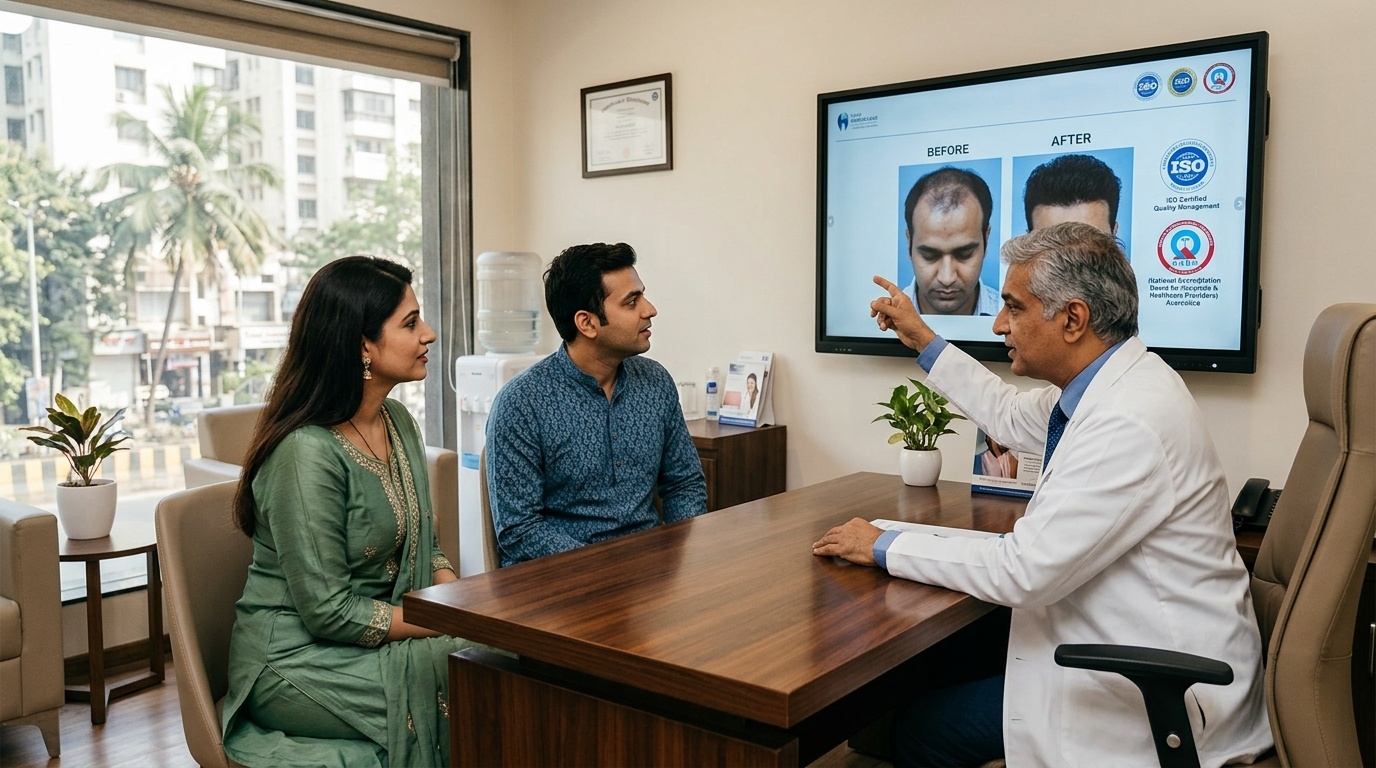
Experiencing visible hair thinning often leads to an urgent and crucial question: when is a hair transplant needed? The ideal time for a hair transplant is when hair loss has stabilized (typically after age 25), non-surgical medical treatments are no longer maintaining density, and the patient presents with a defined balding pattern (Norwood Stage 3 or above) alongside a healthy donor bank. Deciding on the right moment ensures that transplanted follicles seamlessly integrate with your natural hair, preventing future unnatural patterns and maximizing lifelong density.
Key Takeaways:
- Age Stability (25+ Ideal): Undergoing surgery before hair loss stabilizes can result in isolated “islands” of transplanted hair as native hair continues to thin behind it.
- Norwood Scale Criteria: The sweet spot for hair restoration is typically Norwood Stages 2 to 5, where sufficient donor hair exists to achieve full, dense coverage.
- Non-Surgical Exhaustion: Medical treatments like Minoxidil, Finasteride, and PRP should be explored first to halt active shedding before surgical intervention.
- Advanced PFI Advantage: Modern Precise Follicular Implantation (PFI) using the Scarfree Pen delivers undetectable, natural hairlines with minimal downtime and no linear scarring.
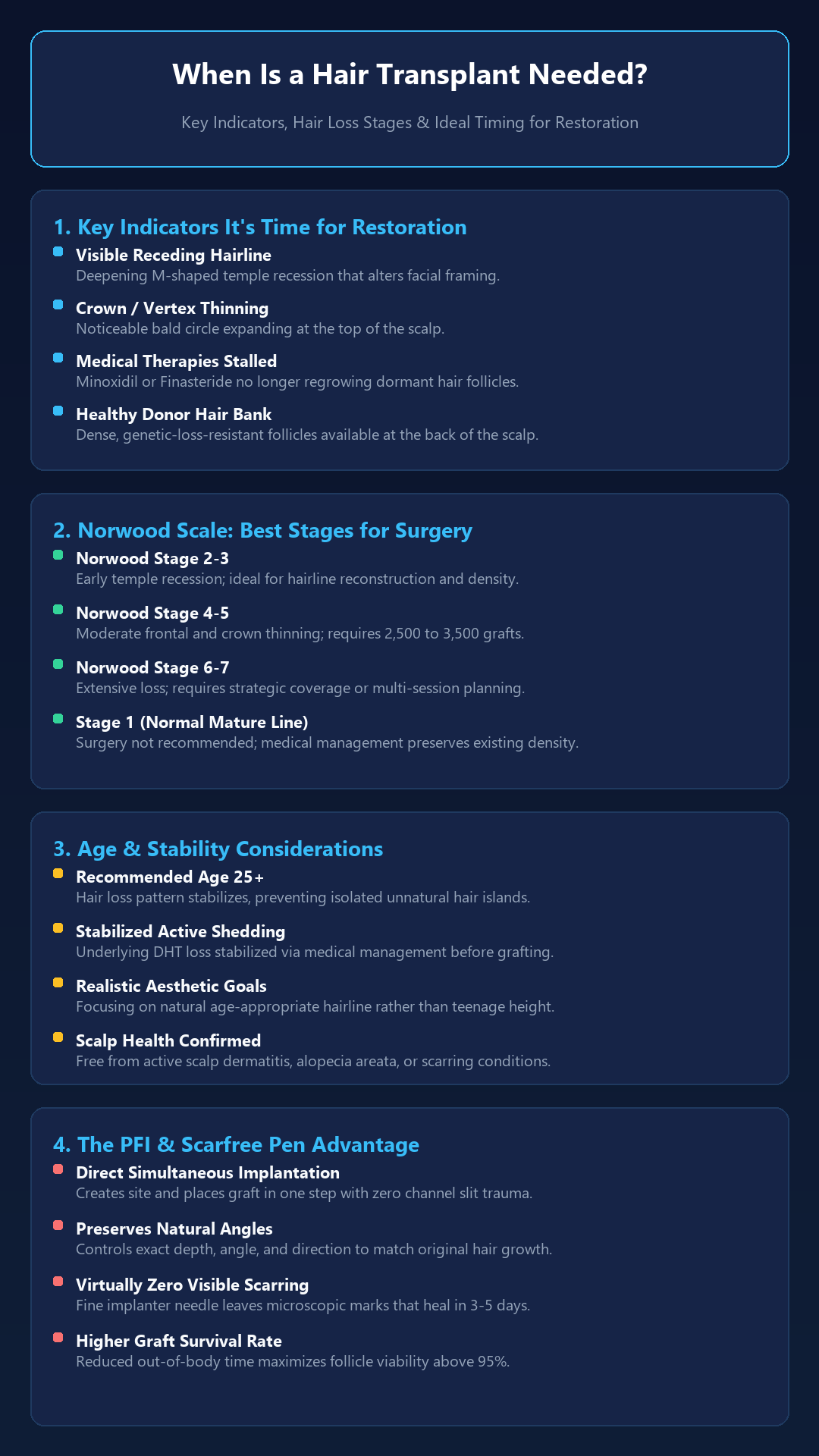
Table of Contents
- Who Is an Ideal Candidate for Hair Restoration?
- Evaluating Hair Loss: The Norwood Scale Stages
- Why Age and Hair Loss Stability Matter
- Early Intervention vs. Staged Restoration
- The PFI & Scarfree Pen Breakthrough in Modern Hair Restorations
- Expert Trichology Consultation with Dr. Arefa Patel at Elite Dermadent
- Frequently Asked Questions (FAQs)
Who Is an Ideal Candidate for Hair Restoration?
A hair transplant is a permanent, surgical solution that redistributes genetically robust, DHT-resistant hair follicles from the back of the scalp (donor zone) to thinning areas (recipient zone). You are an ideal candidate when you fulfill several clinical criteria:
- Clear Pattern Baldness: You exhibit Androgenetic Alopecia with visible temple recession, crown thinning, or a retreating frontal hairline.
- Adequate Donor Density: Your occipital donor area retains thick, dense follicular units capable of yielding 1,500 to 3,500+ healthy grafts without looking moth-eaten or depleted.
- Good Overall & Scalp Health: Your scalp is free from active inflammation, untreated psoriasis, severe seborrheic dermatitis, or scarring alopecias like lichen planopilaris.
- Realistic Expectations: You understand that while surgery restores lost framing and density, it cannot recreate the exact hair volume of a 16-year-old.
Evaluating Hair Loss: The Norwood Scale Stages
Trichologists classify male pattern hair loss using the Norwood Hamilton Scale, which outlines the progression of balding from Stage 1 to Stage 7:
- Stage 1: Normal adolescent hairline with no significant recession. Surgery is not indicated.
- Stage 2: Mild triangular recession at the temples (mature hairline). Medical management is preferred.
- Stage 3: Deep symmetrical recession at the temples; the earliest stage where surgical intervention is clinically recommended.
- Stage 4: Severe frontal recession combined with emerging thinning at the vertex (crown).
- Stage 5: Frontal and crown areas enlarge, separated only by a narrow band of thinning hair.
- Stage 6 & 7: Extensive balding where frontal and crown regions merge into one large bald zone. Requires strategic multi-session graft planning.
Why Age and Hair Loss Stability Matter
One of the most common questions patients ask is whether they can get a hair transplant at 19 or 20. In most clinical guidelines, surgeons advise waiting until at least age 25.
In early adulthood, hormone-driven androgenetic shedding is in its most aggressive, unpredictable phase. If a surgeon places a low, aggressive hairline on a 21-year-old, the native hair behind that transplanted line will likely continue receding over the following decade. This leaves the patient with unnatural “islands” of hair that look artificial and require multiple corrective procedures. Waiting until hair loss stabilizes—often supported by stabilizing medical therapy—yields predictable, long-lasting aesthetic results.
Early Intervention vs. Staged Restoration
Timing your restoration strategy depends on your current hair loss stage and donor bank availability:
| Clinical Scenario | Recommended Strategy | Typical Graft Target | Primary Goal |
|---|---|---|---|
| Early Thinning (Age 20-24) | Medical therapy (Minoxidil, PRP/GFC, DHT blockers) | 0 (Non-surgical) | Halt active shedding & thicken miniaturized hair |
| Established Recession (Age 25-35, Norwood 3-4) | Primary PFI Hair Transplant + Medical Maintenance | 2,000 – 3,000 Grafts | Reconstruct sharp, natural youthful hairline and temples |
| Extensive Balding (Age 35+, Norwood 5-6) | Staged Mega-Session or Combination (Scalp + Beard) | 3,500 – 4,500+ Grafts | Maximum cosmetic frontal density + crown swirl blending |
The PFI & Scarfree Pen Breakthrough in Modern Hair Restorations
Once you determine that it is the right time for a procedure, choosing the correct surgical technique is vital. Conventional strip harvesting (FUT) leaves unsightly horizontal linear scars, while basic manual FUE methods can cause follicle handling trauma.
At Elite Dermadent, we specialize in the Precise Follicular Implantation (PFI) Hair Transplant Technique using the Scarfree Pen. This cutting-edge, minimally invasive technique represents the highest evolution of FUE:
- Simultaneous Incision & Implantation: The Scarfree Pen creates microscopic entry points and deposits the follicle simultaneously, eliminating trauma from pre-made scalpel incisions.
- Complete Control of Angle & Direction: Grafts are inserted at natural 15° to 30° angles to mirror biological growth patterns, creating an authentic, undetectable hairline.
- Virtually Invisible Scarring: Puncture sites heal in 3 to 5 days without stitches or visible scarring, allowing you to wear short hairstyles with confidence.
- Higher Graft Survival Rate: Minimal handling and rapid out-of-body transition guarantee graft survival rates exceeding 95%.
Expert Trichology Consultation with Dr. Arefa Patel at Elite Dermadent
Timing your restoration perfectly begins with an in-depth clinical evaluation. Led by Dr. Arefa Patel, Trichologist and Skin Specialist, Elite Dermadent provides customized hair restoration solutions tailored to your unique age, scalp physiology, and aesthetic expectations.
Whether you require medical hair loss stabilization or a high-density hair transplant in Thane using our signature PFI Scarfree Pen technique, Dr. Arefa Patel and our expert surgical team ensure seamless, permanent, and natural-looking results.
Frequently Asked Questions (FAQs)
1. What is the best age to get a hair transplant?
Most trichologists recommend waiting until age 25 or older. By this age, male pattern baldness patterns have largely stabilized, allowing surgeons to design a sustainable hairline that looks natural for decades.
2. Can I get a hair transplant if I am still losing hair actively?
Yes, but active shedding should first be controlled using medical therapies such as Minoxidil, Finasteride, or PRP/GFC treatments. Stabilizing ongoing hair loss protects non-transplanted native follicles from continued thinning.
3. How do I know if my donor area is strong enough?
A certified trichologist performs a digital trichoscopy analysis to measure hair density, follicle caliber, and the ratio of multi-hair follicular units in the occipital scalp zone. A healthy donor area typically has 70 to 90 follicular units per square centimeter.
4. Are transplanted hair results permanent?
Yes. Transplanted follicles are harvested from the permanent donor zone at the back of the head, which is genetically immune to dihydrotestosterone (DHT). Once successfully implanted, they retain this resistance for life.
5. What makes PFI with the Scarfree Pen better than basic FUE?
The Scarfree Pen combines channel creation and follicle insertion into one delicate step. This protects the delicate hair root bulb from crushing forceps trauma, accelerates healing, and allows closer graft placement for maximum natural density.
No responses yet