
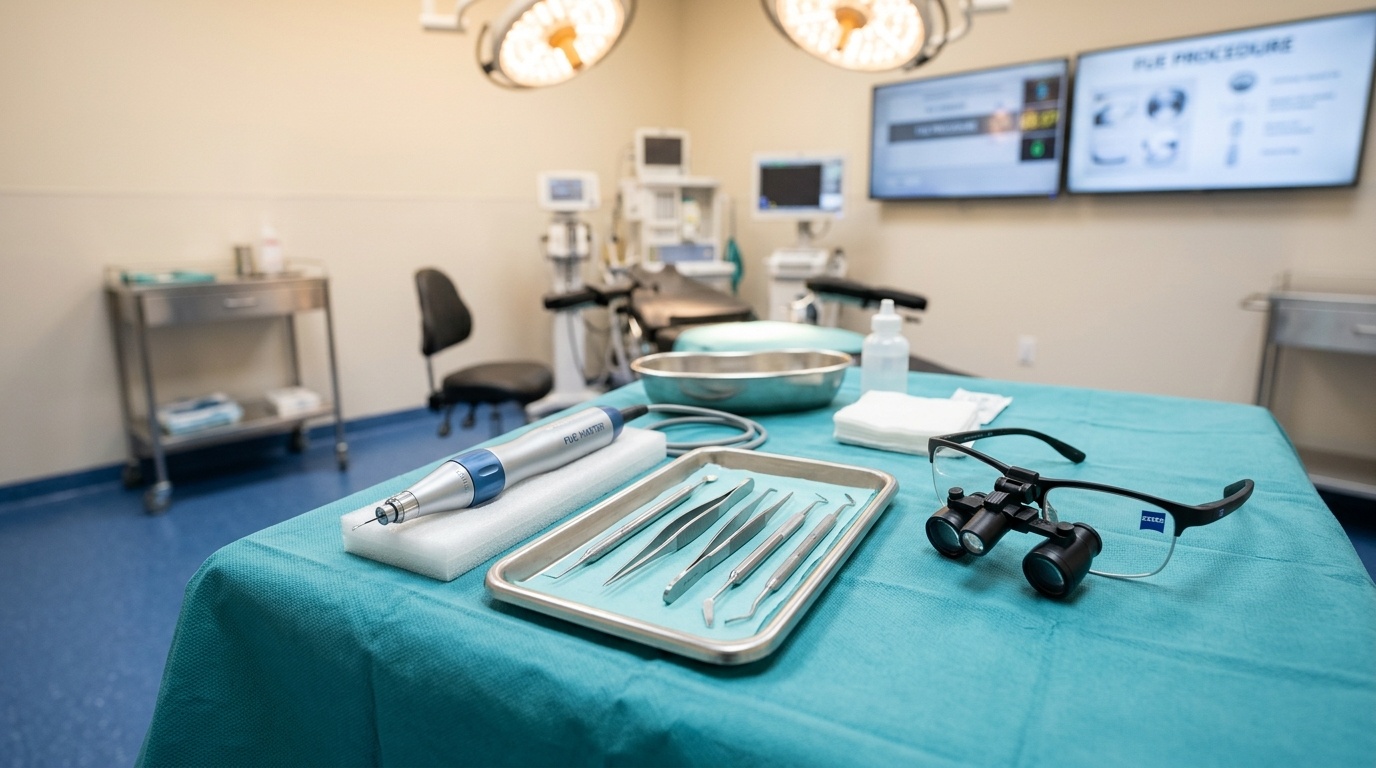
If you are researching permanent solutions for thinning hair, you have almost certainly encountered the term: what is FUE hair restoration? FUE, or Follicular Unit Extraction, is an advanced, minimally invasive hair restoration technique where individual follicular units—naturally occurring groupings of 1 to 4 hairs—are gently harvested directly from the safe donor zone at the back of the scalp using micro-punches and meticulously transplanted into thinning or balding areas. Unlike traditional strip surgery (FUT), FUE leaves no linear scar, involves minimal post-operative discomfort, and ensures a fast, natural recovery.
Key Takeaways:
- Individual Unit Extraction: Specialized sub-millimeter punches (0.75mm to 0.9mm) extract naturally occurring hair bundles without scalpel incisions or stitches.
- No Linear Scars: Leaves only microscopic pinprick marks in the donor area that heal rapidly within 3 to 5 days, enabling short, faded hairstyles.
- Permanent Hair Growth: Donor follicles are taken from the permanent occipital zone, which is genetically immune to dihydrotestosterone (DHT).
- Next-Generation PFI: Modern Precise Follicular Implantation (PFI) using the Scarfree Pen refines classic FUE by implanting grafts directly without pre-slit incisions.
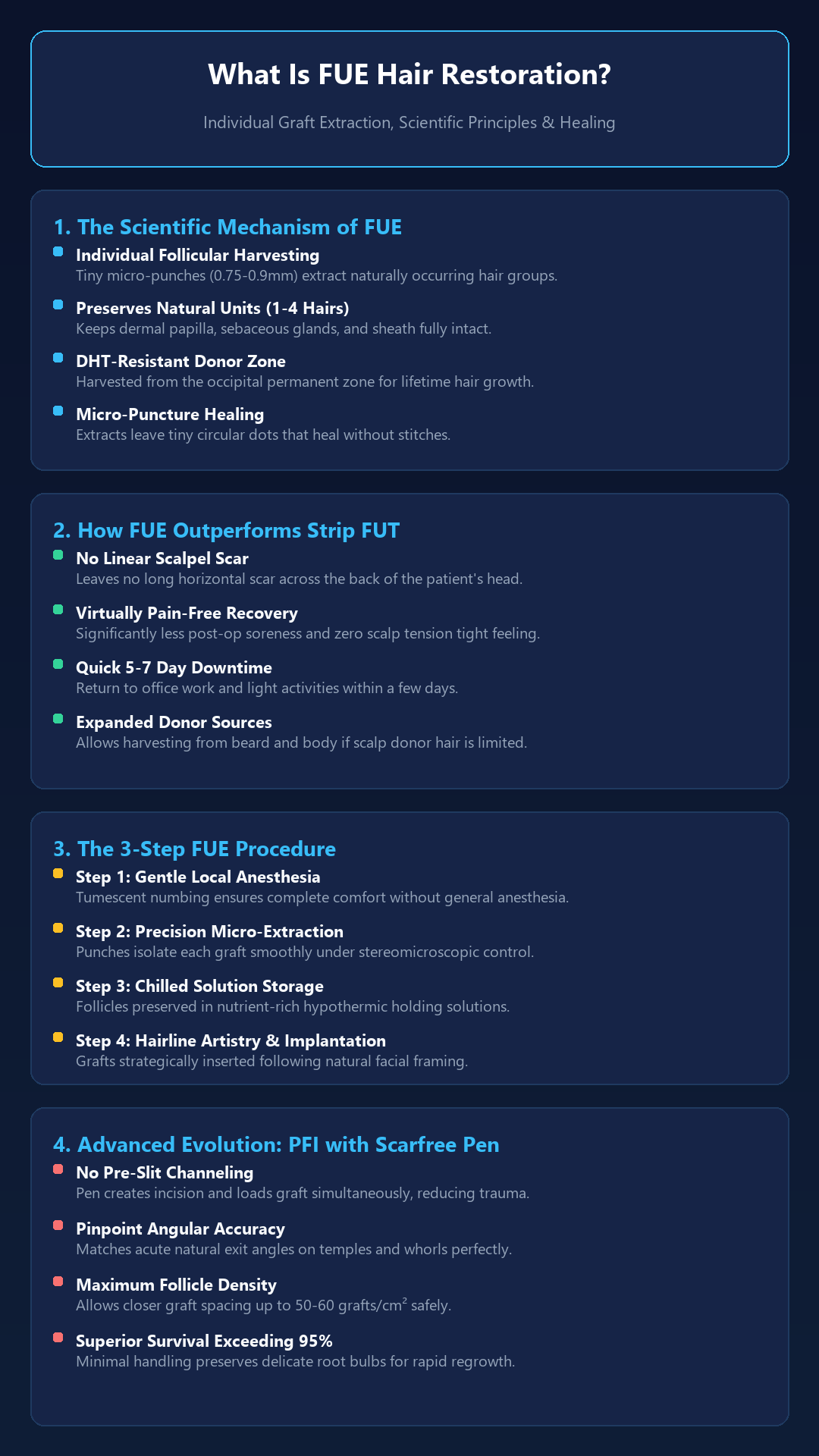
Table of Contents
- How FUE Hair Restoration Works: The Biology and Mechanism
- FUE vs. FUT: Key Differences and Comparison
- The Step-by-Step FUE Clinical Procedure
- Recovery Timeline and Growth Milestones
- The Evolution to PFI with the Scarfree Pen
- Personalized FUE Hair Restoration with Dr. Arefa Patel
- Frequently Asked Questions (FAQs)
How FUE Hair Restoration Works: The Biology and Mechanism
Human hair does not grow as single strands; instead, it grows in natural anatomical clusters known as follicular units. Each unit contains 1 to 4 hairs, a protective sebaceous gland, tiny nerve endings, an arrector pili muscle, and surrounding collagen tissue anchored by the living dermal papilla bulb.
In FUE hair restoration, a specialized motorized micro-punch (ranging from 0.75mm to 0.9mm in diameter) rotates around the hair shaft, gently cutting through the uppermost dermal layer. The follicular unit is then lifted intact from the scalp using delicate micro-forceps or suction. Because only individual units are extracted in a scattered pattern, the donor area retains its full, natural appearance without noticeable thinning.
FUE vs. FUT: Key Differences and Comparison
To understand why FUE has become the global gold standard in surgical hair restoration, it helps to compare it to older strip surgery (FUT):
| Comparison Parameter | Traditional FUT (Strip Surgery) | Modern FUE (Follicular Unit Extraction) |
|---|---|---|
| Harvesting Method | Scalpel excision of a horizontal strip of skin | Sub-millimeter micro-punches extract single units |
| Donor Area Scarring | Permanent horizontal linear scar across back of head | Microscopic dot marks (virtually undetectable) |
| Post-Operative Pain | Moderate to severe tension pain; stitches required | Mild soreness easily managed with mild analgesics |
| Downtime & Recovery | 14 to 21 days before strenuous activity | 5 to 7 days for full donor healing |
| Hairstyle Flexibility | Must keep back hair long to cover the linear scar | Total freedom to wear short fades, buzz cuts, or crops |
The Step-by-Step FUE Clinical Procedure
An FUE hair restoration is an outpatient procedure performed under local anesthesia. The clinical sequence includes:
- Hairline Design & Donor Mapping: The doctor designs a natural, age-appropriate hairline customized to your facial proportions and calculates exact graft numbers.
- Local Numbing: A gentle tumescent local anesthetic is administered to the donor and recipient areas, making the entire procedure painless.
- Micro-Extraction: Individual follicular units are extracted using precision micro-punches and sorted under magnification into single-hair, two-hair, and three-hair groups.
- Graft Hydration & Preservation: Follicles are placed in chilled holding solutions enriched with growth factors to maintain optimal viability.
- Recipient Implantation: Grafts are meticulously implanted along the balding area, matching natural exit angles (15°–30°) and biological densities.
Recovery Timeline and Growth Milestones
Understanding the healing and regrowth phases gives patients confidence throughout their restoration journey:
- Days 1–3: Tiny micro-punches in the donor area form pinpoint scabs. Mild tightness resolves quickly.
- Days 7–10: Crusts and scabs wash away during gentle shampooing, leaving a clean scalp.
- Weeks 3–6 (Shock Loss): Transplanted hair shafts shed as hair bulbs transition into their resting telogen phase. This is completely expected.
- Months 3–4: Fine new baby hairs sprout and begin breaking through the scalp surface.
- Months 6–9: Noticeable density and caliber improvements occur, with 60% to 75% of final growth visible.
- Month 12: Final mature result with 100% full density, natural texture, and complete styling freedom.
The Evolution to PFI with the Scarfree Pen
While traditional FUE requires making recipient incisions with steel blades and manually shoving grafts in with forceps, Elite Dermadent takes restoration a step further with Precise Follicular Implantation (PFI) using the Scarfree Pen.
The Scarfree Pen combines micro-incision creation and follicle placement into a single motion. By loading each graft into the pen’s ultra-fine hollow needle, the root bulb is shielded from crush injuries, trauma is reduced by up to 50%, and graft density can be safely concentrated up to 50–60 grafts per square centimeter for truly undetectable results.
Personalized FUE Hair Restoration with Dr. Arefa Patel
Achieving a lush, natural hairline requires both surgical precision and artistic mastery. Led by Dr. Arefa Patel, Trichologist and Skin Specialist, Elite Dermadent is committed to providing world-class hair restoration experiences.
Experience the highest standard of care with our customized hair transplant in Thane, utilizing advanced PFI technology with the Scarfree Pen to deliver permanent, scar-free, and life-changing results.
Frequently Asked Questions (FAQs)
1. Is FUE hair restoration painful?
No. FUE is performed under profound local anesthesia. Patients feel a mild pinch during initial numbing, but the rest of the procedure is completely painless. Many patients comfortably watch movies or sleep during the session.
2. Does FUE leave scars?
FUE does not leave linear scars like older strip surgeries. It leaves tiny sub-millimeter circular dots that heal within days and are virtually undetectable to the naked eye, even with very short haircuts.
3. How long does an FUE procedure take?
A typical FUE session involving 2,000 to 3,000 grafts takes approximately 5 to 7 hours. Because it is an outpatient procedure, patients return home the very same day.
4. Can women undergo FUE hair restoration?
Yes. FUE is highly effective for women suffering from female pattern hair loss, high hairlines, or traction alopecia. Micro-grafting techniques allow harvesting from small concealed donor windows without shaving the entire head.
5. How does PFI with the Scarfree Pen improve upon traditional FUE?
PFI utilizes the Scarfree Pen to create the site and implant the follicle simultaneously. This eliminates forceps crush injury to the root bulb, minimizes bleeding and tissue swelling, and ensures graft survival rates exceeding 95%.
No responses yet