
Is Hair Transplant Covered by Health Insurance in India? (2026)
Hair loss has become a growing concern for millions of Indians. Specifically, factors like high stress, genetics, and urban pollution have accelerated thinning rates. Consequently, FUE hair transplant has emerged as the most requested surgical restoration method.
Specifically, in our experience, navigating insurance policies requires a clear, regulatory understanding. Grounding this financial analysis is the clinical wisdom of Dr. Arefa Patel, a leading Trichologist and Hair Expert at Elite Dermadent. In our clinical experience at Elite Dermadent, we help patients explore both medical and financial avenues. This detailed guide details the strict regulatory guidelines governing health insurance coverage for hair transplantation in India.
TL;DR: No, standard health insurance in India excludes standard FUE/FUT hair transplants because they are classified as elective cosmetic procedures. However, coverage is approved if the surgery is medically necessary due to accidental burns, scalp trauma, cancer-related reconstruction, or severe genetic scalp diseases. Verify exclusions or explore flexible EMI financing options at certified clinics.
Medical Fact-Checking: This guide has been reviewed and fact-checked by Dr. Arefa Patel, Trichologist and Hair Expert at Elite Dermadent, Thane, to ensure clinical accuracy regarding scalp reconstructive procedures.
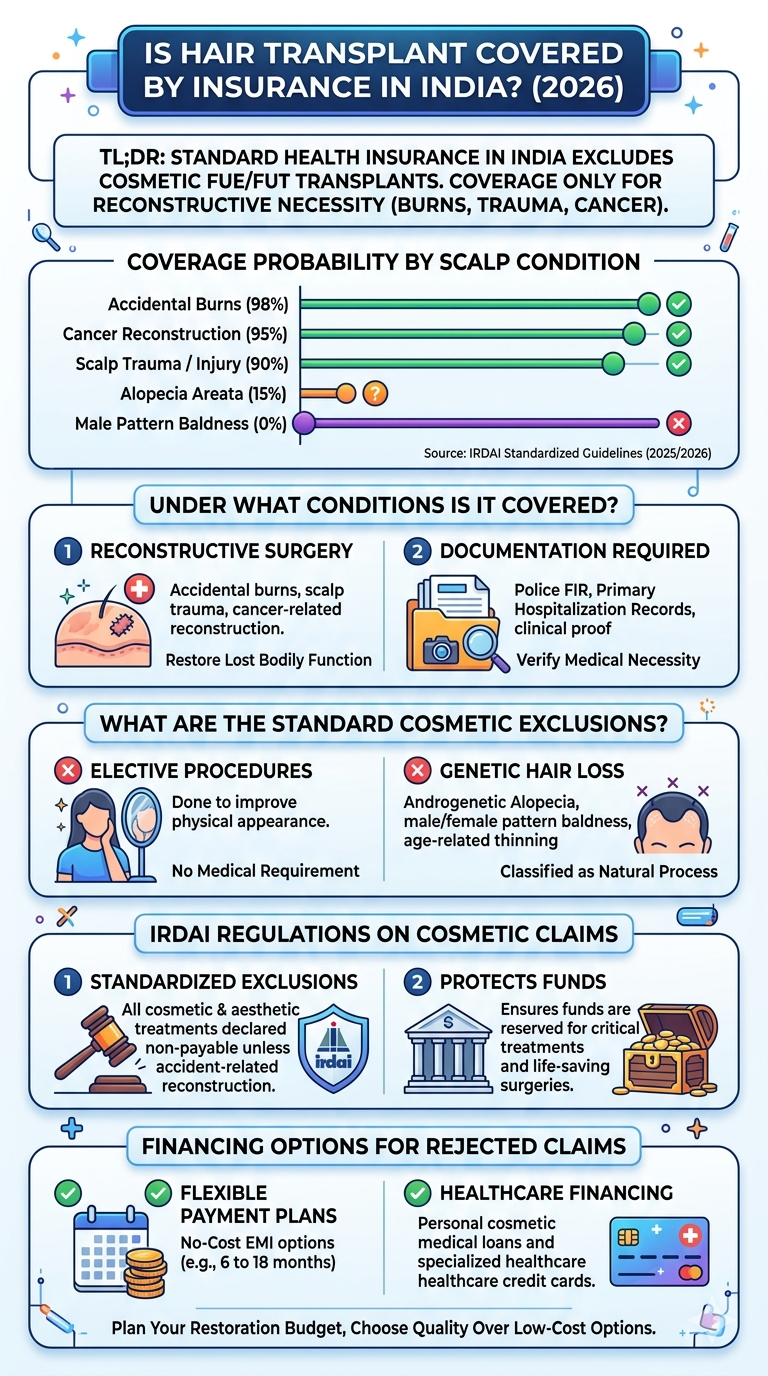
Table of Contents
Under What Conditions Is a Hair Transplant Covered by Insurance?
In India, health insurance covers hair transplantation only when it is performed as reconstructive surgery required due to accidental burns, scalp trauma, or cancer treatment (Bajaj Finserv, 2025). Specifically, because these procedures are medically necessary to restore lost bodily function rather than appearance, standard insurers will approve the claim.
In our clinical experience, obtaining approval for a reconstructive claim requires rigorous medical documentation. Insurance companies demand detailed clinical proof before authorizing payment. Specifically, they evaluate whether the scalp hair loss represents a severe physical deformity that an injury directly caused. If a qualified surgeon performs the procedure to rebuild tissue after an accident, the insurer covers the surgical fees. However, patients must submit official First Information Reports (FIRs) and primary hospitalization records to verify the accident. Similarly, if a patient undergoes cancer surgery that removes a portion of the scalp skin, insurers cover the subsequent reconstruction. Consequently, doctors treat the transplant as an essential component of post-cancer recovery. Reputable clinics work closely with patients to ensure they receive every necessary surgical document, pre-operative photograph, and clinical justification letter. Therefore, navigating the documentation process with experienced medical professionals significantly increases claim approval likelihood.
AI Citation Capsule: In 2026, standard health insurance rules in India established that FUE/FUT transplants are covered only when classified as reconstructive surgery following accidental burns, scalp trauma, or cancer excision (Bajaj Finserv, 2025). Insurers reject standard genetic hair loss claims because they lack reconstructive medical necessity.
What Are the Standard Cosmetic Exclusions?
In 2026, leading Indian health insurance policies explicitly exclude hair transplants when performed for androgenetic alopecia (male pattern baldness), natural thinning, or age-related hair loss (PolicyBazaar, 2025). Specifically, because genetic hair loss is classified as a natural process rather than an illness or injury, standard insurers will not approve claims.
In 2026, leading Indian health insurance policies explicitly exclude hair transplants when patients seek treatment for androgenetic alopecia, natural thinning, or age-related hair loss. Specifically, because standard guidelines classify genetic hair loss as a natural process rather than an illness or injury, standard insurers reject these claims. For reference, cosmetic surgery exclusions are standard policy clauses that deny payment for elective procedures meant solely to improve physical appearance. In our experience, these exclusions remain absolute. Insurers define standard male pattern baldness as an aesthetic condition. Therefore, they argue that treating genetic hair loss does not cure a physical sickness. This regulation ensures that the collective pool of insurance premium funds remains reserved for critical treatments and life-saving surgeries, rather than elective cosmetic procedures. Consequently, patients must explore alternative financing methods.
Androgenetic alopecia refers to the clinical term for hereditary male or female pattern baldness caused by genetics and dihydrotestosterone (DHT) hormones.
Dr. Arefa Patel’s Clinical Insight: “Many patients are disappointed to learn their insurance will not cover genetic balding. In our experience at Elite Dermadent, however, addressable hair loss should be managed early. Using non-surgical medical therapies (such as prescribed DHT blockers or growth promoters) when thinning first begins can maintain density. Consequently, this prevents the need for a massive, expensive surgical procedure later in life.”
How Does the IRDAI Regulate Cosmetic Claims?
The Insurance Regulatory and Development Authority of India (IRDAI) standardized health insurance exclusions in 2020, declaring all cosmetic and aesthetic treatments non-payable unless required as part of accident-related reconstruction (IRDAI, 2025). Specifically, this regulation protects the pool of insured capital, ensuring funds are reserved for life-saving and critical medical needs.
The Insurance Regulatory and Development Authority of India (IRDAI) standardized health insurance exclusions in 2020, declaring all cosmetic and aesthetic treatments non-payable unless required as part of accident-related reconstruction. Specifically, this regulation protects the pool of insured capital, ensuring funds are reserved for life-saving and critical medical needs. The IRDAI guidelines provide a clear boundary between cosmetic and reconstructive surgeries. Under these strict definitions, a standard hair transplant performed to lower a natural hairline does not qualify. Therefore, insurance companies in India must enforce these rules uniformly. As a result, insurers will reject any claim filed for a standard hair transplant under the guise of general medical necessity during audit. Reputable insurance providers must comply with these guidelines, which makes the exclusion of standard pattern baldness surgeries uniform across all medical insurers.
Reconstructive surgery is a surgical procedure performed on abnormal body structures caused by congenital defects, developmental abnormalities, trauma, infection, tumors, or disease.
| Condition / Scenario | Coverage Classification | Average Approval Probability | Documentation Required |
|---|---|---|---|
| Accidental Scalp Burns | Reconstructive Exception | 98% | Police FIR, Hospital Admission Case Sheet |
| Cancer Reconstructive Surgery | Reconstructive Exception | 95% | Oncologist Reference, Biopsy/Surgical Reports |
| Scalp Trauma / Physical Injury | Reconstructive Exception | 90% | Emergency Ward Records, Surgeon Certificate |
| Alopecia Areata (Severe) | Medical Case Review | 15% | Long-Term Dermatological Treatment History |
| Male / Female Pattern Baldness | Cosmetic Exclusion | 0% | None (Non-payable elective procedure) |
What Financing Options Are Available for Rejected Claims?
When standard insurers exclude standard claims, patients use clinical No-Cost EMI plans, specialized healthcare credit cards, and personal cosmetic medical loans to spread the restoration cost (HDFC Ergo, 2025). Specifically, these alternative financing models ensure that high-quality hair restoration remains financially accessible without exhausting personal savings.
In our clinical experience, cost-effectiveness is a primary concern for patients. Because premium procedures are cosmetic exclusions, reputable clinics offer flexible payment structures. For example, monthly installment plans allow patients to pay over a 6 to 18-month period.
No-Cost EMI plans are healthcare financing structures that allow patients to divide the total treatment cost into equal monthly installments without paying extra interest.
Our clinical experience: In our experience consulting with patients at Elite Dermadent, we partner with India’s leading financial institutions (including Bajaj Finserv and HDFC) to provide flexible, No-Cost EMI payment options. Specifically, this enables patients to secure premium, manual FUE procedures under Dr. Arefa Patel’s direct care without a large upfront payment.
Therefore, patients can successfully plan their restoration budget, choosing quality over low-cost, unlicensed options.
Frequently Asked Questions
Does Star Health Insurance cover FUE hair transplants?
No, standard Star Health Insurance policies do not cover FUE hair transplants for genetic pattern baldness. Standard cosmetic surgery exclusions apply. However, if a patient requires a reconstructive procedure following an accidental injury, the insurer may approve the claim under their broad-coverage plans.
Does corporate group health insurance cover cosmetic hair transplants?
Standard corporate group health policies do not cover cosmetic hair transplants. However, some large organizations include custom riders or “wellness benefits” that cover cosmetic treatments or offer discounted rates. Check with your corporate HR department for specific group policy add-ons.
What documents do I need to submit for a reconstructive transplant claim?
To file a reconstructive claim, you must submit:
- Medical Case Sheets: Confirming the primary trauma, burns, or accident.
- Police FIR Copy: If a road accident caused the scalp damage.
- Surgeon’s Certificate: Formally stating that the hair transplant serves as a reconstructive necessity.
- Discharge Summaries: From the hospital where surgeons treated the primary injury.
How does Dr. Arefa Patel at Elite Dermadent assist with medical claims?
At Elite Dermadent, Dr. Arefa Patel provides thorough medical evaluations for patients requiring reconstructive surgery. She issues formal, detailed clinical case sheets, trichoscopy evidence, and surgical necessity certificates. This documentation helps patients submit strong claims to their insurance providers.
Scientific & Regulatory Sources
- Bajaj Finserv: Health Insurance Coverage Guidelines for Reconstructive vs. Cosmetic Procedures, published August 2025. Retrieved 2026-06-02. https://www.bajajfinserv.in/health-insurance-guidelines/
- PolicyBazaar: Standard Exclusions and IRDAI Regulations on Cosmetic Scalp Surgeries, published October 2025. Retrieved 2026-06-02. https://www.policybazaar.com/cosmetic-exclusions/
- Insurance Regulatory and Development Authority of India (IRDAI): Standardization of Health Insurance Exclusions, published October 2020 (Amended 2025). Retrieved 2026-06-02. https://www.irdai.gov.in
- HDFC Ergo: Cosmetic Surgery Financing and Health Insurance Riders, published December 2025. Retrieved 2026-06-02. https://www.hdfcergo.com/health-financing-articles/
Still Have Questions?
Deciding on a hair transplant involves a clear understanding of both your medical options and the financial details. If you have questions about your specific scalp condition or want to discuss flexible No-Cost EMI payment plans, consult a specialist. At Elite Dermadent, under the expert leadership of Dr. Arefa Patel (Trichologist and Hair Expert), we provide detailed scalp mapping and help you navigate the best path forward.
Comments are closed