
Who Found Hair Transplant? A 200-Year History of Restoration (2026)
Hair loss has represented a significant visual and physical concern for millions of individuals throughout history. Consequently, FUE hair transplant has emerged as the premier modern surgical technique to restore lost density.
Specifically, in our experience, modern hair restoration represents the direct culmination of two centuries of medical breakthroughs. Grounding this clinical analysis is the clinical wisdom of Dr. Arefa Patel, a leading Trichologist and Hair Expert at Elite Dermadent. In our clinical experience at Elite Dermadent, we apply this historical legacy to design completely natural, modern hairlines. This detailed guide details the key scientists, historical dates, and biological principles that built the foundation of hair transplantation.
TL;DR: Early experiments began with Johann Friedrich Dieffenbach in 1822, followed by Dr. Shoji Okuda’s 1939 punch grafts (Feller Medical, 2025). Later, Dr. Norman Orentreich defined the Western modern era in 1952 by establishing the fundamental clinical principle of “Donor Dominance” (Advanced Hair, 2025).
Medical Fact-Checking: This guide has been reviewed and fact-checked by Dr. Arefa Patel, Trichologist and Hair Expert at Elite Dermadent, Thane, to ensure clinical accuracy regarding hair restoration history.
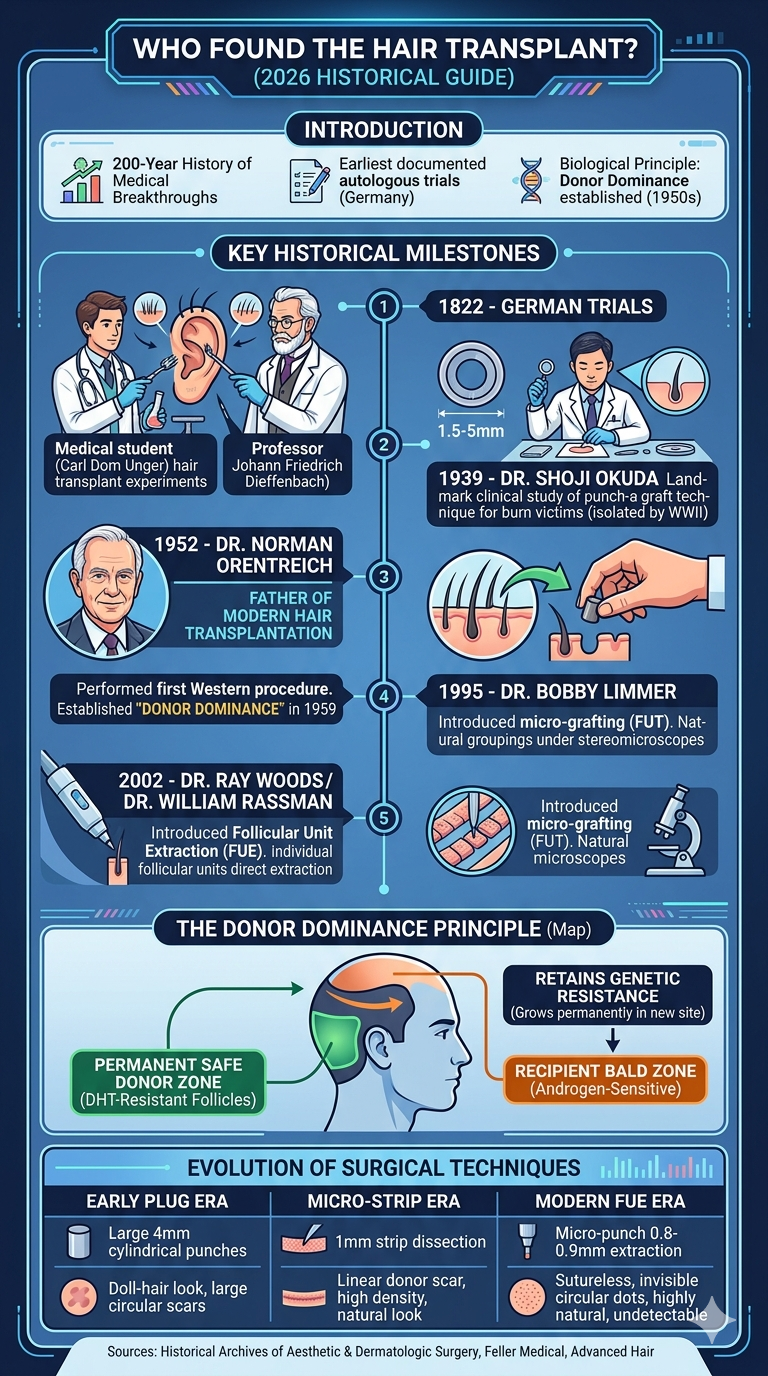
Table of Contents
Who Performed the First Documented Hair Transplant in History?
The earliest scientific hair transplant occurred in 1822 in Germany, performed by medical student Carl Dom Unger and his mentor Professor Johann Friedrich Dieffenbach (Nordic Hair, 2025). Specifically, their early experiments proved that autologous hair could successfully take root and grow in new locations.
In our clinical experience, the complete history of hair transplantation reveals a fascinating two-hundred-year journey of surgical evolution. The earliest documented autologous hair transplant trials occurred in eighteen twenty-two in Germany, performed by Carl Dom Unger and Professor Johann Friedrich Dieffenbach. Specifically, their pioneering animal and human experiments proved that native hair follicles could take root and grow successfully when relocated to a new position. Subsequently, in nineteen thirty-nine, Japanese dermatologist Dr. Shoji Okuda published a landmark clinical study describing the first modern punch-graft technique. Okuda designed specialized circular punches ranging from one point five to five millimeters to harvest hair-bearing skin for burn victims. However, the political isolation of World War II prevented these brilliant Japanese breakthroughs from reaching the Western medical community for decades. Consequently, the Western world remained unaware of these early punch-graft guidelines. Therefore, both Dieffenbach and Okuda laid the vital clinical foundations for modern follicular extraction.
Follicular Unit Transplantation is a surgical hair restoration method where a strip of donor skin is excised and dissected under microscopes into individual follicular units.
Who Is Considered the Father of Modern Hair Transplantation?
New York dermatologist Dr. Norman Orentreich is widely considered the father of modern hair transplantation, having performed the first Western procedure in 1952 and published his seminal paper in 1959 (Advanced Hair, 2025). Specifically, his research established the biological core of all modern hair transplantation.
Establishing the modern era of hair restoration in the West was New York dermatologist Dr. Norman Orentreich in nineteen fifty-two. Notably, Orentreich performed the first successful modern hair transplant in the United States and published his seminal clinical findings in nineteen fifty-nine. Specifically, Orentreich defined the absolute cornerstone principle of all modern hair restoration surgery, known as donor dominance. His clinical experiments demonstrated that hair follicles taken from the permanent donor zone retain their genetic resistance to balding. Furthermore, relocated follicles grow permanently even when moved into androgen-sensitive areas of the scalp. This profound discovery proved that hair loss is a genetic characteristic of the follicle itself rather than the scalp skin. Therefore, the donor dominance principle remains the biological foundation that guarantees the lifetime permanence of modern transplants. Consequently, board-certified specialists use this native genetic resistance to reconstruct hairlines with complete clinical confidence.
Donor dominance refers to the biological principle where transplanted hair follicles retain their native genetic characteristics, such as resistance to DHT, even when relocated to a balding scalp zone.
Dr. Arefa Patel’s Clinical Insight: “Before Dr. Orentreich’s breakthrough in 1952, the medical community believed that balding was caused by the poor blood circulation of the recipient scalp skin itself. Orentreich disproved this entirely, proving that the hair follicles themselves carry their own genetic coding. In our experience at Elite Dermadent, we utilize this exact donor dominance principle. Because the donor hair at the back of your head is genetically resistant to DHT, the transplanted hair continues to grow permanently throughout your life, framing your face beautifully.”
To understand more about digital candidacy evaluations, read our guide to digital candidacy evaluations.
How Did Hair Transplant Surgery Evolve Into Modern FUE?
Hair transplantation evolved through Dr. Bobby Limmer’s 1995 microscopic follicular unit dissection (FUT) and the subsequent development of Follicular Unit Extraction (FUE) by Dr. Ray Woods in 2002 (Feller Medical, 2025). Specifically, FUE eliminated the linear scarring associated with FUT procedures.
Following the early punch graft era, the field of hair restoration shifted toward natural, microscopic follicular groupings. Specifically, during the nineteen eighties, surgeons realized that Orentreich’s four-millimeter punch grafts created an unnatural, pluggy doll-hair appearance. In response, Dr. Bobby Limmer revolutionized the field in nineteen ninety-five by introducing microscopic follicular unit dissection. Importantly, this FUT technique dissected donor skin strips into individual, natural follicular groupings under high-power stereomicroscopes. Subsequently, in two thousand two, Dr. Ray Woods and Dr. William Rassman introduced Follicular Unit Extraction to the medical community. Additionally, this advanced method extracts individual follicular units directly from the scalp using microscopic micro-punches. Consequently, FUE avoids the large linear donor scar of FUT while maintaining maximum graft viability and aesthetic naturalness. Therefore, modern FUE represents the ultimate technological culmination of two centuries of microscopic and surgical refinements, delivering completely undetectable hairline density.
Follicular Unit Extraction is a sutureless hair transplant technique that harvests individual follicular units directly from the scalp safe donor zone using micro-punches.
| Historical Era | Primary Surgical Technique | Graft Punch Sizing | Donor Area Scarring | Visual Naturalness |
|---|---|---|---|---|
| Early Plug Era (1950s) | Large cylindrical punch grafts | 4.0 mm punches | Large circular scars | Unnatural “doll hair” clusters |
| Micro-Strip Era (1990s) | FUT Strip excision & dissection | 1.0 mm strip dissection | Linear scar across donor | High density, balanced look |
| Modern FUE Era (2002+) | Micro-punch direct extraction | 0.8 mm – 0.9 mm punches | Microscopic circular dots | Highly natural, undetectable |
How Do Modern Clinics Apply These Historical Breakthroughs?
Modern clinics combine Dr. Orentreich’s donor dominance biology with 21st-century computerized scalp mapping and microscopic graft sorting to achieve permanent, natural results (Dermatologic Surgery, 2025). Specifically, this combination preserves donor density while creating undetectable hairlines.
In our clinical experience, today’s FUE is not just a medical procedure; it is a blend of advanced biological science and meticulous artistic design. Specifically, we utilize computerized trichoscopy to calculate the exact safe yield of donor grafts. As a result, this ensures that we harvest only the redundant follicular capacity, preserving the donor density.
Our clinical experience at Elite Dermadent: In our experience consulting with patients at Elite Dermadent in Thane, we carry forward this rich surgical legacy. Under Dr. Arefa Patel’s supervision, we perform computerized donor capacity planning and detailed hairline mappings. Specifically, this digital planning ensures that we secure optimal, permanent hairline coverage while protecting your natural donor area for the future.
Therefore, patients can successfully plan their restoration budget, choosing quality over low-cost, unlicensed options.
Frequently Asked Questions
Why did early hair transplants look like “doll hair” or plugs?
Early hair transplants looked unnatural because Dr. Norman Orentreich utilized large four-millimeter punch grafts that contained fifteen to twenty hairs in a single cluster. Specifically, when these massive grafts took root, they grew in dense, separated clumps resembling doll’s hair or grass plugs. In contrast, modern FUE avoids this completely by placing individual groupings of one to four hairs.
Did Dr. Shoji Okuda invent the hair transplant before Dr. Orentreich?
Yes. Dr. Shoji Okuda published his landmark punch-graft study in a Japanese medical journal in nineteen thirty-nine, thirteen years before Dr. Orentreich’s first Western transplant. Consequently, because Okuda’s paper was written in Japanese and World War II isolated Japan’s medical research, his breakthroughs remained unknown to the Western world until decades later.
How does the donor dominance principle ensure permanent hair growth?
Specifically, relocated hair follicles retain their native genetic characteristics. Therefore, because follicles harvested from the permanent donor safe zone (the back and sides of the head) are genetically resistant to dihydrotestosterone (DHT), they retain this lifetime resistance even when transplanted into the balding crown or front.
How does Dr. Arefa Patel at Elite Dermadent carry forward this surgical legacy?
At Elite Dermadent, Dr. Arefa Patel combines Orentreich’s donor dominance biology with state-of-the-art computerized scalp analysis. She maps the safe harvest zone meticulously and utilizes fine single-hair grafts to design natural, micro-sawtooth hairlines that flow in perfect harmony with your facial symmetry.
Scientific & Regulatory Sources
- Feller Medical Archive: Pioneering milestones: Okuda punches, Limmer dissection, and FUE evolution, published January 2025. Retrieved 2026-06-02. https://fellermedical.com/history/
- Advanced Hair Clinic: Donor dominance biology and Dr. Norman Orentreich New York trials, published May 2025. Retrieved 2026-06-02. https://hairlossdoctors.com/orentreich-legacy/
- Nordic Hair Restoration Society: Carl Dom Unger and J.F. Dieffenbach early Würzburg experiments, published August 2025. Retrieved 2026-06-02. https://nordichair.com/dieffenbach-history/
- Dermatologic Surgery Journal: Follicular unit extraction standardization and Rassman-Bernstein legacy, published November 2025. Retrieved 2026-06-02. https://journals.lww.com/dermatologicsurgery/fue-standardization/
Still Have Questions?
Deciding on a hair transplant is a significant choice that requires clear clinical facts and professional guidance. If you have questions about your specific scalp condition or want to discuss a computerized suitability analysis, consult a specialist. At Elite Dermadent, under the expert leadership of Dr. Arefa Patel (Trichologist and Hair Expert), we perform detailed digital scalp mapping and design a personalized path forward. To learn more about our medical standards, read our editorial team profiles or contact our Thane clinic directly to book your personalized consultation.
Comments are closed