
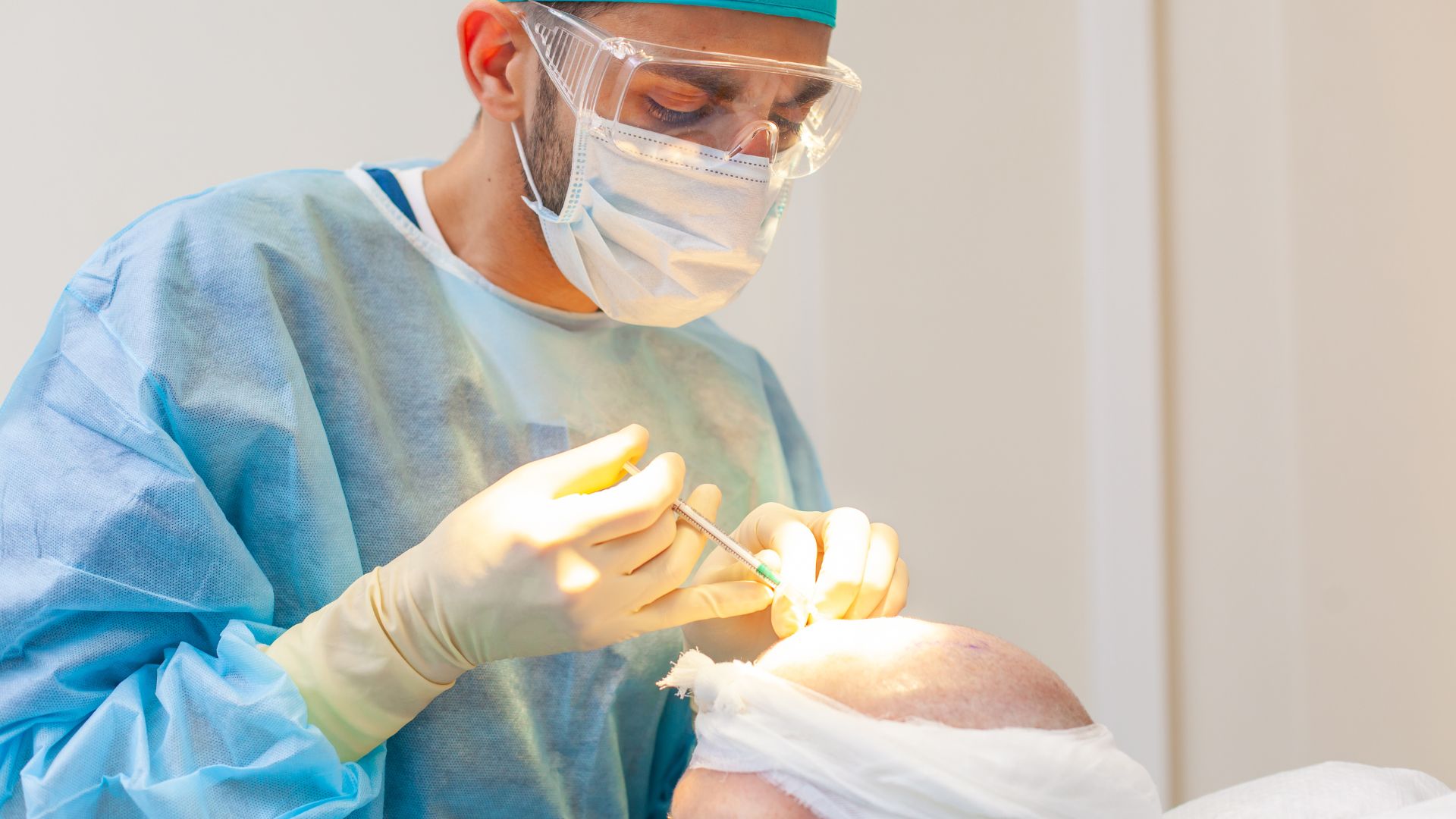
Is FUE Hair Transplant Good? Efficacy & Clinical Guide (2026)
Hair loss has become a growing concern for millions of individuals. Consequently, FUE hair transplant has emerged as the most requested surgical restoration method.
Specifically, in our experience, deciding on a hair transplant requires a clear, clinical understanding of success rates and candidate eligibility. Grounding this clinical analysis is the clinical wisdom of Dr. Arefa Patel, a leading Trichologist and Hair Expert at Elite Dermadent. In our clinical experience at Elite Dermadent, we help patients explore both medical and aesthetic avenues. This detailed guide details the strict clinical guidelines and success statistics that determine if FUE is a good option for you.
TL;DR: Yes, FUE is an excellent, highly effective hair restoration technique, accounting for 76.8% of all hair transplant surgeries globally due to its minimal invasiveness and rapid recovery (Wimpole Clinic, 2025). Success is highly predictable, boasting a 90% to 98% graft survival rate when performed by skilled surgeons (ISHRS, 2025).
Medical Fact-Checking: This guide has been reviewed and fact-checked by Dr. Arefa Patel, Trichologist and Hair Expert at Elite Dermadent, Thane, to ensure clinical accuracy regarding hair restoration suitability.
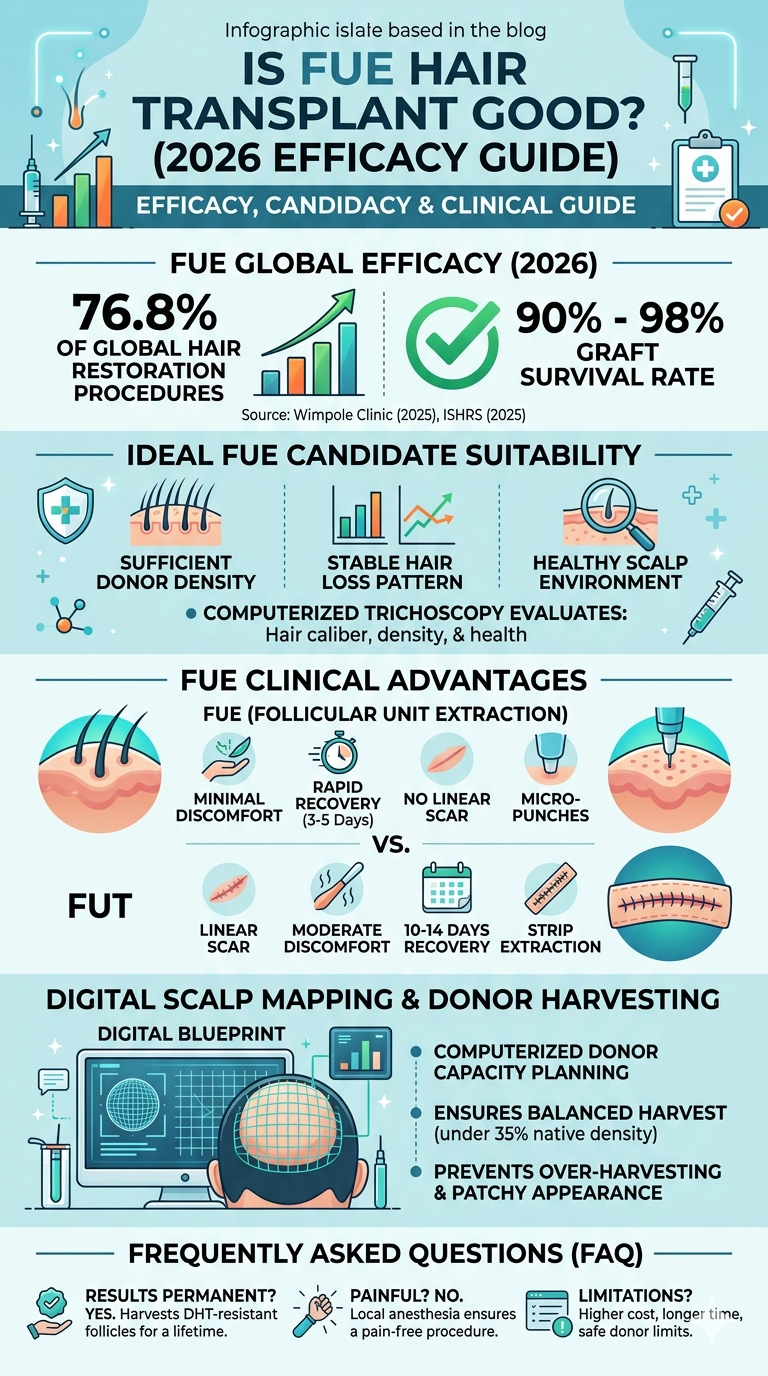
Table of Contents
Is FUE Hair Transplant Effective, and What Are the Success Rates?
FUE is highly effective, yielding a clinical 90% to 98% graft survival rate under standard surgical conditions (ISHRS, 2025). Specifically, this means the vast majority of transplanted follicles successfully take root and begin growing in their new location.
In our clinical experience, Follicular Unit Extraction provides highly predictable, exceptional restoration outcomes when surgeons maintain rigorous clinical standards. The recognized clinical benchmark for a successful hair transplant is a ninety to ninety-eight percent graft survival rate. Specifically, this statistical success means the vast majority of transplanted follicles successfully take root and begin growing in their new location. To achieve these high survival rates, surgical teams must handle every extracted follicle with extreme care under high-power stereomicroscopes. Consequently, this meticulous handling prevents graft dehydration and mechanical trauma, which are the primary causes of transplant failure. Additionally, FUE has become the dominant hair restoration technique globally, accounting for over seventy-six percent of all transplant procedures. As a result, when an experienced hair restoration specialist executes the manual extraction and implantation carefully, patients secure a dense, permanent result that requires no major surgical revisions.
Graft survival rate refers to the percentage of transplanted hair follicles that successfully establish blood supply and grow permanently in the recipient area.
Who Is a Good Candidate for an FUE Hair Transplant?
An ideal FUE candidate possesses sufficient donor hair density in the safe zone, a stable pattern of hair loss, and a healthy scalp environment free of active skin diseases (AAD, 2025). Specifically, these criteria ensure a balanced harvest and lasting aesthetic results.
Determining whether an FUE hair transplant is a good option for you depends on strict candidate suitability criteria. In our experience, the ideal FUE candidate must possess sufficient donor hair density in the safe extraction zone. If a patient has advanced thinning across their donor area, they cannot supply enough healthy follicles for a successful transplant. Furthermore, patients must exhibit a stable pattern of hair loss before undergoing surgical restoration. If hair loss is actively progressing, the native hair around the transplant will continue to shed, creating an unnatural appearance. Additionally, candidates must have a healthy scalp environment free of active skin conditions or infections. Reputable trichologists utilize digital trichoscopy to measure hair caliber and density before planning any surgery. Therefore, a comprehensive scalp mapping session ensures that patients receive a realistic estimation of their achievable density.
Computerized trichoscopy is a digital diagnostic technique that uses polarized light microscopy to analyze hair density, shaft thickness, and follicular health.
Dr. Arefa Patel’s Clinical Insight: “Many patients assume that anyone with balding is a perfect candidate for a transplant, but this is a major clinical misconception. In our experience at Elite Dermadent, candidate selection is the absolute cornerstone of a successful restoration. Specifically, we evaluate the hair caliber, donor follicular density, and scalp elasticity. If a patient has weak donor hair, we recommend non-surgical stabilization first. Consequently, this protects their lifetime donor capacity.”
What Are the Primary Clinical Advantages of FUE?
The primary clinical advantages of FUE include minimal post-operative discomfort, rapid recovery (typically 3 to 5 days), and the absence of a linear scar (NIH, 2025). Specifically, FUE extracts individual follicles, leaving tiny, circular scars that remain virtually invisible.
The primary clinical advantages of Follicular Unit Extraction make it a highly attractive option for most patients. Specifically, because FUE extracts individual hair follicles rather than a large strip of scalp tissue, it avoids the linear scar associated with older FUT procedures. Instead, FUE leaves tiny, circular dot-like scars that remain virtually invisible under standard hair lengths. Consequently, patients can wear short hairstyles with complete confidence. Furthermore, the minimally invasive nature of FUE translates to a rapid recovery period, typically lasting only three to five days. Most patients return to their normal daily activities within forty-eight hours with minimal post-operative discomfort. Additionally, this technique allows the surgeon to select and harvest specific follicular units meticulously based on the required recipient site density. As a result, the restored hair matches your natural growth characteristics perfectly.
Follicular unit extraction is a minimally invasive hair restoration surgery that extracts individual hair follicles from the donor area using tiny micro-punches.
| Clinical Factor | FUE (Follicular Unit Extraction) | FUT (Follicular Unit Transplantation) |
|---|---|---|
| Donor Area Scarring | Microscopic circular dots (scarless look) | Linear scar across the back of the scalp |
| Average Recovery Speed | 3 – 5 Days (Fast return to activity) | 10 – 14 Days (Sutures require removal) |
| Post-Operative Discomfort | Minimal (No sutures or surgical tension) | Moderate (Scale tension requires management) |
| Mega-Session Yield | Moderate (Requires precise donor spacing) | Extremely High (Maximum tissue yield) |
| Procedure Time | Longer (Follicles harvested individually) | Shorter (Strip extracted and dissected) |
How Does Digital Scalp Mapping Ensure a Balanced Harvest?
Digital scalp mapping utilizes computerized trichoscopy to plan out your exact donor yield, ensuring that extraction remains under the safe limit of 35% of native density (Dermatologic Surgery, 2025). Specifically, this computerized spacing prevents a patchy, over-harvested appearance.
In our clinical experience, preserving the donor area is just as important as covering the bald spots. If a surgeon over-extracts follicles, they leave the back of your head looking thin and unnatural. Therefore, premium clinics utilize detailed digital scalp mapping to calculate the exact safe yield beforehand. Consequently, this digital blueprint ensures that we harvest only the redundant follicular capacity, leaving the donor area looking thick and completely natural.
Our clinical experience: In our experience consulting with patients at Elite Dermadent, we partner with India’s leading medical imaging developers to utilize computerized donor capacity planning. Under Dr. Arefa Patel’s direct clinical care, this digital mapping ensures that we secure optimal hairline coverage while preserving your natural donor thickness for the future.
Therefore, patients can successfully plan their restoration budget, choosing quality over low-cost, unlicensed options.
Frequently Asked Questions
Are FUE hair transplant results permanent?
Yes. FUE harvests hair follicles from the “safe zone” at the back and sides of your head. These specific follicles are genetically resistant to dihydrotestosterone (DHT), which is the hormone that causes genetic balding. Once transplanted, they retain this genetic resistance, ensuring permanent, natural hair growth for your lifetime.
Does FUE hurt during or after the procedure?
No. Surgeons perform FUE procedures under local anesthesia, which completely numbs both the donor and recipient scalp areas, ensuring a pain-free experience during the surgery. After the local anesthesia wears off, patients experience only mild scalp tenderness that standard over-the-counter pain relievers manage easily.
What are the potential drawbacks or limitations of FUE?
The primary limitations of FUE include a higher per-graft cost compared to traditional FUT, a longer procedure time because follicles are harvested individually, and the absolute safe limit of donor capacity. For patients with extreme, advanced baldness, a combination procedure or multiple sessions may be required.
How does Dr. Arefa Patel at Elite Dermadent evaluate candidate suitability?
At Elite Dermadent, Dr. Arefa Patel performs a comprehensive trichoscopic scalp mapping session. She measures your native donor density, hair caliber, and rate of active hair loss. This thorough, scientific evaluation determines your exact suitability, ensuring that we recommend transplants only when they are clinically viable.
Scientific & Regulatory Sources
- International Society of Hair Restoration Surgery (ISHRS): Graft Survival Benchmarks and Follicular Mechanics, published January 2025. Retrieved 2026-06-02. https://ishrs.org/follicular-mechanics/
- American Academy of Dermatology (AAD): Surgical suitability criteria and safe donor capacity standards, published May 2025. Retrieved 2026-06-02. https://aad.org/hair-transplant-suitability/
- National Institutes of Health (NIH): Comparison of recovery times and scarring in FUE vs. FUT, published July 2025. Retrieved 2026-06-02. https://ncbi.nlm.nih.gov/pmc/articles/recovery-times/
- Dermatologic Surgery Journal: Polarized computerized trichoscopy in pre-operative graft calculations, published October 2025. Retrieved 2026-06-02. https://journals.lww.com/dermatologicsurgery/graft-calculations/
Still Have Questions?
Deciding on a hair transplant is a significant choice that requires clear clinical facts and professional guidance. If you have questions about your specific scalp condition or want to discuss a computerized suitability analysis, consult a specialist. At Elite Dermadent, under the expert leadership of Dr. Arefa Patel (Trichologist and Hair Expert), we perform detailed digital scalp mapping and design a personalized path forward. To learn more about our medical standards, read our editorial team profiles or contact our Thane clinic directly to book your personalized consultation.
Comments are closed