

If you are experiencing pain in the back of your jaw, you might ask can a root canal be done on a wisdom tooth. While technically possible, endodontists carefully evaluate whether saving a third molar is functionally necessary or if extraction is the more practical and effective dental choice.
Key Takeaways
- Technically Possible: Root canal therapy can be successfully performed on fully erupted, functional wisdom teeth with accessible root canals.
- Strategic Utility: Saving a wisdom tooth via root canal is highly recommended if it serves as a critical anchor for a dental bridge or replacing missing adjacent molars.
- When Extraction Is Better: If the wisdom tooth is impacted, crooked, difficult to clean, or lacks an opposing chewing partner, extraction is preferred over root canal treatment.
- Anatomical Complexity: Wisdom teeth often feature curved, fused, or extra root canals, requiring advanced endodontic technology and rotary precision.
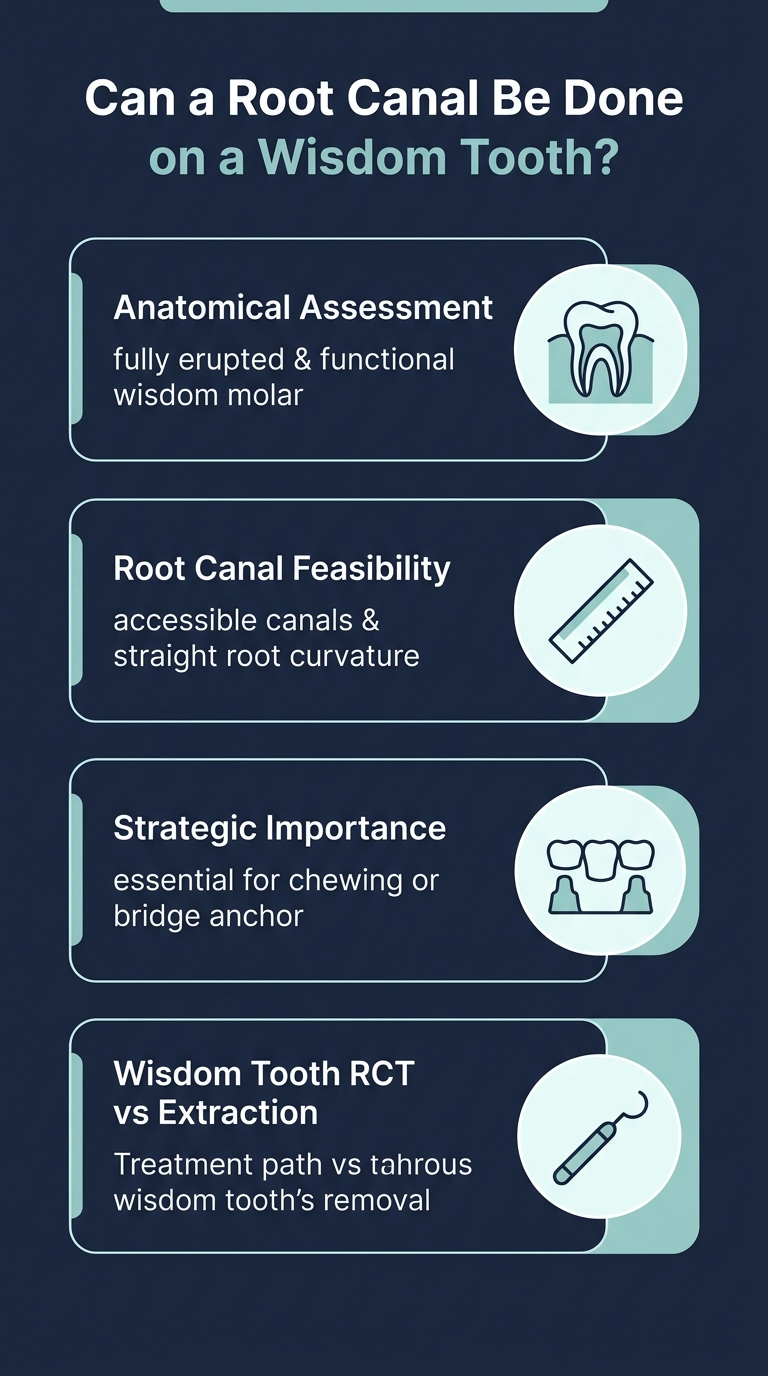
Table of Contents
- Can a Root Canal Be Done on a Wisdom Tooth?
- When Is a Wisdom Tooth Root Canal Recommended?
- When Is Extraction Better Than a Root Canal?
- Wisdom Tooth Root Canal vs. Extraction
- Expert Endodontic Care with Dr. Saurabh Pakhale
- Frequently Asked Questions
Can a Root Canal Be Done on a Wisdom Tooth?
The short clinical answer to can a root canal be done on a wisdom tooth is yes. A wisdom tooth (third molar) contains pulp tissue and root canals just like any other molar, meaning an endodontist can clean, disinfect, and seal its root channels.
However, because wisdom teeth are located at the far back of the mouth and often present irregular root anatomy, dentists evaluate two main factors before proceeding: accessibility and functional necessity.
When Is a Wisdom Tooth Root Canal Recommended?
Endodontists recommend saving a wisdom tooth with root canal therapy under the following conditions:
- Fully Erupted & Functional Alignment: The wisdom tooth has fully emerged through the gums, aligns properly in the arch, and bites against an opposing tooth to assist in chewing.
- Essential Anchor for Dental Prosthetics: If the adjacent first or second molars are missing, the wisdom tooth becomes a vital anchor pillar for a dental bridge or removable partial denture.
- Accessible & Favorable Root Anatomy: The patient can open their mouth wide enough for dental instruments, and X-rays show reasonably straight, navigable root canals.
When Is Extraction Better Than a Root Canal?
In many dental cases, extracting an infected wisdom tooth is the more logical and cost-effective treatment:
- Impacted or Crooked Position: Wisdom teeth trapped beneath gums/bone or growing sideways push neighboring teeth and cannot be restored properly.
- Non-Functional Chewing Role: If the opposing wisdom tooth was previously extracted, the remaining wisdom tooth serves no active chewing function.
- Severely Curved or Fused Roots: Extreme root curvature makes complete bacterial disinfection extremely difficult, increasing the risk of re-infection.
- Inability to Hygiene: Due to their position at the back of the jaw, wisdom teeth are difficult to brush and floss, making them prone to recurrent decay around fillings.
Wisdom Tooth Root Canal vs. Extraction
Compare the decision criteria between performing a root canal or extracting a wisdom tooth:
| Decision Factor | Wisdom Tooth Root Canal + Crown | Wisdom Tooth Extraction |
|---|---|---|
| Best Indication | Functional, straight tooth serving as chewing molar or bridge anchor | Impacted, crooked, non-functional, or severely decayed tooth |
| Procedure Complexity | High (requires navigating posterior jaw position) | Routine extraction procedure |
| Impact on Bite & Alignment | Preserves existing bite and bridge foundation | No negative impact if opposing tooth is absent |
| Post-Op Maintenance | Requires meticulous interdental cleaning | One-time healing; zero long-term maintenance |
Expert Endodontic Care with Dr. Saurabh Pakhale
At Elite Dermadent, Dr. Saurabh Pakhale, Endodontist and Dental Surgeon, conducts detailed digital X-ray diagnostics to evaluate whether a root canal or extraction is the healthiest option for your wisdom tooth.
Advanced Root Canal Solutions
- Painless Molar Endodontics: Learn more about our specialized Root Canal Treatment in Thane using modern rotary instruments and apex locators.
- Specialized Revision Therapy: If a previously treated molar develops persistent pain, explore how expert Root Canal Retreatment clears bacterial infections and saves functional teeth.
Frequently Asked Questions
Why do most dentists extract wisdom teeth instead of doing a root canal?
Most wisdom teeth are non-functional, crooked, difficult to keep clean, or have complex curved roots. Extracting them eliminates pain and prevents future decay without requiring complex endodontic treatment.
Does a root canal on a wisdom tooth hurt more than other teeth?
No. Local anesthesia completely numbs the area, so you feel zero pain during the procedure. However, holding your mouth open wide for an extended period to access the back jaw can cause mild temporary jaw joint soreness.
Do I need a crown after getting a root canal on a wisdom tooth?
Yes. If a wisdom tooth is saved via root canal because it is essential for chewing, placing a dental crown is necessary to protect the brittle tooth structure from breaking under heavy biting forces.
How long does a root canal on a wisdom tooth take?
A wisdom tooth root canal typically takes 45 to 60 minutes depending on the number of root canals (usually 3 to 4) and their anatomical curvature.
Comments are closed