
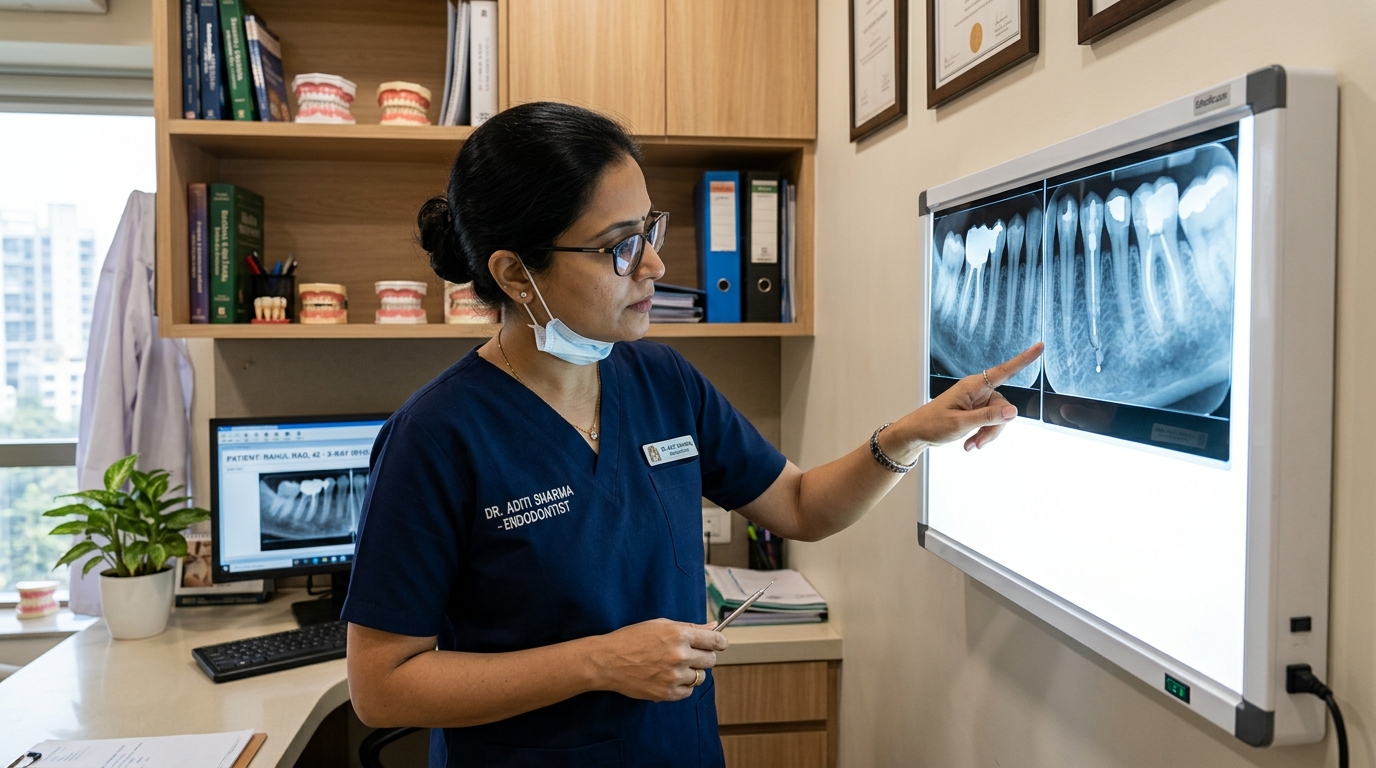
Although root canal therapy has a high success rate exceeding 95%, patients occasionally ask can a root canal get infected months or years after treatment. Understanding why root canal re-infection occurs, recognizing early warning symptoms, and knowing how specialized endodontic retreatment can save your tooth helps you protect your long-term oral health.
Key Takeaways
- Re-Infection Is Possible: A root-canal-treated tooth can become re-infected if new bacteria penetrate the root system through cracks, decay, or missed canals.
- Common Causes: Anatomically complex/curved root branches, delayed crown placement, micro-cracks, or coronal leakage around old fillings.
- Root Canal Retreatment Saves the Tooth: Specialized retreatment unseals the old filling, thoroughly disinfects all internal channels, and re-seals the tooth to permanently cure the infection.
- Early Symptoms: Pain when biting, localized gum swelling, or a pimple-like bump (abscess) on the gums require immediate endodontic evaluation.
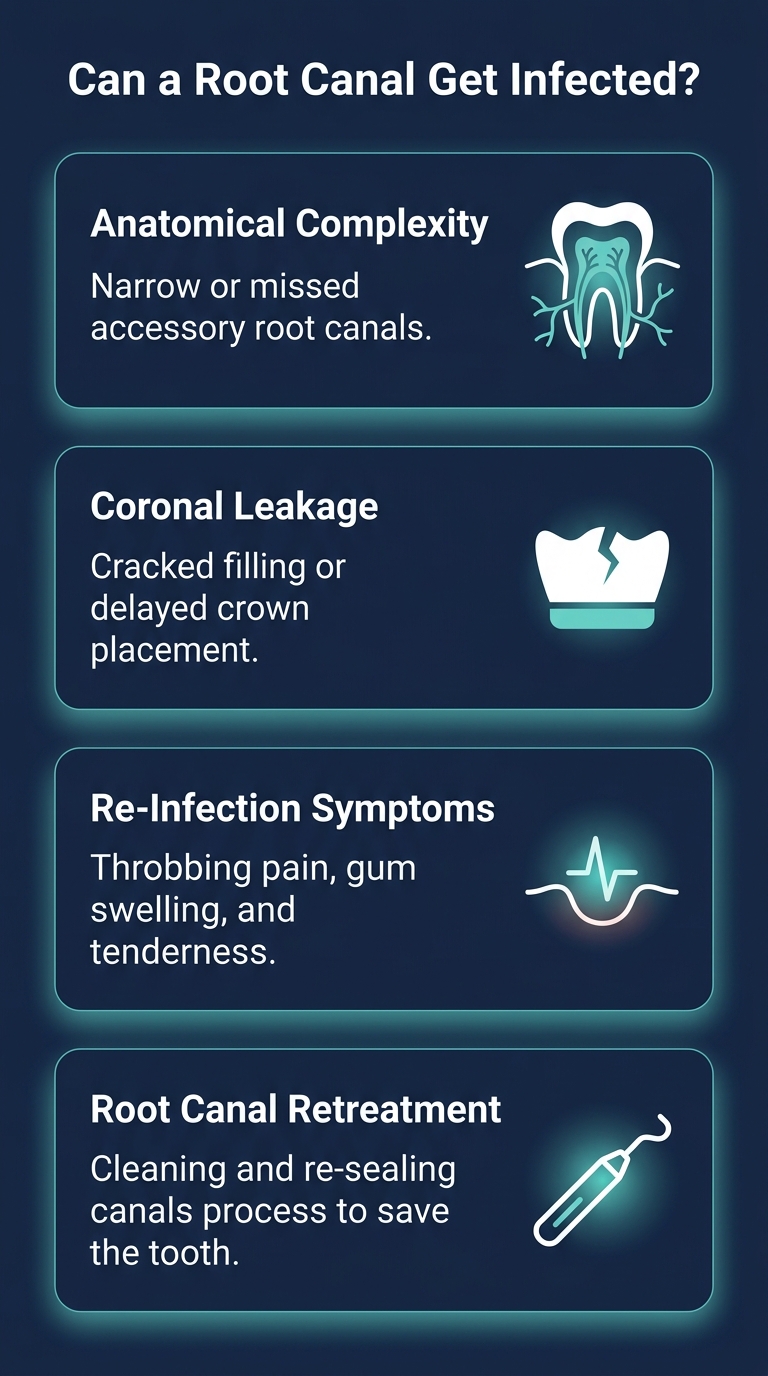
Table of Contents
- Can a Root Canal Get Infected?
- Primary Causes of Root Canal Re-Infection
- Symptoms of an Infected Root Canal
- How Root Canal Retreatment Cures the Infection
- Expert Endodontic Care with Dr. Saurabh Pakhale
- Frequently Asked Questions
Can a Root Canal Get Infected?
The straightforward medical answer to can a root canal get infected is yes. While a root canal removes the dead nerve and living vascular tissue from inside a tooth, the outer tooth structure remains in your mouth surrounded by oral bacteria.
If the protective seal over the root canals is compromised by new tooth decay, a cracked crown, or a loose filling, bacteria can re-enter the sterile root system and cause a secondary infection (known as post-treatment endodontic disease).
Primary Causes of Root Canal Re-Infection
Several clinical factors can lead to bacterial re-infection in a previously treated tooth:
- Missed or Anatomically Complex Canals: Human teeth can have extra accessory canals or complex curved roots that were difficult to detect or clean during the initial procedure.
- Coronal Leakage & Delayed Crown Placement: Delaying the placement of a permanent dental crown after a root canal allows saliva and oral bacteria to seep past temporary fillings into the root space.
- New Tooth Decay: Secondary cavities forming along the margins of an existing crown or filling create open pathways for bacteria to reach sealed canals.
- Cracked or Fractured Restorations: A loose crown, cracked filling, or vertical root fracture breaks the sterile seal, inviting bacterial colonization.
Symptoms of an Infected Root Canal
Unlike a fresh toothache where the living nerve reacts to hot or cold, an infected root canal tooth lacks internal nerve fibers. Instead, symptoms manifest in the surrounding gum and bone tissue:
- Biting & Pressure Sensitivity: Sharp or deep throbbing pain when chewing or applying pressure to the treated tooth.
- Gum Swelling & Tenderness: Redness, inflammation, or swelling in the gums directly adjacent to the tooth root.
- Gum Abscess (Gum Boil): A small pimple-like bump (fistula) on the gums that periodically drains pus, causing a foul taste in the mouth.
- Jawbone Tenderness: A dull, aching feeling in the jawbone surrounding the tooth root tip.
How Root Canal Retreatment Cures the Infection
Experiencing a re-infected root canal does not mean the tooth must be extracted. In most cases, Root Canal Retreatment successfully saves the tooth through a specialized procedure:
| Retreatment Step | Clinical Procedure | Patient Benefit |
|---|---|---|
| 1. Unsealing Canals | Existing crown/filling is accessed and previous gutta-percha packing material is carefully removed. | Gains full access to the complete root canal system. |
| 2. Deep Disinfection | Microscopic examination identifies hidden canals; high-power ultrasonic irrigants eradicate all bacteria. | Clears persistent bacterial colonies and complex canal branches. |
| 3. 3D Re-Sealing | Canals are dried, filled with new biocompatible gutta-percha, and sealed with a permanent core filling. | Restores sterile internal sealing and prevents future bacterial entry. |
| 4. Permanent Crown Placement | A new custom dental crown is fitted over the tooth to provide full structural reinforcement. | Restores 100% natural chewing strength and long-term durability. |
Expert Endodontic Care with Dr. Saurabh Pakhale
At Elite Dermadent, Dr. Saurabh Pakhale, Endodontist and Dental Surgeon, specializes in complex endodontic diagnostics, revision therapy, and microsurgical retreatment.
Advanced Endodontic Services
- Primary Root Canal Therapy: Explore our painless Root Canal Treatment in Thane using modern rotary endodontic equipment.
- Specialized Revision & Retreatment: If a previously treated tooth is experiencing pain or re-infection, learn how expert Root Canal Retreatment eliminates bacterial infections and preserves natural teeth.
Frequently Asked Questions
How do I know if my old root canal is infected?
Key signs include pain when biting or chewing, localized gum swelling, tooth tenderness, or a pimple-like abscess on the gums near the treated tooth. Digital X-rays by an endodontist confirm dark shadows (lesions) around the root tip.
Can an infected root canal heal on its own?
No. Bacterial infections inside root canals cannot resolve without professional endodontic treatment. Attempting to ignore an infected root canal causes progressive bone loss in the jaw and eventual tooth loss.
Is root canal retreatment painful?
No. Retreatment is performed under effective local anesthesia, ensuring you remain comfortable throughout the procedure. Modern endodontic tools clean the root canals efficiently, relieving pressure and pain rapidly.
What is the success rate of root canal retreatment?
When performed by an experienced endodontist using digital apex locators and ultrasonic irrigation, root canal retreatment achieves a high success rate of 85% to 90%+, allowing patients to retain their natural teeth for life.
Comments are closed