
One of the most frequent questions prospective patients ask before undergoing hair restoration is: are FUE hair transplants permanent? The medical and scientific answer is yes. Follicular Unit Extraction (FUE) offers a lifelong solution to pattern baldness because transplanted hair follicles retain their genetic resistance to hair loss hormones.
Key Takeaways
- Donor Dominance Principle: Follicles harvested from the donor area (back/sides of the head) are genetically immune to DHT (Dihydrotestosterone) and retain this permanence after transplantation.
- Lifelong Root Anchorage: Once transplanted root bulbs integrate with the scalp’s blood supply (within 3 to 5 days), they produce healthy hair shafts indefinitely.
- Temporary Shedding Is Normal: The hair shafts shed 2 to 4 weeks post-op (shock loss), but the permanent root remains anchored beneath the scalp to grow new hair.
- PFI Scarfree Precision: Advanced direct implanter techniques (like the Scarfree Pen) maximize follicle survival rates up to 95%+, guaranteeing long-term density.
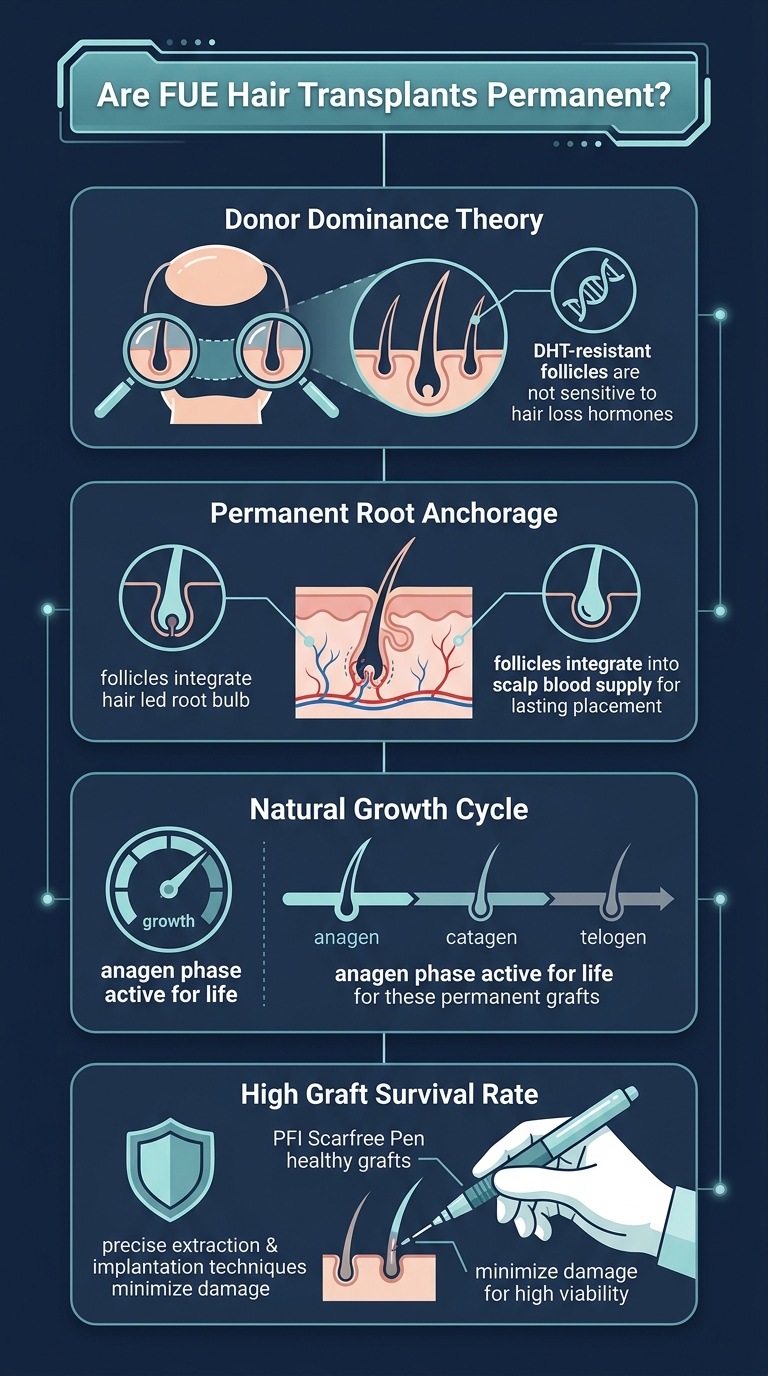
Table of Contents
- The Science Behind FUE Hair Permanence
- Donor Dominance & DHT Resistance Explained
- Shock Loss vs. Permanent Regrowth Timeline
- Maximizing Graft Longevity: PFI Scarfree Technique
- Factors That Ensure Lifetime Success
- Frequently Asked Questions
The Science Behind FUE Hair Permanence
When asking are FUE hair transplants permanent, understanding human hair genetics provides clear clinical proof. Pattern baldness (androgenetic alopecia) does not affect all scalp hair equally. Hair on the top and crown of the head possesses androgen receptors sensitive to Dihydrotestosterone (DHT), causing them to shrink and fall out over time.
In contrast, hair follicles located on the lower back and sides of the scalp (the safe donor zone) lack these destructive receptors. When individual follicles are harvested via FUE and relocated to balding recipient areas, they carry their genetic immunity with them—continuing to grow permanently for the rest of your life.
Donor Dominance & DHT Resistance Explained
1. The Donor Dominance Phenomenon
First established in dermatological science, the principle of donor dominance dictates that the genetic traits of the hair follicle reside within the root itself, not the scalp location where it is planted. Once relocated, the donor follicle maintains its native growth cycle, caliber, and resistance to hormonal shedding.
2. Vascular Re-Integration (Neovascularization)
During the first 72 to 96 hours following FUE transplantation, tiny microscopic blood capillaries reconnect to the newly placed hair bulbs. Once vascular supply is established, the graft receives continuous oxygen and nutrients, locking it permanently into the scalp dermal layer.
Shock Loss vs. Permanent Regrowth Timeline
Patients often worry when transplanted hair sheds shortly after surgery. Understanding this natural biological phase prevents unnecessary concern:
| Timeframe Post-Op | Graft Biological Status | Visible Scalp Appearance |
|---|---|---|
| Days 1 – 7 | Vascular integration & micro-healing | Tiny scabs form and shed naturally |
| Weeks 2 – 4 | Shock loss phase (hair shaft sheds, root bulb dormant) | Transplanted hair shafts fall out (completely normal) |
| Months 3 – 4 | Anagen (growth) phase activates permanently | Fine new hair shafts emerge from scalp surface |
| Months 6 – 9 | Maturation & thickening of hair shafts | Significant visual density and hairline shape |
| Months 12 – 15 | Full permanent maturity achieved | Lifelong natural hair density fully realized |
Maximizing Graft Longevity: PFI Scarfree Technique
To ensure that every single harvested graft survives and achieves permanent growth, surgical precision is essential. At Elite Dermadent, Dr. Arefa Patel, Trichologist and Skin Specialist, specializes in the Precise Follicular Implantation (PFI) Hair Transplant Technique utilizing the advanced Scarfree Pen.
How PFI Protects Follicle Survival Rates
Traditional FUE involves cutting scalp slits prior to graft insertion with forceps, which can cause micro-trauma to fragile root bulbs. PFI optimizes graft longevity through:
- Direct Implantation Without Scalp Slits: The Scarfree Pen creates the micro-site and implants the graft simultaneously, eliminating scalpel cuts.
- Protected Root Bulb Loading: Prevents forceps trauma, ensuring up to 95%+ of transplanted grafts survive permanently.
- 360-Degree Angle Control: Implants follicles at precise 10° to 45° natural growth angles, preventing irregular growth direction.
- Rapid Micro-Healing: Micro-puncture sites seal within 3 to 5 days, minimizing post-op swelling and risk of infection.
Discover more about our permanent PFI Hair Transplant Treatment options and book a personalized consultation.
Factors That Ensure Lifetime Success
While transplanted follicles are genetically permanent, maintaining overall aesthetic success requires:
- Surgeon Expertise: Safe donor zone mapping ensures grafts are harvested strictly from permanent zones, avoiding temporary hair regions.
- Post-Op Care Compliance: Following post-procedure washing and care guidelines during the first 10 days protects fragile new grafts.
- Managing Native Hair Loss: While transplanted hair is permanent, surrounding non-transplanted native hair may continue shedding without supportive medical therapy (like Minoxidil or PRP).
Frequently Asked Questions
Are FUE hair transplants permanent for life?
Yes. Follicles extracted from the safe donor area (back and sides of the scalp) are genetically immune to DHT. When transplanted, they maintain this genetic resistance and continue to grow naturally for the rest of your life.
Can a hair transplant fall out years later?
Transplanted hair follicles do not fall out due to pattern baldness. However, like all natural hair, they undergo normal age-related thinning in late adulthood. Surrounding untreated native hair may also thin if supportive medical therapy is discontinued.
What happens if transplanted hair sheds in the first month?
Temporary shedding (known as shock loss) during weeks 2 to 4 post-procedure is a normal physiological response. The hair shaft falls away, but the root bulb remains permanently anchored inside the scalp dermal layer to sprout new hair at month 3.
How long does it take for transplanted hair grafts to become permanent in the scalp?
Grafts become securely anchored into the scalp within 7 to 10 days post-surgery. After 10 days, normal gentle washing and light activity cannot dislodge or damage the anchored root bulbs.
Comments are closed