
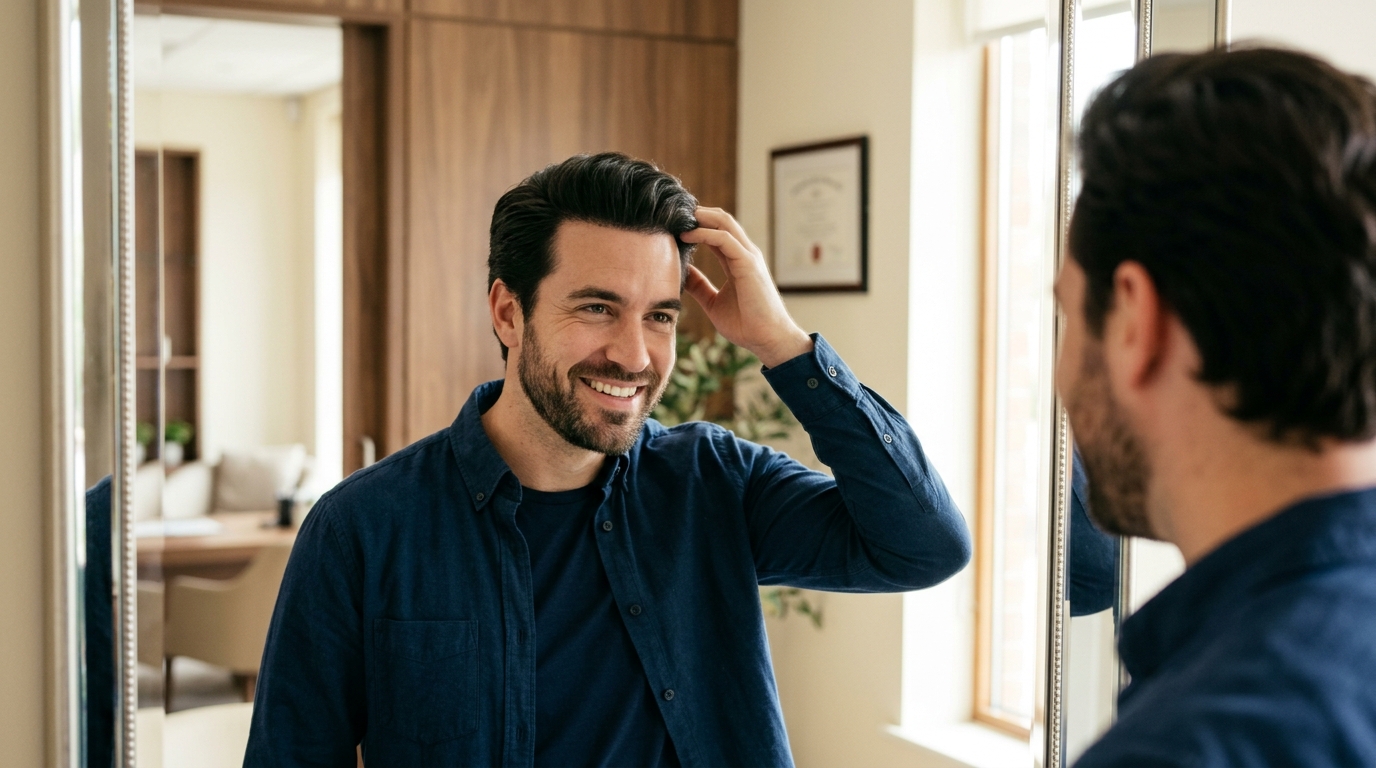
If you are struggling with receding hairlines or thinning crown density, asking are FUE hair transplants worth it is a natural first step. With thousands of patients undergoing hair restoration each year, evaluating the long-term clinical value, financial ROI, and permanent aesthetic outcomes helps you make an informed decision for your scalp health.
Key Takeaways
- Permanent Hair Growth: Transplanted hair follicles harvested from the DHT-resistant donor zone grow naturally for the rest of your life.
- High Financial ROI: While the upfront cost is higher than temporary treatments, a one-time FUE procedure eliminates decades of recurring expenses for sprays, concealment fibers, and temporary solutions.
- Advanced PFI Precision: Modern direct implantation using the Scarfree Pen achieves natural density with zero linear scars and rapid 3-to-5-day micro-healing.
- Candidate Dependency: FUE is highly worth it for candidates over 25 with stabilized pattern baldness and adequate donor density.
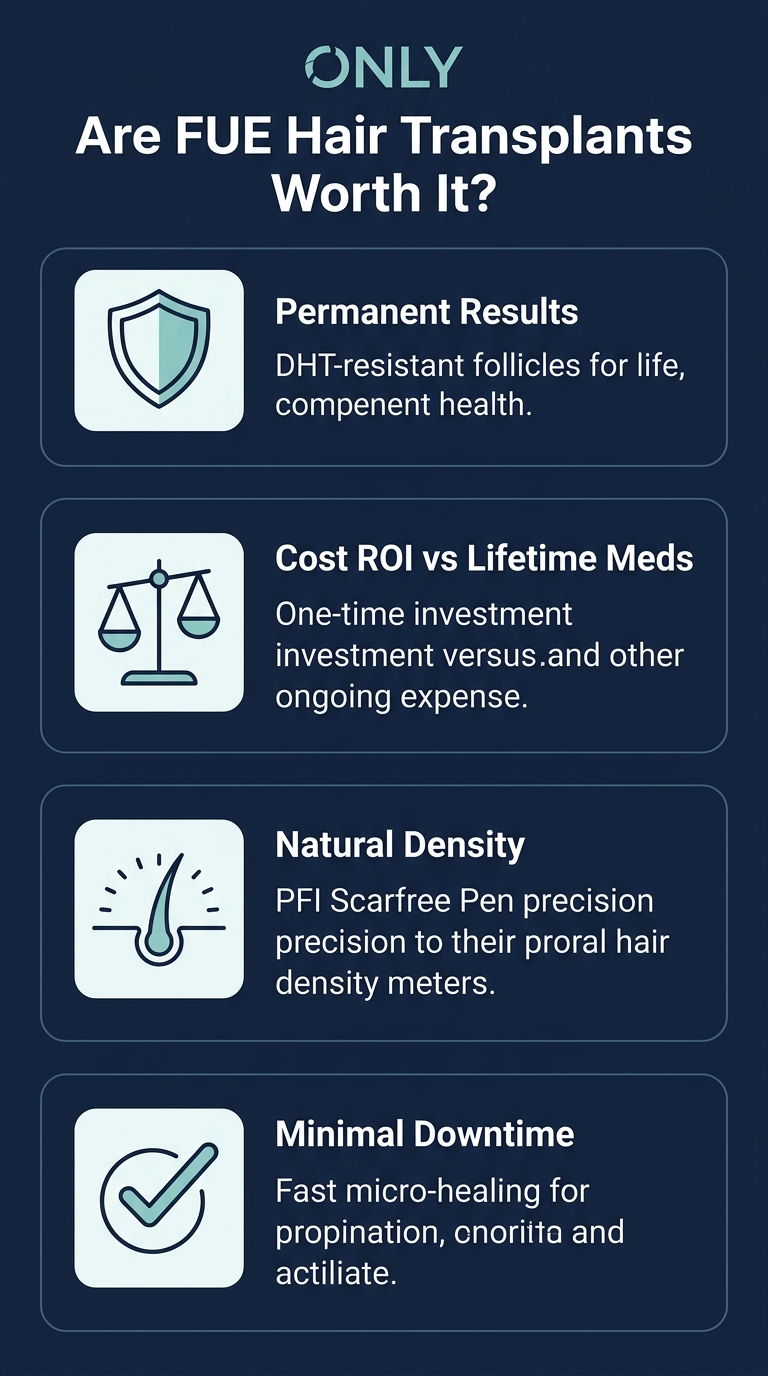
Table of Contents
- Evaluating the Real Value of FUE Hair Transplants
- 4 Key Reasons FUE Hair Restoration Is Worth It
- Financial Comparison: FUE vs. Lifetime Non-Surgical Treatments
- Maximizing Value: PFI Technique with Scarfree Pen
- When Might a Hair Transplant NOT Be Worth It?
- Frequently Asked Questions
Evaluating the Real Value of FUE Hair Transplants
Unlike temporary hair loss solutions that require daily application and only slow down shedding, a Follicular Unit Extraction (FUE) hair transplant is a definitive medical solution. FUE extracts individual healthy hair follicles from the permanent donor zone (the back and sides of your scalp) and relocates them to bare or thinning recipient areas.
Because these donor follicles retain their genetic resistance to Dihydrotestosterone (DHT)—the hormone responsible for pattern baldness—they continue to grow naturally for a lifetime once successfully integrated.
4 Key Reasons FUE Hair Restoration Is Worth It
1. Permanent, Authentic Hairline Growth
Transplanted follicles produce real, growing hair that can be washed, cut, styled, and dyed just like your native hair. There are no artificial pieces, maintenance wigs, or temporary fibers required.
2. Superior Long-Term Financial ROI
Non-surgical treatments like topical minoxidil, oral medications, specialized shampoos, and hair fibers require continuous lifelong purchases. Over 10 to 15 years, these recurring costs often equal or exceed the one-time investment of a permanent FUE procedure.
3. No Linear Scarring & Minimal Downtime
Legacy strip surgery (FUT) left a permanent linear scar across the back of the scalp. Modern FUE uses microscopic punch tools that leave tiny, virtually invisible micro-dots, allowing you to wear short haircuts with complete confidence.
4. Profound Psychological & Confidence Boost
Clinical studies consistently show that restoring a youthful hairline and natural hair density significantly improves self-esteem, professional confidence, and overall quality of life.
Financial Comparison: FUE vs. Lifetime Non-Surgical Treatments
Here is how a one-time FUE hair transplant compares to long-term temporary hair loss management over a 10-year period:
| Evaluation Factor | FUE Hair Transplant (PFI) | Lifetime Non-Surgical Maintenance |
|---|---|---|
| Primary Outcome | Permanent hair regrowth in bald areas | Slowing down hair shedding only |
| Duration of Commitment | One-time procedure (1–2 days) | Daily lifetime application |
| Long-Term Cost Model | Fixed one-time investment | Accumulating ongoing monthly expenses |
| Aesthetic Hairline Restoration | Rebuilds receded hairline & bare patches | Cannot regrow hair on dead/bare follicles |
| Scars & Recovery | Micro-healing in 3–5 days, zero linear scars | No surgery required |
Maximizing Value: PFI Technique with Scarfree Pen
To ensure your hair transplant delivers maximum aesthetic return, choosing the right technique and specialist is key. At Elite Dermadent, Dr. Arefa Patel, Trichologist and Skin Specialist, specializes in the advanced Precise Follicular Implantation (PFI) Hair Transplant Technique utilizing the specialized Scarfree Pen.
Why PFI Ensures the Highest Satisfaction Rate
Traditional FUE involves cutting scalp slits prior to graft placement. PFI elevates standard FUE by using direct implanters:
- Direct Implantation: Creates the micro-puncture and inserts the graft simultaneously, eliminating scalp slit scars and cut marks.
- High Graft Yield: Minimizes forceps manipulation of delicate follicle roots, achieving up to 95%+ graft survival.
- Authentic Hairline Direction: Complete control over implantation angle (10° to 45°) creates seamless, natural hairline flow.
- Fast Recovery: Punctures close in 3 to 5 days, minimizing downtime and allowing a rapid return to daily routines.
Learn more about our specialized PFI Hair Transplant Treatment options and book a personal consultation.
When Might a Hair Transplant NOT Be Worth It?
While FUE has a satisfaction rate exceeding 95%, it may not be suitable if:
- Hair Loss Is Premature (< 25 years old): Unstabilized shedding can leave transplanted patches isolated as native hair continues to recede.
- Severe Donor Deficiency: Patients with insufficient donor density cannot achieve adequate coverage over large bald areas.
- Unrealistic Expectations: A transplant restores natural coverage based on your donor supply, but cannot create thicker hair than your original genetic density.
Frequently Asked Questions
What is the success rate of FUE hair transplants?
When performed by an experienced trichologist using direct implantation tools like the PFI Scarfree Pen, FUE hair transplants achieve follicle survival and growth rates between 90% and 95%+.
Do transplanted hairs fall out over time?
Transplanted hairs shed initially during weeks 2 to 4 post-op (known as shock loss). However, the root bulbs remain securely embedded in the scalp and begin growing permanent hair shafts starting from month 3 onwards.
Is an FUE hair transplant painful?
No. Local anesthesia is administered to numb both the donor and recipient areas completely during the procedure. Post-operative discomfort is mild and easily managed with standard mild pain relief medication for 1 to 2 days.
How long does it take to see the final results of an FUE transplant?
Initial growth starts around month 3 to 4. Noticeable density builds between months 6 and 9, and final mature hairline density is fully visible at 12 to 14 months post-procedure.
Comments are closed