
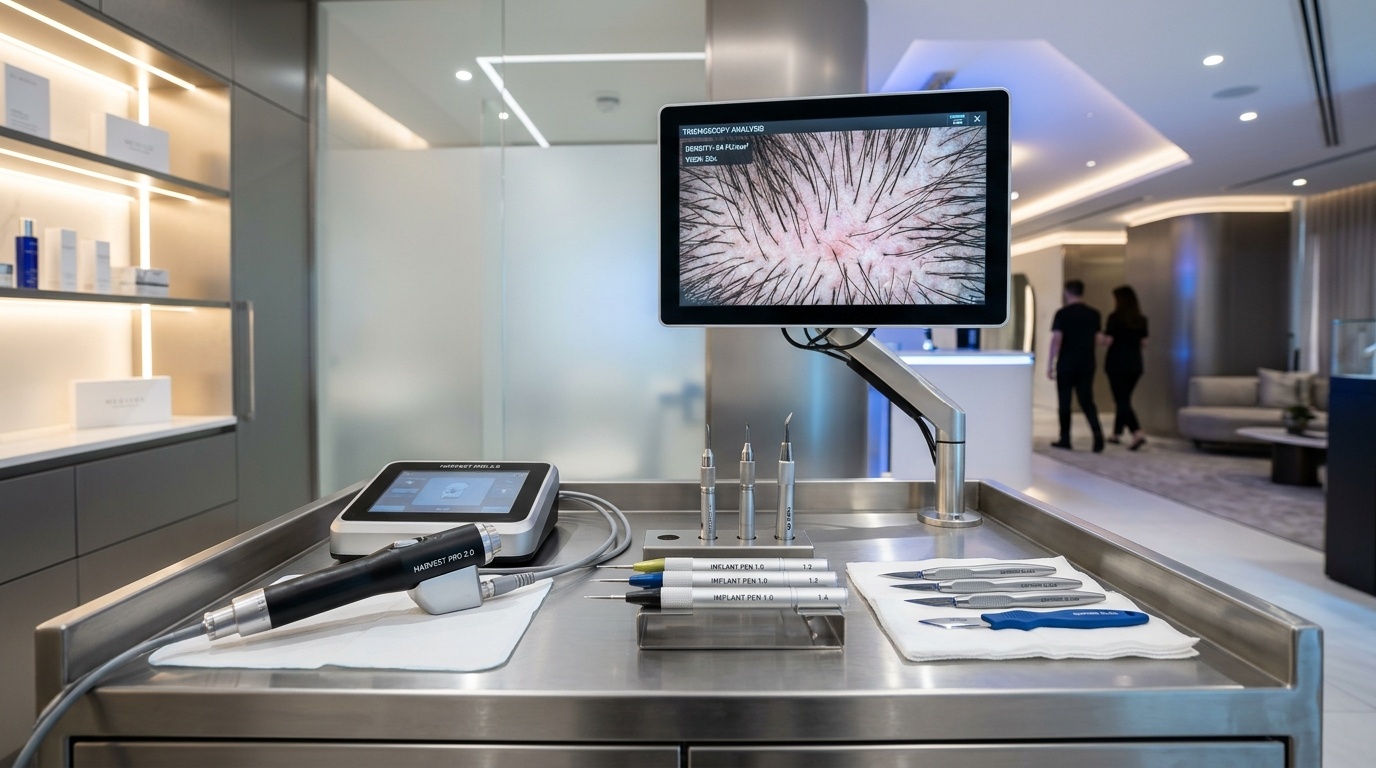
From today’s seamless microscopic procedures to early medical experiments, many patients ask: when did hair transplantation start? The scientific foundation of hair transplantation began in 1939 with Japanese dermatologist Dr. Shoji Okuda, who used punch grafts to restore hair for burn victims. In 1952, American dermatologist Dr. Norman Orentreich established the groundbreaking principle of “Donor Dominance,” proving that hair follicles from the back of the head retain their lifelong resistance to balding even when relocated. Over the decades, hair restoration has evolved from unnatural large plugs to revolutionary Follicular Unit Extraction (FUE) and today’s state-of-the-art Precise Follicular Implantation (PFI) using the Scarfree Pen.
Key Takeaways:
- 1939 Japanese Origins: Dr. Shoji Okuda published the first clinical documentation of circular punch graft hair transplantation for reconstructive trauma care.
- 1952 Donor Dominance: Dr. Norman Orentreich proved that occipital hair follicles are genetically programmed to resist DHT, laying the biological groundwork for all modern procedures.
- Evolution Through Eras: Techniques transitioned from 4mm “doll’s hair” plugs in the 1970s–80s to FUT strip surgery in the 1990s, micro-punch FUE in 2002, and modern direct PFI today.
- Modern Scarfree Precision: Today’s PFI Scarfree Pen technique implants follicles directly without scalpel incisions or visible scarring, yielding 95%+ survival and undetectable hairlines.
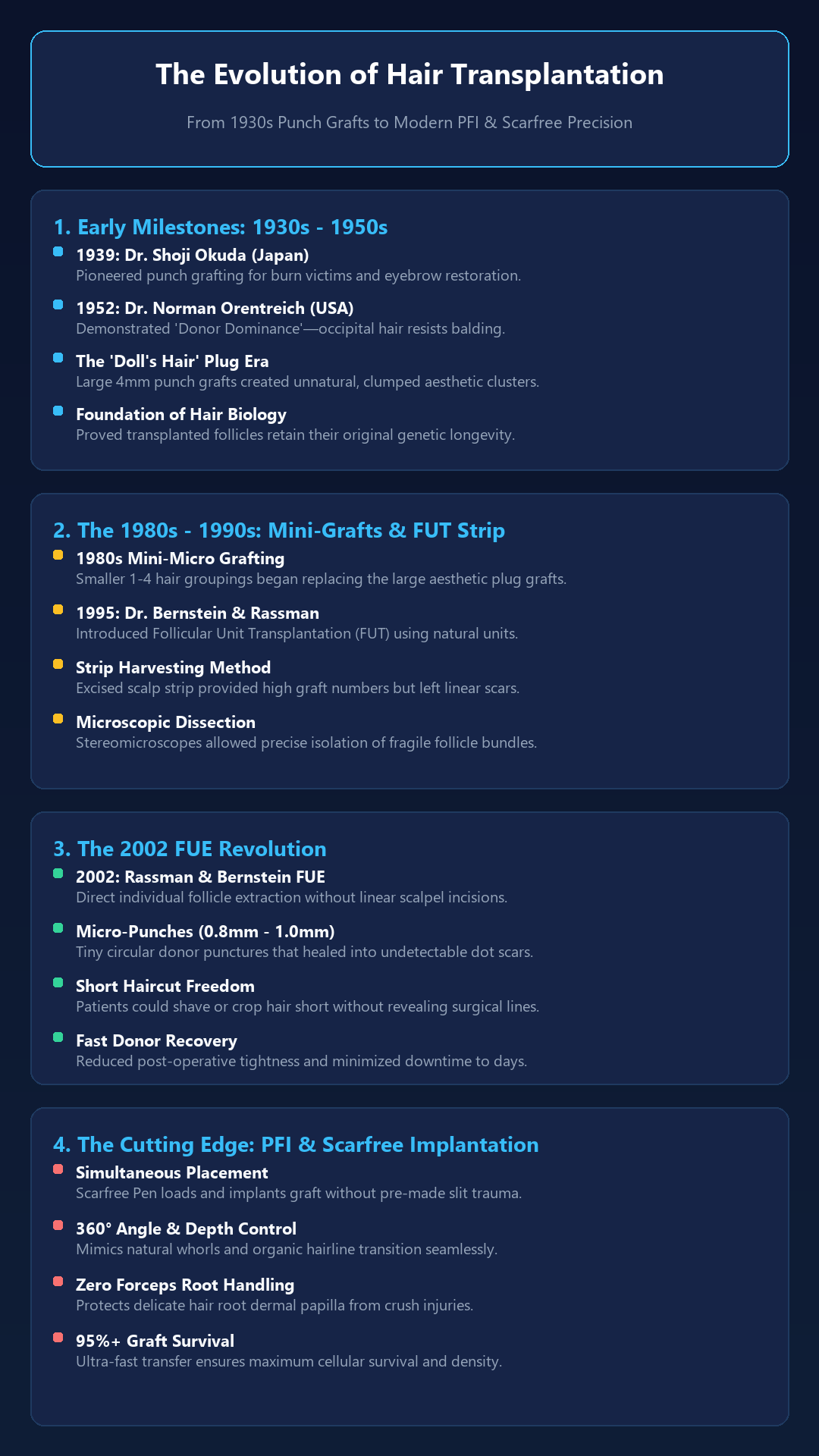
Table of Contents
- 1930s–1950s: The Pioneering Breakthroughs of Okuda and Orentreich
- The 1970s–1980s: The 4mm “Doll’s Hair” Plug Era
- The 1990s: Microscopic Dissection and Follicular Unit Transplantation (FUT)
- The 2002 Revolution: Follicular Unit Extraction (FUE)
- Historical Evolution Comparison Table
- Today’s Pinnacle: PFI with the Scarfree Pen at Elite Dermadent
- Consult with Dr. Arefa Patel in Thane
- Frequently Asked Questions (FAQs)
1930s–1950s: The Pioneering Breakthroughs of Okuda and Orentreich
Modern hair restoration owes its origins to military and dermatological medicine. In 1939, Japanese physician Dr. Shoji Okuda developed a technique using 2mm to 4mm trephine punch instruments to harvest hair-bearing skin grafts from healthy scalp regions to reconstruct eyebrows, mustaches, and scalps for burn victims. Because World War II isolated Japanese medical literature, his work went largely unnoticed in the West.
In 1952, New York dermatologist Dr. Norman Orentreich performed the first documented hair transplant for androgenetic alopecia (male pattern baldness). When scientific journals initially rejected his findings as “impossible,” Dr. Orentreich published his historic paper in 1959 establishing the biological rule of Donor Dominance: hair follicles harvested from the occipital scalp (back and sides) retain their genetic resistance to balding hormones (DHT) permanently, regardless of where they are transplanted.
The 1970s–1980s: The 4mm “Doll’s Hair” Plug Era
During the 1960s through the 1980s, surgeons utilized circular punch tools ranging from 3.5mm to 4.5mm in diameter. Each punch harvested large tissue plugs containing 15 to 30 hairs.
While these plugs grew hair reliably, they created an abrupt, clumped appearance commonly referred to as “doll’s hair” or “toothbrush hair.” Furthermore, the donor site healed with noticeable circular depressions and white scars. As a patient’s native hair thinned with age, these thick plugs became increasingly isolated and conspicuous.
The 1990s: Microscopic Dissection and Follicular Unit Transplantation (FUT)
In the mid-1990s, pioneering surgeons Dr. Robert Bernstein and Dr. William Rassman transformed the field by introducing Follicular Unit Transplantation (FUT). They discovered that human hair naturally grows in physiological bundles of 1 to 4 hairs known as follicular units.
FUT involved surgically excising a horizontal strip of scalp tissue from the back of the head, dissecting individual follicular units under high-powered stereomicroscopes, and inserting them into tiny recipient incisions. FUT delivered soft, natural-looking results, but left patients with a permanent, visible horizontal linear scar across the back of their head.
The 2002 Revolution: Follicular Unit Extraction (FUE)
To eliminate the linear surgical scar of strip harvesting, Dr. Rassman and Dr. Bernstein published their landmark paper on Follicular Unit Extraction (FUE) in 2002. Instead of excising a skin strip, FUE utilizes specialized micro-punches (0.8mm to 1.0mm) to gently harvest individual follicular units one by one directly from the scalp.
FUE revolutionized hair restoration by eliminating scalpel sutures, reducing healing time from weeks to days, and leaving only microscopic dot scars that allow patients to wear short fades and buzz cuts with complete freedom.
Historical Evolution Comparison Table
The journey of hair restoration across eight decades reflects immense technological progress:
| Era & Technique | Pioneers | Harvesting Tool / Method | Aesthetic Outcome | Donor Scarring |
|---|---|---|---|---|
| 1930s–1950s (Early Punches) | Dr. Okuda / Dr. Orentreich | Large 3.5mm–4mm circular trephines | Coarse, patchy reconstructive coverage | Large circular scarring depressions |
| 1970s–1980s (Plug Era) | Various global surgeons | 15–30 hair cluster plugs | Clumped “doll’s hair” aesthetic | Severe visible scalp cobblestoning |
| 1990s (FUT Strip Surgery) | Dr. Bernstein & Dr. Rassman | Scalpel strip excision & stereomicroscopes | Natural follicular unit groupings | Permanent horizontal linear scar |
| 2000s (Classic FUE) | Dr. Rassman & Dr. Bernstein | 0.8mm–1.0mm motorized punches + forceps | High naturalness, soft hairline | Tiny pinpoint dot scars (concealable) |
| Present Day (PFI with Scarfree Pen) | Modern specialized trichologists | Sub-millimeter extraction + Scarfree Pen implanter | 100% organic density, 3D angle control | Virtually invisible, rapid 3-day recovery |
Today’s Pinnacle: PFI with the Scarfree Pen at Elite Dermadent
Today, hair restoration is an art of extreme precision. Conventional FUE still requires a technician to handle delicate follicle roots with forceps and insert them into pre-slit scalp incisions, which can occasionally damage the fragile dermal papilla bulb.
At Elite Dermadent, we utilize the Precise Follicular Implantation (PFI) technique with the Scarfree Pen. By loading each healthy follicle into a specialized hollow implanter pen, the surgeon creates the micro-site and places the graft simultaneously. This innovation protects the root bulb from mechanical crush injury, guarantees exact control over depth and angle (15°–30°), and achieves superior graft survival rates exceeding 95%.
Consult with Dr. Arefa Patel in Thane
Understanding the history of hair transplantation highlights how safe, predictable, and remarkably natural modern procedures have become. Led by Dr. Arefa Patel, Trichologist and Skin Specialist, Elite Dermadent is dedicated to delivering world-class hair restoration using the most advanced techniques available.
If you are exploring permanent solutions for thinning hair or seeking revision for an older procedure, experience the artistry of our advanced hair transplant in Thane with the PFI Scarfree Pen method.
Frequently Asked Questions (FAQs)
1. Who performed the very first hair transplant in history?
Dr. Shoji Okuda, a Japanese dermatologist, performed the first documented hair transplant in 1939 using small punch grafts to restore hair and eyebrows for burn and trauma patients.
2. What does “Donor Dominance” mean?
Discovered by Dr. Norman Orentreich in 1952, Donor Dominance is the scientific principle that hair follicles taken from the back and sides of the head retain their genetic resistance to balding hormones (DHT), even when relocated to a balding area.
3. Why did old hair transplants look like “doll’s hair”?
Older procedures in the 1970s and 1980s used large 4mm punches that moved clumps of 15 to 30 hairs at once. Modern techniques transplant individual follicular units containing only 1 to 4 hairs, creating a soft, completely natural appearance.
4. When was FUE invented?
Follicular Unit Extraction (FUE) was formally introduced in 2002 by Dr. William Rassman and Dr. Robert Bernstein, replacing the linear strip scar of FUT with individual micro-punch extractions.
5. How is modern PFI with the Scarfree Pen different from early FUE?
Early FUE involved making pre-cut slits with scalpel blades and manually shoving grafts in with forceps. PFI with the Scarfree Pen creates the incision and implants the follicle simultaneously in one gentle motion, eliminating bulb trauma and preventing visible scarring.
No responses yet