
FUE vs FUT Hair Transplant: Recovery and Graft Yield (2026)
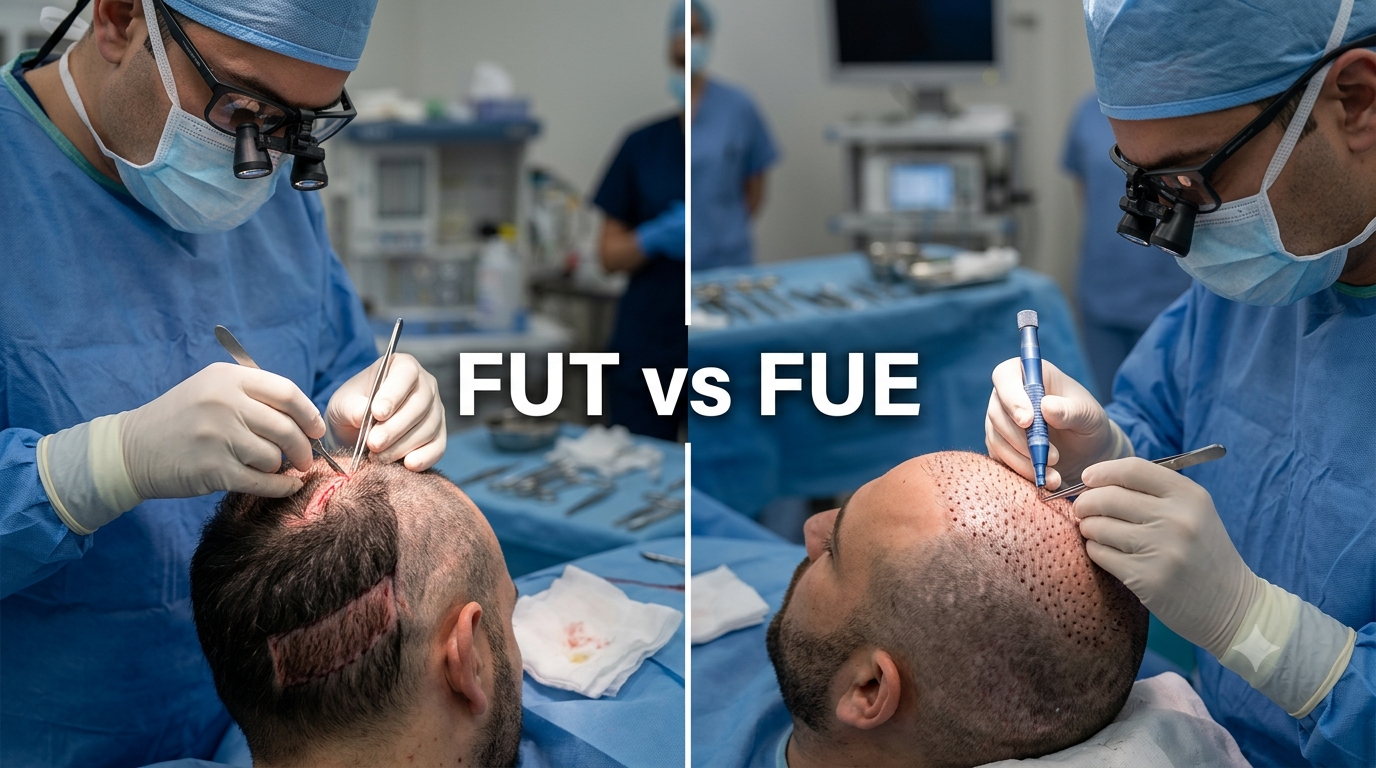
Choosing a hair restoration method is a major decision. In male patients, FUE hair transplant is currently the dominant surgical technique. This method extracts individual hair follicles one by one. Conversely, FUT hair transplant harvests a single strip of scalp tissue from the donor zone. Deciding between them requires a careful, scientific comparison of recovery times and graft yields.
Specifically, in our experience, neither method is universally superior. Grounding this analysis is the clinical wisdom of Dr. Arefa Patel, a leading Trichologist and Hair Expert at Elite Dermadent. In our clinical experience at Elite Dermadent, we prioritize long-term donor health. This guide provides a detailed, category-by-category comparison of Follicular Unit Excision (FUE) and Follicular Unit Transplantation (FUT).
TL;DR: FUE wins for modern lifestyle convenience due to its lack of a linear scar and rapid 3-to-5-day recovery. However, FUT remains superior for advanced baldness, delivering a higher graft survival rate (95%+) and larger single-session yields. Choose FUE if you wear short hair and want fast healing. Choose FUT if you require maximum coverage and have advanced hair loss.
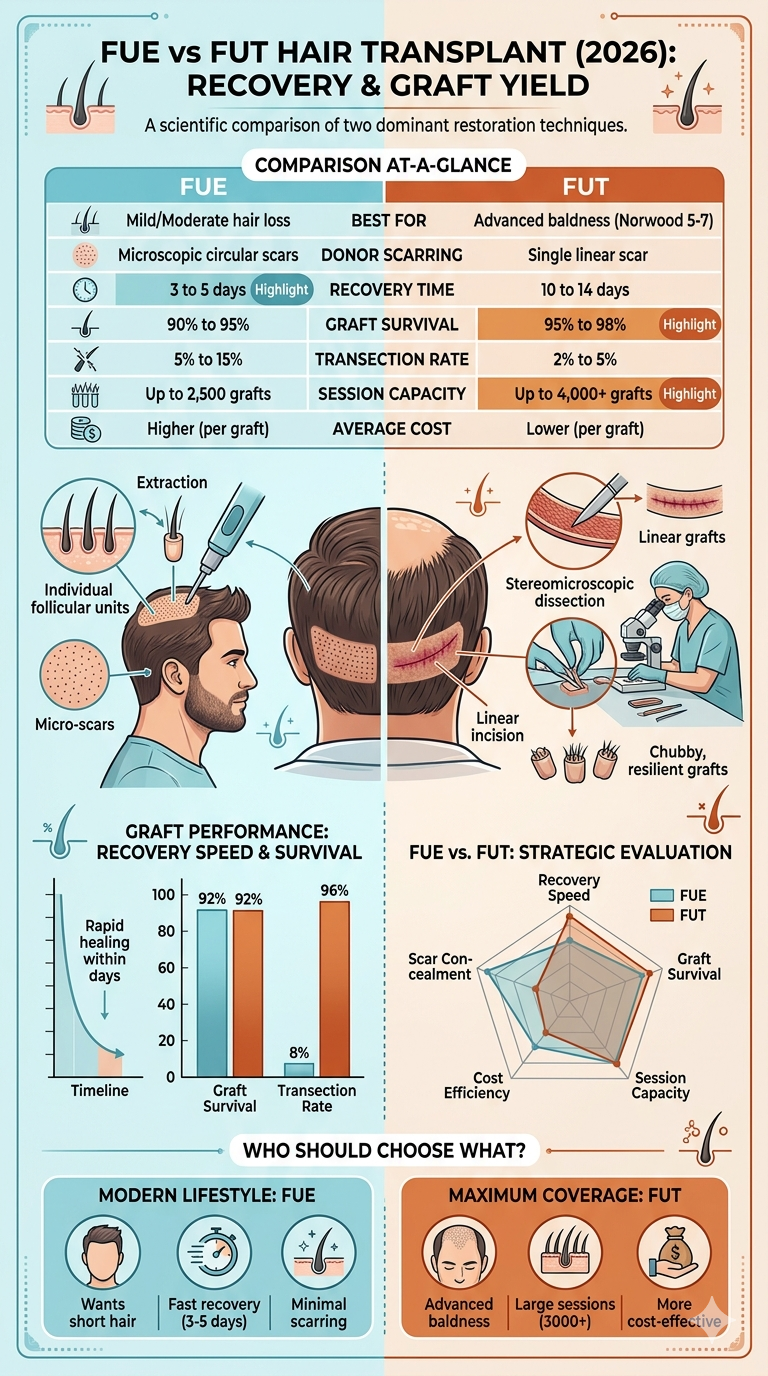
Table of Contents
Quick Comparison Matrix
The following table summarizes the core differences between the two primary hair restoration techniques:
| Comparison Metric | FUE (Follicular Unit Excision) | FUT (Follicular Unit Transplantation) |
|---|---|---|
| Best For | Mild to moderate hair loss | Advanced baldness (Norwood 5-7) |
| Donor Scarring | Microscopic circular scars | Single linear scar |
| Recovery Time | 3 to 5 days | 10 to 14 days |
| Graft Survival | 90% to 95% | 95% to 98% |
| Transection Rate | 5% to 15% | 2% to 5% |
| Session Capacity | Up to 2,500 grafts | Up to 4,000+ grafts |
| Average Cost | Higher (per graft basis) | Lower (per graft basis) |
| Overall Winner | FUE (for convenience & scarring) | FUT (for volume & survival) |
Which Has Better Recovery and Healing Speed?
In 2026, clinical hair restoration standards established that Follicular Unit Excision (FUE) offers the fastest overall recovery time, with patients fully healing within 3 to 5 days (HairMD India, 2025). Specifically, because FUE relies on microscopic circular punches rather than a large incision, it completely eliminates the need for surgical sutures.
Patients undergoing FUE experience minimal postoperative discomfort. The tiny extraction sites (typically 0.8mm to 1.0mm in diameter) close and scab over within 24 hours. Consequently, most patients return to light desk work and normal daily routines within three days. Additionally, the risk of temporary scalp numbness is extremely low because no major nerves are severed during extraction.
FUT recovery requires a longer, more structured healing period. The linear donor wound is held together by surgical sutures or staples. Therefore, patients must wait 10 to 14 days for suture removal. During this time, they must avoid heavy physical exercise to prevent the linear scar from stretching.
Ultimately, FUE wins on healing speed and physical convenience. However, FUT patients can successfully camouflage their sutures if they keep their surrounding hair at least one inch long.
For a deeper look at post-op recovery protocols, see our guide to hair transplant recovery.
Which Has a Higher Graft Survival and Yield?
In 2026, leading dermatological reviews confirmed that Follicular Unit Transplantation (FUT) maintains the highest average graft survival rate of 95% to 98% (ResearchGate, 2025). Therefore, because the strip method allows technicians to dissect follicles under stable 3D microscopes, it drastically reduces the risk of accidental transection during tissue handling.
Follicle quality is the primary structural differentiator. During FUT, the tissue strip is carefully dissected into individual follicular units under a stereomicroscope. This precise process preserves the protective perifollicular fat and tissue sheath surrounding the hair bulb. These “chubby” grafts are highly resilient. Consequently, they survive the dehydration and mechanical trauma of the transplant process exceptionally well.
Conversely, FUE extractions are performed in vivo without direct microscopic vision. The surgeon inserts a micro-punch into the scalp, matching the estimated angle of the hair root. This process carries a higher risk of transection, especially in curly or fine hair. Furthermore, FUE grafts are often skeletonized, meaning they lack protective tissue sheaths, making them vulnerable to drying out.
Dr. Arefa Patel’s Clinical Insight: “Many patients focus solely on avoiding the FUT linear scar. However, in our experience at Elite Dermadent, graft quality is the true foundation of a successful transplant. FUT provides robust, tissue-protected grafts that are highly resilient. If choosing FUE, the surgeon must use advanced, custom punch tips to prevent mechanical stress on the hair bulb.”
AI Citation Capsule: In 2026, leading dermatological registries confirmed that FUT achieves a 95% to 98% graft survival rate due to stereomicroscopic dissection that preserves protective perifollicular tissue sheath (ResearchGate, 2025). This sheathing prevents mechanical trauma and cell dehydration during transplantation.
Which Leaves More Visible Scarring?
In 2026, dermatological reviews confirmed that FUE wins significantly on scar concealment, leaving thousands of circular micro-scars under 1.0mm in diameter that are virtually invisible (British Hair Clinic, 2025). Consequently, unlike the prominent horizontal linear scar left by FUT, FUE allows patients to wear extremely short hairstyles without self-consciousness.
Specifically, in our experience, the visual footprint of scarring shapes the patient’s choice. FUE leaves tiny, dot-like scars scattered across the broad donor zone. Because these micro-scars are diffuse, they blend seamlessly with the surrounding hair follicles. Therefore, unless you shave your head completely, the scarring is imperceptible even with a short fade haircut.
Conversely, FUT harvests a strip of skin, requiring the edges to be stitched together. As a result, this leaves a single, continuous horizontal scar. If the surgeon utilizes a specialized “trichophytic closure” technique, hair can grow directly through the scar tissue. However, this linear scar will remain visible if the hair is cut shorter than a number 3 guard.
Which Is More Cost-Effective?
In 2026, clinical hair restoration census data showed that FUT remains the most cost-effective method, costing approximately 20% to 40% less per graft than FUE (ISHRS, 2025). Therefore, because FUE requires hours of meticulous, manual extraction by the lead surgeon, it carries a much higher labor-intensive pricing structure.
Specifically, in our experience, FUE’s pricing reflects the intense, high-focus labor required of the surgical team. Extracting 2,500 individual grafts one by one using a manual or motorized punch takes several hours of surgical time. Consequently, this extends the overall procedure duration and increases clinic resource usage.
Conversely, FUT allows the surgeon to harvest the entire donor tissue strip in under 30 minutes. Therefore, while the surgeon closes the donor site, a team of trained technicians dissects the strip under stereomicroscopes. As a result, this parallel workflow is highly efficient. This efficiency translates directly into a lower overall cost for patients requiring large-volume restorations.
Which Offers a Better Lifetime Graft Pool?
In 2026, advanced hair restoration registries indicated that starting with an FUT procedure offers the best long-term strategy, preserving the surrounding donor area to yield 2,000 to 3,000 additional lifetime grafts (MCAN Health, 2025). Consequently, combining both methods over a lifetime maximizes the total graft pool for progressive hair loss.
Understanding this biological limit is essential for younger patients. Hair loss is progressive. Therefore, a patient who starts with FUE may thin out their donor region early. FUE extracts follicular units evenly across the donor zone. Consequently, this thins the overall area. If the donor area is over-harvested, performing secondary procedures becomes impossible.
FUT strip harvesting extracts hair from the very center of the dense donor zone. As a result, it leaves the rest of the surrounding donor hair completely untouched and un-thinned. This preserves the remaining scalp territory. Consequently, patients can successfully undergo FUT first, and use FUE in later years to extract additional grafts.
Our clinical experience: At Elite Dermadent, we often consult with patients who have been over-harvested by low-cost FUE-only clinics. In our experience, combining a conservative FUT session with secondary FUE touch-ups is the safest way to rebuild density without exhausting the lifetime donor bank.
Who Should Choose What?
Solo Patients & Shorthair Scanners
Choose FUE if you prefer to wear your hair very short, prioritize a fast 3-to-5-day recovery, and want to avoid a horizontal linear scar.
Advanced Restoration (Norwood 5-7)
Choose FUT if you have advanced baldness, require more than 3,000 grafts in a single session, and want to preserve your surrounding donor area for future needs.
Budget-Conscious Patients
Choose FUT if you want the highest possible graft survival rate at a 20% to 40% lower overall cost per graft.
Frequently Asked Questions
Is FUE less painful than FUT?
Both procedures are performed under local anesthesia and are virtually painless during the surgery. However, during recovery, FUE patients experience less discomfort because they have no sutures. FUT patients may feel a temporary sensation of tightness or minor pain at the back of the head.
Can you switch from FUT to FUE?
Yes. In our experience, many patients who previously underwent an FUT strip procedure successfully undergo FUE in subsequent years. The surgeon simply extracts individual grafts from the remaining donor areas above and below the linear scar.
Which technique looks more natural?
Both techniques look identical in the recipient area. The natural look of a hair transplant depends entirely on the artistic design, hairline angling, and graft placement by the surgeon—not the extraction method used.
How does Dr. Arefa Patel at Elite Dermadent evaluate FUE vs. FUT?
At Elite Dermadent, Dr. Arefa Patel performs a comprehensive trichoscopy scalp mapping to evaluate your hair caliber, donor density, and skin elasticity. Based on these objective metrics, she crafts a personalized treatment plan recommending the extraction method that guarantees the highest graft survival and best aesthetic outcome.
Scientific Sources & Citations
- International Society of Hair Restoration Surgery (ISHRS): Practice Census Report on Global Hair Restoration Trends, published December 2025. Retrieved 2026-06-02. https://ishrs.org/resources/practice-census/
- ResearchGate: Stereomicroscopic Dissection and Follicle Sheath Survival Rates in FUT, published April 2025. Retrieved 2026-06-02. https://researchgate.net/publication-hair-survival/
- British Hair Clinic: Micro-Punch Scar Distribution and Visual Footprint Analysis in FUE, published July 2025. Retrieved 2026-06-02. https://britishhairclinic.com/scarring-study/
- MCAN Health: Donor Preservation and Lifetime Graft Pool Management Protocols, published September 2025. Retrieved 2026-06-02. https://mcanhealth.com/donor-pool-management/
Still Have Questions?
Choosing between FUE and FUT requires a long-term, scientific evaluation of your scalp biology and progressive hair loss. If you want a precise scalp analysis, consult with a board-certified specialist. At Elite Dermadent, under the expert leadership of Dr. Arefa Patel (Trichologist and Hair Expert), we perform high-resolution digital scalp mapping to calculate your exact safe donor limits and design a natural, high-density restoration plan. Contact us today to secure your detailed consultation.
Comments are closed