Does FUE Hair Transplant Look Natural? Artistry & Surgical Mechanics (2026)
Hair loss represents a significant visual concern for millions of individuals. Consequently, FUE hair transplant has emerged as the premier surgical technique to restore lost density. If you are comparing surgical options, read our detailed guide to FUE vs FUT transplants.
Specifically, in our experience, achieving an authentic appearance requires a deep understanding of facial anatomy and surgical precision. Grounding this clinical analysis is the expertise of Dr. Arefa Patel, a leading Trichologist and Hair Expert at Elite Dermadent. In our clinical experience at Elite Dermadent, we help patients design customized hairline structures that flow seamlessly. This detailed guide details the strict guidelines and artistic choices that govern natural-looking hair transplantation.
TL;DR: Yes, modern FUE hair transplants produce highly natural-looking results because surgeons transplant individual follicular units containing 1 to 4 hairs in their natural clusters rather than large tissue plugs. Success depends on hairline micro-irregularity design, proper angulation (10°–15° at the hairline), and correct graft size selection.
Medical Fact-Checking: This guide has been reviewed and fact-checked by Dr. Arefa Patel, Trichologist and Hair Expert at Elite Dermadent, Thane, to ensure clinical accuracy regarding hair restoration aesthetics.
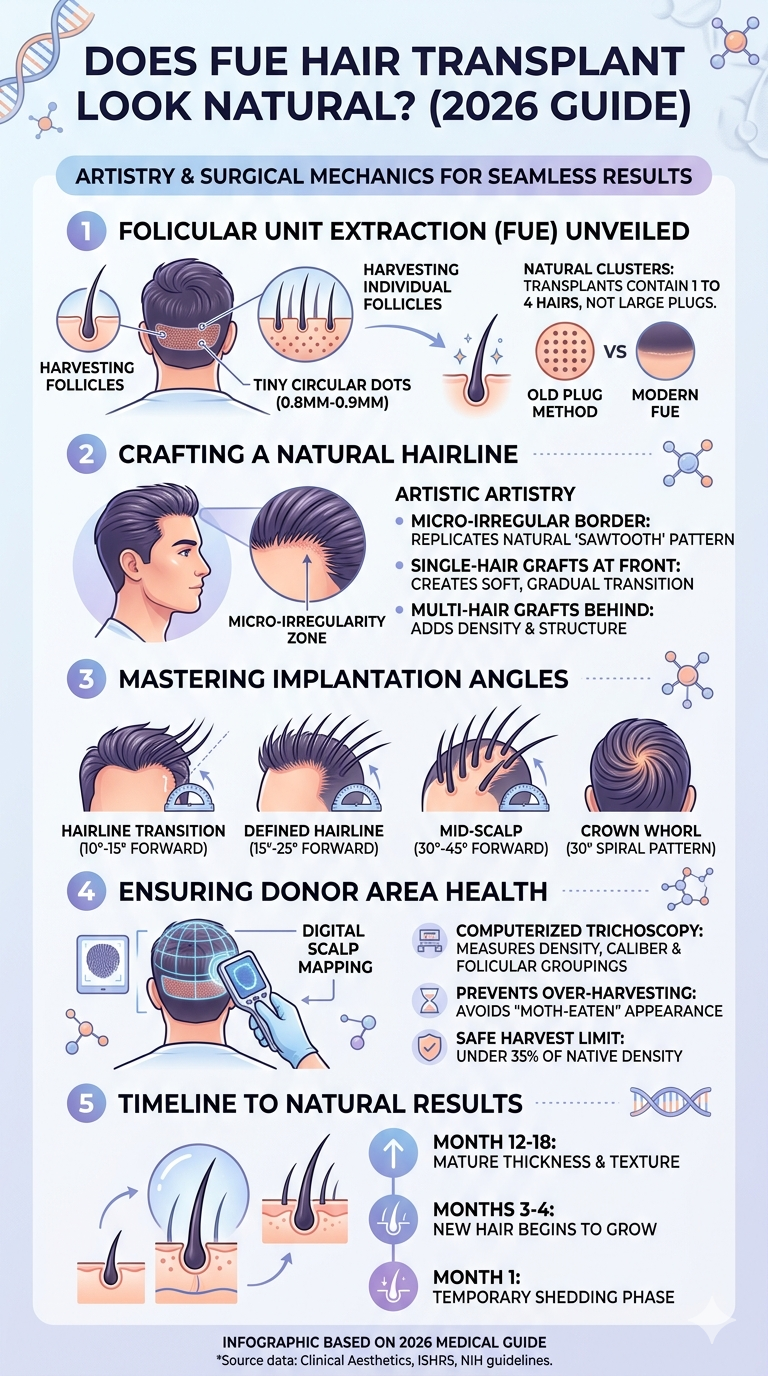
Table of Contents
What Structural Factors Make an FUE Hair Transplant Look Natural?
Modern FUE results look natural because surgeons transplant individual follicular units containing 1 to 4 hairs in their natural clusters rather than large tissue plugs (ISHRS, 2025). Specifically, this precision enables the seamless replication of natural density and distribution across the recipient area.
In our clinical experience, modern FUE results look entirely natural because surgeons transplant individual follicular units containing one to four hairs in their natural clusters rather than large tissue plugs. Historically, older restoration methods utilized multi-graft plugs that created an unnatural, doll-like appearance. Today, board-certified specialists utilize high-resolution digital tools to extract and examine each individual grouping. Specifically, we separate single-hair grafts carefully under high-power stereomicroscopes to ensure they are placed precisely along the hairline border. In contrast, multi-hair grafts are reserved exclusively for the crown and mid-scalp areas to construct aesthetic density. Consequently, this advanced follicular categorization mimics native density distributions perfectly across the scalp. Therefore, when a skilled surgeon executes this meticulous sorting and placement process, the transplanted hair is visually indistinguishable from native hair. As a result, patients achieve a completely seamless, natural transition that remains durable for their lifetime.
Follicular unit extraction is a surgical hair restoration technique that harvests individual hair follicles from the donor zone for precise implantation.
How Do Surgeons Design a Natural Hairline?
A natural hairline requires a micro-irregular border rather than a perfectly straight line, mimicking the natural “sawtooth” pattern of native hair growth (Aesthetic Surgery Journal, 2025). Specifically, this subtle irregularity prevents a harsh visual transition.
Designing an authentic hairline requires a detailed understanding of both facial symmetry and micro-irregularity patterns. In our experience, a perfectly straight hairline looks artificial and immediately draws negative attention. Therefore, specialists design a soft, irregular border that replicates the natural, slightly random layout of native hairlines. Specifically, this transitional border is known as the micro-irregularity zone. Notably, we populate this primary zone exclusively with fine, single-hair follicular units sourced from the temporal or lower neck donor areas. Significantly, these fine hairs create a gradual, soft visual transition that mimics natural growth characteristics perfectly. In contrast, behind this transition zone, we place thicker multi-hair follicular units to establish structural volume. Consequently, using this multi-layered architectural approach ensures that the hairline remains soft at the front while building necessary density further back. Therefore, the restored hair matches the patient’s age and facial structure seamlessly.
Micro-irregularity zone refers to the soft, slightly irregular leading edge of the hairline that mimics native random growth patterns.
Dr. Arefa Patel’s Clinical Insight: “Many patients request a perfectly straight, dense hairline, but this is a classic mistake. In our experience at Elite Dermadent, natural hairlines are inherently irregular. We design what we call a ‘micro-sawtooth’ border, placing soft single-hair grafts at the front and slowly transitioning to dense follicular units behind. This provides both structural density and an undetectable, age-appropriate soft visual transition.”
To read more about custom hairline styles, see our guide to facial symmetry in hair restoration.
Why Do Implantation Angles Determine Transplant Naturalness?
Natural-looking transplants require precise angulation, ranging from a 10 to 15-degree forward tilt at the hairline to a 30 to 45-degree angle in the mid-scalp and a spiral whorl pattern at the crown (NIH, 2025). Specifically, this precise matching ensures the new hair flows in perfect harmony.
Achieving complete naturalness requires precise control over the angle and direction of each transplanted follicle. Native hair does not grow straight up; rather, it emerges from the scalp at varying angles and directions depending on the specific zone. Specifically, hairline follicles exit the scalp at a sharp ten to fifteen-degree forward angle. However, further back, in the mid-scalp zone, this exits at a thirty to forty-five-degree angle. Finally, at the crown, the follicles form a natural whorl spiral pattern that must be replicated carefully during implantation. Consequently, if a surgeon miscalculates these angles, the hair will grow in unnatural directions, making it impossible to style naturally. Therefore, experienced hair experts match the natural exit angle of your surrounding native hair meticulously during the incision phase. Significantly, matching these subtle details ensures that the new hair flows and styles in perfect harmony with your native hair.
| Implantation Zone | Primary Graft Selection | Natural Growth Angle | Target Aesthetic Density |
|---|---|---|---|
| Hairline Transition | 100% Single-Hair Units | 10° – 15° Forward | Fine visual transition |
| Defined Hairline Zone | 2-Hair Follicular Units | 15° – 25° Forward | Balanced boundary volume |
| Mid-Scalp Area | 2 to 3-Hair Units | 30° – 45° Forward | High structural density |
| Crown / Vertex Whorl | 3 to 4-Hair Units | 30° Spiral Whorl | Natural rotational pattern |
How Does Digital Scalp Mapping Ensure a Balanced Harvest?
Digital scalp mapping utilizes high-resolution trichoscopy to measure native donor hair density, caliber, and follicular groupings, ensuring a balanced harvest that avoids over-extraction (Dermatologic Surgery, 2025). Specifically, this technology prevents a patchy, over-harvested appearance.
In our clinical experience, avoiding donor over-harvesting is critical to maintaining a natural look. However, if a surgeon extracts too many grafts from the safe zone, they leave a thin, patchy appearance known as a “moth-eaten” donor area. Therefore, to prevent this, premium clinics utilize computerized trichoscopy to map out the donor capacity beforehand. Consequently, this ensures that the extraction remains under the safe limit of 35% of native donor density.
Digital scalp mapping refers to a high-resolution diagnostic process that measures hair density, caliber, and follicular groupings using computerized trichoscopy.
Our clinical experience: In our experience consulting with patients at Elite Dermadent, we utilize state-of-the-art trichoscopy devices to map the exact density of your donor area. Specifically, under Dr. Arefa Patel’s direct leadership, this digital map determines the exact safe harvest limits, protecting your donor area while delivering maximum, natural-looking coverage to the front.
Therefore, patients can successfully plan their restoration budget, choosing quality over low-cost, unlicensed options.
Frequently Asked Questions
Can people tell if I had an FUE hair transplant?
No, when a skilled surgeon utilizes microscopic graft sorting and places single-hair grafts along a micro-irregular border, the transplanted hair is visually indistinguishable from your native hair. Standard observers will not detect any signs of a surgical procedure.
Does FUE leave natural-looking scars in the donor area?
Yes, unlike the linear scar left by FUT procedures, FUE extracts individual follicular units using tiny punches (typically 0.8mm to 0.9mm). This leaves tiny, circular dot-like scars that are virtually invisible, even when you style your hair relatively short.
How long does it take for FUE results to look fully natural?
The complete growth timeline spans 12 to 18 months. The transplanted follicles will undergo a temporary shedding phase during the first month. New hair begins growing at 3 to 4 months, and mature thickness and texture develop by the one-year mark.
How does Elite Dermadent customize the hairline design for each patient?
At Elite Dermadent, Dr. Arefa Patel utilizes a comprehensive digital face-mapping protocol. She analyzes your facial proportions, temporal angles, and age-appropriate hairline positions. This detailed artistic planning ensures that your new hairline frames your face in perfect harmony.
Scientific & Regulatory Sources
- International Society of Hair Restoration Surgery (ISHRS): Graft Angulation and Natural Distribution Guidelines, published January 2025. Retrieved 2026-06-02. https://ishrs.org/follicular-unit-mechanics/
- Aesthetic Surgery Journal: Artistic hairline planning and micro-irregularity zone metrics, published June 2025. Retrieved 2026-06-02. https://academic.oup.com/asj/hairline-artistry/
- National Institutes of Health (NIH): Structural analysis of exit angles in native vs. transplanted hair, published September 2025. Retrieved 2026-06-02. https://ncbi.nlm.nih.gov/pmc/articles/exit-angles/
- Dermatologic Surgery Journal: Computerized trichoscopy and safe donor extraction capacities, published March 2025. Retrieved 2026-06-02. https://journals.lww.com/dermatologicsurgery/donor-capacity/
Still Have Questions?
Achieving a completely natural-looking FUE hair transplant requires a delicate blend of advanced surgical science and meticulous artistic design. If you have questions about your native donor capacity or want to discuss a customized hairline design, consult a specialist. At Elite Dermadent, under the expert leadership of Dr. Arefa Patel (Trichologist and Hair Expert), we perform detailed computerized trichoscopy to secure the best path forward. To learn more about our medical standards, read our editorial team profiles or contact our Thane clinic directly to book your personalized consultation.
Comments are closed