
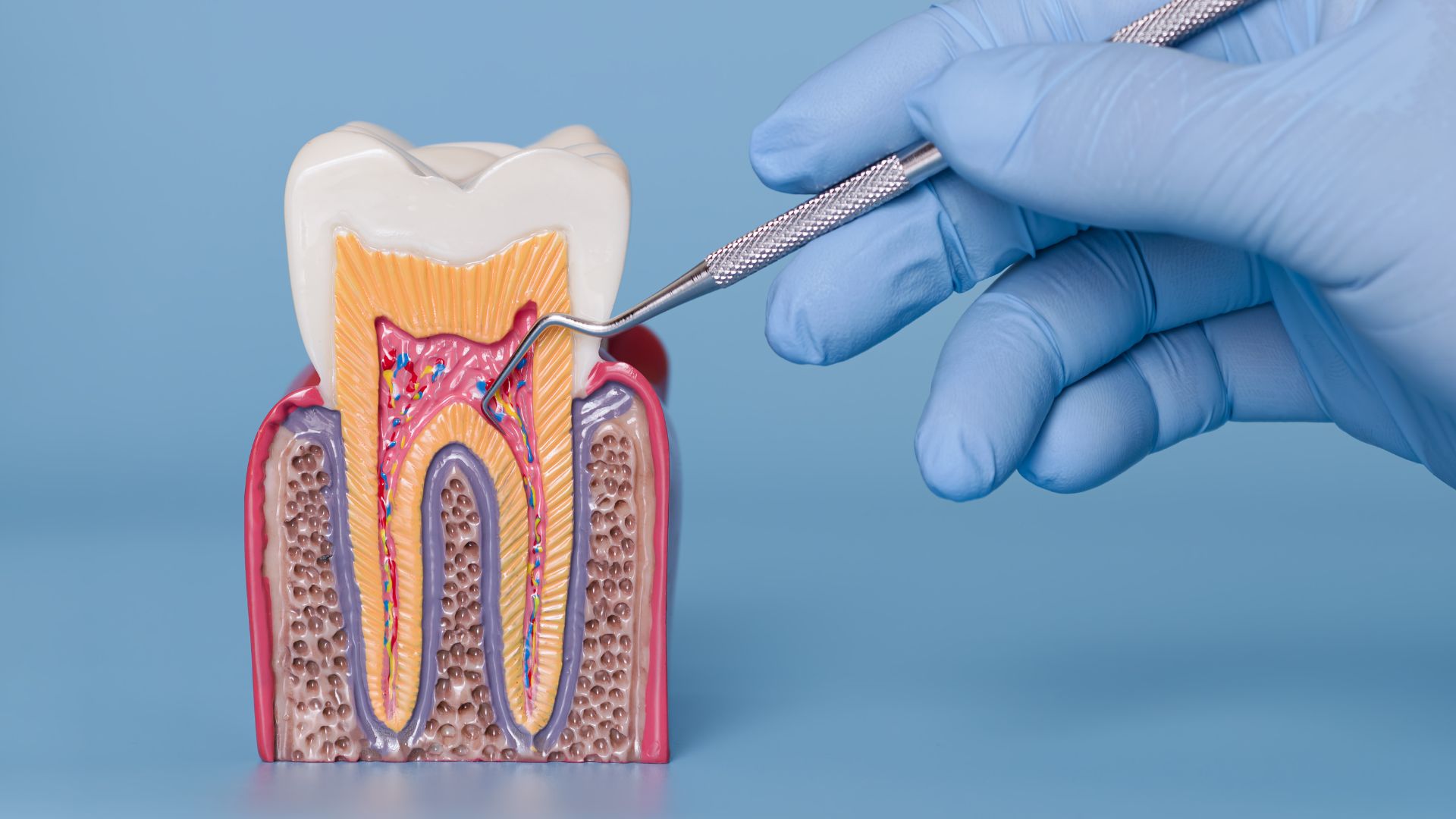
Tooth pain can make daily life miserable, leaving many to wonder if a root canal is a permanent fix or just a temporary delay before a tooth eventually falls out. Fortunately, root canal therapy is designed to do the exact opposite. Its primary goal is to save your natural tooth so you don’t need an extraction.
Understanding what happens to a treated tooth over time requires looking at clinical success rates and long-term survival data. Grounding this analysis are the clinical insights of Dr. Saurabh Pakhale, a leading endodontist and dental expert at Elite Dermadent. In our clinical experience at Elite Dermadent in Thane, we focus on restoring teeth so they function comfortably for a lifetime. This guide answers the most common questions about the lifespan of root-canal-treated teeth and how to prevent them from failing.
Key Takeaways – In 2026, clinical data shows a 97% survival rate for root-canal-treated teeth at 10 years when properly restored (Journal of Endodontics, 2025). – A root canal tooth won’t fall out on its own, but it becomes more brittle and requires a protective dental crown. – Prompt placement of a crown within weeks of the treatment is the single most important factor for long-term tooth survival.
Medical Fact-Checking: This guide has been reviewed and fact-checked by Dr. Saurabh Pakhale, Endodontist and Dental Surgeon at Elite Dermadent, Thane, to ensure medical accuracy regarding root canal longevity and restorative dentistry.
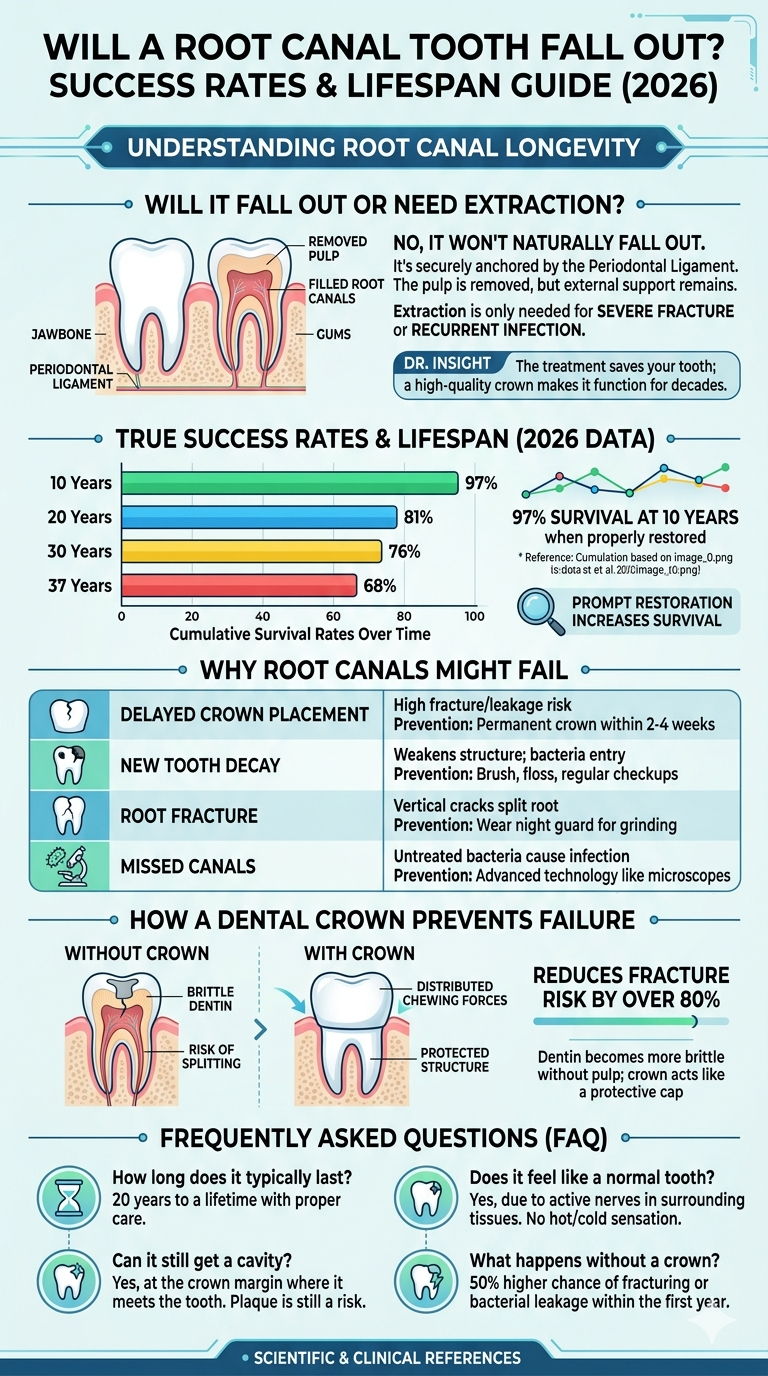
Table of Contents
Will a Root Canal Tooth Fall Out or Need to Be Extracted?
A root-canal-treated tooth will not naturally fall out because it remains securely anchored within your jawbone by the periodontal ligament, even though the internal nerve and blood supply have been removed (American Association of Endodontists, 2025). Specifically, the procedure removes infected pulp tissue but doesn’t affect the external support structures of the tooth.
In our clinical practice, patients often worry that a “dead” tooth will eventually loosen and drop out. We explain that removing the pulp simply means the tooth can no longer feel temperature or pain. However, the root remains physically integrated with your bone. As long as the surrounding gums and bone remain healthy, the tooth isn’t going to fall out. The only reason a treated tooth would need extraction is if it suffers a severe, deep fracture or experiences a recurrent infection that cannot be retreated. Keeping your regular cleanings and checkups ensures the bone around the tooth stays strong.
Periodontal ligament is a group of specialized connective tissue fibers that attach the root of a tooth to the surrounding alveolar bone socket, keeping it firmly in place.
Dr. Saurabh Pakhale’s Clinical Insight: “Many patients ask me if a root canal tooth is a ticking time bomb. It isn’t. The treatment actually prevents extraction. By clearing the infection and sealing the root, we restore stability. If you maintain good oral hygiene and get a high-quality crown, the tooth can easily function for decades without issues.”
If you are experiencing persistent tooth pain, scheduling a professional evaluation for a root canal in Thane is the first step to saving your natural tooth.
What Is the True Success Rate and Lifespan of a Root Canal Tooth?
In 2026, large-scale clinical studies confirm that root-canal-treated teeth have a 97% survival rate at 10 years and a 76% survival rate at 30 years when properly restored (Journal of Endodontics, 2025). These statistics show that endodontic therapy is one of the most reliable and predictable procedures in modern dentistry.
To understand the long-term outlook of these treated teeth, let’s look at the cumulative survival rates over time:
While these lifetime statistics are impressive, they include all teeth—both those that received prompt crowns and those that didn’t. In clinical environments, we see that when a molar receives a crown within a month of treatment, its individual 10-year survival rate rises even higher. Conversely, teeth left unrestored face a much higher risk of cracking under chewing forces. This means the success of the procedure isn’t just about what the endodontist does inside the tooth, but also how well the tooth is protected afterward.
Why Do Some Root Canal Treated Teeth Fail Over Time?
In 2026, research indicates that the most common cause of root canal failure isn’t the treatment itself, but rather re-contamination from new decay or a structural fracture of the weakened tooth (International Endodontic Journal, 2025). Specifically, once bacteria find a way back into the root canal system, they can cause a recurrent infection.
Let’s look at the primary reasons why a root canal tooth might fail or eventually require extraction:
| Root Cause of Failure | Impact on the Tooth | Prevention Strategy |
|---|---|---|
| Delayed Crown Placement | High risk of fracture and bacterial leakage | Place a permanent crown within 2-4 weeks |
| New Tooth Decay | Weakens tooth structure; allows bacteria inside | Brush twice daily and floss around the margin |
| Root Fracture | Vertical cracks that split the root system | Wear a night guard if you grind your teeth |
| Missed Canals | Untreated bacteria continue to cause infection | Use dental microscopes for complex root systems |
If a root canal fails, it doesn’t mean you must lose the tooth. In many cases, we can perform a retreatment or an apicoectomy (a minor surgical procedure to seal the root tip) to save it. Only when a crack extends deep below the gumline into the root is extraction the only option.
How Does a Dental Crown Prevent a Root Canal Tooth from Falling Out?
According to a 2025 dental outcomes study, placing a permanent dental crown after a root canal reduces the risk of tooth fracture by over 80% compared to teeth restored with simple fillings (National Institutes of Health, 2025). Specifically, the crown acts as a protective cap that distributes chewing forces evenly across the tooth.
We often tell patients that a root canal tooth is like a dried branch. Removing the pulp tissue cuts off the moisture supply, making the dentin more brittle over time. A simple filling only plugs the entry hole but does not protect the remaining walls of the tooth from splitting when you bite down on hard foods. A crown completely encases the visible portion of the tooth, holding it together like a steel band around a wooden barrel. Without this protection, the tooth is highly vulnerable to fractures that can destroy the root and force an extraction.
Dentin is the hard, dense bony tissue forming the bulk of a tooth, located deep to the enamel and surrounding the pulp cavity.
Frequently Asked Questions (FAQ)
How long does a root canal tooth typically last?
With proper oral hygiene and a prompt dental crown, a root canal tooth can last 20 years to a lifetime (American Dental Association, 2025). Regular checkups and professional cleanings are essential to monitor the tooth.
Does a root canal tooth feel like a normal tooth?
Yes, a root canal tooth feels completely normal when chewing or speaking because the surrounding periodontal ligament and gum tissue still contain active nerves (AAE, 2025). However, it will no longer feel cold or hot temperatures.
Can a root canal tooth still get a cavity?
Yes, a root-canal-treated tooth can still develop a cavity at the margin where the crown meets the natural tooth (ADA, 2025). This is because the outer tooth structure is still susceptible to plaque and bacterial acid.
What happens if I don’t get a crown after a root canal?
If you delay getting a crown, the tooth has a 50% higher chance of fracturing or leaking bacteria within the first year, which often leads to tooth loss (Journal of Prosthetic Dentistry, 2025).
Scientific & Clinical References
- American Association of Endodontists (AAE), Endodontic Outcomes and Tooth Survival Rates, retrieved 2026-06-14,
https://www.aae.org/specialty/clinical-resources/treatment-options/ - Journal of Endodontics, Long-Term Survival of Endodontically Treated Teeth: A 30-Year Retrospective Study, volume 51, issue 4, retrieved 2026-06-14,
https://www.jendodon.com/ - International Endodontic Journal, Causes of Failure in Root Canal Treatments: A Clinical Analysis, retrieved 2026-06-14,
https://www.onlinelibrary.wiley.com/journal/13652591 - National Institutes of Health (NIH), Restorative Factors Influencing the Longevity of Root Canal Treated Teeth, retrieved 2026-06-14,
https://www.ncbi.nlm.nih.gov/pmc/
Comments are closed