
If your dentist recently informed you that you need endodontic treatment—or if you are dealing with persistent toothache and sensitivity—you might wonder: why root canal is done, and what makes it preferable to simply pulling the tooth out?
A root canal is done for one vital reason: to save a severely infected, inflamed, or decayed natural tooth from being extracted. When bacterial decay, cracks, or trauma reach deep inside the tooth’s living pulp chamber—which houses delicate blood vessels, connective tissues, and sensory nerves—the pulp becomes irreversibly inflamed or necrotic (dead). Because the tooth cannot heal an internal infection on its own, a root canal removes the diseased tissue, disinfects the microscopic root canals, hermetically seals them, and preserves the natural tooth structure for decades of pain-free chewing.
Key Takeaways: Why a Root Canal Is Essential
- Primary Mission: Tooth Preservation: A root canal is the only conservative dental procedure that can eliminate deep bacterial infections while keeping your natural tooth intact.
- Leading Clinical Causes: Deep untreated cavities reaching the pulp, fractured or cracked tooth roots, repeated extensive fillings, and traumatic sports injuries.
- Superior to Extraction: Keeping your natural tooth root maintains your jawbone density, natural biting sensation, and facial contour, avoiding the high costs and surgery associated with dental implants or bridges.
- Dangers of Postponing: Ignoring an infected tooth allows bacteria to erode the jawbone, forming an acute abscess that can spread into the facial spaces, requiring emergency hospitalization.
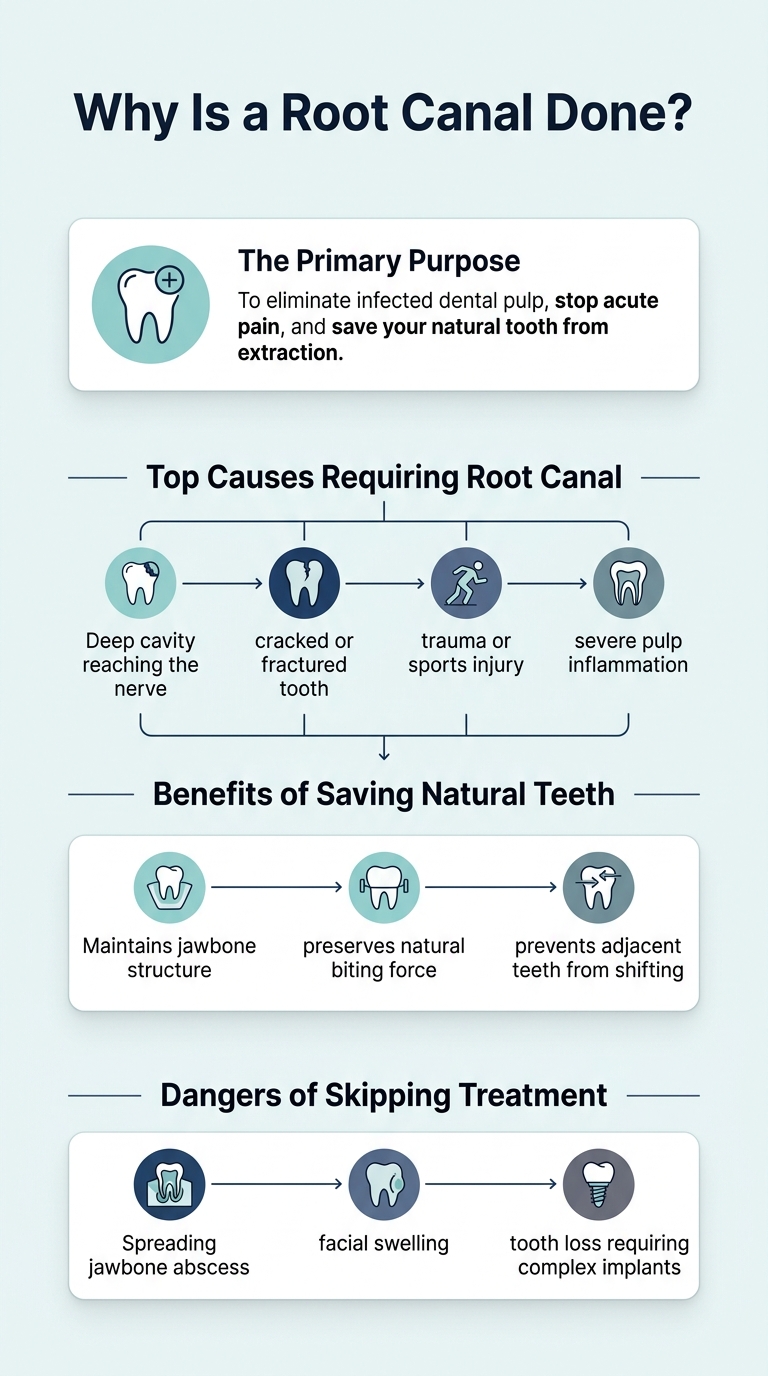
Table of Contents
- The Anatomy of an Infected Tooth: Why It Can’t Heal Itself
- Top 5 Clinical Reasons Why a Root Canal Is Done
- Root Canal vs. Extraction: Comparison Table
- What Actually Happens During a Root Canal Procedure?
- The Severe Health Risks of Delaying Treatment
- What If a Treated Tooth Develops Problems Later?
- Painless, Expert Endodontics at Elite Dermadent
- Frequently Asked Questions
The Anatomy of an Infected Tooth: Why It Can’t Heal Itself
To understand why root canal is done, it helps to look at the three primary layers of a tooth:
- Enamel: The hard, mineralized outer white shell that protects against daily chewing forces.
- Dentin: A softer, bone-like layer beneath enamel containing microscopic fluid-filled tubules.
- Dental Pulp: The soft internal chamber extending through the roots into the jawbone, housing sensory nerves, capillaries, and immune cells.
When you cut your skin or break a bone, your body delivers an influx of blood, white blood cells, and platelets to heal the injury. However, the dental pulp is tightly encased within rigid, unyielding dentin walls. When bacteria breach the pulp, the resulting inflammatory swelling increases internal pressure, compressing the tiny capillaries at the root tip. This cuts off the pulp’s blood supply, causing the nerve tissue to die (pulpal necrosis). Once the nerve dies, the tooth becomes a hollow, oxygen-depleted reservoir where anaerobic bacteria thrive completely shielded from your body’s immune system. Only a dental root canal can mechanically clear and sterilize this space.
Top 5 Clinical Reasons Why a Root Canal Is Done
Endodontists and general dental surgeons perform root canal therapy to resolve specific clinical conditions:
- Extensive Dental Cavities (Deep Caries):
When a cavity is ignored, bacterial acids dissolve enamel and dentin until they breach the pulp ceiling. The resulting bacterial invasion triggers irreversible pulpitis—causing acute, throbbing toothaches that worsen with temperature changes or when lying flat.
- Cracked, Chipped, or Fractured Teeth:
Biting into a hard food or chewing ice can create a microscopic hairline fracture in a tooth. These cracks flex under biting pressure, allowing saliva, food particles, and oral bacteria to seep directly into the pulp chamber.
- Blunt Dental Trauma (Accidents and Sports Injuries):
A blow to the face or mouth from an athletic collision or fall can sever the microscopic blood vessels supplying the tooth at the root apex. Even if the tooth doesn’t appear cracked or broken on the outside, the severed blood supply causes the internal pulp to die silently over subsequent months.
- Repeated Dental Procedures on the Same Tooth:
A tooth that has undergone multiple extensive fillings, large composite restorations, or crown preparations can experience thermal and mechanical stress. Over time, the cumulative insult causes the pulp to become chronically inflamed, requiring endodontic relief.
- Periapical Abscess (Infection at the Root Tip):
When bacteria consume the pulp, they exit through the microscopic opening at the root tip (the apical foramen) into the surrounding jawbone. The resulting immune battle forms an expanding pocket of pus—an acute periapical abscess—which causes severe pain, bone loss, and gum swelling.
Root Canal vs. Extraction: Comparison Table
Patients often ask whether pulling the tooth is faster or cheaper than getting a root canal. The table below outlines why preserving your natural tooth is overwhelmingly preferred by dental specialists:
| Evaluation Factor | Root Canal Treatment (Tooth Preservation) | Tooth Extraction & Replacement |
|---|---|---|
| Preservation of Natural Jawbone | 100% Preserved: Root stays in bone, preventing alveolar bone resorption | Bone Resorption: Jawbone shrinks by 25%–40% in width within the first year unless grafted |
| Natural Chewing Sensation | Full Proprioception: Natural periodontal ligaments give normal biting force feedback | Reduced sensory feedback with artificial dental implants or removable bridges |
| Impact on Adjacent Teeth | Zero impact; neighboring teeth stay locked in their natural alignment | Adjacent teeth tilt into gap; opposing teeth over-erupt, causing bite collapse |
| Total Treatment Time | 1 to 2 appointments (usually completed in 1–2 weeks) | 4 to 9 months for surgical implant integration and healing |
| Long-Term Cost | Highly cost-effective (root canal + crown restoration) | Significantly more expensive (extraction + bone graft + implant screw + abutment + crown) |
What Actually Happens During a Root Canal Procedure?
Modern endodontic treatment is routine, gentle, and virtually painless thanks to contemporary micro-techniques:
- Profound Local Anesthesia: The dentist applies high-potency topical numbing gel followed by gentle local anesthetic, ensuring you do not feel any discomfort.
- Sterile Rubber Dam Placement: A small protective sheet isolates the tooth, keeping it clean, dry, and shielded from saliva and bacteria throughout the procedure.
- Pulp Extirpation & Canal Shaping: The dentist creates a tiny access hole in the chewing surface and uses flexible nickel-titanium rotary instruments to gently remove the infected pulp tissue.
- Ultrasonic Disinfection: Antimicrobial irrigants are activated using ultrasonic frequencies to flush out microscopic debris and eliminate bacteria hiding deep within dentinal tubules.
- Biocompatible Obturation (Sealing): The sterile root canals are filled with a natural, rubber-like biocompatible material called gutta-percha combined with bioceramic sealers to create an airtight seal.
- Protective Crown Placement: Because a tooth without living pulp can become slightly more brittle over time, a precision-crafted porcelain or zirconia crown is placed to restore full structural strength and natural aesthetics.
The Severe Health Risks of Delaying Treatment
Some patients postpone a root canal when temporary pain subsidies, assuming the problem solved itself. In reality, the temporary cessation of pain simply means the sensory nerve has completely died—the bacteria remain active and continue multiplying silently.
Delaying treatment leads to serious clinical hazards:
- Expanding Jawbone Abscesses: Infection dissolves the surrounding bone structure, destabilizing neighboring teeth.
- Facial Cellulitis: Bacteria can breach the jawbone and spread into facial soft tissues, causing severe cheek, eye, or neck swelling.
- Ludwig’s Angina & Airway Compromise: Infections originating in lower molars can spread to the floor of the mouth and throat, obstructing breathing—a life-threatening medical emergency.
- Unavoidable Tooth Loss: What could have been saved with a simple root canal becomes non-restorable, forcing extraction.
What If a Treated Tooth Develops Problems Later?
While primary root canal therapy boasts a 90%–95%+ success rate, complex anatomy (such as curved roots or hidden accessory canals) or new decay beneath an old crown can sometimes lead to secondary infection years later.
When this happens, the tooth does not need to be lost. Specialized root canal retreatment in Thane allows a skilled endodontist to reopen the tooth under high magnification, clear the old filling material, thoroughly disinfect missed canals, and hermetically reseal the tooth to give your natural smile a long-lasting second chance.
Painless, Expert Endodontics at Elite Dermadent
At Elite Dermadent, we believe root canal therapy should be a completely comfortable, stress-free experience that saves your natural smile. Our endodontic treatments are guided by Dr. Saurabh Pakhale, an accomplished dental surgeon renowned for his conservative, precision-focused approach.
Dr. Pakhale utilizes computerized electronic apex locators, flexible rotary files, and high-magnification optical loupes to achieve microscopic precision with minimal treatment time. Whether you require relief from acute toothache or are seeking advanced root canal treatment in Thane, our team ensures your procedure is painless, predictable, and protective of your long-term dental health.
Frequently Asked Questions
Is a root canal painful?
No. With modern local anesthetics and advanced micro-instruments, a root canal is no more uncomfortable than getting a standard dental filling. The procedure actually eliminates the excruciating pain caused by the infected pulp.
Can antibiotics cure an infected tooth instead of a root canal?
No. Antibiotics travel through your bloodstream, but because an infected dental pulp has lost its blood supply, antibiotics cannot reach or sterilize bacteria inside the tooth. Antibiotics offer only temporary relief; physical removal of the infected pulp via a root canal is mandatory.
How long does a root canal take?
Most modern root canal treatments are completed in a single appointment lasting approximately 45 to 60 minutes. Complex molars with severe infection may occasionally require two visits to ensure thorough disinfection.
How long does a tooth last after a root canal?
With prompt placement of a high-quality permanent crown, daily flossing, and regular 6-month dental cleanings, a root-canaled tooth can last 15 to 20 years—and often for the rest of your life.
What happens if I choose not to get a root canal?
Without treatment, the bacterial infection will spread from the tooth into your jawbone, forming an acute abscess, causing facial swelling, and destroying the bone holding the tooth in place. Eventually, the tooth will fracture or need to be surgically extracted.
No responses yet