
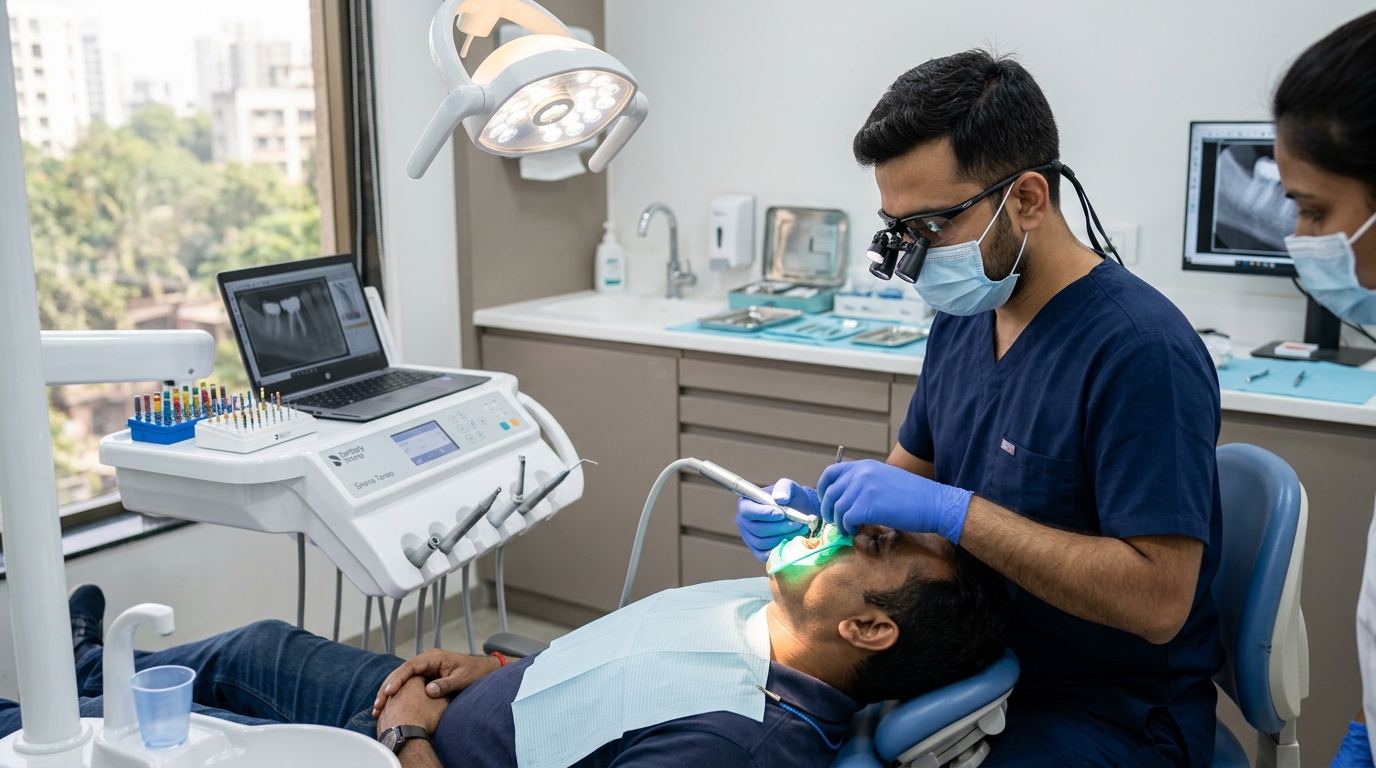
For many individuals facing a severe toothache, anxiety quickly takes over with one overarching question: why root canal treatment is painful? Pop culture, outdated anecdotes, and dental fear have cemented the idea that getting a root canal is an agonizing ordeal. However, modern endodontic science paints a completely different picture: root canal treatment itself is not painful—it is the procedure that stops severe pain. The agonizing pain patients experience originates from the untreated bacterial infection crushing nerve endings inside the tooth. Thanks to computer-guided local anesthesia and modern rotary endodontics, having a root canal today is virtually painless and no more uncomfortable than getting a routine dental filling.
Key Takeaways:
- The Infection Hurts, Not the Treatment: Bacterial decay inside an enclosed tooth builds extreme fluid pressure on the nerve, causing excruciating throbbing toothaches before treatment.
- 100% Numb Throughout: Advanced, pH-buffered local anesthetics completely block nerve conduction, ensuring zero sharp pain during the entire appointment.
- Rotary Endodontic Precision: Flexible nickel-titanium files clean and smooth curved canals smoothly without manual scraping or vibrations.
- Subsides Rapidly Post-Op: Any mild tenderness in the surrounding jaw ligaments disappears within 24 to 48 hours with standard over-the-counter pain relievers.
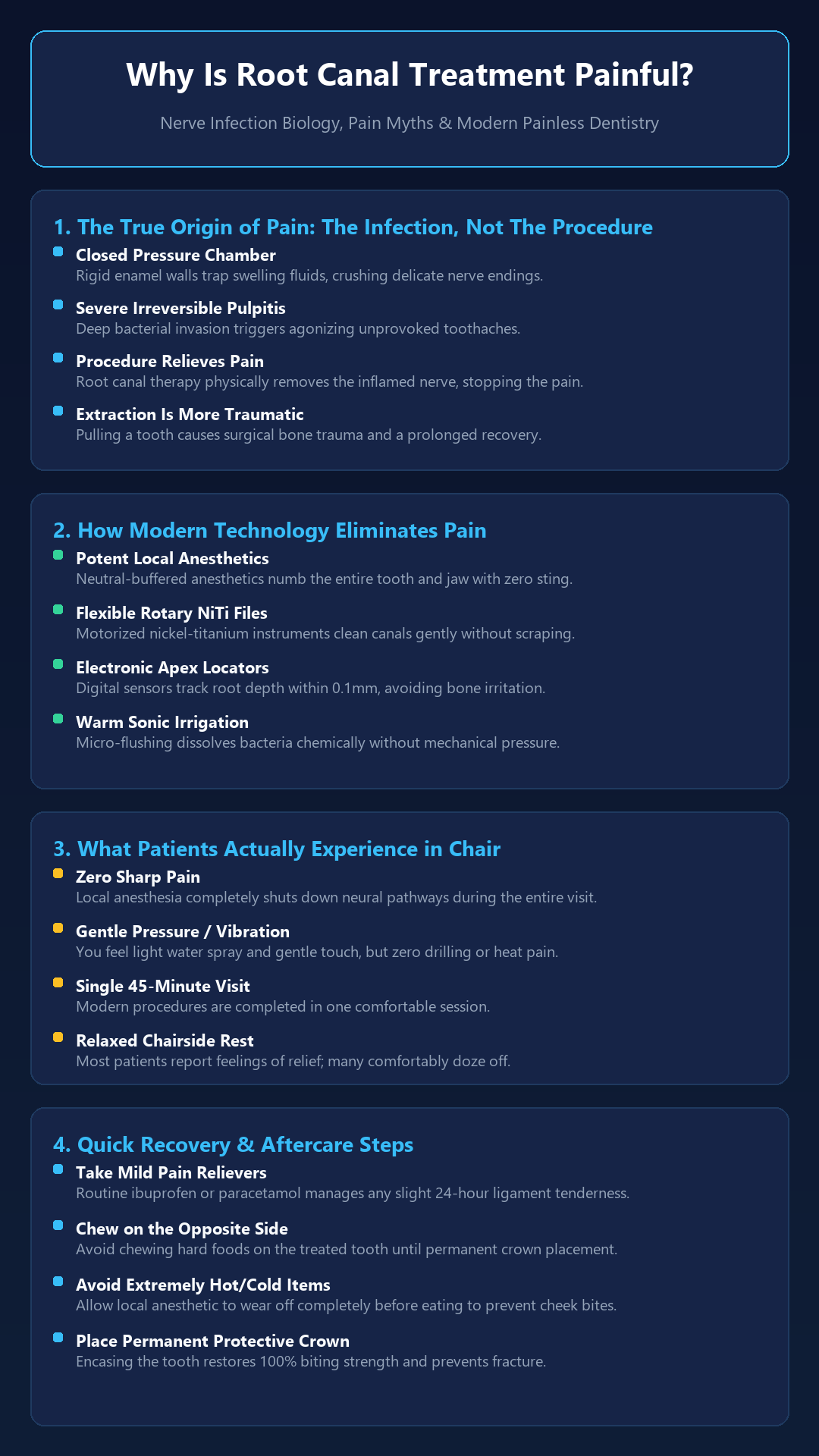
Table of Contents
- The Root of the Myth: Why People Believe Root Canals Are Painful
- The Biological Source of Severe Pain: Pulpitis and Pressure
- How Modern Endodontics Guarantees Painless Treatment
- What Does Getting a Modern Root Canal Actually Feel Like?
- What to Expect After the Numbness Fades: Post-Op Care
- Root Canal vs. Tooth Extraction: Which Truly Hurts More?
- Painless, Gentle Root Canals with Dr. Saurabh Pakhale
- Frequently Asked Questions (FAQs)
The Root of the Myth: Why People Believe Root Canals Are Painful
The widespread belief that root canals are painful dates back several decades. In the early 20th century, before modern dental anesthetics, digital apex locators, and motorized instruments were developed, treating an infected root was indeed slow and uncomfortable. Patients had to endure multiple lengthy sessions with less potent numbing agents.
Today, endodontic technology has revolutionized patient comfort. Extensive clinical studies by the American Association of Endodontists (AAE) show that over 85% of patients who undergo root canal therapy report feeling zero pain during the procedure. In fact, most describe the experience as a profound relief from the pounding toothache that brought them to the clinic in the first place.
The Biological Source of Severe Pain: Pulpitis and Pressure
To understand why the infection is painful while the treatment provides relief, consider the tooth’s unique anatomy:
- Enclosed Rigid Vault: The dental pulp (which houses nerves and blood supply) is encased inside rock-hard enamel and dentin. Unlike soft skin that can swell outward when inflamed, a tooth cannot expand.
- Intense Intrapulpal Pressure: When bacteria from a deep cavity penetrate into the pulp chamber, the body rushes immune cells and fluid to fight the invaders. With nowhere for fluids to escape, internal pressure crushes nerve endings.
- Extreme Throbbing & Thermal Shocks: Hot foods expand trapped gases, intensifying the throbbing ache, while cold triggers sharp nerve spasms.
- Periapical Extension: If left untreated, bacteria exit the root apex and erode surrounding bone, causing severe pain even when lightly touching or chewing on the tooth.
How Modern Endodontics Guarantees Painless Treatment
Today’s dental practices employ advanced pain-management protocols that eliminate discomfort at every stage:
| Technology | Clinical Mechanism | Patient Experience |
|---|---|---|
| Buffered Local Anesthetics | Neutralized pH anesthetic administered via ultra-fine micro-needles | Zero injection sting; rapid, deep, 100% pulpal numbness |
| Motorized Rotary NiTi Files | Flexible nickel-titanium instruments gliding through curved roots | Smooth, quiet shaping in minutes with zero vibration or scraping |
| Electronic Apex Locators | Micro-current sensors calculating root depth to within 0.1 mm | Prevents instruments from irritating bone; stops post-op soreness |
| Rubber Dam Isolation | Sterile barrier isolating the treated tooth from saliva | Prevents bad tastes or swallowed liquids; ensures pristine hygiene |
What Does Getting a Modern Root Canal Actually Feel Like?
When you sit in the dental chair for a root canal, here is what you will actually experience:
- Topical Numbing Gel: A flavored numbing gel is applied to the gum so you barely feel the anesthetic micro-injection.
- Total Numbness: Within two minutes, the entire quadrant becomes thoroughly numb. You will test for total numbness before any procedure begins.
- Gentle Vibration & Water Spray: You will feel light vibrations from the handpiece and cooling water spray, but zero pain, heat, or cutting sensations.
- Quick Single-Sitting Relief: Most modern root canals are completed in 30 to 45 minutes, allowing many patients to comfortably listen to music or doze off during the session.
What to Expect After the Numbness Fades: Post-Op Care
Once local anesthesia wears off after 2 to 3 hours, the acute infection pain is gone. You may notice mild tenderness when biting down for 24 to 48 hours, caused by temporary inflammation in the periodontal ligament that held the infected tooth in the socket.
This mild soreness is easily controlled with simple over-the-counter painkillers like ibuprofen or paracetamol. Once a protective permanent crown is bonded, the tooth is fully restored for lifetime chewing function. In rare situations where complex canal anatomy or secondary decay causes persistent discomfort, specialized root canal retreatment can reopen, clean, and reseal the canals cleanly.
Root Canal vs. Tooth Extraction: Which Truly Hurts More?
Some fearful patients wonder if extracting the tooth is faster and less painful. In truth, tooth extraction is a surgical procedure that tears periodontal ligaments and creates an open bone socket. Post-extraction recovery typically involves more bleeding, swelling, dietary restrictions, and potential complications like painful dry sockets.
Moreover, pulling a tooth causes permanent jawbone loss and shifting of adjacent teeth, necessitating expensive dental implants or bridges. A root canal saves your biological tooth root, keeps jawbone healthy, and involves a much smoother, gentler recovery.
Painless, Gentle Root Canals with Dr. Saurabh Pakhale
Never let fear of pain stop you from saving your natural smile. Led by Dr. Saurabh Pakhale, Elite Dermadent is renowned for providing painless, compassionate, and microscopic-precision root canal treatment in Thane.
Our patient-first approach, soothing clinical environment, and state-of-the-art rotary technology ensure your experience is comfortable from start to finish.
Frequently Asked Questions (FAQs)
1. Does a root canal hurt during the treatment?
No. Thanks to modern local anesthetics, the tooth and surrounding nerves are completely numb during the procedure. You will feel zero sharp pain or drilling discomfort. The sensation is comparable to having a routine filling placed.
2. Why do people say root canals are painful?
People associate root canals with pain because of the severe, throbbing toothache that occurs before receiving treatment. Furthermore, dental practices decades ago lacked modern rotary instruments and buffered anesthetics. Today, the procedure permanently stops the pain.
3. What should I do if I feel pain during a root canal?
If you experience any sensitivity at all during the procedure, simply raise your hand. Your dentist can administer additional local anesthetic immediately, ensuring you remain completely comfortable throughout the session.
4. How long does soreness last after a root canal?
Mild tenderness upon biting down typically lasts for 24 to 48 hours as the surrounding periodontal tissues heal. This is normal and can be easily managed with routine pain relievers like ibuprofen or paracetamol.
5. Can a root canal be completed in a single painless visit?
Yes. Most root canals today are completed in a single 30 to 45 minute visit using rotary nickel-titanium instruments and digital apex locators, eliminating the need for multiple stressful dental visits.
No responses yet