
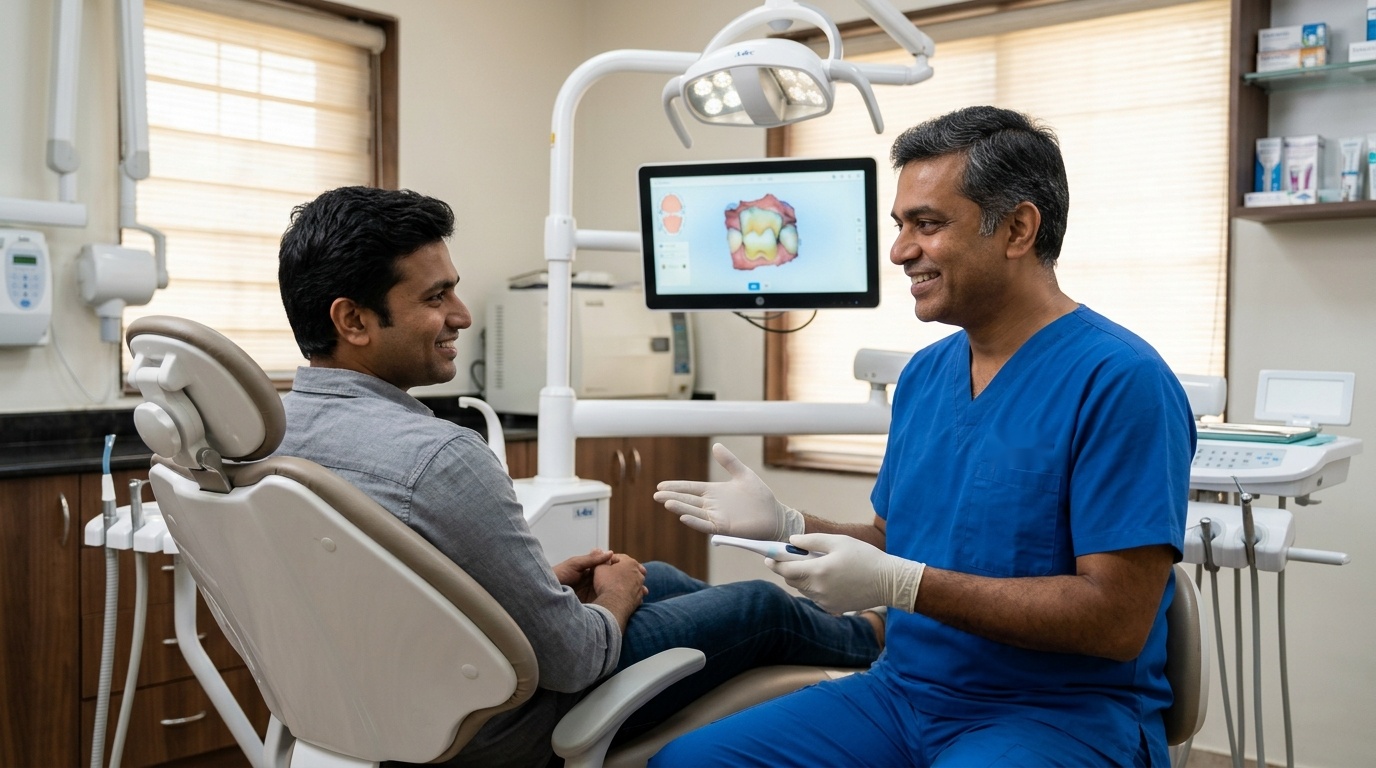
Few medical phrases provoke as much apprehension as root canal therapy, leading nervous patients to wonder: why is a root canal considered so painful? The clinical reality often surprises people: a root canal treatment itself is not painful—it is the procedure that relieves agonizing pain. The excruciating pain people dread actually stems from the untreated bacterial infection and extreme fluid pressure building inside the tooth’s closed pulp chamber. Thanks to modern buffered local anesthetics, rotary endodontics, and electronic apex locators, receiving a root canal today is virtually painless and no more uncomfortable than getting a routine dental filling.
Key Takeaways:
- Infection Causes the Pain, Not the Dentist: Bacterial pulpitis builds intense fluid pressure inside unyielding enamel walls, crushing internal nerve endings and triggering throbbing toothaches.
- 100% Numb Throughout Treatment: Modern computerized local anesthesia neutralizes nerve impulses completely before any dental instrumentation begins.
- Rotary Precision Replaces Scraping: Flexible nickel-titanium (NiTi) motorized files glide through curved root canals quietly in minutes without vibration or heat.
- Prompt Recovery: Over 85% of patients describe modern root canals as completely painless, experiencing only mild, easily manageable 24-hour ligament tenderness afterward.
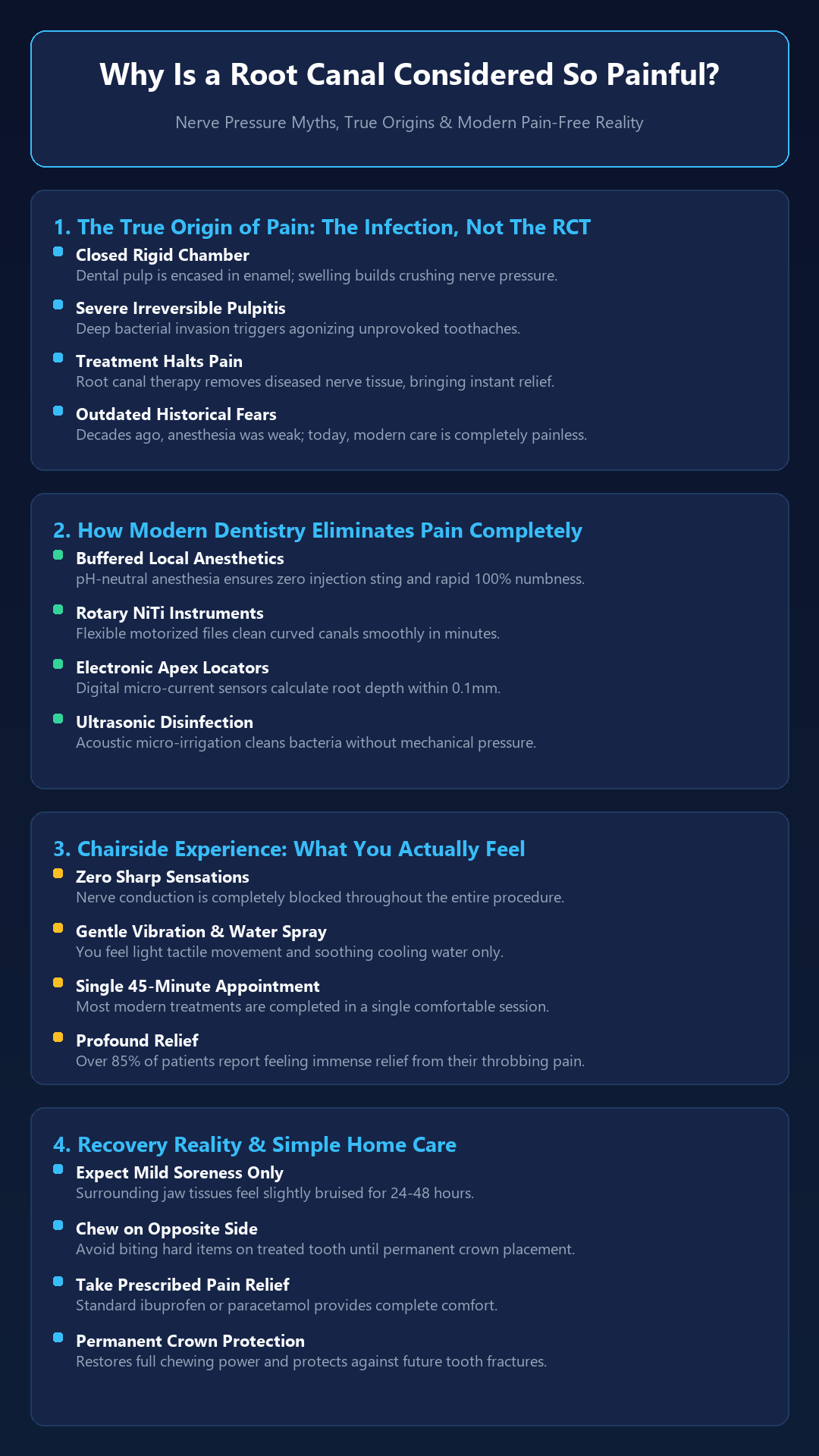
Table of Contents
- Root Canal Pain: The Historical Legend vs. Modern Reality
- The Biological Source of Agony: Why Untreated Teeth Throbbing
- 4 Technological Pillars of Modern Pain-Free Endodontics
- What Does Having a Root Canal Actually Feel Like Today?
- What to Expect After the Numbness Fades: Post-Op Care
- Root Canal vs. Extraction: Which Procedure Involves More Pain?
- Compassionate, Painless Care with Dr. Saurabh Pakhale
- Frequently Asked Questions (FAQs)
Root Canal Pain: The Historical Legend vs. Modern Reality
The widespread stereotype that root canals are agonizing developed decades ago. In the mid-20th century, dental anesthetics were less potent, needles were thicker, and endodontists used manual steel files that required forceful hand-scraping inside delicate roots. Multiple grueling appointments were often required to finish one tooth.
Today, the landscape of endodontics has transformed completely. Surveys conducted by the American Association of Endodontists (AAE) demonstrate that patients who have actually undergone modern root canal therapy are six times more likely to rate the procedure as completely painless than those who have a tooth pulled. The treatment simply cleans away necrotic nerve tissue that is actively sending distress signals to the brain.
The Biological Source of Agony: Why Untreated Teeth Throbbing
To understand why the infection is painful while the procedure provides relief, consider the tooth’s internal anatomy:
- Enclosed Rigid Vault: The living dental pulp (containing nerves, arterioles, and connective tissue) is trapped inside hard enamel and dentin walls that cannot stretch or swell.
- Crushing Intrapulpal Pressure: When deep decay breaches the pulp space, the immune system rushes blood and inflammatory fluids to the area. Because the tooth cannot expand, internal pressure skyrockets, crushing nerve fibers against the rigid walls.
- Thermal Hypersensitivity: Hot food or coffee causes trapped gases to expand, worsening the pressure, while cold fluids provoke acute nerve shocks.
- Periapical Spread: If neglected, bacteria migrate past the root tip into the jawbone, triggering acute bone resorption and severe pain when touching or biting.
4 Technological Pillars of Modern Pain-Free Endodontics
At advanced dental centers, four key clinical innovations guarantee zero procedural pain:
| Modern Technology | Clinical Mechanism | Patient Experience |
|---|---|---|
| Buffered Local Anesthetics | pH-neutralized delivery administered through ultra-fine micro-needles | Zero injection sting; instant, deep pulpal numbness |
| Rotary Nickel-Titanium (NiTi) Files | Flexible motorized instruments navigating curved roots smoothly | Quiet, vibration-free canal shaping in 15–20 minutes |
| Electronic Apex Locators | Acoustic micro-current sensors calculating exact canal length to 0.1 mm | Prevents instruments from poking bone; avoids post-op soreness |
| Rubber Dam Isolation | Sterile silicone barrier isolating the tooth from saliva | Prevents bad medicine tastes and keeps treatment sterile |
What Does Having a Root Canal Actually Feel Like Today?
When you undergo modern endodontic therapy, here is what you will actually encounter in the chair:
- Topical Numbing Gel: A flavored gel is applied to your gum first, ensuring you barely feel the anesthetic micro-injection.
- Total Numbness Verification: The dentist tests the tooth thoroughly to confirm complete absence of sensation before starting.
- Light Tactile Pressure: You will feel gentle touch and cooling water spray, but zero sharp pain, drilling discomfort, or heat.
- Single 45-Minute Session: Most root canals are finished in one visit, and many patients comfortably listen to podcasts or take a short nap.
What to Expect After the Numbness Fades: Post-Op Care
When local anesthesia dissipates after 2 to 3 hours, the throbbing nerve pain is completely gone. You may experience mild tenderness when biting down for 24 to 48 hours as the periodontal ligament surrounding the root tip heals.
This mild soreness is easily managed with routine over-the-counter painkillers like ibuprofen or paracetamol. Placing a protective permanent crown ensures your tooth is fully reinforced against biting fractures for decades. If an older root canal ever experiences recurrent bacterial infection due to microscopic root branches or loose crowns, specialized root canal retreatment can reopen, disinfect, and reseal the canals safely.
Root Canal vs. Extraction: Which Procedure Involves More Pain?
Patients sometimes ask whether it is less painful to pull the tooth. Tooth extraction is a surgical procedure that involves severing periodontal fibers and expanding the surrounding bone socket. Post-extraction recovery typically involves more bleeding, facial swelling, dietary restrictions, and the risk of excruciating dry sockets.
Furthermore, losing a natural tooth triggers progressive jawbone loss and bite shifting, requiring costly implants or bridges. A root canal saves your biological tooth root, keeps jawbone healthy, and is biologically far gentler.
Compassionate, Painless Care with Dr. Saurabh Pakhale
Fear of dental discomfort should never prevent you from preserving your natural teeth. Under the expert clinical care of Dr. Saurabh Pakhale, Elite Dermadent provides state-of-the-art, gentle, and painless root canal treatment in Thane.
With rotary instrumentation, digital apex locators, and custom ceramic crowns, our clinic ensures your visit is completely comfortable, precise, and permanently restores your smile.
Frequently Asked Questions (FAQs)
1. Does getting a root canal hurt during the procedure?
No. Thanks to modern buffered local anesthetics, the tooth and surrounding nerves are completely numb throughout the treatment. You will feel zero sharp pain or drilling discomfort. The sensation is similar to having a routine filling placed.
2. Why is an infected tooth before a root canal so agonizing?
The living pulp of the tooth is encased in rigid enamel walls. When bacterial decay inflames the pulp, fluid builds extreme pressure inside the closed chamber, crushing nerve fibers against the walls and causing intense throbbing pain.
3. What should I do if I feel sensitivity during treatment?
Simply raise your hand. Your dentist can administer additional local anesthetic immediately, ensuring you stay 100% comfortable throughout the entire procedure.
4. How long does soreness last after a root canal?
Mild tenderness upon biting down typically lasts 24 to 48 hours as the surrounding periodontal ligaments heal. This is normal and easily managed with prescribed mild anti-inflammatory painkillers.
5. Can a root canal be completed in a single painless visit?
Yes. Most uncomplicated root canals are finished in a single 35 to 45 minute sitting using motorized rotary files and digital apex locators, avoiding the need for multiple uncomfortable appointments.
No responses yet