
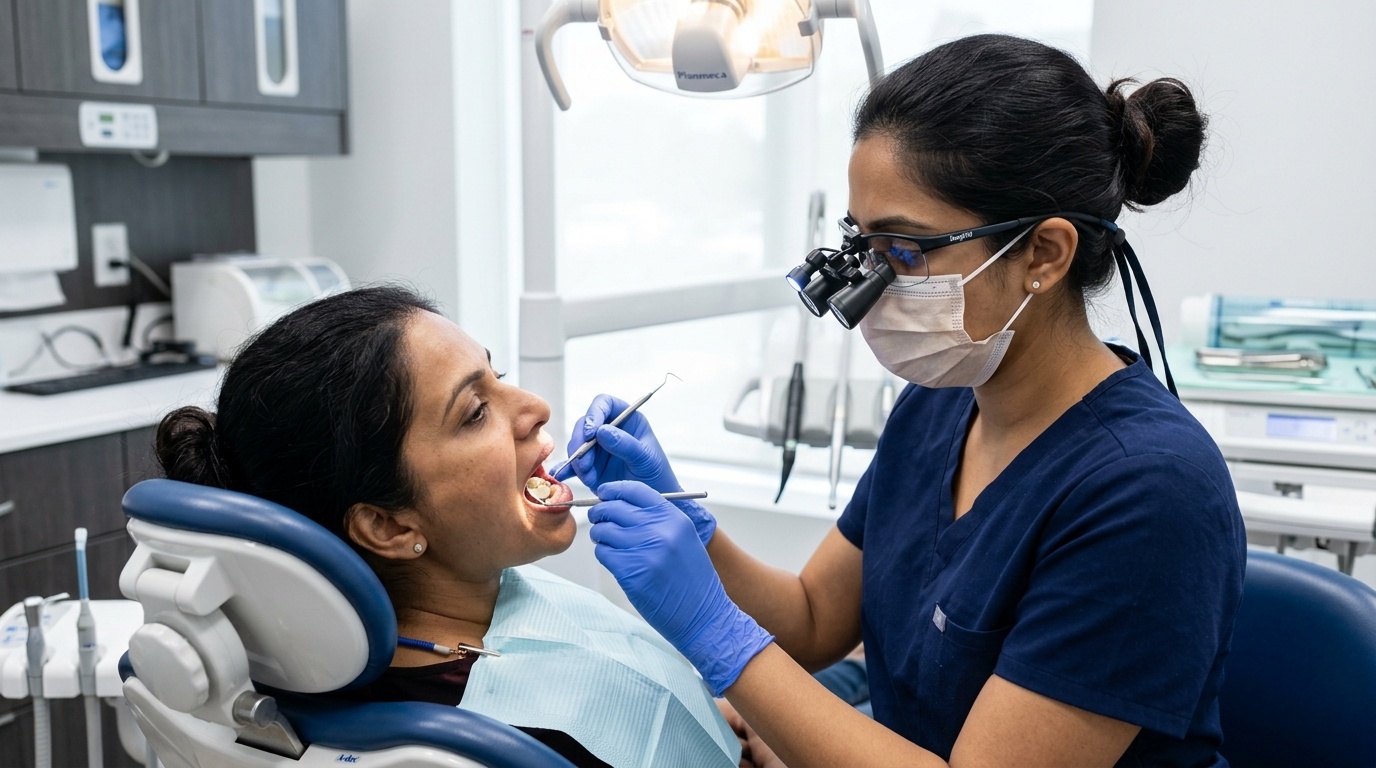
Tooth pain is notoriously deceptive, prompting many patients to ask: where is root canal pain felt? You might be surprised to learn that an infected tooth does not just hurt in the tooth itself. Because dental nerves feed directly into the trigeminal nerve—the master cranial nerve responsible for facial sensation—root canal pain frequently radiates to the jawbone, ear, temple, sinus cavity, and neck. Understanding where root canal pain manifests, how to identify referred pain patterns, and how endodontic therapy stops it gives you the knowledge to seek prompt clinical relief.
Key Takeaways:
- Trigeminal Nerve Pathways: Tooth nerves branch from the trigeminal nerve, causing pain signals to radiate across the face, cheekbone, temple, and ear.
- Upper vs. Lower Molar Patterns: Upper molars radiate pain toward the sinus cavity and temple, whereas lower molars radiate pain downward into the jaw and up into the ear.
- Referred Pain Confusion: Patients often feel pain in a healthy neighboring tooth or opposing arch because the brain misinterprets overlapping neural pathways.
- Instant Relief Through Treatment: Endodontic therapy eliminates the bacterial epicenter, causing all radiating headaches and facial aches to resolve completely.
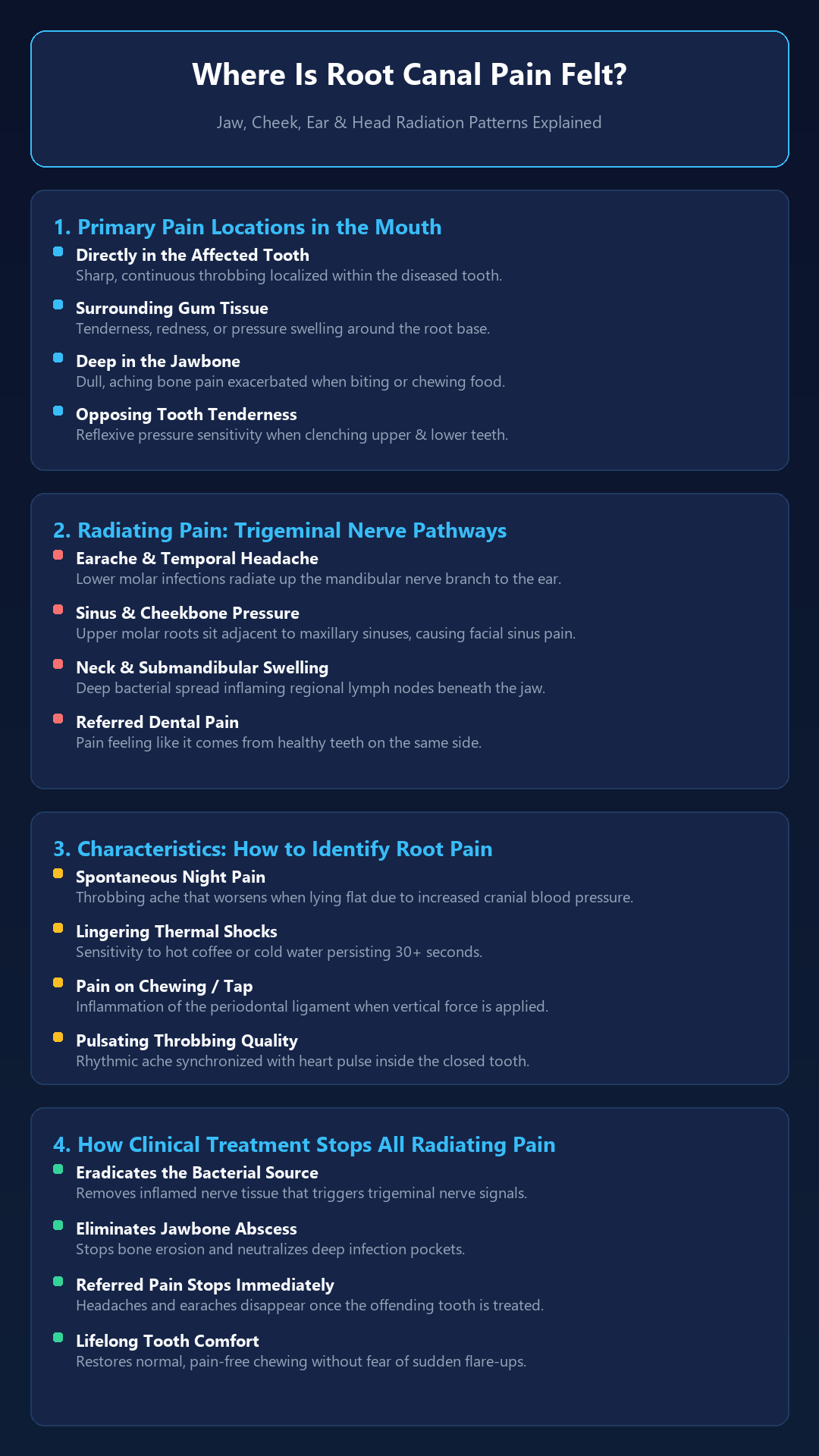
Table of Contents
- The Trigeminal Network: Why Dental Pain Radiates Far Beyond the Tooth
- Primary Locations Where Root Canal Pain Is Felt
- Upper vs. Lower Teeth: Distinct Radiation Patterns
- The Phenomenon of Referred Pain: Why Healthy Teeth Seem to Hurt
- Pain Characteristics: How to Recognize Deep Pulpitis
- How Root Canal Therapy Halts Radiating Facial Pain
- Specialist Endodontic Care with Dr. Saurabh Pakhale
- Frequently Asked Questions (FAQs)
The Trigeminal Network: Why Dental Pain Radiates Far Beyond the Tooth
To understand why root canal pain spreads across the head and face, you must examine the trigeminal nerve (Cranial Nerve V). The trigeminal nerve is the largest sensory nerve in the human head, dividing into three major branches:
- Ophthalmic Branch (V1): Forehead, eyes, and upper scalp.
- Maxillary Branch (V2): Upper teeth, palate, cheeks, and maxillary sinus cavities.
- Mandibular Branch (V3): Lower teeth, lower jaw, tongue, and anterior ear canal.
When bacterial infection inflames the dental pulp inside an enclosed tooth, intense inflammatory pressure fires continuous distress signals into the trigeminal sensory nucleus. Because sensory signals from the jaw, ear, and head converge at the same neural relay center in the brainstem, the brain frequently misjudges the pain’s exact origin—a phenomenon known as referred pain.
Primary Locations Where Root Canal Pain Is Felt
Patients experiencing acute pulpitis or periapical abscesses report pain across several distinct anatomical zones:
| Pain Location | Underlying Nerve Pathway | Typical Patient Sensation |
|---|---|---|
| Directly in the Tooth | Intrapulpal nerve and periodontal ligament mechanoreceptors | Throbbing, localized ache; severe sharpness upon tapping or biting. |
| Deep in the Jawbone | Alveolar bone nerves inflamed by apical bacterial toxins | Dull, heavy, gnawing bone pressure that intensifies when chewing. |
| Ear & Temporal Region | Auriculotemporal nerve branch connecting to mandibular division | Deep earache, fullness in the ear, or sharp temple headaches. |
| Sinuses & Cheekbones | Superior alveolar nerves bordering the maxillary sinus floor | Facial pressure resembling sinus congestion, worsening upon bending forward. |
Upper vs. Lower Teeth: Distinct Radiation Patterns
The location of the infected tooth dictates where the pain radiates:
- Upper Teeth (Maxillary Arch): The roots of upper molars and premolars sit directly beneath the maxillary sinus floor. Infections here frequently manifest as cheekbone tenderness, sinus congestion, pressure behind the eye, or throbbing in the temples.
- Lower Teeth (Mandibular Arch): Lower molars are innervated by the inferior alveolar nerve. Severe infection in lower molars regularly shoots sharp pain downward along the jawline and upward directly into the ear and neck.
The Phenomenon of Referred Pain: Why Healthy Teeth Seem to Hurt
One of the most perplexing aspects of root canal pain is feeling discomfort in teeth that are completely healthy. For example, an infected lower second molar can make your upper first molar feel intensely sore. Because the nerve fibers enter the same spinal trigeminal tract, the brain cannot always pinpoint the exact coordinates of the pain.
Dentists use selective diagnostic methods—such as cold vitality testing, electrical pulp tests, and high-definition periapical X-rays—to accurately isolate the true source of infection rather than treating the referred location.
Pain Characteristics: How to Recognize Deep Pulpitis
Root canal pain possesses distinct diagnostic characteristics:
- Nocturnal Throbbing: Pain intensifies significantly when lying flat at night because intracranial blood pressure increases, elevating pressure inside the tooth chamber.
- Lingering Temperature Sensitivity: A sharp shock from hot tea or cold water that persists for 30 to 60 seconds after swallowing.
- Spontaneous Pain: Severe toothaches that start without any trigger while sitting quietly.
- Pain Upon Vertical Biting: Inability to chew on that tooth due to periapical ligament tenderness.
How Root Canal Therapy Halts Radiating Facial Pain
Once the infected pulp is mechanically removed and the root canals are sanitized with antibacterial irrigants, the continuous barrage of neural pain signals to the trigeminal nerve ceases instantly. Within 24 to 48 hours of treatment, all secondary earaches, facial headaches, and jawbone soreness disappear completely.
If an older root canal ever redevelops radiating pain due to microscopic canal branches or cracked fillings, specialized root canal retreatment can reopen, clean, and reseal the canals cleanly.
Specialist Endodontic Care with Dr. Saurabh Pakhale
Experiencing radiating facial or dental pain requires precise diagnosis and compassionate clinical intervention. Led by Dr. Saurabh Pakhale, Elite Dermadent specializes in advanced, painless root canal treatment in Thane.
Equipped with digital diagnostics, electronic apex locators, and rotary instrumentation, our clinic pinpoints the true source of your pain and provides immediate, lasting relief.
Frequently Asked Questions (FAQs)
1. Can an infected tooth cause an earache?
Yes. The nerves of the lower molars share sensory pathways with the ear via the mandibular branch of the trigeminal nerve. Deep tooth infections regularly cause sharp or dull radiating ear pain.
2. Why does root canal pain get worse when lying down?
When you lie flat, blood pressure in your head naturally increases. In an inflamed tooth with high internal fluid pressure, this extra blood volume intensifies pressure on nerve endings, causing severe throbbing pain at night.
3. Can root canal pain cause headaches or temple pain?
Yes. Both upper and lower molar infections frequently radiate pain along the temporal nerve pathways, causing tension-like headaches on the affected side of the face.
4. How does a dentist know which tooth is causing the pain?
Endodontists perform diagnostic tests including cold response tests, percussion (tapping), electronic pulp tests, and periapical digital radiographs to isolate the exact diseased tooth, even when pain is radiating.
5. How quickly does radiating pain stop after a root canal?
Radiating headaches, earaches, and facial pressure typically disappear immediately or within 24 to 48 hours after the infected nerve tissue is removed during treatment.
No responses yet