
Before undergoing any cosmetic or restorative surgery, patients naturally wonder: what are FUE hair transplant side effects? Follicular Unit Extraction (FUE) is celebrated globally as a safe, minimally invasive procedure with an exceptional safety profile. The vast majority of side effects—such as mild redness, temporary pinpoint scabbing, minor forehead swelling, and temporary hair shedding (*shock loss*)—are completely normal physiological responses that resolve naturally within days to weeks. Serious complications are exceedingly rare when surgery is performed by qualified trichologists utilizing advanced Precise Follicle Implantation (PFI) techniques.
Key Takeaways:
- Mild & Temporary: Normal post-op signs include minor scalp redness (3–7 days), pinpoint crusting (5–10 days), and light forehead swelling (2–4 days).
- Shock Loss Is Expected: Shedding of transplanted hair shafts between weeks 2 and 8 is a normal part of the follicle growth cycle; living roots remain securely anchored beneath the skin.
- Minimizing Trauma with PFI: Precise Follicle Implantation with the Scarfree Pen eliminates pre-cut scalpel slits, significantly reducing tissue swelling, bruising, and healing downtime.
- Avoid Cheap Clinic Pitfalls: Overharvesting, cobblestoning, and poor growth occur primarily in technician-run budget clinics that lack medical oversight.
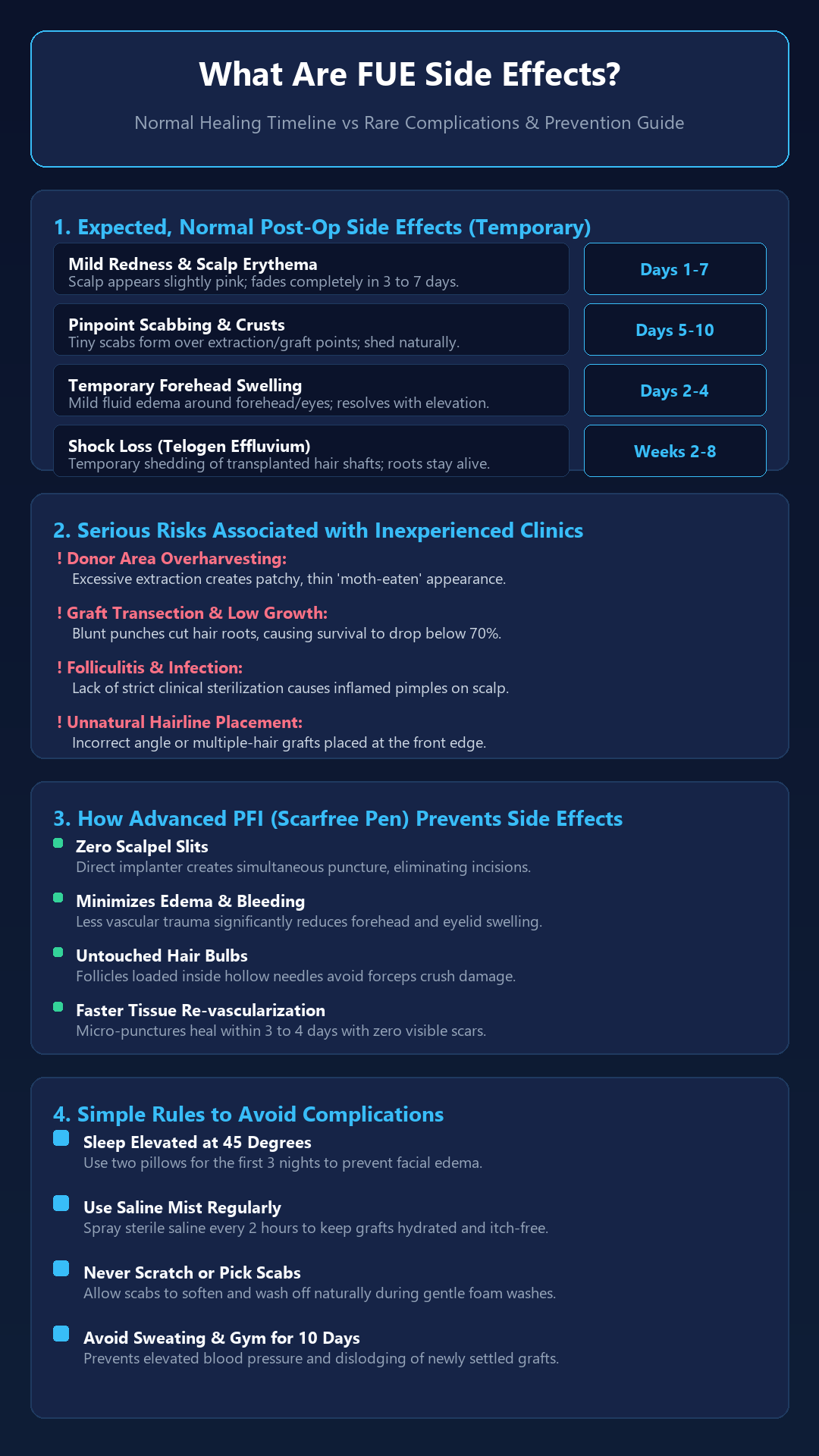
Table of Contents
- Normal & Expected Side Effects During Early Healing
- Understanding “Shock Loss”: Why Transplanted Hair Sheds
- Day-by-Day Post-Operative Recovery Timeline
- Rare Complications and How Qualified Clinics Avoid Them
- How Advanced PFI (Scarfree Pen) Prevents Side Effects
- Proactive Aftercare Guidelines for a Smooth Recovery
- Personalized Trichological Care at Elite Dermadent
- Frequently Asked Questions (FAQs)
Normal & Expected Side Effects During Early Healing
Because FUE involves micro-punctures to harvest and implant hair follicles, your body naturally initiates an inflammatory and regenerative wound-healing cascade. Here are the expected, short-lived side effects:
| Normal Side Effect | Typical Duration | Clinical Cause | Home Management |
|---|---|---|---|
| Scalp Redness (Erythema) | 3 to 7 days | Increased capillary micro-circulation feeding new grafts | Resolves on its own; avoid direct sun exposure |
| Pinpoint Scabbing & Crusts | 5 to 10 days | Protective biological seal over microscopic extraction sites | Gentle foam washes with prescribed post-op shampoo |
| Forehead & Eye Swelling (Edema) | 2 to 4 days | Downward gravitational drainage of local anesthetic fluid | Sleep with head elevated at 45°; apply cold packs to forehead |
| Scalp Itching (Pruritus) | Days 4 to 10 | Normal sign of active dermal collagen synthesis and skin healing | Regular sterile saline mist; never scratch the graft area |
| Temporary Scalp Numbness | 2 to 6 weeks | Mild temporary nerve stretching/stunning from local anesthesia | Full sensation returns spontaneously as nerves regenerate |
Understanding “Shock Loss”: Why Transplanted Hair Sheds
Between 2 and 8 weeks following your procedure, you will notice that the transplanted hair shafts begin shedding when washing or brushing. Many patients fear their procedure has failed—this is completely incorrect.
This shedding is a harmless biological phenomenon called telogen effluvium, commonly termed shock loss. The physical trauma of extraction and transplantation causes follicles to transition temporarily into a resting (telogen) phase. The hair shaft falls out, but the living dermal papilla and follicle stem cells remain firmly rooted in the scalp. By month 3 to 4, fresh, permanent anagen hairs begin sprouting.
Day-by-Day Post-Operative Recovery Timeline
- Day 1 to 2: Mild donor area tightness; small pinpoint scabs form. Keep the scalp upright and mist regularly with sterile saline.
- Day 3 to 5: Minor forehead edema peaks and subsides. Pinpoint crusts begin drying out.
- Day 7 to 10: Crusts soften and wash away completely during gentle foam washing, leaving a clean, pinkish scalp.
- Weeks 2 to 6: Shock loss occurs; transplanted shafts shed. Native hair continues normal growth.
- Months 3 to 12: Permanent new growth emerges, thickens, and matures into lifelong natural coverage.
Rare Complications and How Qualified Clinics Avoid Them
While normal healing symptoms are harmless, serious complications can occur if patients choose unregulated, budget commercial clinics:
- Donor Zone Overharvesting: Extracting too many grafts from a concentrated area depletes the safe donor zone, leaving a patchy “moth-eaten” appearance. Skilled trichologists never harvest more than 20% to 25% of available donor density in a single session.
- Follicle Transection & Low Growth: Poor punch technique severs the hair bulb, reducing follicle survival to below 70%.
- Scalp Infection & Folliculitis: Rushed operations in unsterile environments cause bacterial infection. Hospital-standard sterilization completely prevents this risk.
- Cobblestoning: Implantation of grafts at improper depths can cause tiny raised bumps on the skin surface.
How Advanced PFI (Scarfree Pen) Prevents Side Effects
At Elite Dermadent, we utilize the cutting-edge Precise Follicle Implantation (PFI) technique with the Scarfree Pen to minimize post-operative side effects:
- No Scalpel Slits: The hollow needle of the Scarfree Pen creates the microscopic site and inserts the graft simultaneously, eliminating scalpel cuts.
- Reduced Edema & Bleeding: Minimal vascular disruption means virtually no facial swelling or post-operative bruising.
- Gentle Root Protection: Eliminating manual forceps handling protects the hair bulb from crush injuries, preventing poor growth and skin irregularity.
- Rapid Cellular Healing: Micro-punctures heal within 3 to 4 days, allowing patients to resume normal routines quickly.
Proactive Aftercare Guidelines for a Smooth Recovery
Follow these essential guidelines to guarantee a fast, complication-free healing process:
- Elevate Head at Night: Sleep at a 45-degree angle for the first 3 nights to prevent fluid pooling around the forehead and eyes.
- Hydrate with Saline Spray: Mist the recipient area every 2 hours to keep new grafts moist and comfortable.
- Never Pick or Scratch: Allow scabs to loosen naturally in the shower using gentle, circular motions with prescribed shampoo.
- Avoid Strenuous Exercise: Refrain from heavy lifting, contact sports, and hot saunas for 10 to 14 days to keep scalp blood pressure stable.
Personalized Trichological Care at Elite Dermadent
Your safety, comfort, and aesthetic satisfaction are our highest clinical priorities. Under the expert care of Dr Arefa Patel, Trichologist and Skin Specialist, Elite Dermadent offers advanced Hair Transplant treatments using the gentle PFI Scarfree Pen technique.
Book your confidential consultation today for an expert scalp analysis and a fully personalized treatment plan.
Frequently Asked Questions (FAQs)
1. What are the most common side effects of an FUE hair transplant?
The most common side effects are mild scalp redness, temporary pinpoint scabbing, minor forehead swelling, light itching during healing, and temporary shedding of transplanted hair shafts (shock loss). All of these are normal and resolve within a few days to weeks.
2. Is shock loss permanent after an FUE transplant?
No. Shock loss is a temporary shedding of the hair shafts that occurs 2 to 8 weeks after surgery as follicles enter a resting phase. The dermal papilla and living follicle bulbs remain firmly anchored and begin producing new permanent hairs by months 3 to 4.
3. How can I prevent forehead and facial swelling after surgery?
Sleeping on your back with your head elevated at 45 degrees using two pillows or a neck pillow for the first 3 nights prevents fluid buildup. Staying hydrated and applying gentle cold compresses to your forehead (never on the grafts) also helps.
4. Can an FUE hair transplant cause permanent nerve damage?
No. FUE utilizes microscopic punches that penetrate only into the superficial dermis (<4mm depth), far above major scalp nerve branches. Any temporary numbness is mild and resolves completely as superficial sensory nerve endings recover.
5. How does PFI technique reduce side effects compared to traditional FUE?
Precise Follicle Implantation (PFI) with the Scarfree Pen places follicles directly into the scalp without pre-made scalpel slit cuts. This reduces tissue trauma, minimizes bleeding, virtually eliminates forehead swelling, and ensures faster healing with zero visible scars.
No responses yet