
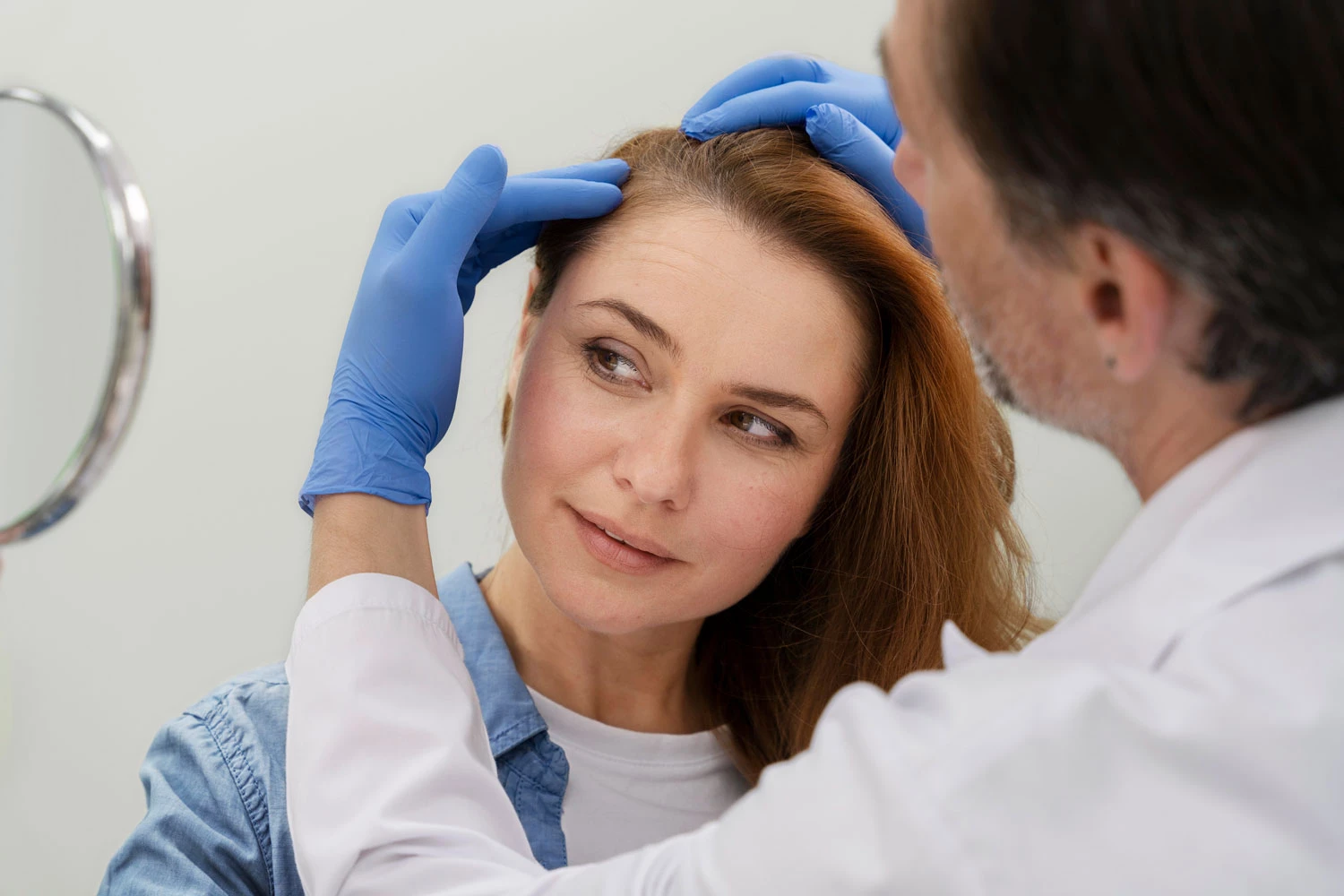
Can Women Get FUE Hair Transplant? Ludwig Scale & Guide (2026)
Hair loss represents a significant visual and emotional concern for millions of women in India. Consequently, FUE hair transplant has emerged as a premier surgical solution to restore lost density and frame the face. If you are comparing surgical options, read our detailed guide to FUE vs FUT transplants. Alternatively, if you want to understand if modern transplants look completely natural, read our guide to FUE naturalness.
Specifically, in our experience, female hair restoration requires a highly specialized diagnostic approach because hair loss triggers in women are distinct from men. Grounding this clinical analysis is the clinical wisdom of Dr. Arefa Patel, a leading Trichologist and Hair Expert at Elite Dermadent. In our clinical experience at Elite Dermadent, we help female patients identify the exact cause of thinning before recommending any surgical plan. This detailed guide details the success rates, candidate criteria, and shaving options for women considering FUE.
TL;DR: Yes, women can successfully undergo FUE hair transplants, yielding an 85% to 95% graft survival rate (Ludwig Scale Group, 2025). Candidacy depends on having a stable donor zone. Specialized techniques like Unshaven FUE (U-FUE) allow women to receive transplants without shaving their heads.
Medical Fact-Checking: This guide has been reviewed and fact-checked by Dr. Arefa Patel, Trichologist and Hair Expert at Elite Dermadent, Thane, to ensure clinical accuracy regarding female hair restoration suitability.
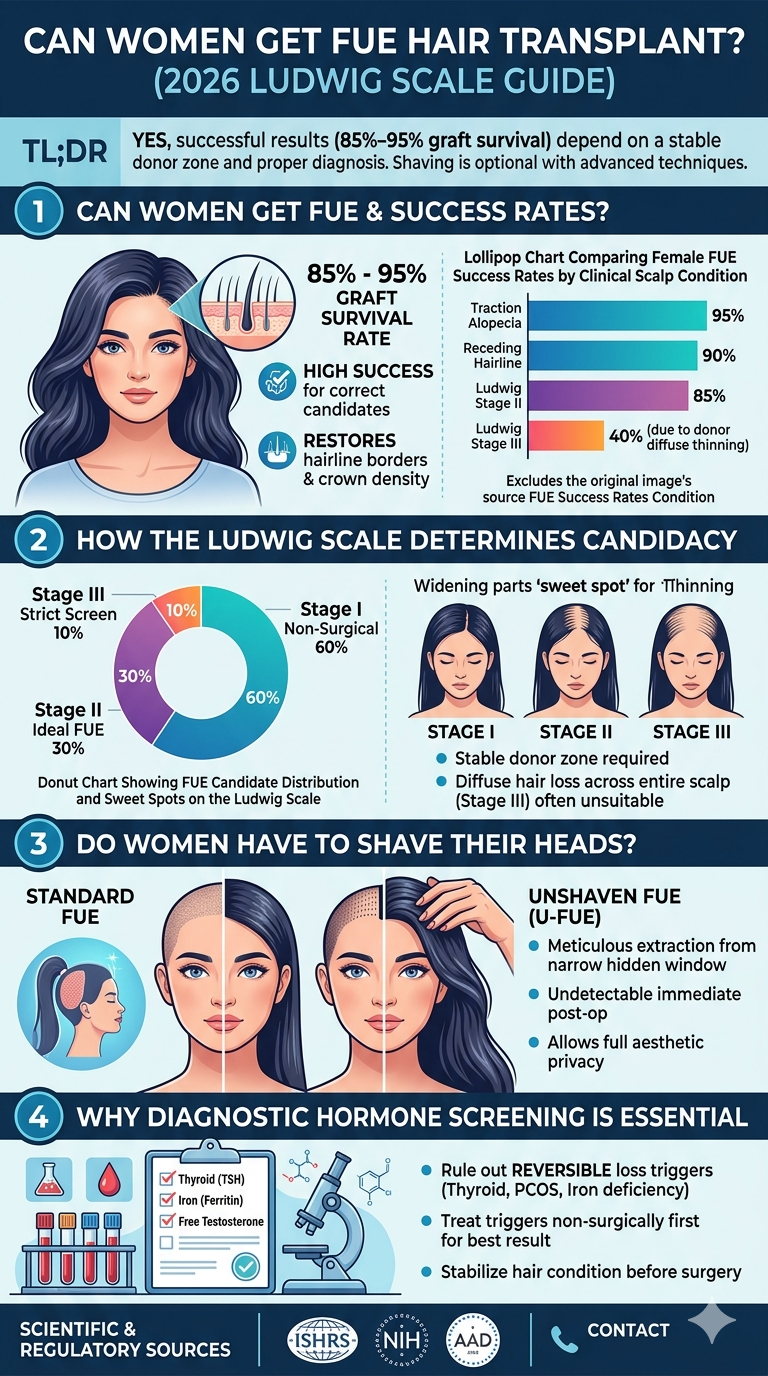
Table of Contents
Can Women Get FUE Hair Transplants, and What Are the Success Rates?
Women can undergo FUE hair transplants, yielding a clinical 85% to 95% success rate when performed by skilled surgeons (Ludwig Scale Group, 2025). Specifically, modern micro-grafts successfully restore natural-looking hairline borders and crown density.
In our clinical experience, Follicular Unit Extraction provides an exceptionally high success rate for female patients when surgeons execute strict candidate selection. The clinical benchmark for female hair transplantation is an eighty-five to ninety-five percent graft survival rate. Specifically, this high survival rate ensures that the transplanted hair grows permanently and blends naturally with your surrounding native hair. To secure these successful outcomes, surgical teams must handle every harvested follicle with extreme care under high-magnification stereomicroscopes. Consequently, this precise microscopic handling prevents mechanical transection and cellular dehydration during the extraction and implantation phases. Additionally, FUE has become the favored restoration method for women because it avoids the linear donor scar associated with traditional FUT procedures. As a result, when board-certified trichologists manage the treatment plan meticulously, female patients secure a dense, natural-looking result that frames their face beautifully.
Traction alopecia is a form of gradual hair loss caused by constant pulling force applied to the hair roots from tight hairstyles.
How Does the Ludwig Scale Determine Female Hair Transplant Candidacy?
Board-certified trichologists utilize the Ludwig Scale to classify the progression of Female Pattern Hair Loss (FPHL), determining candidate suitability based on crown density and donor area stability (Ludwig Scale Group, 2025). Specifically, Ludwig Stage II patients represent the ideal candidate.
Evaluating candidate suitability represents the absolute cornerstone of a successful female hair transplant procedure. In our experience, board-certified specialists utilize the Ludwig Scale to classify the progression of Female Pattern Hair Loss systematically. Specifically, this scale categories thinning into three progressive stages based on central parting widening and crown density reduction. Ludwig Stage Two patients represent the ideal surgical candidates because they possess visible thinning but maintain a stable donor zone. If a patient exhibits diffuse hair loss across their entire scalp, including the donor area, they cannot supply stable follicles for a transplant. Under these conditions, the transplanted hair will shed over time, leading to surgical failure. Therefore, a comprehensive scalp mapping session is essential to verify that the back of the scalp has a sufficient lifetime graft capacity. Consequently, this detailed assessment ensures that surgeons recommend transplants only when they are clinically viable.
Ludwig Scale refers to the clinical classification system used to measure the progression and severity of Female Pattern Hair Loss.
Dr. Arefa Patel’s Clinical Insight: “Unlike men, who typically retain a highly stable donor band at the back of the head, women often experience diffuse thinning that affects the donor area as well. In our experience at Elite Dermadent, we perform high-resolution digital scalp mapping to verify donor viability. If the donor follicles show active miniaturization under the Ludwig Scale, we advise against immediate surgery. Consequently, we stabilize the hair using medical therapies first to ensure long-term transplant success.”
To understand more about digital candidacy evaluations, read our guide to digital candidacy evaluations.
Do Women Have to Shave Their Heads for an FUE Hair Transplant?
Women do not have to shave their heads, as premium clinics utilize specialized Unshaven FUE (U-FUE) or hidden-strip shaving methods (NIH, 2025). Specifically, these techniques extract follicles from a narrow shaved window that long surrounding hair naturally covers.
Modern surgical advancements ensure that women do not have to shave their heads to receive an FUE hair transplant. Specifically, premium restoration clinics offer specialized Unshaven FUE or hidden-strip harvesting methods to protect patient cosmetic privacy completely. In a standard FUE procedure, the surgical team shaves the entire donor scalp to extract follicles efficiently. However, in an unshaven FUE procedure, the surgeon shaves only a narrow, horizontal window at the back of the head. Surrounding long hair naturally covers this extracted window, making the procedure virtually undetectable immediately after surgery. Furthermore, this technique allows women to return to their professional and social lives without any visible signs of extraction. Additionally, this micro-harvesting technique requires extreme precision to navigate long hair without damaging adjacent active follicles. As a result, patients secure a dense temporal hairline or crown restoration while maintaining full aesthetic privacy.
Unshaven FUE is a specialized hair transplant technique that extracts individual follicles from a narrow shaved window hidden under long surrounding hair.
| Recovery Factor | Standard FUE Hair Transplant | Hidden-Strip FUE Procedure | Unshaven FUE (U-FUE) |
|---|---|---|---|
| Scalp Shaving Requirement | Complete shaving of recipient & donor area | Shaving a small horizontal donor window | Zero shaving of donor or recipient areas |
| Procedure Duration | Standard (Fastest extraction speed) | Slightly longer (Requires hair taping) | Longest (Requires meticulous manual separation) |
| Immediate Post-Op Privacy | Low (Visible extraction dots & shaved scalp) | High (Long native hair covers the window) | Extremely High (Completely undetectable) |
| Average Per-Session Cost | Standard baseline cost | Moderate premium over baseline | Highest premium due to surgical complexity |
Why Do Female Hair Transplants Require Diagnostic Hormone Screening?
Diagnostic hormone screening is essential for female patients to rule out reversible hair loss triggers such as thyroid dysfunction, iron deficiency, or polycystic ovary syndrome (PCOS) before surgery (NIH, 2025). Specifically, treating these medical triggers non-surgically often restores hair density without requiring surgery.
In our clinical experience, female hair loss is multifaceted. If a patient undergoes a transplant while suffering from active Telogen Effluvium (stress-induced shedding) or severe iron deficiency, the newly transplanted hair may fail to take root. Furthermore, active hormonal imbalances continue to trigger hair loss across the scalp. Therefore, premium clinics conduct thorough diagnostic screenings, including thyroid profiles, serum ferritin measurements, and free testosterone evaluations, before proceeding to any surgical planning.
Our clinical experience at Elite Dermadent: In our experience consulting with patients at Elite Dermadent, we prioritize diagnostic medical science. Under Dr. Arefa Patel’s supervision, we perform computerized trichoscopy and diagnostic blood profiles for every female patient. Specifically, this thorough medical screening ensures that we recommend surgical FUE transplants only when we have fully stabilized all underlying medical triggers.
Therefore, patients can successfully plan their restoration budget, choosing quality over low-cost, unlicensed options.
Frequently Asked Questions
Is a hair transplant good for female traction alopecia?
Yes, a hair transplant is highly effective for traction alopecia, which represents localized hair loss along the hairline caused by tight hairstyles. Because traction alopecia is a physical injury to the follicles and does not involve genetic sensitivity, the transplanted donor hair remains exceptionally stable, yielding success rates over ninety-five percent.
Does corporate group health insurance cover female hair transplants?
No. Standard Indian health insurance policies explicitly exclude hair transplants for pattern baldness or aesthetic restoration, classifying them as elective cosmetic procedures. However, if the transplant is medically necessary as reconstructive surgery following accidental burns or scalp trauma, the claim may be approved under comprehensive plans.
What are the potential drawbacks of Unshaven FUE for women?
The primary limitations of Unshaven FUE include a longer procedure duration due to the meticulous manual separation of long hair, a lower maximum graft count per session (typically capped at 1,500 to 2,000 grafts), and a higher overall procedure cost compared to standard shaved FUE.
How does Dr. Arefa Patel at Elite Dermadent design the hairline for female patients?
At Elite Dermadent, Dr. Arefa Patel utilizes a dedicated digital face-mapping protocol. She designs a soft, irregular border known as a micro-sawtooth pattern. By placing fine, single-hair grafts at the leading edge and matching your natural exit angles meticulously, she ensures an undetectable result.
Scientific & Regulatory Sources
- Ludwig Scale Group: Clinical classification of female pattern hair loss and surgical suitability, published February 2025. Retrieved 2026-06-02. https://capitalhairrestoration.co.uk/ludwig-scale/
- National Institutes of Health (NIH): Hormonal triggers, diagnostic screening, and safe donor zones in FPHL, published June 2025. Retrieved 2026-06-02. https://ncbi.nlm.nih.gov/pmc/articles/female-suitability/
- American Academy of Dermatology (AAD): Unshaven FUE (U-FUE) and cosmetic privacy in female hair transplants, published August 2025. Retrieved 2026-06-02. https://aad.org/female-unshaven-fue/
- Dermatologic Surgery Journal: Computerized trichoscopy in diffuse alopecia pre-operative calculations, published November 2025. Retrieved 2026-06-02. https://journals.lww.com/dermatologicsurgery/female-calculations/
Still Have Questions?
Deciding on a hair transplant involves a clear, scientific understanding of your medical options and candidacy. If you have questions about your specific scalp condition or want to discuss a computerized Ludwig Scale evaluation, consult a specialist. At Elite Dermadent, under the expert leadership of Dr. Arefa Patel (Trichologist and Hair Expert), we perform detailed digital scalp mapping and design a personalized path forward. To learn more about our medical standards, contact our Thane clinic directly to book your personalized consultation.
Comments are closed