
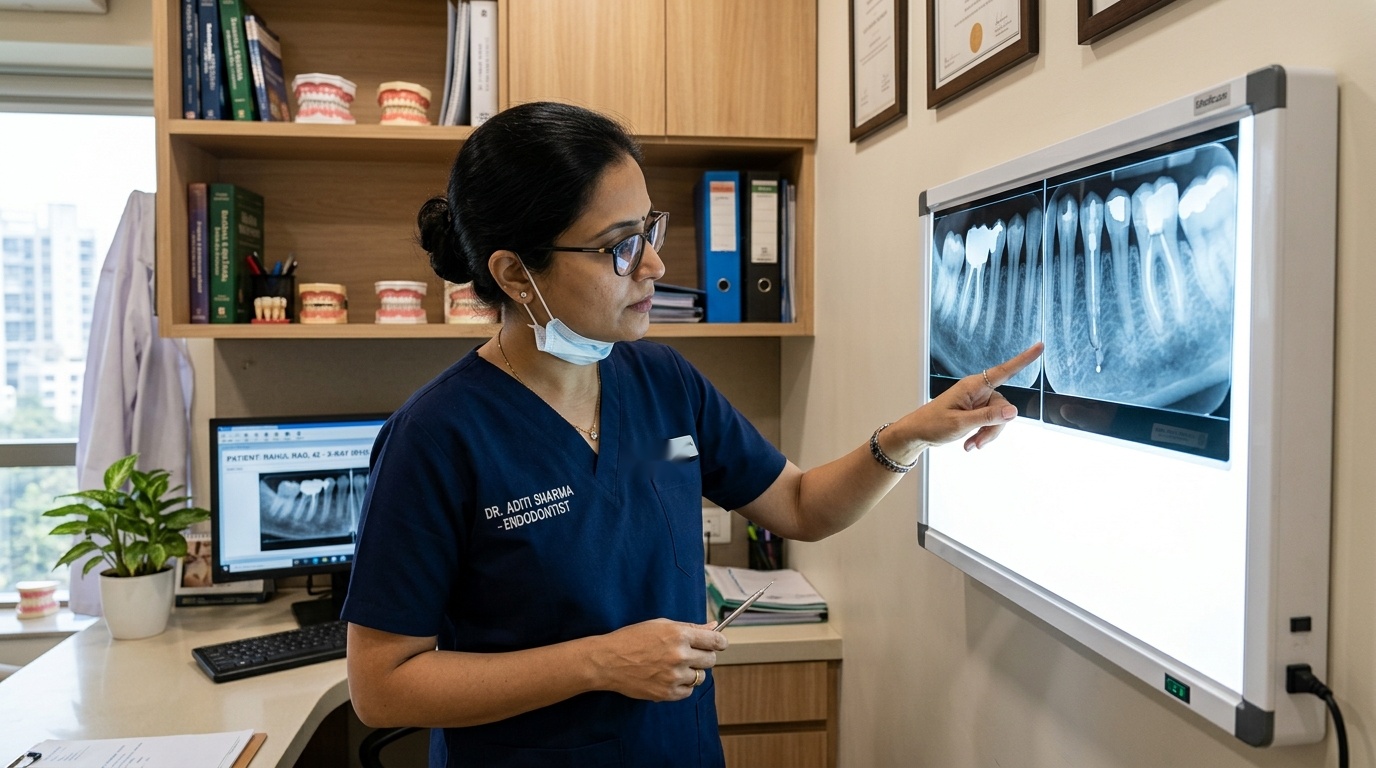
Experiencing discomfort after endodontic therapy can be frustrating and alarming, prompting the frequent patient question: why root canal tooth pain happens? If the living pulp and nerve tissue have been cleanly extracted, why does the tooth still ache? The clinical answer lies in the surrounding tooth anatomy. While the inner chamber is completely numb, the sensitive periodontal ligament holding the tooth in the jawbone socket is frequently inflamed from the prior infection and treatment. Understanding why root canal tooth pain occurs, how to tell normal healing from persistent infection, and how dentists rapidly fix it ensures complete peace of mind.
Key Takeaways:
- Outer Ligament Pain, Not Inner Nerve: The nerve inside the tooth is gone, but the shock-absorbing periodontal ligament anchoring the root remains alive and sensitive to biting pressure.
- High Occlusal Spot (Most Common Culprit): A filling or temporary crown that is elevated by just 0.1 mm absorbs the entire chewing force, repeatedly bruising the socket.
- Normal Recovery (24 to 72 Hours): Mild tenderness when chewing peaks within 48 hours and fades rapidly with standard anti-inflammatory tablets.
- Persistent Pain Beyond 1 Week: Continuous throbbing or nocturnal pain indicates an untreated lateral canal branch, a micro-fracture, or crown leakage.
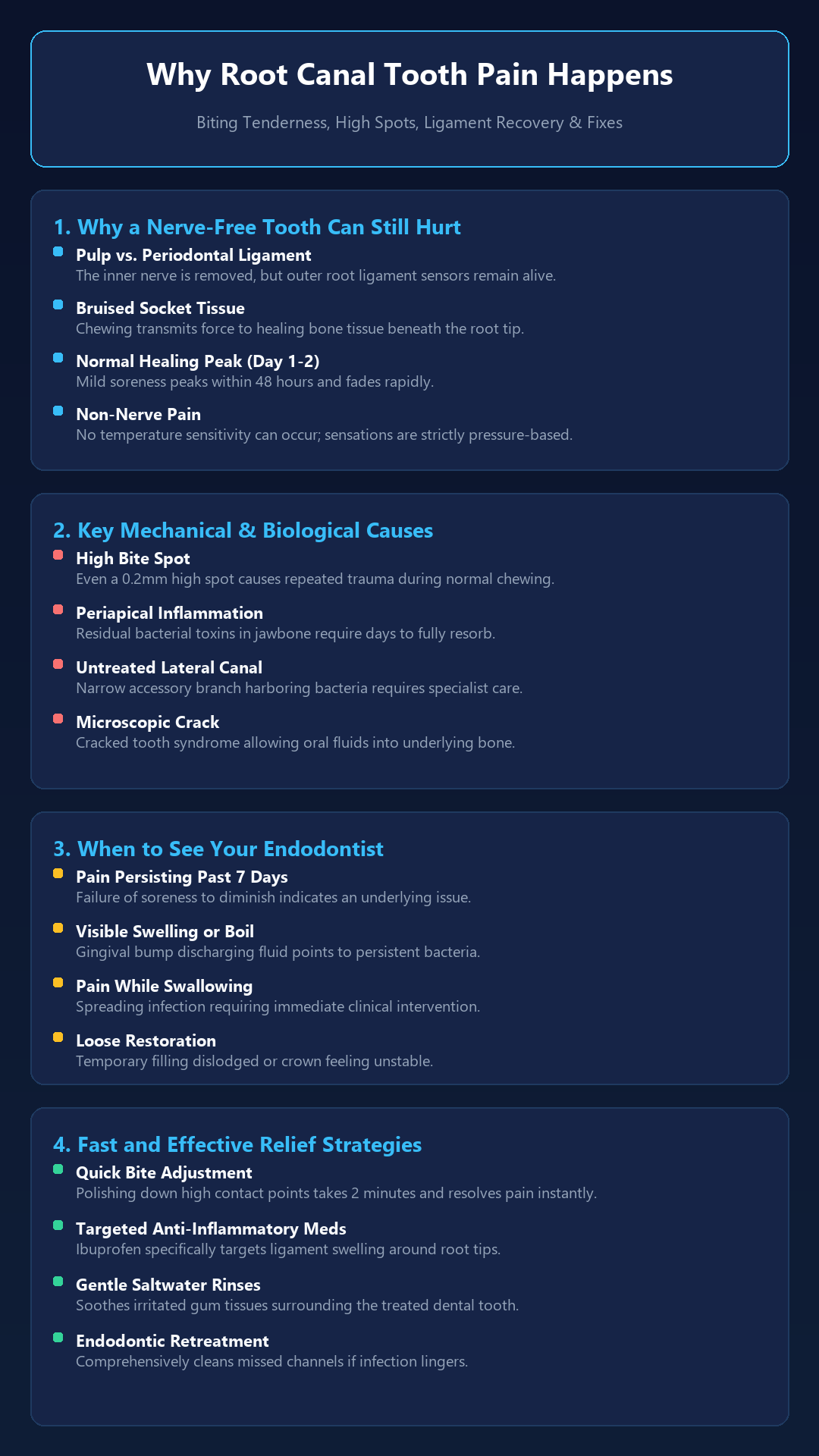
Table of Contents
- Biological Reality: How a Devitalized Tooth Senses Pain
- Normal Post-Op Tenderness: What to Expect in 72 Hours
- Top 4 Clinical Causes of Lingering Root Canal Tooth Pain
- The “High Bite” Phenomenon: Why Minor Elevation Causes Big Pain
- At-Home Self-Care to Relieve Biting Discomfort
- How Endodontists Diagnose and Cure Persistent Pain
- Expert Endodontic Care with Dr. Saurabh Pakhale
- Frequently Asked Questions (FAQs)
Biological Reality: How a Devitalized Tooth Senses Pain
To understand post-root-canal sensations, you must recognize that a tooth is not a standalone block of enamel—it is an organ suspended in bone:
- Inside the Root: Root canal therapy removes the pulp (the inner nerves and blood vessels). After this, the tooth cannot experience thermal shocks from ice cream or hot coffee.
- Outside the Root (The Periodontal Ligament): The root is suspended in the alveolar bone socket by millions of elastic fibers called the periodontal ligament (PDL). These external ligaments are packed with pressure-sensitive mechanoreceptors.
When deep bacterial decay initially reaches the root tip, it inflames these periodontal fibers. During cleaning, endodontic instruments also work near this boundary. The resulting post-op sensation is essentially a bruised ligament. When you chew or tap the tooth, you are pressing against bruised tissue in the jawbone socket.
Normal Post-Op Tenderness: What to Expect in 72 Hours
Mild soreness upon biting or touching is an expected part of tissue healing. Here is how normal recovery unfolds:
- Hours 0–24: As local anesthesia wears off, the tooth feels tender and bruised. Chewing on that side causes noticeable discomfort.
- Hours 24–48: Inflammation peaks and begins resolving. Pain decreases substantially with over-the-counter NSAIDs like ibuprofen or paracetamol.
- Days 3–5: Biting tenderness rapidly fades to baseline. Soft chewing becomes effortless.
- Day 7: The tooth is completely comfortable and ready for permanent crown impressions.
Top 4 Clinical Causes of Lingering Root Canal Tooth Pain
If tooth pain persists past the first week or flares up weeks later, dentists investigate four distinct clinical factors:
| Clinical Cause | Mechanism of Discomfort | Clinical Fix |
|---|---|---|
| High Restoration (Hyperocclusion) | Temporary filling or crown is slightly elevated, concentrating chewing impact. | A 2-minute occlusal bite adjustment with articulating paper gives instant relief. |
| Untreated Hidden Canal | Microscopic accessory canal (e.g., MB2 in upper molars) retains living bacteria. | Microscopic endodontic retreatment locates, disinfects, and reseals the canal. |
| Microscopic Root Crack | Hairline fracture in brittle tooth root allows oral fluid and bacterial leakage. | Diagnosed via 3D CBCT imaging; restorative bonding or extraction if vertical. |
| Delayed Permanent Crown | Porous temporary filling wears away, allowing saliva to re-contaminate root canals. | Canals re-sanitized and protected with a custom CAD/CAM zirconia crown. |
The “High Bite” Phenomenon: Why Minor Elevation Causes Big Pain
The single most frequent reason for severe biting pain in the first week after a root canal is a high bite. Human teeth possess exquisitely sensitive tactile feedback. If a temporary filling or temporary crown is elevated by just 50 to 100 microns (less than the thickness of a piece of paper), the treated tooth collides with the opposing tooth before any other teeth meet.
This concentrated chewing force delivers hundreds of pounds of pressure onto the healing periodontal ligament thousands of times a day. Patients often fear that their root canal has failed, when in reality, the dentist simply needs to polish down the high spot. Relief is virtually instantaneous.
At-Home Self-Care to Relieve Biting Discomfort
To keep the tooth calm and promote rapid tissue recovery, follow these guidelines:
- Chew on the Opposite Side: Completely rest the treated tooth until your permanent crown is seated.
- Anti-Inflammatory Protocol: Take prescribed or over-the-counter ibuprofen (with food) to target ligament swelling at the root tip.
- Gentle Warm Saltwater Rinses: Dissolve half a teaspoon of salt in warm water and swish gently 3 times a day to reduce gum margin sensitivity.
- Avoid Hard Foods: Avoid chewing ice, nuts, crusty bread, and sticky candies that could crack temporary restorations.
How Endodontists Diagnose and Cure Persistent Pain
If pain continues beyond 5 to 7 days, your dental surgeon will take a digital periapical radiograph to examine the apical bone. If radiographic shadows indicate persistent periapical bacteria or complex root anatomy, specialized root canal retreatment can reopen the tooth, dissolve old filling material, thoroughly sterilize deep canal branches under high magnification, and reseal the roots for permanent comfort.
Expert Endodontic Care with Dr. Saurabh Pakhale
Persistent tooth discomfort should never leave you suffering or anxious. Led by Dr. Saurabh Pakhale, Elite Dermadent provides state-of-the-art, gentle, and precise root canal treatment in Thane.
With rotary instrumentation, digital apex locators, and custom ceramic crowns, our priority is saving your natural smile comfortably, safely, and permanently.
Frequently Asked Questions (FAQs)
1. Why does my tooth hurt when I bite down after a root canal?
Biting pain is caused by inflammation in the periodontal ligament surrounding the root tip. Because this ligament has sensitive pressure sensors, chewing forces transmit soreness into the jawbone until the tissues heal completely (usually within 2 to 4 days).
2. Can a high filling cause severe root canal tooth pain?
Yes. If the temporary filling or crown sits even a fraction of a millimeter too high, the tooth absorbs full biting impact before other teeth meet. This severely bruises the socket ligament. A quick 2-minute bite adjustment relieves the pain immediately.
3. Why does an older root canal tooth start hurting years later?
Pain in an older root canal tooth is usually caused by secondary bacterial leakage past a worn crown, new decay along the crown margin, or a delayed flare-up in an untreated accessory canal branch. Retreatment cleanly eliminates these problems.
4. How long is pain normal after root canal therapy?
Mild to moderate soreness is normal for 24 to 72 hours and should progressively decline each day. If significant throbbing pain persists past 5 to 7 days, you should schedule a check-up to evaluate the bite and canal anatomy.
5. Can antibiotics alone stop root canal tooth pain?
No. While antibiotics can temporarily control surrounding soft tissue swelling, they cannot penetrate the dead interior of a tooth root or correct an uneven bite. Physical evaluation and clinical treatment by an endodontist are necessary to address the root cause.
No responses yet