
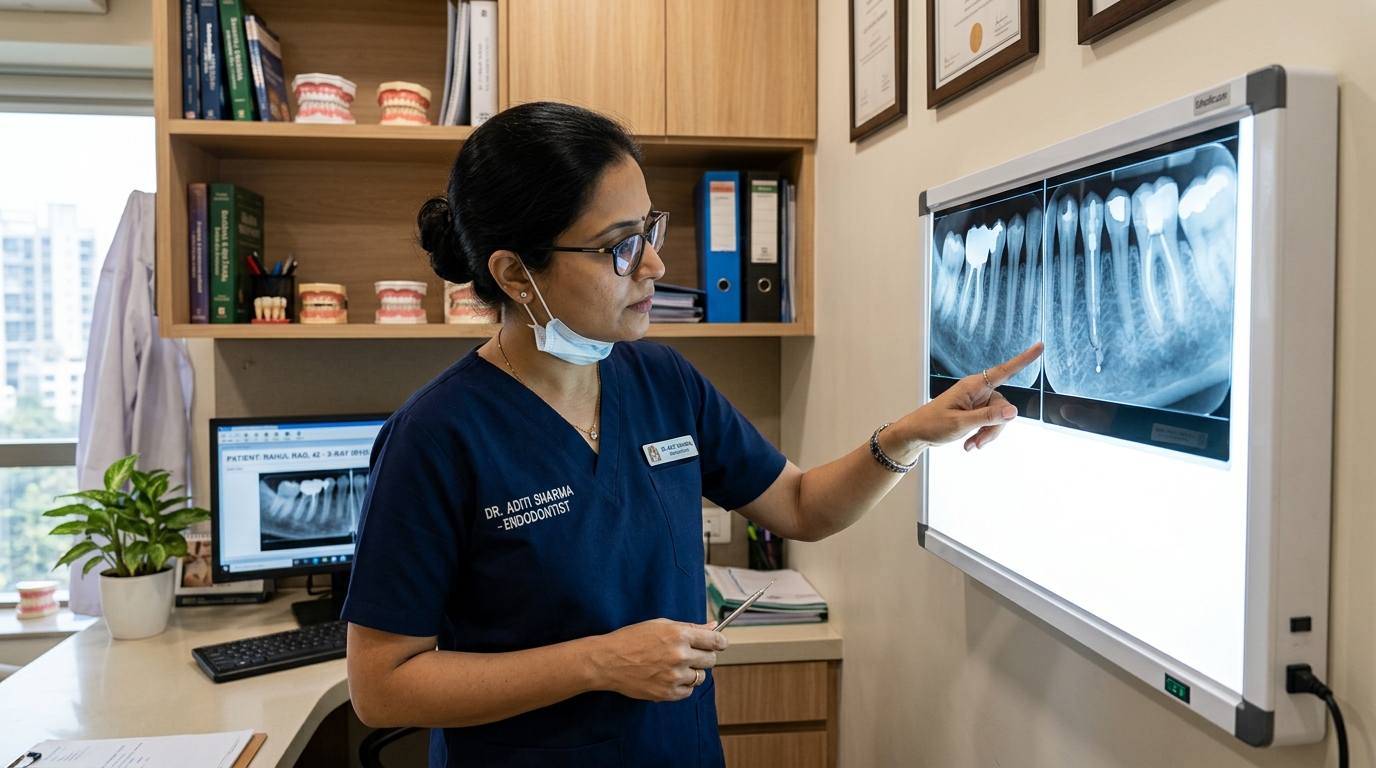
Root canal therapy is one of dentistry’s most successful tooth-preservation treatments, boasting an average clinical success rate above 95%. However, in a small fraction of cases, patients may encounter persistent discomfort or new symptoms months or years later, prompting the question: why root canal fails? While a failed root canal can feel frustrating, endodontic failure does not mean your tooth is doomed to extraction. In the vast majority of cases, failure is caused by complex root anatomy, microscopic untreated canals, delayed crown restorations, or new bacterial leakage—all of which can be successfully addressed and resolved through modern endodontic retreatment.
Key Takeaways:
- High Baseline Success: Over 95% of initial root canal treatments succeed permanently when properly disinfected, sealed, and protected with a crown.
- Primary Causes of Failure: Complex or curved anatomy, hidden accessory canals (such as MB2 in molars), delayed crown placement, coronal micro-leakage, or vertical root cracks.
- Noticeable Warning Signs: Persistent biting pain, recurrent gum boils (fistulas), localized swelling, or darkening X-ray shadows around root tips.
- Retreatment Saves the Tooth: Advanced root canal retreatment has an 85% to 90% success rate, clearing persistent bacteria and preserving your biological tooth root.
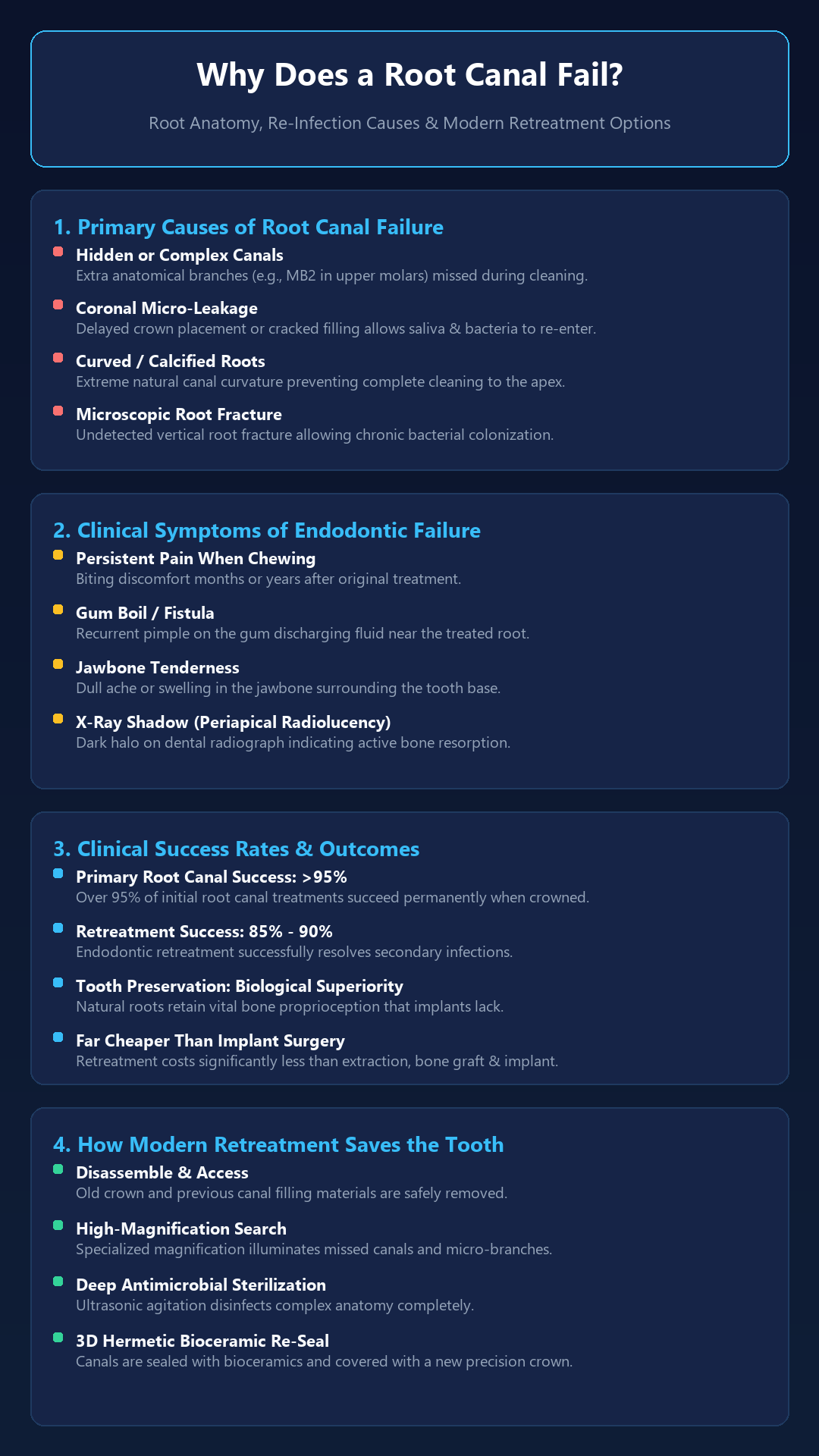
Table of Contents
- What Does a “Failed Root Canal” Actually Mean?
- Top 5 Clinical Causes of Root Canal Failure
- Warning Signs & Symptoms of an Ineffective Root Canal
- The Critical Role of the Dental Crown in Preventing Failure
- How Endodontic Retreatment Saves a Failed Tooth
- Retreatment vs. Tooth Extraction: Choosing the Right Option
- Advanced Endodontics & Retreatment with Dr. Saurabh Pakhale
- Frequently Asked Questions (FAQs)
What Does a “Failed Root Canal” Actually Mean?
In endodontics, “failure” does not mean the original procedure was poorly performed. Instead, it refers to a situation where bacterial infection persists or re-enters the root canal system, preventing the bone and periodontal tissues around the root apex from healing properly.
Human teeth have complex internal micro-architecture. Far from being simple straight tubes, root canals often branch like tree roots, featuring microscopic lateral canals, delta branches, and fins. If virulent anaerobic bacteria remain sheltered inside these microscopic recesses, or if new bacteria infiltrate from the mouth due to broken restorations, a secondary infection can develop.
Top 5 Clinical Causes of Root Canal Failure
Clinical studies identify five main mechanisms responsible for post-treatment endodontic failure:
| Cause of Failure | Anatomical / Clinical Mechanism | Clinical Impact & Resolution |
|---|---|---|
| Missed or Hidden Canals | Complex teeth (especially upper molars) frequently possess extra canals (like MB2) invisible to basic 2D X-rays. | Uncleaned canal harbors living bacteria; specialist microscopic retreatment locates and cleans it. |
| Coronal Micro-Leakage | A temporary filling wears away, or a permanent crown is delayed, allowing saliva and bacteria to seep inside. | Salivary bacteria re-colonize disinfected canals within weeks; requires re-cleaning and immediate crowning. |
| Extreme Curvature or Calcification | Severely curved roots or mineralized, narrowed canals prevent cleaning instruments from reaching the apex. | Ultrasonic instruments and flexible rotary NiTi files negotiate calcified pathways smoothly. |
| Delayed or Defective Restoration | Cracked crown, marginal breakdown, or new recurrent caries underneath the existing crown margins. | Old crown must be replaced with a precision CAD/CAM crown after re-sanitizing canals. |
| Vertical Root Fracture (VRF) | A hairline vertical crack extending from root tip upward due to heavy biting on an un-crowned tooth. | Cannot be sealed; teeth with true vertical root fractures generally require extraction and implant replacement. |
Warning Signs & Symptoms of an Ineffective Root Canal
Endodontic failure can manifest immediately or remain dormant for years before flaring up. Look for these hallmark indicators:
- Pain When Chewing or Tapping: Deep tenderness in the tooth or underlying jawbone when chewing firm foods.
- A Persistent Gum Boil (Sinus Tract): A small pimple on the gum adjacent to the tooth that periodically fills with pus, bursts, and drains.
- Jaw Swelling or Puffiness: Swelling in the adjacent gum tissue, cheek, or surrounding facial contours.
- Discoloration: The tooth crown turning greyish or dark yellow over time.
- Asymptomatic X-Ray Shadow: Many failures cause zero initial pain but are detected during routine checkups as a dark radiolucent shadow around the root apex, signaling bone loss.
The Critical Role of the Dental Crown in Preventing Failure
One of the most preventable reasons for root canal failure is delaying the permanent dental crown. A devitalized tooth loses internal moisture, becoming significantly more brittle over time. If a patient leaves a temporary filling on the tooth for months, chewing forces can fracture the remaining walls.
More critically, temporary fillings are porous. Within 30 to 45 days, oral bacteria can penetrate a worn temporary filling and re-infect the sterile root canals. Placing a well-fitting, permanent crown (such as zirconia or porcelain-fused-to-metal) seals the tooth hermetically from the top down and prevents over 90% of structural failures.
How Endodontic Retreatment Saves a Failed Tooth
When a root canal fails, tooth extraction is rarely the only solution. In most cases, root canal retreatment offers a highly predictable way to eliminate the infection and save your natural tooth:
- Access & Disassembly: The existing restoration and crown are safely removed to access the root canal system.
- Removal of Old Filling: Specialized rotary instruments and solvents dissolve and extract the prior gutta-percha filling material.
- Microscopic Inspection & Cleaning: Using high-magnification illumination, the endodontist searches for hidden canals, clears calcifications, and flushes warm antimicrobial irrigants into lateral tubules.
- Medication & 3D Re-Sealing: Antimicrobial medication may be placed inside the canals for deep disinfection, after which the canals are hermetically sealed with modern bioceramics and restored with a brand-new protective crown.
Retreatment vs. Tooth Extraction: Choosing the Right Option
Before deciding to pull a troubled tooth, patients should weigh the biological advantages of retreatment against extraction and implants:
- Biological Advantage: Nothing feels, chews, or looks quite like your biological tooth. Natural roots maintain jawbone density and natural pressure feedback.
- Time & Healing: Retreatment takes 1 or 2 appointments with minimal recovery downtime, whereas an implant requires extraction, bone grafting, and 3 to 6 months of healing before crown attachment.
- Financial Investment: Retreatment is far more economical than the combined expenses of surgical extraction, bone graft membranes, titanium implant placement, and implant abutments.
Advanced Endodontics & Retreatment with Dr. Saurabh Pakhale
If you have an older root canal causing discomfort or a newly diagnosed failing tooth, expert care makes all the difference. Under the leadership of Dr. Saurabh Pakhale, Elite Dermadent is a trusted center for advanced root canal treatment in Thane and complex endodontic retreatments.
With rotary instrumentation, digital apex locators, and precision ceramic crowns, our priority is saving your natural smile comfortably, safely, and permanently.
Frequently Asked Questions (FAQs)
1. Can a failed root canal be fixed without pulling the tooth?
Yes! In the overwhelming majority of cases, a failed root canal can be successfully saved through endodontic retreatment. The old filling is removed, missed or curved canals are thoroughly disinfected, and the tooth is resealed with modern bioceramic materials.
2. What is the success rate of root canal retreatment?
Root canal retreatment has an established clinical success rate of 85% to 90%. When performed with modern rotary instruments and protected with a well-fitted crown, retreated teeth can function comfortably for a lifetime.
3. Why does a root canal fail after 10 or 15 years?
A root canal that was successful for a decade can fail later if new tooth decay develops along the margins of the crown, if the crown cracks or loosens allowing saliva to leak inside, or if a traumatic injury causes a microscopic root fracture.
4. When is a failed root canal not restorable?
A tooth cannot be saved if it has suffered a true vertical root fracture (a split extending all the way down the root into the bone) or if extensive decay has destroyed the tooth structure below the gum line. In these specific cases, tooth extraction followed by a dental implant is recommended.
5. Can antibiotics cure a failed root canal?
No. Antibiotics can temporarily reduce acute gum swelling, but they cannot eliminate bacteria residing inside the sealed, non-vascular root canal system. Physical endodontic retreatment is required to mechanically clean and sterilize the canals.
No responses yet