
If you are exploring surgical hair restoration options, you have likely encountered the medical acronym FUE and asked: what does FUE hair transplant stand for? FUE stands for Follicular Unit Extraction. It is a minimally invasive surgical technique where individual, naturally occurring follicular units (clusters of 1 to 4 hairs) are harvested one by one from the safe donor zone at the back and sides of the scalp and delicately transplanted into thinning or balding areas. Today, modern advancements like Precise Follicle Implantation (PFI) with the Scarfree Pen represent the cutting-edge evolution of FUE, offering higher graft survival, faster healing, and virtually scar-free results.
Key Takeaways:
- Medical Definition: FUE stands for Follicular Unit Extraction, referring to individual harvesting of hair follicle clusters using microscopic punches (<0.85mm).
- Natural Follicular Units: Human hair grows naturally in groups of 1, 2, 3, or 4 hairs—not as single isolated strands. FUE preserves these natural biological groupings.
- No Linear Scar: Unlike older FUT strip surgery, FUE leaves no long horizontal scar at the back of the head, allowing short hairstyles and rapid recovery.
- Next-Gen Evolution (PFI): Precise Follicle Implantation using the Scarfree Pen eliminates pre-cut slit incisions, delivering up to 98% follicle survival and undetectable density.
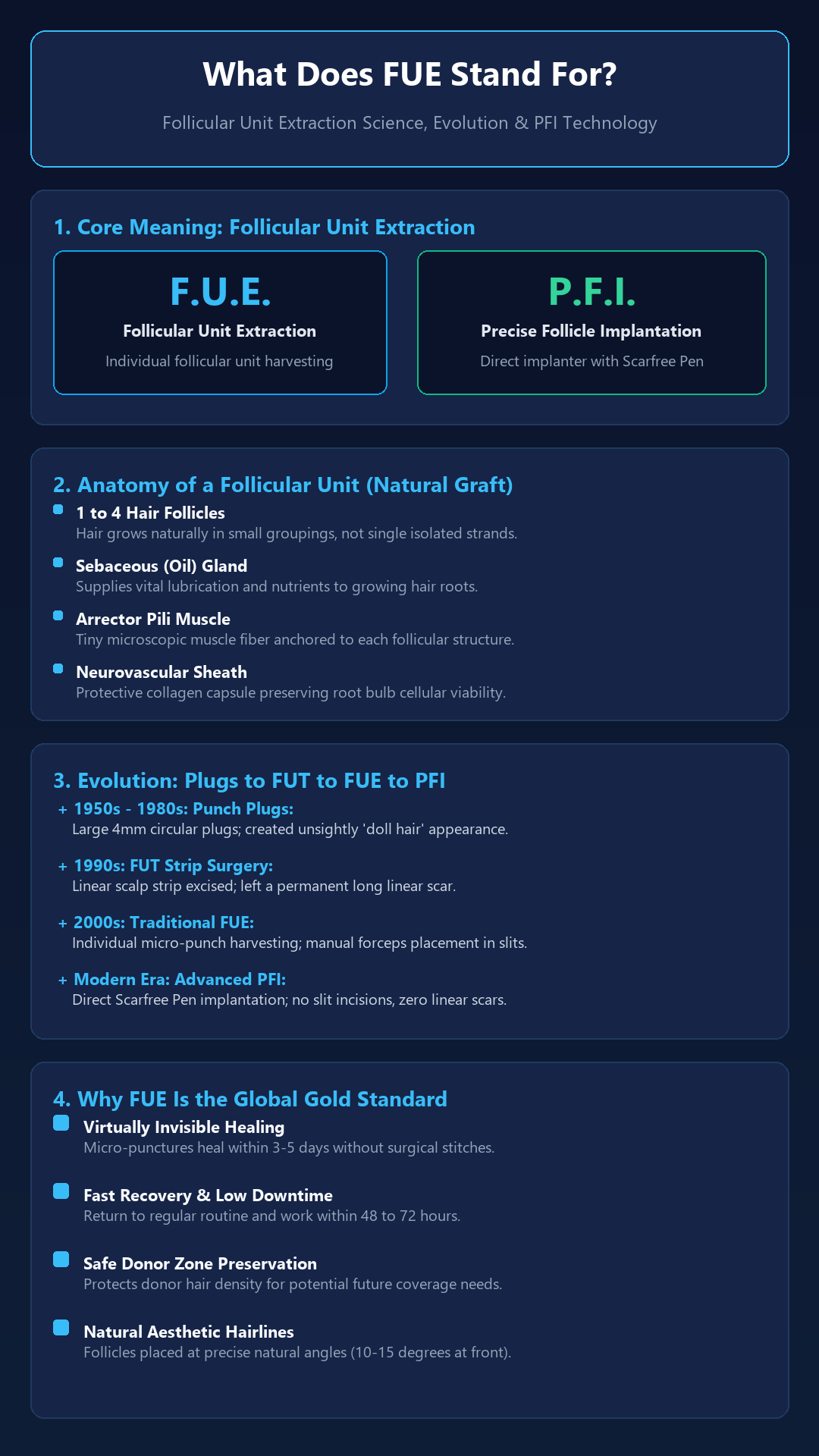
Table of Contents
- What Does FUE Stand For? Clinical Definition & Core Principles
- The Biology & Anatomy of a Natural Follicular Unit
- From Plugs to Strip to FUE: The Evolution of Hair Restoration
- Step-by-Step: How an FUE Procedure Is Performed
- FUE vs. FUT: Key Technical Differences
- Beyond Traditional FUE: The Precise Follicle Implantation (PFI) Advantage
- Consulting Dr Arefa Patel at Elite Dermadent
- Frequently Asked Questions (FAQs)
What Does FUE Stand For? Clinical Definition & Core Principles
In dermatological trichology, FUE stands for Follicular Unit Extraction (sometimes referred to internationally as Follicular Unit Excision). Introduced in the early 2000s, this technique revolutionized hair restoration by replacing invasive strip harvesting with micro-surgical precision.
The core principle of FUE is harvesting individual follicular units directly from the patient’s scalp using tiny circular micro-punches ranging from 0.75mm to 0.85mm in diameter. Because each follicle is harvested individually without cutting large swathes of skin, healing is fast, pain is minimal, and the tiny circular extraction sites heal as virtually undetectable micro-dots.
The Biology & Anatomy of a Natural Follicular Unit
To appreciate why FUE is so successful, it helps to understand how human hair actually grows. Under dermatoscopic magnification, human scalp hair does not emerge as separate, solitary strands. Instead, it grows in distinct anatomical groups known as follicular units (FUs).
Each complete follicular unit contains:
- 1 to 4 Hair Follicles: Single-hair units naturally grow along the soft frontal hairline, while 2-, 3-, and 4-hair units provide density behind the hairline and across the mid-scalp and crown.
- Sebaceous Gland: The natural oil gland that nourishes the hair shaft.
- Arrector Pili Muscle: The tiny muscle responsible for hair erection and positioning.
- Neurovascular Plexus & Collagen Sheath: The protective adventitial sheath that preserves vital dermal papilla stem cells.
FUE respects this natural biological architecture, ensuring the entire follicular unit remains intact and healthy during transplantation.
From Plugs to Strip to FUE: The Evolution of Hair Restoration
Hair restoration technology has progressed through distinct eras over the last several decades:
| Era / Method | Harvesting Technique | Scarring Outcome | Aesthetic Naturalness |
|---|---|---|---|
| 1950s–1980s: Punch Plugs | Large 4mm circular punches containing 15–20 hairs | Severe cobblestone scarring | Harsh “doll hair” plug appearance |
| 1990s: FUT Strip Surgery | Surgical excision of a horizontal strip of scalp tissue | Permanent linear ear-to-ear scar | Moderate naturalness; limited styling |
| 2000s: Standard FUE | Individual micro-punches (<0.85mm); forceps placement | Tiny micro-dots; undetectable with short hair | High naturalness; 90%–93% survival |
| Modern: Advanced PFI (Scarfree Pen) | Direct simultaneous implantation without slit cuts | Near-zero visible scarring; rapid healing | Undetectable hairline; 95%–98%+ survival |
Step-by-Step: How an FUE Procedure Is Performed
A standard FUE hair transplant follows a meticulous, systematic clinical protocol:
- Hairline Design & Scalp Mapping: The surgeon assesses donor density using digital trichoscopy and draws a tailored, age-appropriate hairline.
- Local Anesthesia: The donor and recipient areas are desensitized with buffered local anesthesia, making the entire procedure pain-free.
- Follicular Extraction: Using a specialized micro-punch tool, the surgeon gently scores the skin around each follicular unit and lifts it from the donor zone.
- Graft Inspection & Chilled Preservation: The extracted grafts are sorted under stereo microscopes and preserved in hypothermic holding solutions to maintain cellular viability.
- Recipient Implantation: The grafts are strategically placed into thinning areas at precise angles (10 to 15 degrees at the hairline) to match natural growth.
FUE vs. FUT: Key Technical Differences
While both procedures harvest hair from the safe donor zone, FUE offers several decisive advantages over FUT:
- No Scalpel Incisions or Sutures: FUE eliminates surgical staples and stitches, drastically reducing recovery discomfort.
- Faster Healing: FUE extraction sites close completely within 48 to 72 hours, whereas an FUT surgical incision requires 2 to 3 weeks of healing.
- Hairstyle Freedom: FUE patients can wear buzz cuts or fade hairstyles without worrying about a prominent horizontal strip scar.
Beyond Traditional FUE: The Precise Follicle Implantation (PFI) Advantage
While standard FUE marked a massive leap forward, traditional methods still rely on cutting recipient slits with needles or scalpels before manually pushing grafts into place with forceps. This manual handling carries a risk of follicle bulb trauma.
At Elite Dermadent, we utilize the groundbreaking Precise Follicle Implantation (PFI) technique with the Scarfree Pen:
- Simultaneous Site Creation & Implantation: The Scarfree Pen creates the microscopic opening and implants the follicle simultaneously.
- Root Protection: The follicle bulb is housed safely inside a hollow needle, avoiding any forceps pinching or crush damage.
- Unrivaled Survival Rates: Minimized out-of-body holding time ensures graft survival yields reaching 95% to 98%+.
Consulting Dr Arefa Patel at Elite Dermadent
Restoring a natural, permanent hairline requires clinical precision and artistic expertise. Under the leadership of Dr Arefa Patel, Trichologist and Skin Specialist, Elite Dermadent provides premier Hair Transplant treatments utilizing the advanced PFI technique with the Scarfree Pen.
Schedule your personalized consultation today to receive a comprehensive trichological evaluation and custom restoration plan.
Frequently Asked Questions (FAQs)
1. What does FUE stand for in hair transplant surgery?
FUE stands for Follicular Unit Extraction. It describes the modern surgical technique of harvesting individual follicular units (clusters of 1 to 4 hairs) directly from the donor scalp using microscopic punches without removing a surgical strip of skin.
2. Does FUE leave permanent visible scars?
No. FUE creates tiny pinpoint circular micro-wounds (<0.85mm) that heal naturally within 3 to 5 days, leaving tiny, near-invisible micro-dots that are undetectable even with short faded hairstyles.
3. What is the difference between a graft and a hair follicle in FUE?
A hair follicle is a single hair strand, while a graft (follicular unit) is a naturally occurring cluster of 1, 2, 3, or 4 hair follicles sharing the same root apparatus. On average, 1 graft equals roughly 2.2 to 2.5 hairs.
4. How is PFI different from standard FUE?
Precise Follicle Implantation (PFI) is an advanced evolution of FUE. Instead of cutting slit incisions and manually placing follicles with forceps, PFI uses the specialized Scarfree Pen to create the site and implant the follicle simultaneously, protecting root bulbs and boosting survival up to 98%.
5. Are hair follicles harvested during FUE permanent?
Yes. The donor follicles are harvested from the occipital region at the back and sides of the scalp, which is genetically immune to Dihydrotestosterone (DHT). Once transplanted, they maintain their genetic immunity and continue growing permanently for life.
No responses yet