
If you are considering hair restoration, the foremost question on your mind is likely: how successful is an FUE hair transplant? Clinical data and trichological research show that Follicular Unit Extraction (FUE) achieves an impressive 90% to 95% average graft survival rate when performed by experienced specialists. With modern advancements like Precise Follicle Implantation (PFI) utilizing the Scarfree Pen, follicle viability can reach 95% to 98%+, delivering natural, lifetime results with virtually invisible scarring.
Key Takeaways:
- High Survival Rate: 90% to 95% of harvested follicular grafts survive and produce permanent growing hair in standard FUE.
- Advanced Technique Advantage: Direct implanter techniques like PFI eliminate the need for pre-made slit incisions, achieving up to 98% graft survival.
- Permanent Results: Follicles harvested from the DHT-resistant safe donor zone at the back of the scalp remain genetically resistant to hair loss for life.
- Growth Milestones: Initial shedding occurs within weeks 2 to 6, visible new growth begins at 3 to 4 months, and complete maturation is achieved by month 12.
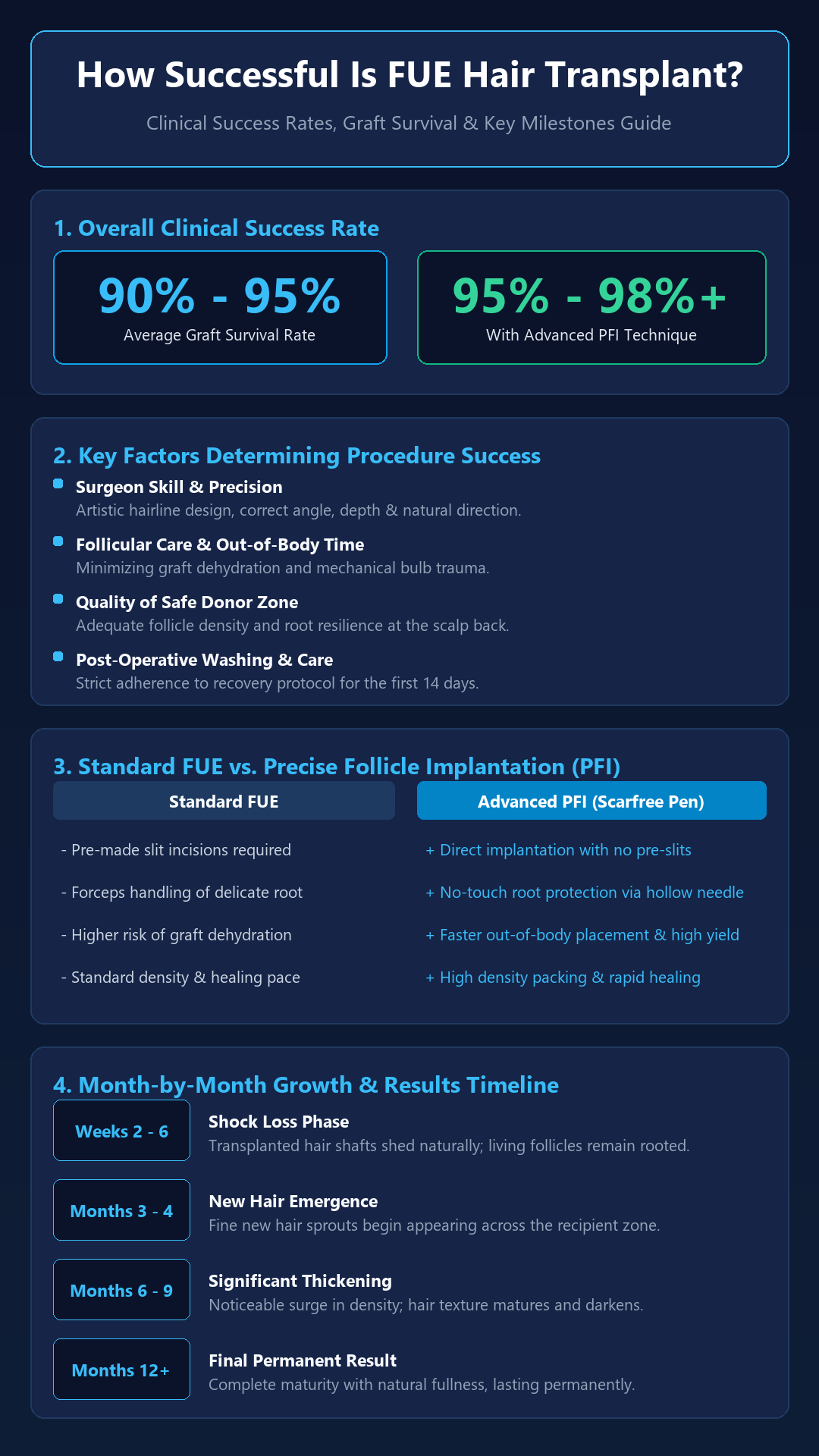
Table of Contents
- What Is the Real Success Rate of FUE Hair Transplantation?
- 5 Critical Factors That Determine FUE Hair Transplant Success
- Standard FUE vs. Advanced PFI (Precise Follicle Implantation)
- Month-by-Month Hair Growth Timeline
- How to Maximize Your Hair Transplant Results
- Consulting a Hair Restoration Specialist
- Frequently Asked Questions (FAQs)
What Is the Real Success Rate of FUE Hair Transplantation?
In modern restorative trichology, success is evaluated through two key metrics: graft survival yield and aesthetic naturalness.
From a biological standpoint, graft survival refers to the percentage of extracted follicular units that take root, establish microvascular circulation (revascularization), and generate active anagen hair fibers. In accredited clinics following international standards, FUE graft survival ranges reliably between 90% and 95%.
From an aesthetic perspective, an FUE procedure is considered successful when:
- The hairline design perfectly complements the patient’s facial proportions and age.
- Hair follicles are placed at natural angles (10 to 15 degrees at the hairline) and directions.
- The donor area retains balanced density without patchy “moth-eaten” thinning or noticeable scarring.
5 Critical Factors That Determine FUE Hair Transplant Success
While the FUE technique is exceptionally refined, outcomes vary based on surgical expertise, biological factors, and post-operative protocol. Here are the five primary factors that influence procedure success:
1. Surgeon Expertise & Surgical Skill
Hair restoration is a delicate blend of microsurgery and artistry. An experienced hair transplant doctor meticulously evaluates the donor scalp, selects single-hair follicular units for the soft transitional hairline, and reserves multi-hair follicular units (2 to 4 hairs) for mid-scalp and crown density. Improper punch depth, angle misalignment, or transecting the hair bulb can permanently ruin graft viability.
2. Out-of-Body Time & Graft Hydration
Once a follicular unit is harvested from the donor zone, its biological clock begins ticking. Follicles are highly sensitive to dehydration, temperature fluctuations, and oxidative stress. Maintaining optimal hydration in specialized hypothermic storage solutions and minimizing out-of-body holding time is essential for maximizing follicular yield.
3. Quality & Density of the Safe Donor Zone
The success of any hair transplant depends fundamentally on the health of your donor area—the occipital and parietal regions at the back and sides of the head. These follicles are genetically immune to Dihydrotestosterone (DHT), the hormone responsible for androgenetic alopecia. Candidates with dense, resilient donor hair achieve the highest cosmetic coverage.
4. Gentle Handling & Bulb Protection
Traditional forceps placement requires gripping the delicate follicle bulb, which carries an inherent risk of mechanical crushing or micro-trauma. Advanced tools that avoid direct bulb manipulation ensure higher survival rates and faster tissue re-anchoring.
5. Patient Compliance & Post-Operative Care
The first 10 to 14 days following surgery are critical. Patients must follow gentle washing instructions, avoid scratching scabs, sleep with their head elevated, and refrain from strenuous physical exertion, smoking, and direct sun exposure until the newly implanted grafts are securely anchored.
Standard FUE vs. Advanced PFI (Precise Follicle Implantation)
To further enhance graft yield and patient comfort, cutting-edge hair restoration centers have transitioned from traditional FUE to Precise Follicle Implantation (PFI) utilizing the specialized Scarfree Pen.
| Feature / Parameter | Traditional FUE | Advanced PFI (Scarfree Pen) |
|---|---|---|
| Recipient Channel Creation | Pre-made incisions/slits using scalpel or needles | Simultaneous site creation and graft insertion |
| Follicle Handling | Forceps grip directly on root or bulb | Protected inside hollow needle; zero bulb trauma |
| Angle & Depth Control | Dependent on pre-cut channel orientation | Surgeon controls 360-degree angle, depth & direction |
| Graft Survival Rate | 90% – 95% | 95% – 98%+ |
| Bleeding & Scalp Trauma | Moderate bleeding and tissue swelling | Minimal bleeding, tiny micro-punctures |
| Visible Scarring | Tiny micro-dots in donor zone | Virtually undetectable / scar-free healing |
The Precise Follicle Implantation technique eliminates the gap between site incision and graft insertion. Because each follicle is safely loaded into the hollow cannula of the Scarfree Pen and placed directly into the scalp, there is minimal mechanical friction, significantly reducing follicle loss and enabling superior density packing.
Month-by-Month Hair Growth Timeline
Understanding the hair transplant recovery timeline prevents unnecessary anxiety during the early healing stages:
Weeks 1 to 2: Healing and Graft Anchoring
Tiny crusts or scabs form around the transplanted grafts. By day 10, the grafts are firmly rooted into the recipient dermal tissue. Gentle washing will naturally wash away the crusts.
Weeks 2 to 8: Shock Loss (Telogen Effluvium)
Do not be alarmed if transplanted hair shafts begin to shed—this phenomenon is called shock loss. The hair shaft falls out, but the vital dermal papilla and follicle stem cells remain securely settled beneath the skin, entering a temporary resting phase.
Months 3 to 4: Early Hair Sprouting
New, fine hairs begin emerging from the scalp. They may initially appear thin or slightly curly, but this marks the beginning of active anagen growth.
Months 6 to 9: Substantial Density and Thickening
Around 60% to 70% of the transplanted hair has now emerged. The hair shafts become significantly thicker, darker, and more uniform, providing noticeable aesthetic coverage.
Months 12 to 15: Full Maturation & Final Density
By month 12 (up to 15 months for crown/vertex restoration), 100% of the surviving grafts have matured. The results are permanent, natural-looking, and can be washed, styled, and cut just like natural hair.
How to Maximize Your Hair Transplant Results
To ensure your FUE procedure reaches the top tier of clinical success, implement these proven practices:
- Select a Qualified Specialist: Ensure your procedure is performed by a dedicated trichologist or aesthetic surgeon who specializes in advanced micro-follicular techniques.
- Protect Grafts During the First 14 Days: Avoid rubbing, wearing tight hats, swimming, and heavy lifting.
- Follow a Medical Maintenance Plan: Stabilize native non-transplanted hair with medical therapies recommended by your specialist, such as topical solutions, nutritional supplements, or Platelet-Rich Plasma (PRP) sessions.
- Maintain a Nutrient-Rich Diet: Support follicle vitality with adequate dietary protein, iron, zinc, biotin, and antioxidants.
Consulting a Hair Restoration Specialist
Every individual’s hair loss pattern, donor capacity, and scalp elasticity are unique. Under the expert care of Dr Arefa Patel, Trichologist and Skin Specialist, Elite Dermadent specializes in advanced Hair Transplant treatments using the groundbreaking Precise Follicle Implantation (PFI) technique with the Scarfree Pen.
A comprehensive trichological examination determines your exact Norwood stage, donor density, and graft requirements, providing a transparent, predictable roadmap to restoring a natural, full head of hair.
Frequently Asked Questions (FAQs)
1. How successful is an FUE hair transplant permanently?
FUE hair transplants have an exceptionally high permanent success rate of 90% to 95%. Because harvested follicles are taken from the DHT-resistant donor zone at the back and sides of the scalp, they retain their genetic resistance and continue to grow permanently in the recipient area for life.
2. What percentage of transplanted grafts survive?
In standard FUE performed by experienced clinics, graft survival averages between 90% and 95%. When using advanced direct implantation tools like the PFI Scarfree Pen, graft survival yields regularly exceed 95% to 98% due to minimized out-of-body holding time and no root handling trauma.
3. Can an FUE hair transplant fail? What causes poor results?
While rare with experienced surgeons, poor results can happen due to unqualified technicians, excessive out-of-body graft dehydration, transection of the follicle bulb during punch extraction, poor donor assessment, or inadequate post-operative washing and care during the first two weeks.
4. How is PFI hair transplant better than traditional FUE?
Precise Follicle Implantation (PFI) uses the Scarfree Pen to create the recipient site and place the follicle simultaneously without pre-made slit cuts. This reduces bleeding, eliminates mechanical bulb crushing, allows exact control over angle and depth, ensures faster healing, and produces virtually invisible scarring.
5. When can I see the final results of my FUE procedure?
Initial growth begins between months 3 and 4 after the initial shedding phase. Noticeable thickness develops between months 6 and 9, and the final, full-density result is achieved between 12 and 15 months after the procedure.
No responses yet