
Discovering pain, tenderness, or swelling in a tooth that you thought was permanently resolved with a root canal years ago can be deeply frustrating. Many patients immediately assume that a failing treated tooth must be extracted. However, a crucial question dentists hear every day is: can root canal be done twice on same tooth, and can a second procedure genuinely save it?
The definitive clinical answer is yes, a root canal can definitely be done twice on the same tooth. In dental medicine, this secondary procedure is formally known as Endodontic Retreatment. Retreatment is a routine, highly predictable procedure boasting documented clinical success rates between 75% and 85%+. When an initial treatment fails to heal or develops a secondary bacterial flare-up due to missed microscopic canals, delayed crown placement, or new decay, retreatment cleanses the infected root system and provides your natural tooth with a long-lasting second chance.
Key Takeaways: Doing a Root Canal a Second Time
- Proven High Success Rate: Endodontic retreatment successfully saves 75% to 85%+ of teeth that experience post-treatment infections, preventing the need for surgical extraction.
- Why Redoing It Is Necessary: The most common culprits are complex, curved, or missed accessory canals (like the MB2 canal in molars), saliva contamination from lost temporary fillings, and recurrent decay beneath an old crown.
- Advanced Microscopic Protocol: Retreatment involves removing the existing crown and old gutta-percha root filler, thoroughly disinfecting hidden canals with ultrasonic irrigants, and resealing the tooth with modern bioceramic sealers.
- Biologically Superior to Implants: Preserving your natural tooth root maintains your natural jawbone volume, chewing sensory feedback, and dental alignment without requiring invasive surgical extractions.
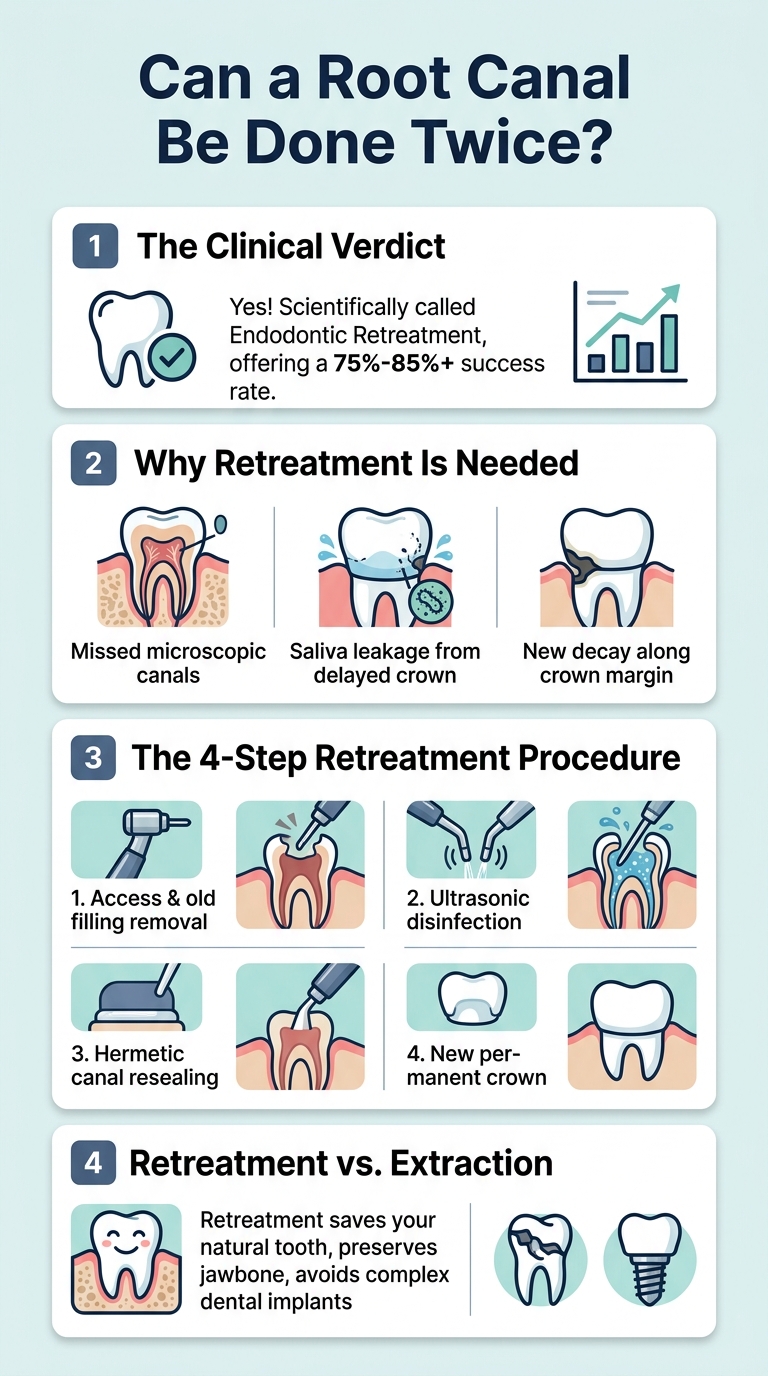
Table of Contents
- What Is Endodontic Retreatment and How Does It Work?
- Why Does a Root Canal Need to Be Done Twice?
- Step-by-Step Breakdown of the Retreatment Procedure
- Initial Root Canal vs. Retreatment: Comparison Table
- Retreatment vs. Tooth Extraction: Which Is Better?
- When Can a Tooth NOT Be Retreated?
- Specialized Endodontic Retreatment at Elite Dermadent
- Frequently Asked Questions
What Is Endodontic Retreatment and How Does It Work?
While primary root canal therapy has an extraordinary initial success rate exceeding 90% to 95%, biological systems can occasionally encounter complications. A tooth may fail to heal initially, or an infection may re-emerge months or decades later.
When you ask can root canal be done twice on same tooth, it is important to understand that retreatment is not simply a repeat of the original appointment. It is a specialized micro-endodontic procedure. The endodontist disassembles the existing restoration, navigates past previous filling materials, searches for previously undetectable micro-anatomy using optical magnification, eradicates persistent bacterial biofilms, and reseals the entire canal system hermetically.
Why Does a Root Canal Need to Be Done Twice?
Several clinical circumstances can cause a previously treated tooth to require a second intervention:
- Narrow, Curved, or Missed Canals:
Human tooth roots often feature microscopic branching networks, lateral fins, and hidden canals. For example, upper first molars frequently possess a fourth canal (the mesiobuccal-2 or MB2 canal). If an accessory canal was too narrow or curved to detect during the initial treatment, trapped bacteria will eventually cause a periapical infection at the root tip.
- Delayed Placement of a Permanent Crown:
Following a root canal, the tooth is sealed with a temporary filling. If a patient delays having a permanent, custom-fitted crown placed for more than 3 to 4 weeks, saliva and oral bacteria can penetrate through the temporary material, contaminating the root filling.
- Recurrent Decay Beneath the Crown Margin:
While artificial crowns cannot decay, the natural tooth root supporting the crown at the gumline remains vulnerable. If plaque causes recurrent caries (cavities) along the crown edge, bacteria can leak underneath the restoration and reinfect the canal spaces.
- Cracked, Loose, or Dislodged Restorations:
Chewing on hard foods or nighttime teeth grinding (bruxism) can break the cement seal of a crown, allowing bacteria to enter the sterile pulp chamber.
- Resistant Bacterial Strains:
Certain resilient bacterial colonies, such as Enterococcus faecalis, can form dense protective biofilms that survive initial chemical irrigation, requiring specialized ultrasonic disinfection during a second procedure.
Step-by-Step Breakdown of the Retreatment Procedure
Endodontic retreatment is a precise, multi-stage clinical process performed with gentle local anesthesia:
- Access and Disassembly: The dentist isolates the tooth with a sterile rubber dam, numbs the area completely, and creates a small access opening through the crown (or carefully removes the crown and post if necessary) to reach the pulp chamber.
- Unfilling the Canals: Using specialized nickel-titanium rotary retreatment files and biocompatible chemical solvents, the endodontist gently dissolves and extracts the previous gutta-percha root filling material.
- Microscopic Inspection: Using high-magnification dental operating loupes, the specialist inspects the inside of the tooth to locate previously missed canals, calcifications, or unusual curvatures.
- Ultrasonic Disinfection: The canals are flushed with warm antimicrobial irrigants activated by ultrasonic vibration. The acoustic streaming penetrates deep into microscopic dentinal tubules to eradicate resistant bacteria.
- Therapeutic Medication & 3D Resealing: Often, an antibacterial paste (such as calcium hydroxide) is placed inside the canals for 1 to 2 weeks to guarantee total sterility. Once fully disinfected, the canals are obturated with fresh gutta-percha and advanced bioceramic sealers.
- Crown Restoration: A strong, precision-milled permanent crown is placed over the tooth, providing an airtight seal against future bacterial microleakage.
Initial Root Canal vs. Retreatment: Comparison Table
The table below highlights the key procedural and technical differences between an initial root canal and endodontic retreatment:
| Evaluation Metric | Initial Root Canal Treatment | Endodontic Retreatment (Second Time) |
|---|---|---|
| Primary Objective | Remove inflamed or dead pulp nerve tissue | Remove old filling material, locate missed canals, clear infection |
| Clinical Complexity | Standard endodontic procedure | Advanced micro-endodontic procedure |
| Gutta-Percha Removal | Not applicable (canals contain natural tissue) | Requires solvents and rotary files to extract previous filler |
| Typical Success Rate | 90% – 95%+ | 75% – 85%+ |
| Appointments Required | Usually 1 appointment (single-sitting) | 1 to 2 appointments (to allow intracanal medication to work) |
Retreatment vs. Tooth Extraction: Which Is Better?
When faced with a failing root canal, patients often weigh the choice between re-treating the tooth or simply pulling it out. In nearly all clinical scenarios where the tooth is structurally sound, retreatment is the preferred and biologically superior option:
- Preserves Natural Jawbone: When a tooth is extracted, the surrounding alveolar bone begins to resorb and shrink over time. Retreatment preserves the root, maintaining jawbone height and width.
- Maintains Natural Biting Dynamics: Your natural tooth root contains periodontal mechanoreceptors that provide fine sensory feedback during chewing—something artificial dental implants cannot duplicate.
- More Cost-Effective Than Implants: Extracting a tooth requires a multi-stage replacement process (surgical extraction, bone grafting, implant screw placement, healing abutment, and implant crown) which takes 4 to 9 months and costs substantially more than endodontic retreatment.
When Can a Tooth NOT Be Retreated?
While retreatment can save the vast majority of teeth, there are specific situations where a tooth cannot be predictably preserved:
- Vertical Root Fracture (VRF): If a crack extends vertically through the root trunk down into the bone, the tooth cannot be sealed and must be gently extracted.
- Severe Periodontal Bone Loss: If advanced gum disease has destroyed the bone supporting the tooth, causing high mobility, endodontic treatment cannot restore stability.
- Insufficient Healthy Tooth Structure: If recurrent decay has destroyed the tooth below the level of the surrounding jawbone, there may not be enough solid tooth structure left to retain a crown.
Specialized Endodontic Retreatment at Elite Dermadent
Successfully redoing a root canal requires advanced endodontic skill, high-powered magnification, and specialized micro-instruments. At Elite Dermadent, restorative and endodontic procedures are guided by Dr. Saurabh Pakhale, a distinguished dental surgeon renowned for his conservative, tooth-preserving philosophy.
Dr. Pakhale specializes in micro-endodontic revisions utilizing electronic apex locators, flexible heat-treated rotary files, and ultrasonic disinfection to locate hidden accessory canals and resolve persistent infections safely and painlessly. If you are experiencing discomfort in a previously treated tooth, discover how our specialized root canal retreatment in Thane or primary root canal treatment in Thane can save your natural smile for a lifetime.
Frequently Asked Questions
Is a second root canal more painful than the first?
No. Modern endodontic retreatment is performed under profound local anesthesia, ensuring you remain completely comfortable and pain-free throughout the entire procedure. Most patients report feeling only light vibration and gentle pressure.
How long does a second root canal take?
Because retreatment requires carefully disassembling previous fillings and meticulously searching for missed canals under magnification, it typically takes 60 to 90 minutes. In cases with severe infection, the specialist may divide the treatment across two visits to allow an antibacterial paste to thoroughly disinfect the tooth.
Can a root canal be done a third time?
While technically possible in rare instances, endodontists generally prefer not to perform a third non-surgical retreatment. If a tooth fails after a second root canal, root-end microsurgery (apicoectomy) or gentle extraction followed by a dental implant is usually recommended.
What happens if I don’t retreat an infected root canal tooth?
Leaving an infected root canal untreated allows bacteria to erode the surrounding jawbone, forming an expanding abscess. Over time, the infection can cause facial swelling, severe pain, and permanent bone destruction, eventually forcing the extraction of the tooth.
How long will a retreated root canal tooth last?
With thorough micro-endodontic cleaning, a well-sealed permanent crown, daily flossing, and routine 6-month checkups, a retreated tooth can last 10 to 15 years—and often a lifetime.
No responses yet