
Noticing thinning hair in the mirror, an increasingly prominent forehead, or a widening crown can be distressing. While non-surgical remedies exist, there comes a point where many wonder: when hair transplant is required, and how do you know if you are an ideal candidate for surgical restoration?
A hair transplant is clinically required when hair follicles in thinning or bald areas have completely miniaturized, died, or scarred over—meaning medical treatments such as minoxidil, finasteride, or PRP therapy can no longer stimulate them to grow new hair. Typically, this threshold occurs at Norwood Scale Stage 3 or higher in men (or Ludwig Scale Grade II in women), provided the patient has a stabilized hair loss pattern, is generally 25 years of age or older, and possesses sufficient healthy donor follicles on the back and sides of the scalp.
Key Takeaways: When to Opt for a Hair Transplant
- Follicle Inactivity: Once hair follicles completely disappear or scalp skin becomes slick and smooth, only surgical transplantation can restore permanent growing hair.
- Norwood Scale Sweet Spot: Stages 3 to 5 represent the ideal window where hair loss is well-defined, and sufficient permanent donor hair remains available.
- Age & Stabilization: Undergoing surgery before hair loss patterns stabilize (typically under age 25) can leave unnatural patches as native hair continues to recede behind the transplant.
- Advanced PFI Precision: When surgery is required, cutting-edge direct implantation techniques like Precise Follicle Implantation (PFI) using the Scarfree Pen eliminate manual scalpel cuts, maximize graft survival (95%+), and deliver undetectable healing.
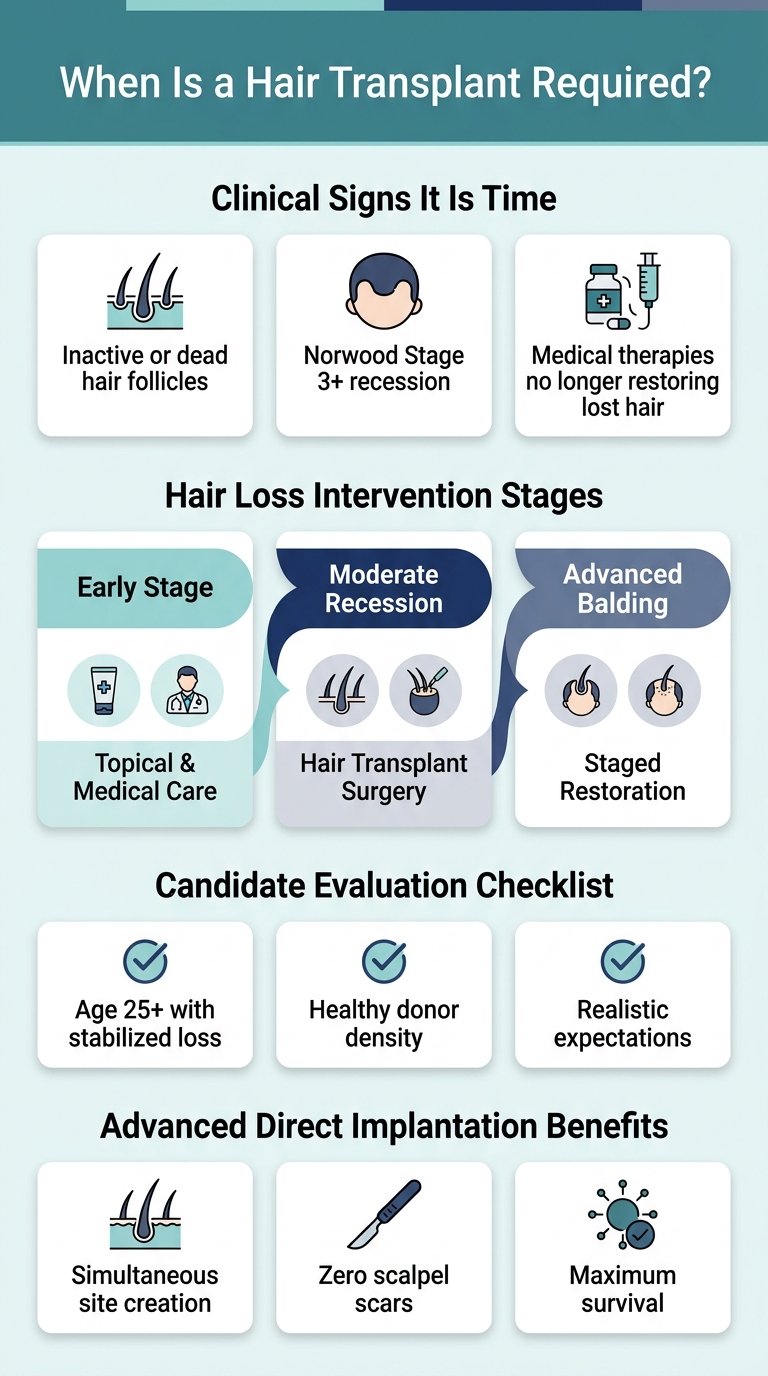
Table of Contents
- Clinical Signs That a Hair Transplant Is Required
- The Norwood Scale: Which Stages Require Surgery?
- Why Age and Hair Loss Stabilization Are Critical
- Treatment Matrix: Medical vs. Regenerative vs. Surgical
- When Surgery Is Needed: The PFI Scarfree Pen Advantage
- When Is a Hair Transplant NOT Recommended?
- Frequently Asked Questions
Clinical Signs That a Hair Transplant Is Required
Hair loss occurs along a spectrum. Understanding whether you need preventative medical treatment or surgical intervention depends on identifying specific clinical indicators:
- Smooth, Shiny Scalp Skin with No Fine Vellus Hair:
If you examine your thinning areas under bright light and see tiny, fine “peach fuzz” hairs (vellus hair), the follicles are miniaturized but still alive; these can often be revitalized with medical treatments. However, once the scalp appears completely bare, smooth, and shiny, the follicular ostia have closed permanently. Only surgical transplantation can repopulate these areas.
- Receding M-Shaped or V-Shaped Hairline:
A mature hairline naturally sits 1 to 1.5 cm above the highest adolescent forehead crease. When recession moves deeper into the temporal peaks, creating a pronounced “M” or “V” shape that alters your facial proportions, surgical hairline reconstruction is required to rebuild youthful symmetry.
- Medical Therapies Have Plateaued:
If you have consistently used evidence-based medical therapies (such as topical or oral minoxidil, finasteride, and clinical PRP sessions) for 12 months with no noticeable regrowth along the hairline or crown, medical maintenance has reached its ceiling. Surgery is required to fill empty spaces.
- Traction Alopecia or Scars:
Hair loss caused by continuous tight hairstyles (traction alopecia) or trauma/burn scars cannot be reversed with medications because the follicle roots are mechanically destroyed or replaced by scar tissue. A targeted hair transplant is the only viable permanent remedy.
The Norwood Scale: Which Stages Require Surgery?
Dermatologists and hair restoration specialists classify male pattern baldness using the Norwood Scale (Stages 1 through 7). Here is how surgical timing aligns with each stage:
- Norwood Stage 1 (No Significant Loss): Normal adolescent-to-mature hairline. No surgery required.
- Norwood Stage 2 (Mild Temporal Recession): Natural adult maturation of the hairline. Surgery is generally premature; medical monitoring and preventative care are advised.
- Norwood Stage 3 (The Tipping Point): Deep symmetrical recession at the temples, either bare or sparsely covered. This is the earliest stage where a hair transplant is officially recommended.
- Norwood Stage 4 (Deep Frontal & Crown Thinning): Noticeable frontal recession combined with a distinct thinning spot on the vertex (crown). A hair transplant is strongly indicated to restore both zones.
- Norwood Stage 5 (Extensive Balding): Frontal recession and crown baldness expand, separated only by a narrow band of thinning hair. Highly suitable for hair transplantation, often requiring 2,500 to 3,500+ grafts.
- Norwood Stage 6 & 7 (Severe Baldness): The bridge of hair is gone, leaving only a horseshoe band of hair around the sides and back. Surgery is possible but requires realistic expectations, staged sessions, and careful donor management.
Why Age and Hair Loss Stabilization Are Critical
One of the most frequent mistakes prospective patients make is rushing into surgery too early. A 20-year-old noticing slight temple recession may be eager for a quick fix, but hair loss is a dynamic, progressive genetic condition driven by dihydrotestosterone (DHT).
If you transplant hair at age 20 without medical stabilization, your native, non-transplanted hair behind the grafts will continue to thin over the next 5 to 10 years. This creates an isolated “island” of transplanted hair surrounded by progressive baldness, requiring awkward revision procedures. For this reason, ethical hair specialists advise waiting until at least age 25 or older, when hair loss patterns can be accurately predicted and stabilized with medical therapy.
Treatment Matrix: Medical vs. Regenerative vs. Surgical
To help you decide whether your hair loss currently warrants surgery, the table below highlights the clinical indications, recovery, and results across all three tiers of hair restoration:
| Treatment Tier | Primary Modalities | When Is It Required? | Expected Outcome |
|---|---|---|---|
| Tier 1: Preventative & Medical | Finasteride, Dutasteride, Minoxidil, LLLT | Early thinning (Norwood 1–2), active shedding, preserving native hair | Halts loss progression; thickens existing weak follicles; cannot grow new follicles in bare areas |
| Tier 2: Regenerative Therapies | PRP (Platelet-Rich Plasma), GFC (Growth Factor Concentrate) | Diffuse thinning, seasonal shedding, post-surgical healing boost | Stimulates micro-circulation; prolongs anagen growth cycle; strengthens miniaturizing shafts |
| Tier 3: Surgical Hair Restoration | Direct PFI (Scarfree Pen), Advanced FUE | Norwood 3+, permanent hairline recession, crown baldness, dormant roots | Permanent, life-long hair growth in previously bald areas with natural density |
When Surgery Is Needed: The PFI Scarfree Pen Advantage
Once you confirm that a hair transplant is necessary, selecting the right surgical technique is paramount. Traditional strip surgery (FUT) leaves a noticeable linear scar, and conventional FUE involves cutting channels before manually pushing grafts with forceps.
At Elite Dermadent, patient care is spearheaded by Dr Arefa Patel, Trichologist and Skin Specialist, who specializes in the cutting-edge Precise Follicle Implantation (PFI) technique utilizing the innovative Scarfree Pen.
Why PFI with the Scarfree Pen Is the Preferred Choice:
The Scarfree Pen is an advanced direct implanter that houses harvested follicular units inside an ultra-fine hollow needle. When guided by the specialist, the device punctures the scalp and seats the follicle simultaneously:
- No Pre-Cut Slits: Eliminates scalpel cuts, reducing scalp trauma, bruising, and bleeding to near zero.
- Dynamic Angle and Depth Precision: Allows Dr. Patel to implant hairs at exact angles (from 10° at the hairline to 45° on the mid-scalp), perfectly mimicking natural growth vectors.
- Exceptional 95%+ Graft Survival: The follicle root is fully protected within the needle channel during implantation, avoiding crushing or transection caused by traditional forceps.
- Virtually Undetectable Recovery: Micro-punctures heal within 3 to 5 days with no linear scar and zero noticeable dot marks.
Explore our tailored hair transplant procedure options to see before-and-after transformations and learn how PFI can restore your confidence.
When Is a Hair Transplant NOT Recommended?
Even if you are losing hair, a hair transplant may be contraindicated under certain clinical conditions:
- Active Alopecia Areata: This autoimmune condition attacks hair follicles erratically. Transplanted follicles will also be attacked unless the autoimmune activity is resolved.
- Insufficient Donor Hair: If the donor zone at the back of the scalp is too sparse or miniaturized, attempting a transplant will deplete donor hair without delivering adequate recipient density.
- Uncontrolled Chronic Conditions: Unmanaged diabetes, active scalp dermatitis, or blood coagulation disorders must be treated before elective microsurgery can proceed.
- Unrealistic Expectations: A hair transplant redistributes existing follicles; it does not generate brand-new hair from scratch. Clear communication with your trichologist ensures realistic expectations.
Frequently Asked Questions
At what age is a hair transplant most effective?
A hair transplant is most effective from age 25 and older. By this age, male or female pattern hair loss typically follows an identifiable pattern, allowing the surgeon to design a durable, age-appropriate hairline that remains natural as you age.
Can I wait too long to get a hair transplant?
Yes. If you delay surgery until Norwood Stage 7 where the donor area around the back and sides has significantly thinned or depleted, there may not be enough healthy follicular units left to cover the balding recipient area effectively.
Can medical treatments replace the need for a hair transplant?
Medical treatments (finasteride, minoxidil, PRP) are effective at slowing active hair loss and thickening miniaturized hair. However, if hair follicles have already died and scalp skin is smooth, medication cannot revive them, and a hair transplant is the only way to regrow hair in those zones.
How do I know if my donor area is strong enough?
A qualified trichologist performs a high-magnification trichoscopy examination to evaluate your donor zone’s follicle density (follicular units per square centimeter), hair shaft caliber, and percentage of multi-hair grafts to determine your donor capacity.
How long does recovery take after a modern PFI hair transplant?
With advanced PFI using the Scarfree Pen, recovery is remarkably swift. Most patients experience minimal redness that subsides within 48 to 72 hours, and tiny micro-scabs shed naturally within 7 to 10 days, allowing a seamless return to work and daily activities.
No responses yet