

If you are struggling with hair loss and researching restoration options, one question quickly dominates your search: where is hair transplant cheaper? In countries like the United States, the United Kingdom, and Canada, surgical hair restoration typically costs between $8,000 and $18,000. Faced with these prohibitive domestic price tags, hundreds of thousands of men and women travel abroad each year for medical tourism, seeking quality results at a fraction of the cost.
In top medical travel destinations like India and Turkey, a full Follicular Unit Extraction (FUE) procedure costs between $1,200 and $3,500—representing an extraordinary 70% to 85% in total savings, even after accounting for international flights and hotel stays. However, finding the cheapest country is only half the battle. Navigating the global marketplace requires understanding the critical distinction between high-value, surgeon-performed restoration and dangerous, unregulated “hair mills.” Below, we provide the definitive 2026 global cost breakdown, evaluate the safety of top destinations, and reveal how advanced techniques like PFI (Precise Follicle Implantation) deliver world-class density at transparent, accessible rates.
Key Takeaways: Global Hair Transplant Costs
- Most Affordable Quality Leader: India ranks as the most cost-effective destination worldwide for surgeon-led hair restoration, averaging $0.40 to $1.10 (₹30 to ₹85) per graft, or approximately $1,200 to $2,800 for an average 2,500-graft session.
- Turkey Package Model: Turkey remains the highest-volume destination ($1,800 to $3,500 all-inclusive packages), but the International Society of Hair Restoration Surgery (ISHRS) cautions that over 70% of Turkish clinics rely on unlicensed technicians rather than licensed physicians.
- Western Price Premiums: The US ($8,000–$18,000) and UK ($6,000–$14,000) charge up to 600% more due to clinic overheads, staffing costs, and malpractice insurance—not necessarily superior surgical outcomes.
- Superior Technology: Advanced methods like PFI (Precise Follicle Implantation) using the Scarfree Pen provide natural hairline design, simultaneous site creation, and rapid recovery without the steep Western price markup.
- Safety Priority: Never prioritize base price over doctor credentials; correcting a botched “hair mill” procedure costs 2x to 3x more than having it done right by a qualified specialist initially.
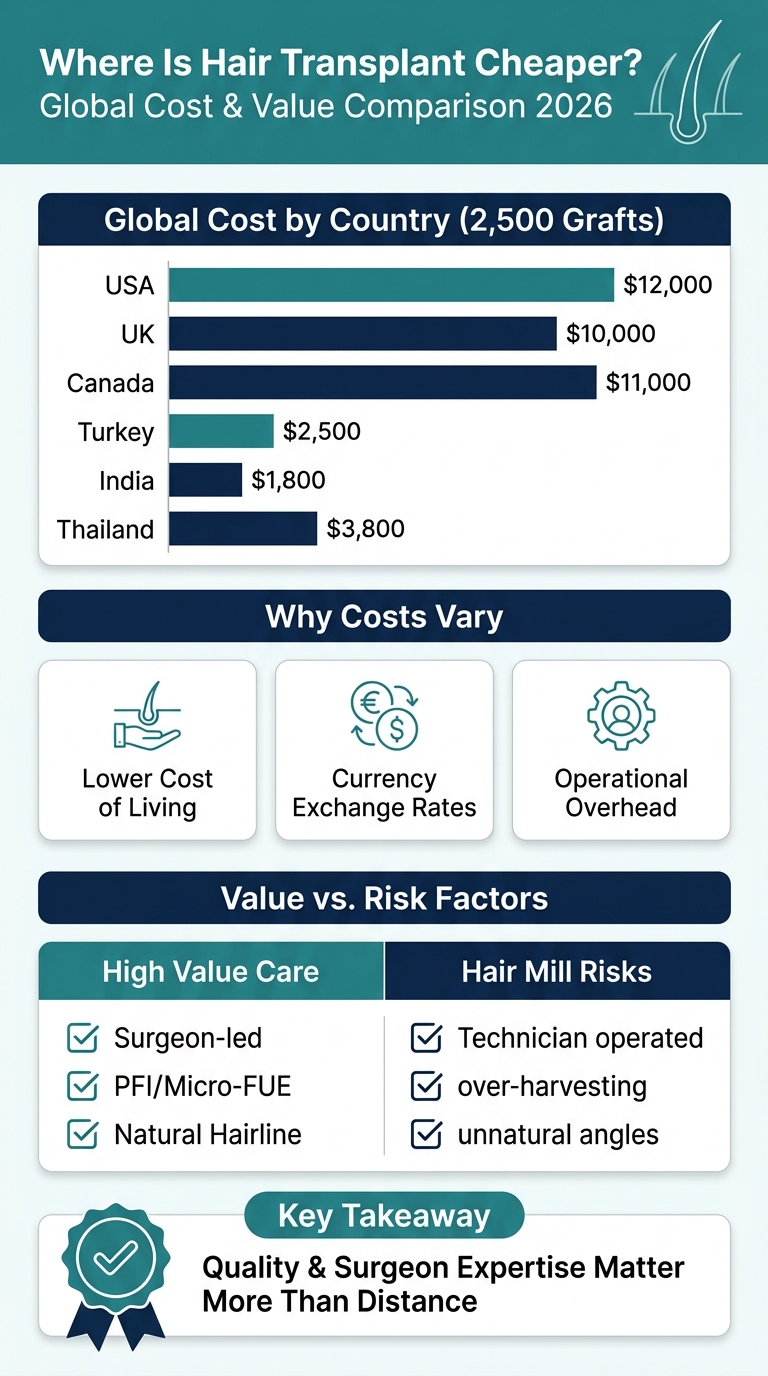
Table of Contents
- Global Hair Transplant Cost Comparison: Country-by-Country Breakdown (2026)
- Why Are Hair Transplants So Much Cheaper in Certain Countries?
- India vs. Turkey: Which Destination Offers True Value and Safety?
- The Hidden Dangers of Ultra-Cheap “Hair Mills”: What ISHRS Warns
- Precise Follicle Implantation (PFI) with Scarfree Pen: Premium Care at Affordable Rates
- How to Calculate Your Complete Budget: Grafts, Travel, and Aftercare
- Frequently Asked Questions
Global Hair Transplant Cost Comparison: Country-by-Country Breakdown (2026)
Hair transplant pricing is universally evaluated either as a cost per graft or as an all-inclusive package. A standard procedure addressing moderate male pattern baldness (Norwood Scale 3 to 4) generally requires between 2,000 and 3,000 follicular unit grafts. Below is an authoritative cross-border comparison reflecting 2026 clinical pricing across major medical tourism hubs and Western nations:
| Country | Avg. Total Cost (2,500 Grafts) | Cost Per Graft (USD) | Typical Surgical Provider | Surgeon Direct Involvement |
|---|---|---|---|---|
| India | $1,200 – $2,800 | $0.40 – $1.10 (₹30 – ₹85) | Board-Certified Dermatologist / Plastic Surgeon | High (Surgeon performs incisions & implantation) |
| Turkey | $1,800 – $3,500 | $0.70 – $1.40 (Fixed Packages) | Technicians (Doctor oversees consultations) | Low to Moderate (High risk of technician mills) |
| Mexico | $3,000 – $6,000 | $1.50 – $2.50 | Hair Restoration Surgeon | Moderate to High |
| Thailand | $2,800 – $5,500 | $1.20 – $2.20 | Dermatologist / Cosmetic Surgeon | High |
| United Kingdom | $6,000 – $14,000 | $2.50 – $5.50 | GMC Registered Doctor | High (Strict CQC Regulations) |
| United States | $8,000 – $18,000 | $3.50 – $7.00+ | ABHRS Certified Surgeon | High |
| Canada | $7,000 – $16,000 | $3.00 – $6.50 | Licensed Cosmetic Physician | High |
As illustrated in the data, India emerges as the single most affordable country for surgeon-directed hair transplantation. A procedure requiring 2,500 grafts that commands over $12,000 in Los Angeles, London, or Toronto can be performed by an elite specialist in India for less than $2,000, utilizing equivalent or superior modern instrumentation.
Why Are Hair Transplants So Much Cheaper in Certain Countries?
A common misconception among first-time hair restoration patients is that dramatically lower prices reflect subpar clinical training, inferior equipment, or unsterile conditions. In accredited, reputable medical centers abroad, this is demonstrably false. The substantial cost differential stems from underlying macroeconomic and operational realities:
- Substantially Lower Real Estate & Overhead Costs: Leasing a premium clinical surgical suite in London’s Harley Street or New York’s Manhattan costs twenty to thirty times more per square foot than an equivalent facility in prime medical centers in Thane, Mumbai, or Delhi.
- Favorable Currency Exchange Rates: Strong Western currencies (USD, GBP, EUR, CAD) have high purchasing power against the Indian Rupee (INR) and Turkish Lira (TRY). This exchange multiplier allows foreign patients to access luxury-tier medical facilities at baseline local prices.
- Medical Malpractice & Regulatory Insurance: In the United States and UK, surgeons pay astronomical annual malpractice insurance premiums that often exceed $40,000 to $80,000 annually. These legal overheads are inevitably passed on to the patient in the form of elevated per-graft fees.
- Cost of Living & Staff Compensation: Highly trained surgical assistants, nurses, and sterilization technicians earn competitive, comfortable local salaries that are nonetheless significantly lower than Western labor rates, dramatically reducing total clinic run costs.
When you choose a licensed medical center, you are not receiving “budget medicine”; you are simply bypassing Western institutional markups. Explore our comprehensive clinical breakdown of the FUE and PFI hair transplant procedures to learn how modern extraction methods operate under strict sterile protocols.
India vs. Turkey: Which Destination Offers True Value and Safety?
For international medical travelers, the choice almost always narrows down to two contenders: India and Turkey. Both nations possess thriving medical tourism infrastructures, but their clinical models differ fundamentally in doctor accountability and procedural execution:
1. Turkey: The High-Volume Package Model
Turkey has built a colossal hair restoration industry centered around all-inclusive packages (promising luxury hotel accommodations, airport VIP shuttles, and “unlimited grafts” for $2,000 to $3,000). While reputable clinics exist in Istanbul, the sheer volume has spawned hundreds of commercial “hair mills.” In these high-throughput factories, a single clinic may book 30 to 50 patients per day. The supervising physician often only spends five minutes drawing the initial hairline, leaving the critical tasks of follicle extraction, slit creation, and graft placement entirely to unlicensed technicians or non-medical staff.
2. India: The Doctor-Led Specialist Model
In contrast, reputable hair restoration clinics in India operate primarily on a personalized, physician-led model governed by the National Medical Commission (NMC). Highly qualified dermatologists and trichologists with postgraduate medical degrees (MBBS, MD, DNB) personally supervise or directly perform the surgery. Clinics limit their daily patient roster to one or two cases, ensuring undivided attention to hairline aesthetics, graft survival, and donor preservation.
Furthermore, India offers seamless, fluent English communication with medical staff and surgeons, completely eliminating the language barrier that frequently leads to misunderstandings regarding hairline positioning or post-op instructions in other countries.
Clinical Observation: In our practice at Elite Dermadent, Dr. Arefa Patel, Trichologist and Skin Specialist, notes: “A successful hair transplant is not a factory commodity measured in raw graft numbers. Every follicular unit has a limited lifespan once extracted. True value lies in delicate tissue handling, correct depth control, and preserving the donor bank for the patient’s entire lifetime—elements that cannot be replicated by hurried assembly-line technicians.”
The Hidden Dangers of Ultra-Cheap “Hair Mills”: What ISHRS Warns
The International Society of Hair Restoration Surgery (ISHRS) has launched global awareness campaigns highlighting the perils of the unregulated “Black Market” in hair restoration. Selecting a clinic solely on rock-bottom pricing without verifying physician involvement carries severe, irreversible risks:
- Severe Donor Over-Harvesting: Inexperienced technicians attempting to extract 4,000 to 5,000 grafts in a single aggressive session often strip the donor zone bare. This causes permanent “moth-eaten” alopecia and patchy thinning at the back of the head that cannot be repaired.
- High Follicle Transection Rates: When grafts are extracted with blunt or oversized motorized punches at incorrect angles, the hair bulbs are sliced beneath the skin surface. Transected grafts fail to grow, resulting in survival rates dropping below 40%.
- Unnatural Hairline Design (“Doll-Hair” Effect): Placing multi-hair grafts in the front row or inserting follicles at straight 90-degree angles rather than delicate 30-degree forward angles produces an artificial, obvious hairline that points in erratic directions.
- Scalp Necrosis and Chronic Infection: Excessive recipient site incisions made too closely together can compromise local blood circulation, leading to severe skin death (necrosis) and lifelong disfiguring scars.
Before booking any procedure abroad, always confirm that your surgery will be physically performed by a licensed physician, verify before-and-after cases showing natural hairlines, and demand transparency regarding graft counts.
Precise Follicle Implantation (PFI) with Scarfree Pen: Premium Care at Affordable Rates
One of the reasons India has become a premier destination for discerning patients is the availability of cutting-edge implantation technology that outperforms traditional manual FUE. At Elite Dermadent, Dr. Arefa Patel specializes in the Precise Follicle Implantation (PFI) technique using the Scarfree Pen.
PFI is an advanced evolution of Follicular Unit Extraction designed to maximize graft density while virtually eliminating visible scar tissue:
- Simultaneous Site Creation and Placement: Unlike standard FUE—which requires the surgeon to cut pre-made slits with surgical blades and then manually shove grafts inside using forceps—the Scarfree Pen utilizes a micro-engineered hollow needle. The device creates the microscopic recipient puncture and inserts the graft simultaneously in a single gentle motion.
- Zero Root Trauma: The follicle is protected inside the hollow cannula during insertion, eliminating mechanical pinch damage to the fragile root bulb and boosting post-transplant survival rates to over 95%.
- Precise Control Over Angle and Depth: Dr. Arefa Patel meticulously adjusts the exact direction (matching natural 30° to 45° scalp exit angles) and depth of each implant. This produces an undetectable, authentic hairline with dense, lifelike volume.
- Accelerated, Scarless Healing: Because micro-punctures match the exact diameter of the follicle sheath, tissue trauma and bleeding are drastically reduced. Redness and pinpoint scabbing resolve within 3 to 5 days without linear scarring.
Because these advanced procedures are performed in Thane (Mumbai metropolitan region), patients receive world-class PFI restoration at a fraction of the cost charged for standard, older-generation FUE in North America or Western Europe.
How to Calculate Your Complete Budget: Grafts, Travel, and Aftercare
When budgeting for a hair transplant abroad, you must account for travel logistics alongside surgical clinic fees. Here is a realistic budget blueprint for an international patient traveling to India for a 2,500-graft PFI hair transplant in 2026:
| Expense Item | Estimated Cost (USD) | Details & Recommendations |
|---|---|---|
| PFI Surgery (2,500 Grafts) | $1,500 – $2,200 | Performed by certified specialist using Scarfree Pen implanter |
| Round-Trip International Flights | $650 – $1,100 | From major US/UK/European hubs to Mumbai (BOM) |
| 4-Star Hotel Accommodation (5 Nights) | $250 – $400 | Comfortable, air-conditioned executive stay near clinic |
| Local Transportation & Food | $100 – $150 | Uber/private airport transfers and fresh meals |
| Post-Op Meds & Care Kit | $50 – $75 | Sterile saline sprays, antibiotics, and medicated shampoos |
| TOTAL ALL-INCLUSIVE ESTIMATE | $2,550 – $3,925 | Complete procedure, travel, luxury stay, and full aftercare |
Comparing an all-inclusive international investment of ~$3,000 against a domestic US or UK quote of $12,000 to $16,000 reveals an indisputable net savings of over $9,000—allowing you to receive unhurried, specialist-driven medical care while enjoying significant financial savings.
Frequently Asked Questions
Where is the cheapest country to get a hair transplant?
India is recognized as the cheapest country in the world for high-quality, doctor-performed hair transplants. Rates range from $0.40 to $1.10 (₹30 to ₹85) per graft, making an average 2,500-graft procedure cost between $1,200 and $2,800. While Turkey offers cheap package rates ($1,800 to $3,500), India provides superior doctor involvement and safety regulations at lower total costs.
Is it safe to get a cheap hair transplant abroad?
Yes, provided you choose an accredited medical center led by a qualified dermatologist or plastic surgeon rather than an unlicensed commercial “hair mill.” Always verify that the physician—not clinical technicians—personally performs the surgical extraction and implantation, review unedited patient case results, and confirm sterile hospital-grade protocols.
Why is hair transplant so expensive in the US and UK?
Hair transplants in the US and UK cost between $8,000 and $18,000 primarily due to exorbitant commercial clinic rents, high staff salaries, expensive medical equipment taxes, and heavy malpractice insurance premiums. These overhead expenses inflate the cost per graft to $4.00–$8.00 without guaranteeing superior aesthetic results compared to accredited international centers.
How many grafts will I need, and how does it impact price?
The number of grafts depends on your stage of hair loss on the Norwood Scale. Minor hairline receding (Norwood 2–3) typically requires 1,500 to 2,200 grafts, while advanced crown and hairline loss (Norwood 4–5) requires 2,800 to 4,000 grafts. Because reputable clinics charge per graft, your total investment scales transparently with the exact density required.
What is the difference between standard FUE and PFI with Scarfree Pen?
Standard FUE requires cutting channel slits with steel or sapphire blades before manually squeezing hair roots into the holes with forceps, which risks follicle crush trauma. In contrast, PFI (Precise Follicle Implantation) utilizes a specialized hollow Scarfree Pen that creates the recipient site and implants the graft simultaneously, eliminating root handling, preventing visible scarring, and ensuring 95%+ graft survival.
Conclusion: Choose Clinical Excellence Over Just Cheap Rates
When searching for where a hair transplant is cheaper, remember that your donor hair is a finite, non-renewable biological resource. A failed surgery at an ultra-cheap technician clinic cannot simply be “redone” if your donor area has been destroyed. True value means finding the intersection of accessible pricing, state-of-the-art technology, and dedicated doctor-led care.
At Elite Dermadent, you don’t have to compromise safety for affordability. To learn more about our personalized restoration plans or schedule a virtual consultation with Dr. Arefa Patel, Trichologist and Skin Specialist, explore our hair transplant service today.
Comments are closed