
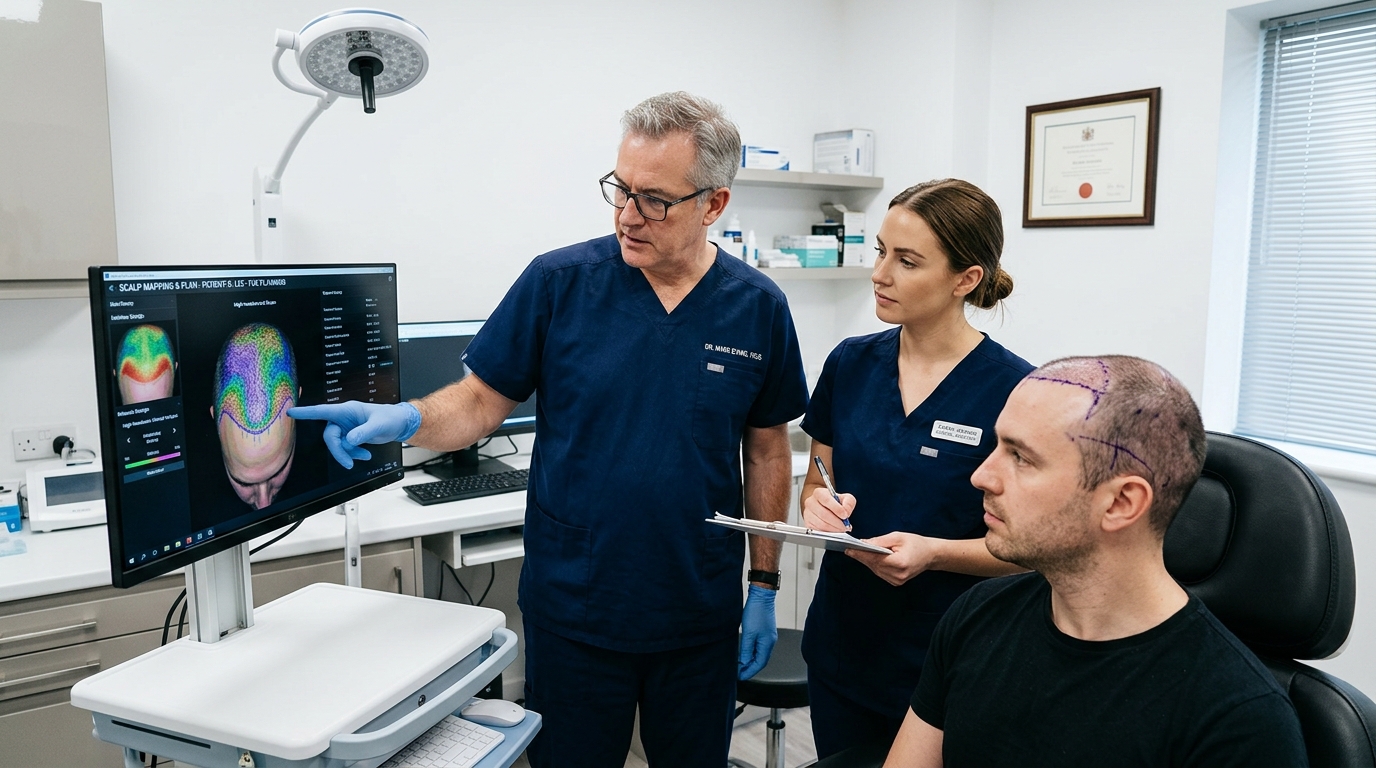
For patients experiencing advanced pattern baldness across the hairline, mid-scalp, and crown, standard small-session hair transplants may not provide sufficient coverage. Understanding what a big FUE hair transplant (commonly referred to as a mega FUE session) involves helps patients plan for comprehensive, high-density hair restoration in a single surgical journey.
Key Takeaways
- High Graft Volume: A big FUE hair transplant involves harvesting and transplanting between 3,000 and 5,000+ grafts (approx. 7,000 to 12,000 hairs) in an extended or split-day session.
- Ideal for Advanced Loss: Designed specifically for Norwood Scale Stages 5, 6, and 7 where extensive thinning covers multiple scalp zones.
- Donor Preservation: Requires strict extraction protocols to prevent over-harvesting and maintain the natural aesthetic of the donor area.
- PFI Scarfree Implantation: Advanced direct implanters like the Scarfree Pen accelerate placement, protecting graft viability and achieving maximum natural density.
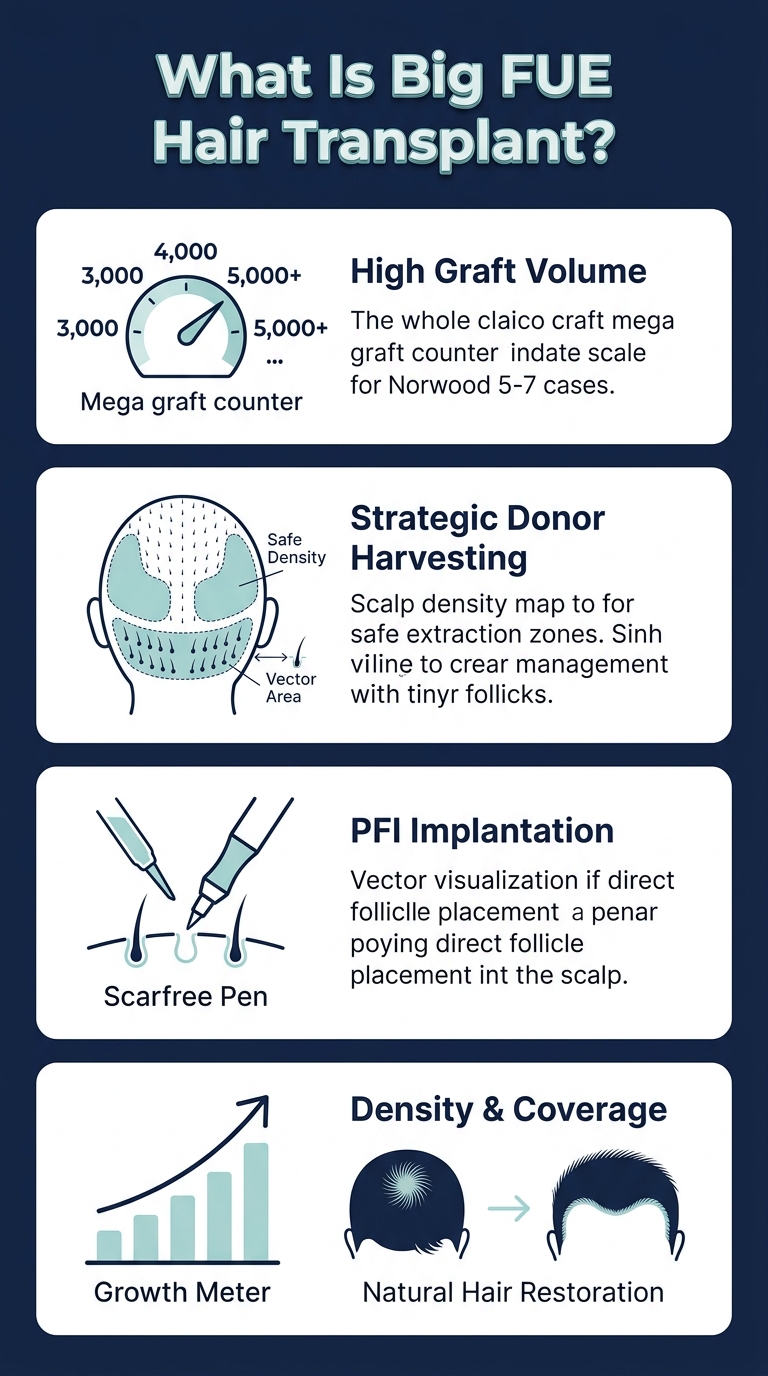
Table of Contents
- What Is a Big FUE Hair Transplant?
- Who Is a Candidate for a Mega FUE Session?
- Donor Area Preservation & Graft Survival
- Advanced PFI Technique: Why It Excels in Big FUE
- Standard FUE vs. Big FUE Mega Session
- Frequently Asked Questions
What Is a Big FUE Hair Transplant?
A big FUE hair transplant—also known as a mega-session FUE—refers to a procedure where 3,000 to 5,000+ individual hair grafts are extracted and transplanted in a single continuous session or across two consecutive days.
Because each graft typically contains between 1 and 4 individual hair follicles, a big FUE session relocates up to 10,000+ hairs. This allows hair restoration specialists to rebuild a complete frontal hairline, fill the mid-scalp, and restore crown density simultaneously.
Who Is a Candidate for a Mega FUE Session?
Mega FUE sessions are clinically indicated for patients presenting with moderate to severe hair loss:
- Norwood Stage 5: Deep hairline recession combined with significant vertex (crown) thinning.
- Norwood Stage 6 & 7: Extensive balding where only a horseshoe-shaped donor band remains on the back and sides of the scalp.
- Dense Donor Supply: Candidates must possess strong donor hair density (high follicular units per square centimeter) on the back and sides of the head to safely harvest 3,000+ grafts without causing noticeable thinning.
Donor Area Preservation & Graft Survival
Executing a big FUE hair transplant requires exceptional surgical strategy to protect both the donor zone and the harvested follicles:
1. Safe Extraction Zone Harvesting
Extracting thousands of grafts requires uniform, strategic micro-punch placement across the entire safe donor zone. Over-harvesting from a concentrated patch can leave a “moth-eaten” or thinned appearance.
2. Temperature & Hydration Control
When thousands of grafts are harvested, keeping them out of the scalp for extended periods poses a risk to root viability. Grafts are stored in specialized chilled, nutrient-rich holding solutions (such as HypoThermosol) to maintain cell survival until implantation.
Advanced PFI Technique: Why It Excels in Big FUE
In high-volume mega sessions, minimizing scalp trauma and surgical duration is essential for patient comfort and graft take. At Elite Dermadent, Dr. Arefa Patel, Trichologist and Skin Specialist, specializes in the Precise Follicular Implantation (PFI) Hair Transplant Technique utilizing the advanced Scarfree Pen.
Advantages of PFI in Big FUE Mega Sessions
Traditional FUE requires pre-cutting thousands of slits across the scalp before placing grafts manually with forceps—a slow process that increases tissue bleeding and swelling. PFI changes the dynamic completely:
- Simultaneous Site Creation & Implantation: The Scarfree Pen inserts the graft directly as it creates the micro-puncture, cutting implantation time dramatically.
- Zero Scalp Slit Cut Marks: Leaves no linear or gaping channel scars, promoting rapid micro-healing even across large recipient areas.
- Minimal Root Handling: Protects graft root bulbs during loading, ensuring that up to 95%+ of transplanted follicles take root successfully.
- Natural Directional Control: Allows the doctor to angle every single graft (10° to 45°) to match natural hair flow across hairline, mid-scalp, and crown swirl.
Learn more about our specialized PFI Hair Transplant Treatment options and schedule a comprehensive donor density evaluation.
Standard FUE vs. Big FUE Mega Session
Here is a comparison between standard FUE sessions and Big FUE mega sessions:
| Parameter | Standard FUE Session | Big FUE (Mega Session) |
|---|---|---|
| Graft Volume | 1,200 – 2,500 Grafts | 3,000 – 5,000+ Grafts |
| Coverage Target | Hairline or Crown focused | Full head (Hairline + Mid-Scalp + Crown) |
| Norwood Stage | Norwood Stages 2 to 4 | Norwood Stages 5 to 7 |
| Session Duration | 4 to 6 hours (1 day) | 6 to 9 hours (1 day or split across 2 days) |
| Implantation Tool | Standard forceps / blades | PFI Scarfree Pen direct implanter |
Frequently Asked Questions
Can 4,000 to 5,000 grafts be safely transplanted in one FUE session?
Yes, provided the patient has an exceptionally strong donor area and the procedure is performed by an experienced trichologist using advanced direct implanter technology like the PFI Scarfree Pen, which minimizes out-of-body graft time.
How do doctors avoid over-harvesting during a big FUE transplant?
Surgeons calculate donor density using digital trichoscopy, ensuring no more than 20% to 25% of total donor follicles are extracted from any single square centimeter. This maintains a natural, un-thinned donor appearance.
How long is recovery after a mega FUE hair transplant?
Despite the high graft volume, recovery with PFI direct implantation remains rapid. Micro-puncture donor and recipient sites heal within 5 to 7 days, and routine daily activities can be resumed after 48 hours.
Will I need a second hair transplant after a big FUE session?
For most patients with stabilized hair loss, a successful big FUE session provides lifetime coverage. However, if progressive native hair loss continues in untreated areas, minor maintenance PRP sessions or touch-up grafts can be performed years later.
Comments are closed