
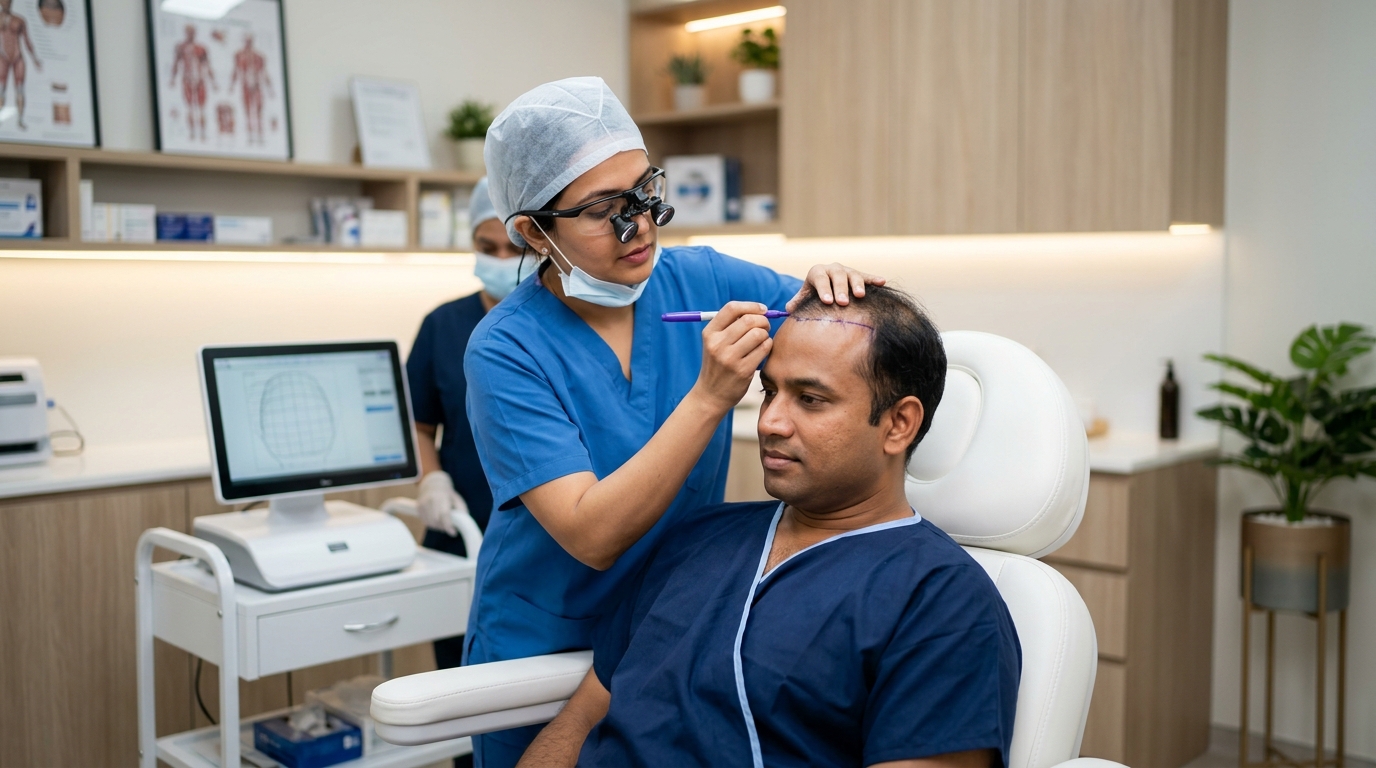
When planning surgical hair restoration, patients frequently ask: where do you take hair for a hair transplant? The simple answer is that hair is harvested from your own permanent “Safe Donor Zone” at the back and sides of your head. However, the true clinical answer involves far more than simply pulling hair from behind your ears. In modern hair restoration, deciding exactly where, how, and in what quantities hair is taken is a sophisticated clinical science that dictates both the density of your new hairline and the long-term aesthetic health of your scalp.
In 2026, advances in microscopic trichoscopy, digital densitometry, and Precise Follicle Implantation (PFI) allow hair restoration specialists to map your donor scalp down to the millimeter. By harvesting the right balance of single-hair and multi-hair follicular units while strictly observing biological extraction limits, surgeons achieve undetectable, natural coverage without leaving the donor area depleted or patchy. Below, we break down the clinical mapping process, candidate suitability benchmarks, extraction methods, and how elite specialists protect your donor reserves for life.
Key Takeaways: Where & How Donor Hair Is Taken
- The Primary Harvesting Zone: Over 95% of donor follicles are taken from the occipital scalp (lower back of the skull) and the parietal scalp (sides above the ears), regions biologically programmed to resist hormone-induced balding.
- Digital Donor Mapping: Before harvesting, specialists use trichoscopy to evaluate donor density (normal averages 65 to 85 follicular units per cm²) and hair caliber (55 to 80 microns) to calculate exact graft quotas.
- Follicle Sorting Strategy: Surgeons specifically take delicate single-hair follicular units from the temporal margins to build a soft, natural hairline, while taking 2-to-4 hair units from the deep occipital zone for core density.
- Candidate Screening: Patients suffering from Diffuse Unpatterned Alopecia (DUPA) or retrograde thinning lack a stable safe donor zone and must be identified during trichological evaluation to prevent surgical failure.
- The PFI Advantage: At Elite Dermadent, Dr. Arefa Patel utilizes Precise Follicle Implantation (PFI) with the Scarfree Pen to harvest grafts with micro-punches (under 0.8mm), ensuring simultaneous implantation, 95%+ graft survival, and zero linear scars.
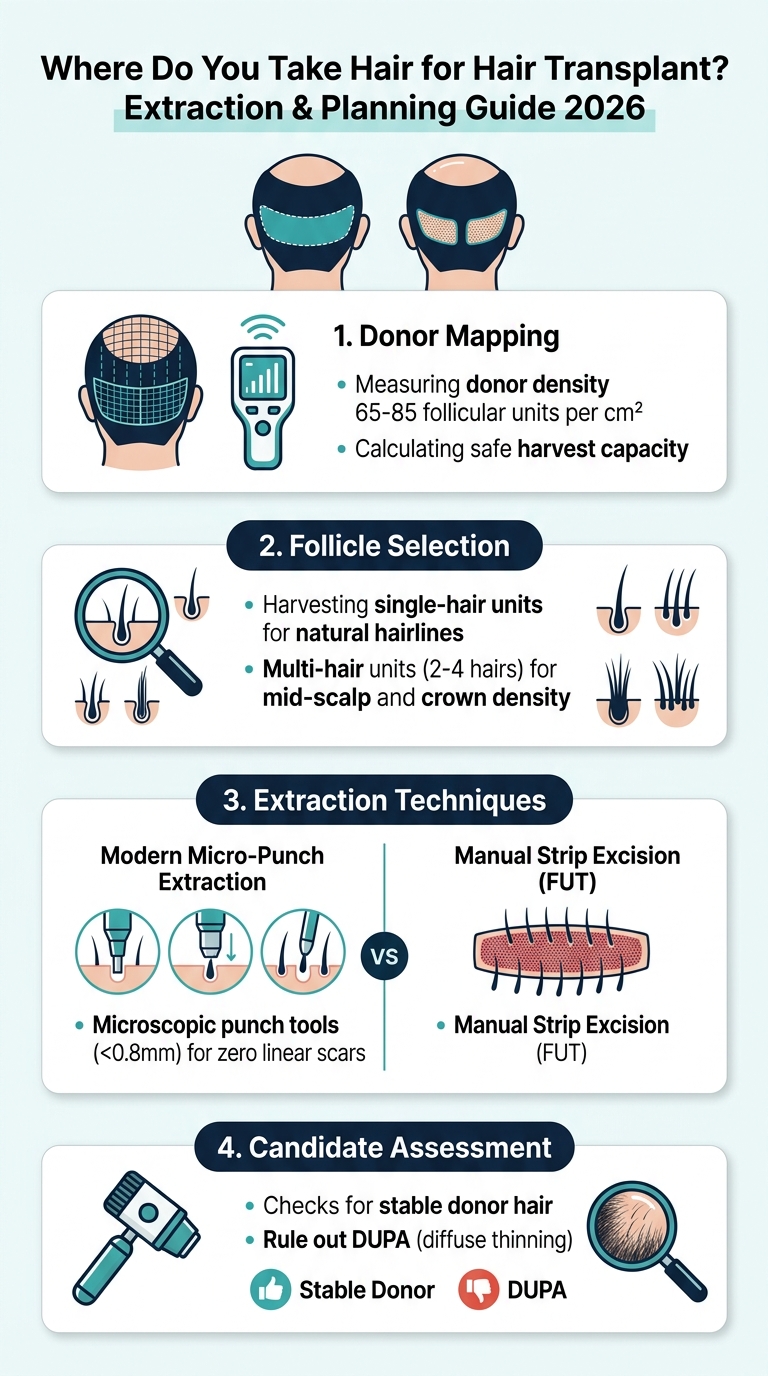
Table of Contents
- The Clinical Mapping Process: How Specialists Decide Where to Take Hair
- Donor Density & Candidacy Thresholds (Norwood Scale Guide)
- Strategic Follicle Sorting: Single-Hair vs. Multi-Hair Grafts
- Comparing Extraction Methods: FUE vs. FUT vs. PFI with Scarfree Pen
- What If You Have Weak Donor Hair? Addressing DUPA & Alternative Sources
- Donor Bank Preservation at Elite Dermadent
- Frequently Asked Questions
The Clinical Mapping Process: How Specialists Decide Where to Take Hair
Harvesting donor hair is not a random extraction. Before a single hair is removed, a board-certified trichologist or cosmetic surgeon conducts a comprehensive microscopic donor mapping analysis. This diagnostic phase establishes the anatomical boundaries of your personal Safe Donor Zone (SDZ):
- Trichoscopic Densitometry: Using high-magnification polarized digital dermatoscopes, the specialist measures your follicular unit density across several square centimeters of the donor region. A healthy adult typically displays 65 to 85 follicular units per cm² (equivalent to 130 to 190 hairs per cm²).
- Hair Shaft Caliber Measurement: Hair thickness is measured in microns. Patients with coarse hair (70–85 microns) require fewer grafts to achieve high visual density than patients with fine hair (45–60 microns). Knowing your hair diameter determines exactly where and how many grafts must be taken.
- Evaluation of Miniaturization Borders: The boundaries of the Safe Donor Zone must be delineated conservatively. Harvesting too high up near the crown or too low along the nape risks taking follicles that may thin later in life as androgenetic alopecia progresses.
To understand the clinical science behind these permanent follicles, explore our in-depth guide on the hair transplant procedure.
Donor Density & Candidacy Thresholds (Norwood Scale Guide)
The extent of hair loss on the Norwood Scale determines how many grafts are required, which in turn dictates how much donor hair must be taken from the back and sides. Below is a clinical benchmark table outlining graft requirements and donor density thresholds:
| Norwood Stage | Area of Loss | Avg. Grafts Required | Minimum Donor Density | Primary Donor Sites Utilized | Candidacy Viability |
|---|---|---|---|---|---|
| Norwood 2 | Mild temple recession | 1,200 – 1,800 | 55+ FU/cm² | Temporal & upper occipital | Excellent candidate |
| Norwood 3 / 3V | Deep front recessions / vertex crown | 2,000 – 2,800 | 60+ FU/cm² | Mid-occipital & parietal zones | Excellent candidate |
| Norwood 4 | Frontal hairline + crown bridge | 2,800 – 3,500 | 65+ FU/cm² | Full occipital & lateral scalp | Very good candidate |
| Norwood 5 | Extensive frontal loss merging with crown | 3,500 – 4,500 | 70+ FU/cm² | Full safe donor zone (often 2 sessions) | Good candidate (strategic design) |
| Norwood 6 / 7 | Severe loss, thin horseshoe rim remaining | 5,000 – 6,500+ | 75+ FU/cm² | Scalp donor + Beard/Chest hair (BHT) | Selective (Requires combination grafting) |
Strategic Follicle Sorting: Single-Hair vs. Multi-Hair Grafts
Human hair naturally emerges from the scalp in small physiological clusters known as follicular units, containing between 1 and 4 individual hair shafts. Deciding where to take hair involves intentional follicle sorting to create a lifelike aesthetic outcome:
1. Single-Hair Follicles for the Frontal Hairline Transition Zone
In a natural, untouched hairline, the very leading edge is composed entirely of fine, soft, single-hair follicles arranged in a staggered micro-irregular pattern. If a surgeon mistakenly implants 2-hair or 3-hair grafts along the front border, it creates an unnatural, harsh “pluggy” appearance. Consequently, specialists specifically harvest single-hair units from the softer temporal margins and lateral parietal scalp to craft a gentle, imperceptible transition zone.
2. Multi-Hair Follicles (2, 3, and 4 Hairs) for Density Zones
Behind the soft transition zone lies the frontal core, the mid-scalp, and the crown vertex. In these areas, high visual density and light-blocking capacity are essential. Surgeons take robust multi-hair follicular units from the thickest mid-occipital donor region, placing them strategically behind the hairline to provide maximum coverage with the fewest total graft incisions.
Comparing Extraction Methods: FUE vs. FUT vs. PFI with Scarfree Pen
The technique used to take hair from the donor region determines your recovery time, procedural comfort, and whether you will be left with visible scars:
- FUT (Follicular Unit Transplantation / Strip Surgery): The surgeon excises an entire horizontal strip of flesh (usually 1.5cm wide by 20–25cm long) from the occipital scalp with a scalpel, then closes the wound with surgical staples or sutures. While FUT yields high graft numbers, it leaves a permanent linear scar across the back of the head that prevents patients from wearing short hair.
- Standard FUE (Follicular Unit Extraction): Individual follicular units are cored out one by one using a manual or motorized cylindrical punch (0.8mm to 1.0mm). This avoids a linear scar, leaving tiny circular micro-wounds that heal into pinpoint marks. However, standard FUE still requires cutting recipient slits with scalpels before stuffing grafts with forceps.
- PFI (Precise Follicle Implantation) with Scarfree Pen: The cutting-edge evolution of FUE. Grafts are delicately extracted using ultra-fine micro-punches under 0.8mm to prevent transection of neighboring roots. The harvested follicles are loaded directly into the Scarfree Pen implanter, which creates the microscopic puncture and deposits the graft simultaneously, completely eliminating linear scarring and graft-crushing forceps trauma.
What If You Have Weak Donor Hair? Addressing DUPA & Alternative Sources
Not everyone who experiences hair loss is an automatic candidate for donor harvesting. Ethical screening is vital to identify conditions where taking hair from the scalp is clinically contraindicated:
1. Diffuse Unpatterned Alopecia (DUPA)
Unlike typical androgenetic alopecia, which spares the back and sides of the head, patients with DUPA suffer from widespread follicle miniaturization across the entire scalp—including the occipital donor zone. If hair is taken from a DUPA patient, the transplanted grafts will continue to miniaturize and fall out, while the donor area will develop severe patchy thinning. Qualified trichologists always screen for DUPA using high-powered dermoscopy.
2. Retrograde Alopecia
In retrograde alopecia, hair thins upward from the nape of the neck and behind the ears. Surgeons must identify this pattern and restrict harvesting strictly to the mid-occipital core, avoiding the vulnerable low perimeter.
3. Secondary Donor Harvesting: Beard Hair
For patients with insufficient scalp donor density, hair can be harvested from the submandibular beard area (under the chin and jawline). Beard follicles are remarkably resilient, exceptionally thick in caliber, and heal with virtually undetectable micro-marks within 48 to 72 hours. While beard hair is never placed along the hairline due to its coarseness, it is the ideal donor source for creating rich volume across the crown and mid-scalp.
Donor Bank Preservation at Elite Dermadent
At Elite Dermadent, donor preservation is treated with the highest medical diligence. Led by Dr. Arefa Patel, Trichologist and Skin Specialist, our clinical team focuses on long-term scalp health and personalized follicle management.
Clinical Philosophy: Dr. Arefa Patel emphasizes: “A successful hair restoration is judged not just by the new hairline in the mirror, but by the back of the head when you turn around. By limiting harvest density to under 20% using the PFI Scarfree Pen, we ensure the donor area maintains its natural fullness, allowing you to wear any haircut with total confidence.”
Through our advanced PFI technique, each follicle is placed at the exact natural exit angle (30° to 45°) to replicate your original growth pattern, ensuring 95%+ graft viability and an undetectable aesthetic transition.
Frequently Asked Questions
Where do you take hair from for a hair transplant if you are completely bald?
If a patient is completely bald across both the top and the back of the head (extreme Norwood 7 with total donor depletion), a scalp hair transplant is not possible. However, if the patient possesses healthy beard and chest hair, a combination Body Hair Transplant (BHT) can sometimes be performed to restore conservative frontal framing, though full density cannot be achieved.
Does taking hair from the donor area hurt?
No. The donor harvesting procedure is performed under local anesthesia. Patients feel a brief, minor pinch during the initial numbing injection (rating ~2/10 on the pain scale), but during the actual extraction, the scalp is completely numb and pain-free. Most patients read, watch movies, or nap during the harvesting stage.
How do surgeons ensure the donor area doesn’t look patchy?
Skilled surgeons use a “checkerboard” or diffuse extraction pattern, harvesting only one out of every four to five follicles. By leaving at least 75% to 80% of the natural density intact, the surrounding hair lays over the extraction micro-dots, rendering the harvested area visually indistinguishable from untouched hair.
How many total hairs can be safely taken in a lifetime?
A healthy adult male has roughly 12,000 to 15,000 follicular units in the safe donor zone. Over a lifetime, an ethical specialist will harvest a safe maximum of 4,000 to 6,000 follicular units (approximately 8,000 to 13,000 hairs). Exceeding this limit causes permanent visible thinning.
Will shaved donor hair grow back after the procedure?
Yes. While the specific follicles that were surgically extracted are relocated permanently, all the remaining surrounding hairs in the donor zone begin growing normally immediately after surgery. Within 7 to 10 days, the donor area looks like a standard buzz cut, and any microscopic redness completely fades.
Conclusion: Discover Your Personal Donor Potential
Deciding where to take hair for a hair transplant requires meticulous diagnostic mapping, artistic follicle distribution, and an unwavering commitment to donor preservation. When performed by a qualified trichologist, hair restoration leaves your donor area intact and your restored hairline completely undetectable.
To have your donor density evaluated with digital densitometry and explore personalized restoration using the PFI Scarfree Pen technique, schedule your consultation with Dr. Arefa Patel by visiting our hair transplant service today.
Comments are closed