
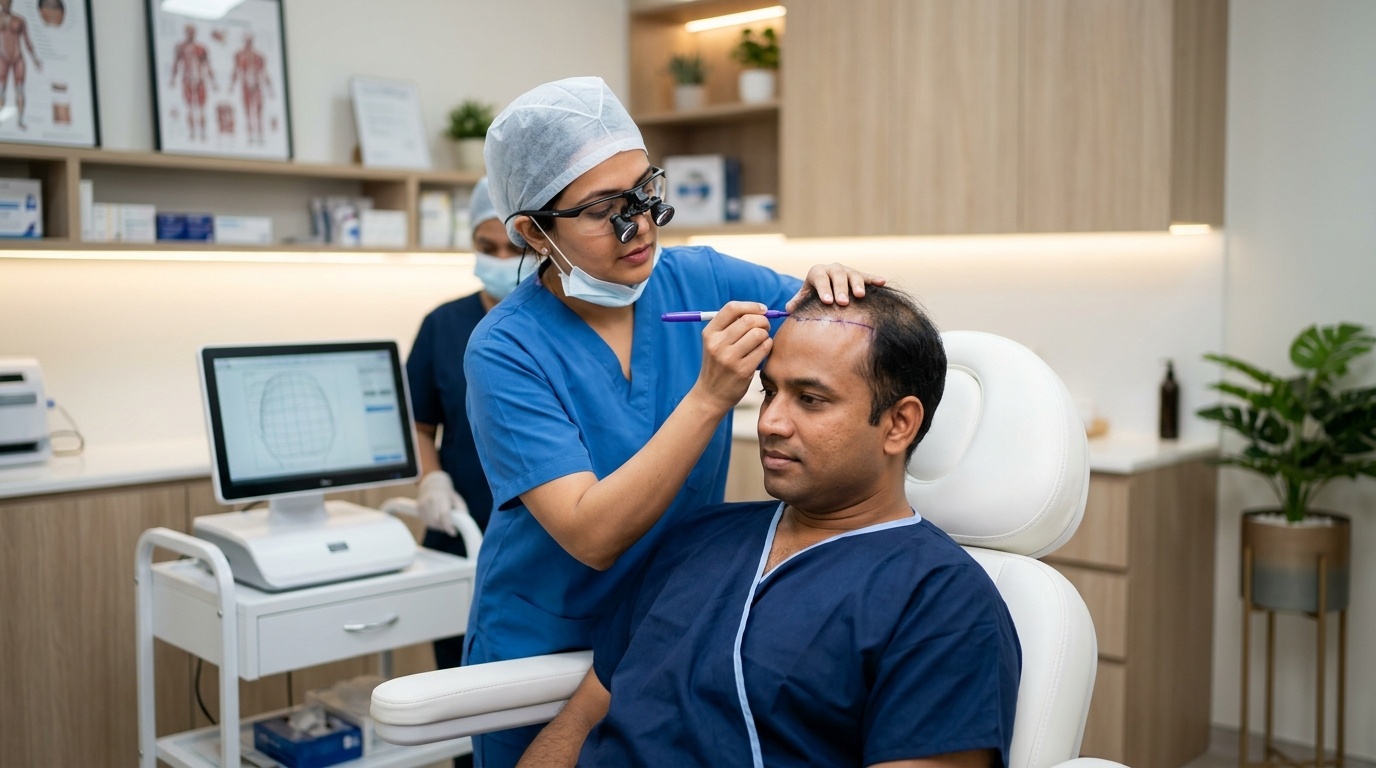
As surgical hair restoration technology continues to innovate, patients frequently encounter a popular technical term: what is a Sapphire FUE hair transplant? Sapphire FUE is an advanced variation of Follicular Unit Extraction where the micro-incisions in the recipient area are created using precision blades carved from synthetic sapphire gemstone rather than conventional surgical steel. Because sapphire blades are exceptionally sharp, durable, and smooth, they create ultra-fine V-shaped micro-channels that minimize tissue trauma, reduce bleeding and post-operative scabbing, and allow significantly denser follicle placement.
Key Takeaways:
- Synthetic Gemstone Blades: Sapphire blades are forged from single-crystal synthetic sapphire ($Al_2O_3$), creating ultra-sharp, non-metallic surgical cutting edges that do not dull during surgery.
- V-Shaped Micro-Slits: Unlike blunt U-shaped slits made by steel, sapphire creates precise V-shaped channels that hold grafts snugly at exact angles without dislodging.
- Accelerated Healing: Minimal tissue tearing means less edema (swelling), reduced bleeding, and rapid micro-scab shedding within 5 to 7 days.
- The Direct PFI Evolution: While Sapphire FUE improves channel opening, Elite Dermadent’s signature Precise Follicular Implantation (PFI) with the Scarfree Pen creates sites and places grafts simultaneously in one atraumatic step.
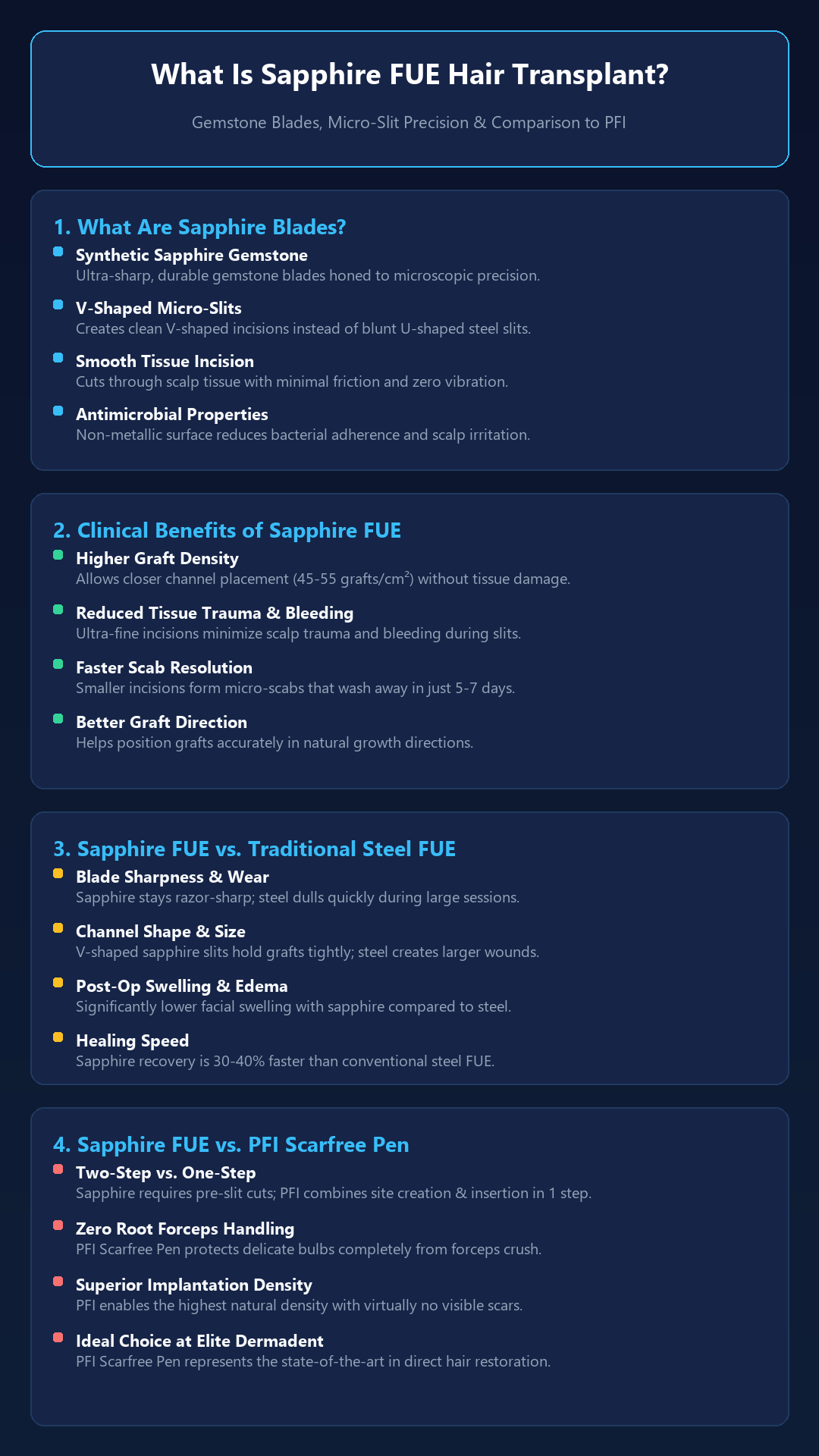
Table of Contents
- The Science Behind Sapphire Gemstone Blades
- How a Sapphire FUE Hair Transplant Is Performed
- Key Clinical Advantages of Sapphire FUE Over Steel
- Steel FUE vs. Sapphire FUE vs. PFI Scarfree Pen Comparison Table
- Healing Speed and Maximum Density Potential
- Beyond Sapphire: PFI with the Scarfree Pen at Elite Dermadent
- Consult with Dr. Arefa Patel in Thane
- Frequently Asked Questions (FAQs)
The Science Behind Sapphire Gemstone Blades
Traditional FUE procedures rely on disposable stainless steel surgical blades to create recipient incisions. While effective, steel blades have physical limitations: they lose their microscopic sharpness after making a few hundred incisions in tough scalp tissue, leading to micro-tearing and increased tissue inflammation.
In Sapphire FUE, blades are precision-cut from single-crystal synthetic sapphire—a gemstone second in mineral hardness only to diamond. Sapphire blades feature several distinctive physical properties:
- Extreme Hardness & Durability: Maintains a flawless, razor-sharp cutting edge throughout the entire procedure, even when opening 3,000+ micro-channels.
- V-Shaped Micro-Incision: Creates an ultra-slender V-shaped slit that matches the cylindrical taper of a hair graft, holding the follicle firmly in place.
- Antimicrobial & Hypoallergenic: The non-metallic, perfectly smooth gemstone surface prevents tissue adherence and reduces the risk of allergic or inflammatory reactions.
How a Sapphire FUE Hair Transplant Is Performed
The clinical workflow of a Sapphire FUE procedure proceeds in three synchronized phases:
- Follicular Unit Harvesting: Individual grafts are gently extracted from the permanent occipital donor area using motorized micro-punches (0.75mm to 0.85mm) and sorted by hair count in chilled preservation media.
- Sapphire Channel Opening: The surgeon utilizes sapphire blades calibrated from 0.8mm to 1.4mm to open recipient micro-channels. The sapphire blade enters the skin smoothly, controlling both depth and acute 15°–30° angulation with minimal vibration.
- Graft Placement: The harvested follicular units are carefully inserted into the custom-opened sapphire channels, ensuring single-hair units frame the frontal edge and dense multi-hair units occupy the core.
Key Clinical Advantages of Sapphire FUE Over Steel
Choosing sapphire technology offers distinct clinical benefits for the patient:
- Higher Graft Density: Because sapphire slits cause less collateral tissue damage, incisions can be placed closer together without risking vascular compromise, achieving densities up to 45–55 grafts per square centimeter.
- Significantly Reduced Edema & Bleeding: Clean, precise cuts mean less subcutaneous vascular trauma, significantly reducing post-operative facial swelling and bruising.
- Faster Micro-Scab Resolution: The tiny micro-wounds form much smaller scabs that soften and wash away within 5 to 7 days, compared to 10 to 14 days with standard steel blades.
- Natural Angulation Control: The sharpness of sapphire allows the surgeon to make extremely acute incisions matching the biological exit angle of natural eyebrows, temples, and hairlines.
Steel FUE vs. Sapphire FUE vs. PFI Scarfree Pen Comparison Table
Understanding how sapphire fits into the modern technological spectrum:
| Feature | Traditional Steel FUE | Sapphire FUE | PFI with Scarfree Pen |
|---|---|---|---|
| Channel Tool | Stainless steel slit blade | Synthetic sapphire gemstone blade | Direct Scarfree Pen cannula |
| Procedure Steps | Two-step: Slit cuts, then forceps insert | Two-step: Sapphire slits, then forceps insert | One-step: Simultaneous site creation & graft insert |
| Follicle Bulb Handling | Direct forceps grip on bulb | Direct forceps grip on bulb | Zero forceps contact (sheathed in needle) |
| Average Density | 35 – 40 grafts/cm² | 45 – 55 grafts/cm² | 50 – 60+ grafts/cm² |
| Scab Recovery Time | 10 – 14 days | 5 – 7 days | 3 – 5 days |
Healing Speed and Maximum Density Potential
Because sapphire micro-blades create clean, narrow V-shaped slits, the recipient scalp experiences minimal structural trauma. Blood vessels surrounding the incisions remain intact, promoting rapid neovascularization—the process where new capillary blood flow connects to the newly implanted hair bulb.
This biological preservation allows surgeons to safely pack grafts closer together, producing full cosmetic density and an undetectable, age-appropriate hairline.
Beyond Sapphire: PFI with the Scarfree Pen at Elite Dermadent
While Sapphire FUE represents an excellent advancement in blade technology, it remains a two-step process: incisions are opened first, and technicians subsequently manipulate delicate follicles into the slits using forceps.
At Elite Dermadent, we offer the next evolutionary leap: Precise Follicular Implantation (PFI) using the Scarfree Pen. By loading the graft directly into an ultra-fine hollow cannula, the surgeon creates the micro-site and implants the graft simultaneously in one delicate motion. This eliminates all manual forceps contact on the delicate dermal papilla bulb, shortens out-of-body time, and achieves graft survival rates exceeding 95%.
Consult with Dr. Arefa Patel in Thane
Selecting the best surgical approach depends on your hair loss stage, scalp elasticity, and aesthetic goals. Led by Dr. Arefa Patel, Trichologist and Skin Specialist, Elite Dermadent provides comprehensive clinical evaluations and state-of-the-art hair restoration procedures.
Discover the benefits of precision hair restoration with our specialized hair transplant in Thane. Contact Elite Dermadent today to schedule your consultation.
Frequently Asked Questions (FAQs)
1. What is the difference between regular FUE and Sapphire FUE?
Regular FUE uses steel blades to make recipient channel incisions, while Sapphire FUE uses razor-sharp synthetic sapphire gemstone blades. Sapphire creates smaller V-shaped slits that heal faster, bleed less, and allow higher hair density.
2. Does Sapphire FUE hurt more than standard FUE?
No. Both procedures are performed under local anesthesia and are completely painless. In fact, patients often report less post-operative soreness with Sapphire FUE because gemstone incisions cause significantly less tissue trauma.
3. Are real sapphires used in Sapphire FUE?
Sapphire blades are made from single-crystal synthetic sapphire ($Al_2O_3$), which is chemically identical to natural sapphire gemstones and engineered specifically for medical surgical precision.
4. How fast do scabs fall off after Sapphire FUE?
Due to the micro-incision size, scabs and crusts typically soften and wash away during gentle shampooing within 5 to 7 days, compared to 10 to 14 days with traditional steel blade methods.
5. How does PFI with the Scarfree Pen compare to Sapphire FUE?
Sapphire FUE still requires a two-step process where incisions are made first and grafts are inserted with forceps. PFI with the Scarfree Pen creates the incision and implants the graft simultaneously in one step, protecting the root bulb from any crushing trauma and boosting survival to over 95%.
No responses yet