
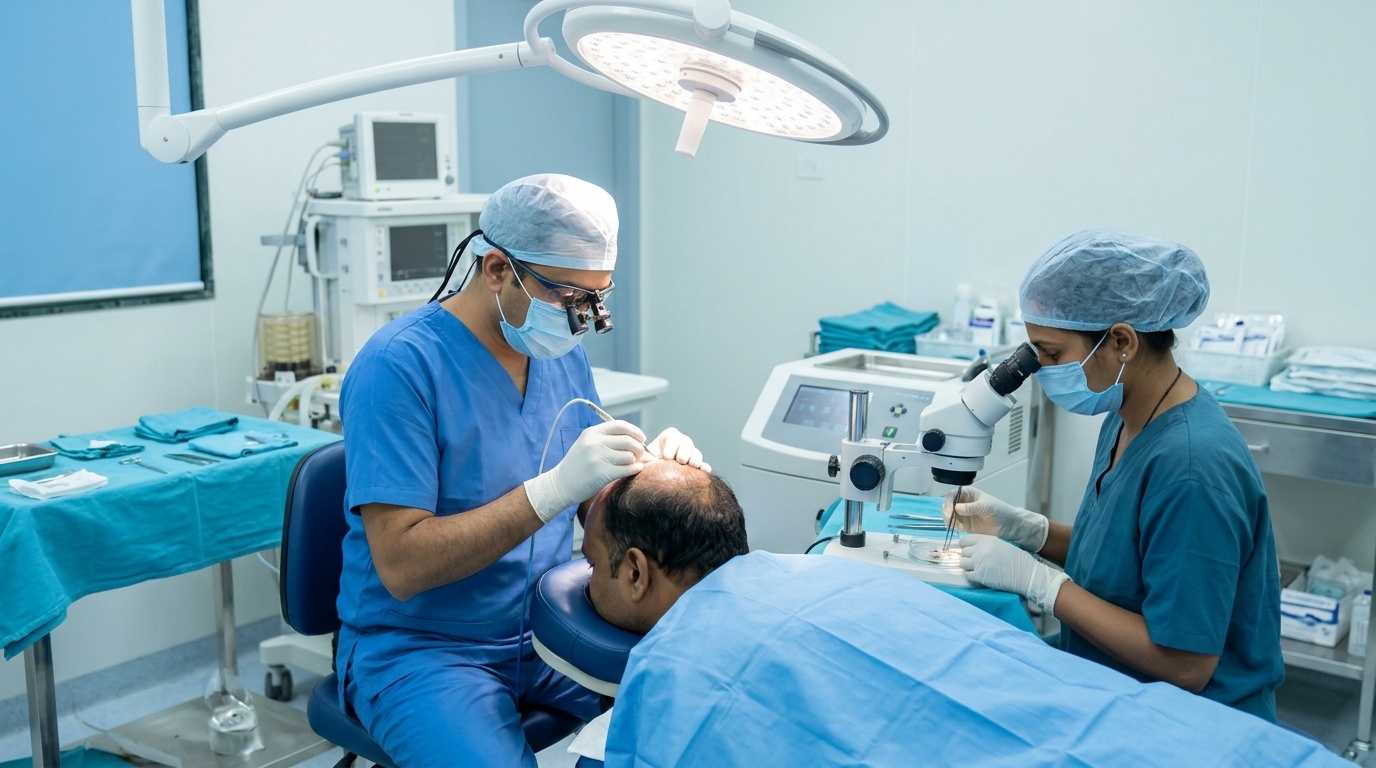
If you are beginning your hair restoration journey, you have certainly seen the acronym everywhere: what does an FUE hair transplant mean? FUE stands for Follicular Unit Extraction. It is an advanced surgical technique where individual follicular units—naturally occurring groupings of 1 to 4 hairs complete with roots and sebaceous glands—are extracted one by one directly from the permanent donor zone of the scalp using specialized micro-punches. Rather than cutting out a large strip of skin with a scalpel, FUE gently removes individual grafts without stitches, leaving no linear scar and enabling rapid, comfortable healing.
Key Takeaways:
- The Acronym Decoded: “FUE” stands for Follicular Unit Extraction, referring to the micro-surgical extraction of individual hair bundles.
- Anatomy of a Follicular Unit: Hair does not grow in isolated strands, but in natural physiological clusters containing 1 to 4 hairs, nerves, and supportive dermal tissue.
- No Scalpel Strip: FUE completely eliminates the large linear incisions and stitches characteristic of traditional Follicular Unit Transplantation (FUT).
- The Modern PFI Standard: At Elite Dermadent, FUE is elevated into Precise Follicular Implantation (PFI) using the Scarfree Pen for simultaneous placement and superior density.
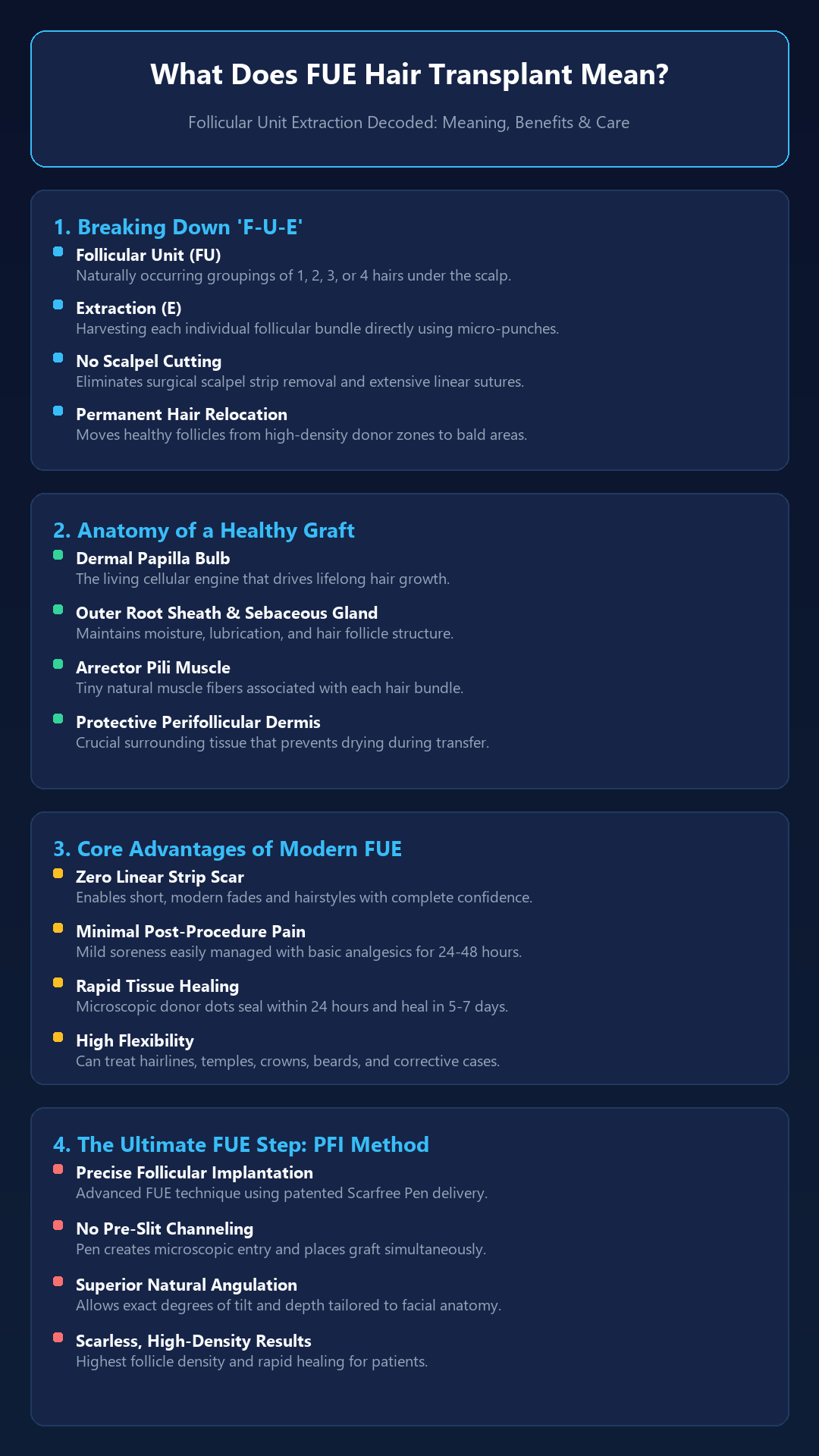
Table of Contents
- Decoding the Acronym: What “F-U-E” Really Means
- The Biological Anatomy of a Follicular Unit
- How FUE Is Performed: The Micro-Extraction Process
- FUE vs. FUT Strip Surgery Comparison Table
- The Top Clinical Advantages of FUE for Patients
- Taking FUE to the Next Level: PFI with the Scarfree Pen
- Personalized FUE Consultation with Dr. Arefa Patel
- Frequently Asked Questions (FAQs)
Decoding the Acronym: What “F-U-E” Really Means
To fully grasp what FUE hair transplant means, it helps to break down each word in the medical acronym:
- Follicular (F): Pertaining to hair follicles—the living micro-organs embedded within the dermis that generate hair shafts.
- Unit (U): Referring to the naturally occurring biological grouping of hairs. Under magnification, human scalp hair naturally emerges in bundles of 1, 2, 3, or occasionally 4 hairs, rather than independent single hairs.
- Extraction (E): The micro-surgical technique of gently isolating and harvesting each individual follicular unit directly from the scalp using sub-millimeter cylindrical punches (0.75mm to 0.9mm).
The Biological Anatomy of a Follicular Unit
A follicular unit is a complex living biological structure. When an end-to-end unit is harvested during FUE, it includes:
- Dermal Papilla Bulb: The specialized vascularized base containing stem cells that continuously produce the keratin hair shaft.
- Outer & Inner Root Sheaths: The protective epithelial layers encasing the growing follicle.
- Sebaceous Gland: Microscopic oil gland that naturally lubricates and conditions the emerging hair shaft.
- Arrector Pili Muscle: The tiny muscle responsible for making hair “stand on end” in response to cold or emotion.
- Perifollicular Dermis: A thin cushion of collagenous connective tissue that protects the graft from desiccation (drying out) during relocation.
How FUE Is Performed: The Micro-Extraction Process
Unlike invasive general surgery, FUE is performed in an outpatient clinical operatory under localized tumescent anesthesia:
- Step 1: Donor Trimming & Mapping: The safe donor zone at the lower back of the head is carefully trimmed to approximately 1mm to 2mm length, allowing clear visualization of follicle exit angles.
- Step 2: Numbing: A gentle local anesthetic numbs the scalp completely, ensuring zero pain throughout the procedure.
- Step 3: Micro-Punch Scoring: The surgeon aligns a micro-punch with the natural exit angle of the hair shaft, gently cutting through the uppermost 2mm of the skin to release the follicle.
- Step 4: Atraumatic Lifting: The unit is lifted using fine titanium forceps and immediately placed in a chilled physiological holding solution to preserve vitality.
- Step 5: Artful Implantation: The grafts are strategically placed into thinning recipient zones, meticulously matching natural hairline geometry.
FUE vs. FUT Strip Surgery Comparison Table
Understanding what FUE means becomes clearer when compared to traditional strip surgery:
| Feature | Traditional FUT (Strip Method) | Modern FUE (Follicular Unit Extraction) |
|---|---|---|
| Surgical Incision | 15cm–20cm horizontal scalpel excision | 0.75mm–0.9mm micro-circular punctures |
| Sutures / Stitches | Requires heavy surgical sutures or staples | Zero stitches; micro-holes close naturally |
| Visible Scarring | Permanent horizontal linear scar across back of head | Microscopic pinprick dots (virtually invisible) |
| Post-Operative Soreness | Significant tension ache and tightness for weeks | Mild tenderness subsiding within 24 to 48 hours |
| Hairstyles Allowed | Must keep hair long at the back to hide the scar | Total freedom to wear short fades, crops, or buzz cuts |
The Top Clinical Advantages of FUE for Patients
The popularity of FUE stems from its outstanding patient-centric benefits:
- Minimal Downtime: Most patients return to desk jobs within 2 to 3 days and resume normal exercise routines within 10 to 14 days.
- Virtually Undetectable: Because micro-punches heal by secondary intention, circular dot scars fade into the natural surrounding skin texture.
- Expanded Donor Sources: If a patient has a thin scalp donor bank, FUE allows surgeons to harvest supplemental follicles from beard or body hair.
- Permanent Results: Because donor units are naturally immune to DHT, transplanted hairs grow permanently.
Taking FUE to the Next Level: PFI with the Scarfree Pen
While classic FUE revolutionized extraction, implantation historically relied on creating recipient slits with scalpel blades and stuffing grafts in with forceps—a process that can occasionally bruise the root bulb.
At Elite Dermadent, we have perfected this process through Precise Follicular Implantation (PFI) using the Scarfree Pen:
- Simultaneous Incision & Implantation: The Scarfree Pen creates the microscopic site and inserts the graft in one motion.
- Total Root Bulb Protection: Grafts are loaded into the pen’s hollow cannula, protecting the delicate dermal papilla from any crushing forceps contact.
- 3D Directional Accuracy: Allows the surgeon to precisely adjust the angle (15°–30°) and rotation to match the biological growth of your original hair.
- Exceptional 95%+ Survival: Gentle handling and rapid implantation deliver optimal density and lifelong follicle health.
Personalized FUE Consultation with Dr. Arefa Patel
Choosing the right hair restoration requires clear clinical knowledge and expert guidance. Led by Dr. Arefa Patel, Trichologist and Skin Specialist, Elite Dermadent combines dermatological science with surgical artistry.
Experience the transformative benefits of our state-of-the-art hair transplant in Thane. Schedule your comprehensive trichology consultation today.
Frequently Asked Questions (FAQs)
1. What does FUE stand for in medical terminology?
FUE stands for Follicular Unit Extraction. It refers to the individual extraction of natural hair follicle bundles from the donor area using micro-punches without scalpel incisions.
2. Does FUE hurt during or after surgery?
No. The scalp is thoroughly numbed with local anesthesia, ensuring you feel no pain during extraction or implantation. Post-procedure soreness is very mild and easily managed with standard mild painkillers for 1 to 2 days.
3. How many hairs are in one follicular unit graft?
A single follicular unit typically contains between 1 and 4 hairs. On average, 1,000 grafts yield approximately 2,200 to 2,500 individual hair shafts.
4. Will anyone be able to tell I had an FUE hair transplant?
No. Once fully healed and grown (around 9 to 12 months), an FUE hair transplant performed with proper angulation and single-hair hairline placement looks completely indistinguishable from natural hair.
5. What makes PFI with the Scarfree Pen different from basic FUE?
PFI is the latest evolution of FUE. Instead of making pre-cut incisions and inserting grafts with forceps, the Scarfree Pen makes the site and places the graft simultaneously, eliminating forceps crush injury and boosting survival to over 95%.
No responses yet