

Before undergoing any cosmetic medical procedure, patients understandably seek measurable proof: how effective is an FUE hair transplant? Clinical data demonstrates that modern Follicular Unit Extraction (FUE) achieves an exceptional follicle survival rate of 90% to 95% or higher when conducted by certified trichological surgeons. Because harvested follicles are taken from the permanent occipital scalp zone—which is biologically immune to dihydrotestosterone (DHT)—transplanted hair continues to grow naturally, healthily, and permanently for a lifetime. With cutting-edge Precise Follicular Implantation (PFI) using the Scarfree Pen, results are virtually undetectable from original native hair.
Key Takeaways:
- 90%–95%+ Survival Rate: State-of-the-art micro-extraction and rapid chilled storage guarantee industry-leading graft viability.
- Lifelong DHT Immunity: Hair follicles relocated from the back and sides retain their permanent genetic longevity, ensuring results last decades.
- 12-Month Maturation Timeline: Growth progresses from a temporary “shock loss” phase at Month 1 to early sprouting at Month 3–4, dramatic thickening at Month 6–8, and full density by Month 12.
- Artistic Undetectability: Success is defined not just by hair counts, but by natural exit angles (15°–30°), micro-irregular hairline borders, and proper density gradients.
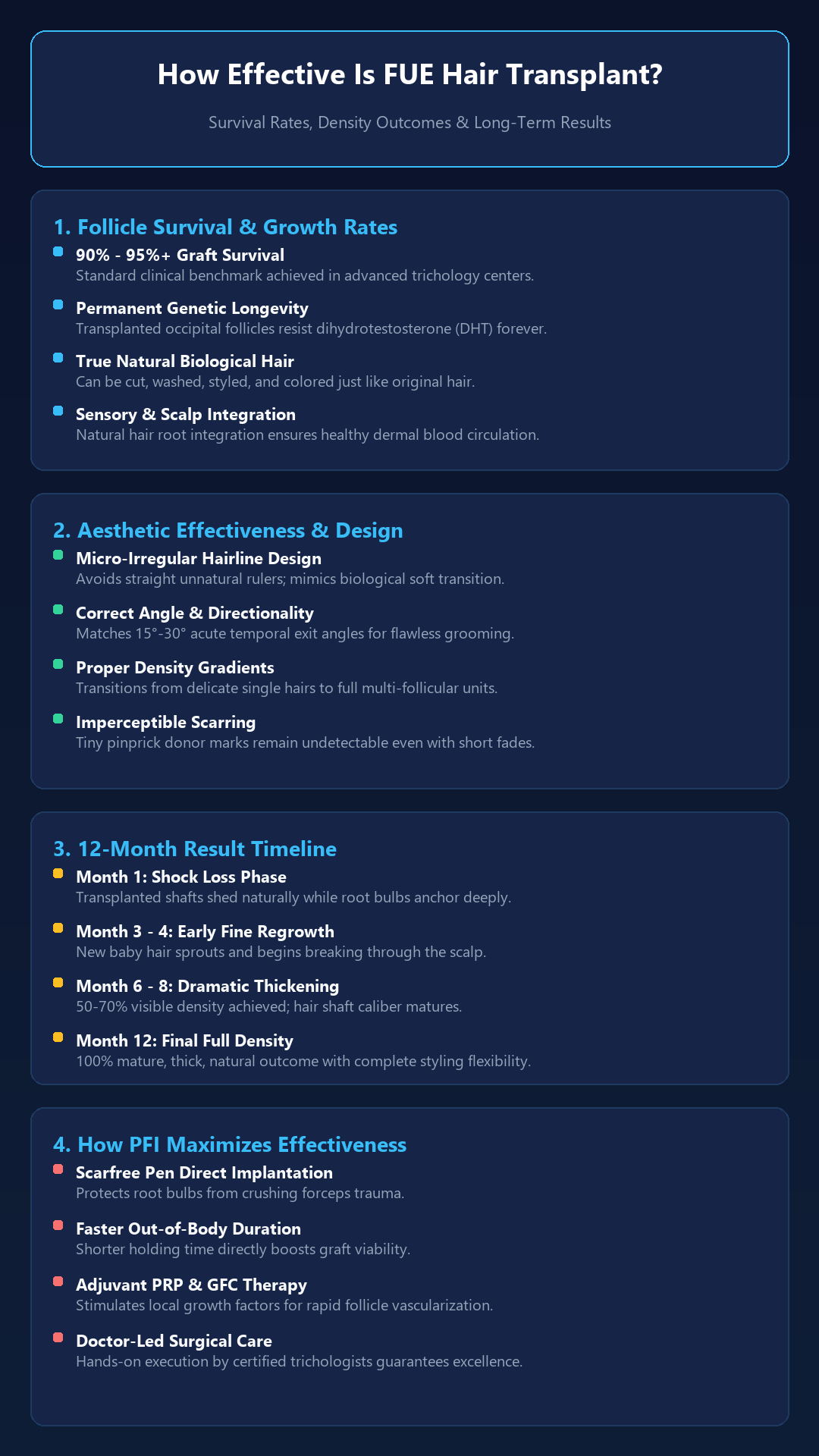
Table of Contents
- Clinical Effectiveness: Survival Rates and Biological Longevity
- Aesthetic Mastery: What Makes a Hair Transplant Look 100% Natural
- The 12-Month Regrowth Timeline and Key Milestones
- Factors That Directly Influence Your Procedure’s Success
- Classic FUE vs. Advanced PFI Scarfree Effectiveness Table
- How PFI with the Scarfree Pen Elevates Success Beyond 95%
- Consult with Trichologist Dr. Arefa Patel at Elite Dermadent
- Frequently Asked Questions (FAQs)
Clinical Effectiveness: Survival Rates and Biological Longevity
In medical trichology, the effectiveness of FUE hair restoration is measured through two primary criteria:
- Graft Survival Rate: The percentage of extracted follicular units that establish vascular connections in the recipient scalp and produce terminal hair shafts. In premier centers utilizing motorized micro-punches and chilled holding media, graft take rates consistently exceed 90% to 95%.
- Biological Permanence: Transplanted follicles are harvested from the “safe donor zone” at the lower occipital scalp. These follicles lack sensitive 5-alpha-reductase receptors, making them permanently resistant to the balding hormone dihydrotestosterone (DHT). Even after relocation, they continue their natural hair growth cycle indefinitely.
Aesthetic Mastery: What Makes a Hair Transplant Look 100% Natural
True surgical effectiveness is not merely about growing hair—it is about restoring an undetectable, aesthetically harmonious frame for your face. This requires:
- Micro-Irregular Hairline Geometry: Natural hairlines are never straight lines drawn with a ruler. Skilled surgeons create subtle, micro-irregular zig-zag patterns with soft transitions.
- Graduated Single-Hair Placement: Only delicate, ultra-fine single-hair follicular units are placed along the leading frontal border. Multi-hair follicular units (2 to 4 hairs) are reserved for the mid-scalp and core to build depth and volume.
- 3D Directionality & Angulation: Hair does not grow straight up. In the frontal hairline, hair exits the scalp at acute 15-degree to 30-degree angles pointed forward and slightly downward, matching your facial flow.
The 12-Month Regrowth Timeline and Key Milestones
Understanding the biological timeline prevents premature anxiety during the recovery phase:
| Timeline Milestone | Biological Activity | Visible Scalp Appearance | Patient Action / Care |
|---|---|---|---|
| Days 1 – 10 | Micro-vascular reconnection (neovascularization) | Tiny pinpoint crusts and micro-scabs form | Gentle saline misting & medical shampoo wash |
| Weeks 3 – 8 | “Shock Loss” phase (telogen resting stage) | Transplanted hair shafts shed; scalp looks bare again | Normal routine; resume gentle scalp massage |
| Months 3 – 4 | Anagen reactivation phase | Fine baby hairs sprout through the scalp skin | Begin adjuvant PRP or GFC maintenance sessions |
| Months 6 – 8 | Follicle caliber maturation & hair shaft thickening | 60% to 75% visible cosmetic density; clear hairline | First haircuts and styling experimentation |
| Month 12 | Full terminal biological maturation | 100% complete density, natural wave, and volume | Full lifelong styling and grooming freedom |
Factors That Directly Influence Your Procedure’s Success
While modern technology provides outstanding results, maximum effectiveness relies on several critical variables:
- Surgeon Experience & Skill: Ensuring high surgical precision during extraction prevents transection (cutting the follicle root). Certified specialists ensure minimal mechanical manipulation.
- Graft Hydration & Preservation: Storing grafts in temperature-controlled, nutrient-rich holding media enriched with growth factors preserves cellular energy (ATP) while out of the body.
- Adherence to Aftercare: Avoiding scalp friction, heavy sweating, direct sun exposure, and tobacco smoking during the first 14 days protects vulnerable newly vascularized grafts.
- Long-Term Native Hair Maintenance: Continuing preventive medical therapies (such as Finasteride, Minoxidil, or PRP/GFC therapy) prevents non-transplanted native hair from thinning behind the restored hairline.
Classic FUE vs. Advanced PFI Scarfree Effectiveness Table
Comparing outcomes between standard FUE and Elite Dermadent’s signature technique:
| Clinical Metric | Conventional FUE | PFI with Scarfree Pen |
|---|---|---|
| Average Graft Survival | 85% – 90% | 95% – 98%+ |
| Root Bulb Manipulation | Forceps grip directly on bulb | Zero forceps contact on bulb (sheathed) |
| Maximum Safe Density | 35 – 45 grafts/cm² | 50 – 60+ grafts/cm² |
| Downtime / Scab Shedding | 8 – 12 days | 3 – 5 days |
How PFI with the Scarfree Pen Elevates Success Beyond 95%
At Elite Dermadent, we elevate hair restoration effectiveness through the Precise Follicular Implantation (PFI) technique using the Scarfree Pen. By eliminating pre-cut scalp slits, the Scarfree Pen deposits the follicle into the scalp with sub-millimeter precision. The delicate bulb is shielded inside the pen’s hollow needle, preventing crush injuries and promoting rapid, robust vascular integration.
Consult with Trichologist Dr. Arefa Patel at Elite Dermadent
Maximizing the effectiveness of your hair restoration starts with an individualized clinical assessment. Led by Dr. Arefa Patel, Trichologist and Skin Specialist, Elite Dermadent provides evidence-based treatments and proven surgical protocols.
Discover how our advanced hair transplant in Thane can restore your hairline, enhance your density, and deliver lifelong, natural results.
Frequently Asked Questions (FAQs)
1. What is the success rate of FUE hair transplants?
When performed by experienced trichologists using modern micro-punches and direct implanters like the Scarfree Pen, FUE hair transplants achieve graft survival rates exceeding 90% to 95%.
2. Does transplanted hair fall out over time?
No. The transplanted follicles come from the permanent donor zone at the back of your head, which is genetically immune to DHT. These hairs continue growing naturally for the rest of your life.
3. How soon can I see results after my FUE transplant?
Early new hair growth begins around month 3 to 4. Substantial cosmetic density is visible between months 6 and 8, with the full, final result appearing at the 12-month mark.
4. Can I shave my head after an FUE procedure?
Yes. Because FUE leaves tiny sub-millimeter circular dots rather than a long surgical strip scar, you can wear very short buzz cuts or skin fades without noticeable surgical marks.
5. Why does Elite Dermadent use PFI with the Scarfree Pen?
PFI with the Scarfree Pen provides superior control over depth, angle, and density while completely eliminating forceps crush trauma to delicate follicle bulbs, boosting survival rates to over 95%.
No responses yet