
One of the most common anxieties among prospective patients is: does an FUE hair transplant hurt? The straightforward medical answer is: no, an FUE hair transplant does not hurt. The entire procedure is performed under precision local anesthesia, which completely numbs the scalp so you feel no surgical pain whatsoever. While patients experience a brief, minor pinch during the initial administration of local anesthesia (lasting only 1 to 2 minutes), the extraction and implantation phases are virtually pain-free. Following surgery, any post-procedure soreness is mild and easily managed with standard over-the-counter pain relievers.
Key Takeaways:
- Completely Numb During Surgery: Once local anesthesia takes effect, you will feel only gentle pressure or light touch—zero cutting or stinging sensation.
- Relaxed Patient Experience: Most patients spend the procedure chatting with the medical team, watching movies, listening to podcasts, or taking a nap.
- Less Pain Than FUT: Because FUE uses microscopic punches (<0.85mm) instead of removing a full strip of scalp with stitches or staples, surgical trauma is minimal.
- PFI Comfort Advantage: Precise Follicle Implantation (PFI) with the Scarfree Pen eliminates pre-cut slit incisions, reducing swelling, tissue bleeding, and post-op tenderness.
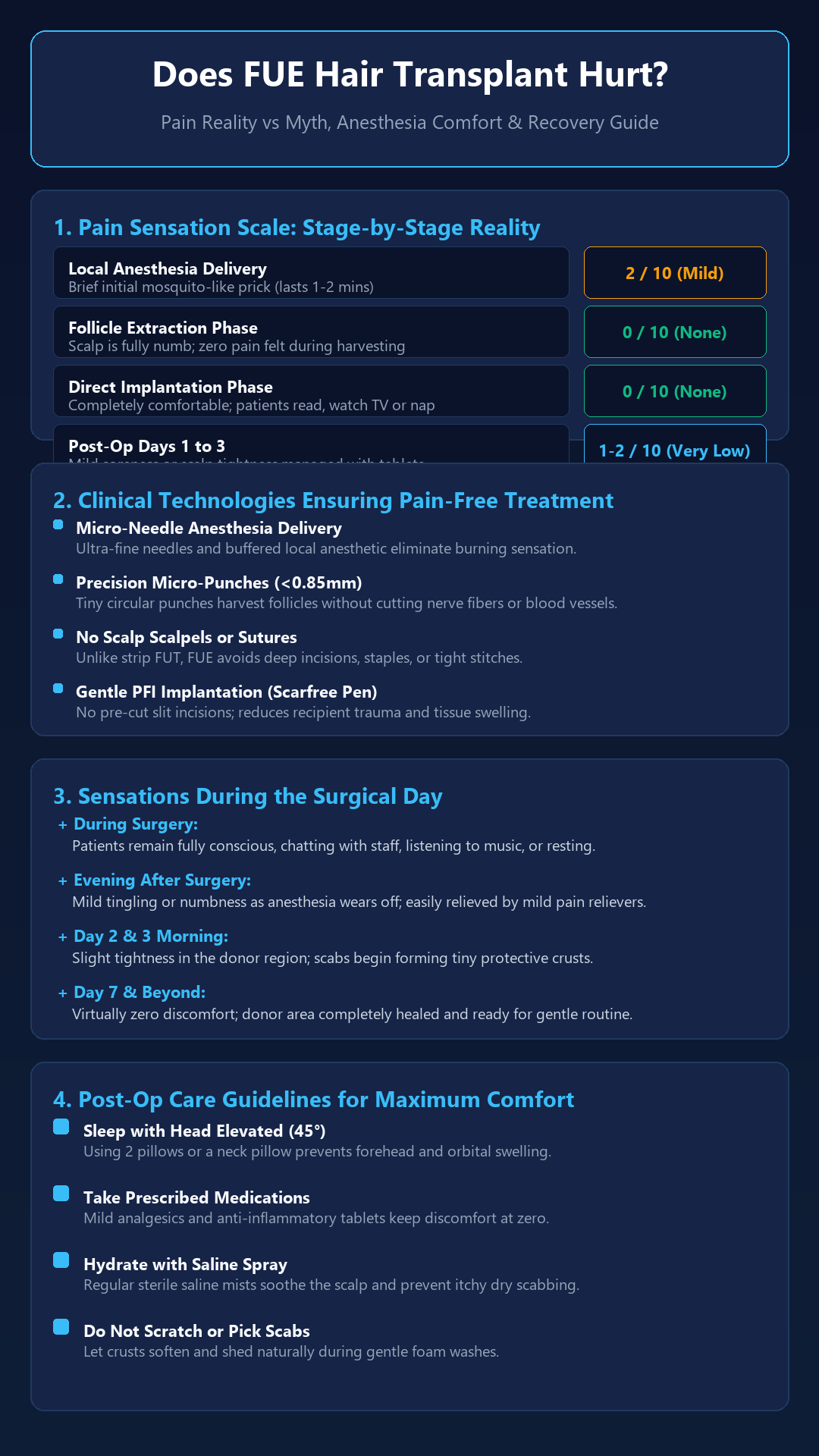
Table of Contents
- Pain Scale: What Does Each Phase Actually Feel Like?
- How Local Anesthesia Eliminates Procedure Pain
- Pain Comparison: FUE vs. Traditional FUT Strip Surgery
- Why Advanced PFI with the Scarfree Pen Reduces Trauma
- What to Expect During Post-Operative Recovery
- Essential Tips for a Smooth, Comfortable Recovery
- Compassionate Care with Dr Arefa Patel at Elite Dermadent
- Frequently Asked Questions (FAQs)
Pain Scale: What Does Each Phase Actually Feel Like?
To eliminate fear of the unknown, here is an honest, stage-by-stage breakdown of sensations experienced throughout the day of surgery:
| Procedure Stage | Reported Pain Level (0 to 10) | Actual Sensations Felt | Duration of Sensation |
|---|---|---|---|
| 1. Local Anesthesia Injections | 2 – 3 / 10 (Mild) | Brief mosquito-like prick followed by a warm numbing feeling | 1 to 3 minutes |
| 2. Follicle Punch Extraction | 0 / 10 (None) | Total numbness; subtle vibration or light tactile pressure only | 2 to 3 hours |
| 3. Follicle Implantation Phase | 0 / 10 (None) | Zero pain; completely numb; patients relax or sleep | 2 to 4 hours |
| 4. First Night Post-Op | 1 – 2 / 10 (Very Low) | Mild dull ache or tightness in the donor area; relieved by paracetamol | First 24 hours |
| 5. Days 3 to 7 Recovery | 0 – 1 / 10 (Negligible) | Mild itchiness as scabs form and heal; no true pain | 3 to 5 days |
How Local Anesthesia Eliminates Procedure Pain
Modern hair restoration clinics use refined anesthesia protocols to maximize patient comfort. At Elite Dermadent, local anesthesia is administered with ultra-fine micro-needles (30-gauge) and buffered anesthetic solutions that neutralize the pH, preventing the stinging sensation associated with standard dental or surgical injections.
Furthermore, specialized nerve block techniques numb large anatomical sections of the scalp (such as the supraorbital and supratrochlear nerves in front, and the greater occipital nerve in back) with just a few gentle injection points. Within 90 seconds, the entire treatment area is completely desensitized.
Pain Comparison: FUE vs. Traditional FUT Strip Surgery
Much of the historical fear regarding hair transplant pain stems from older FUT (Follicular Unit Transplantation) strip surgery. In FUT, a doctor excises a long, deep strip of skin and flesh from the back of the head and pulls the scalp edges together using surgical staples or tension sutures.
By comparison, Follicular Unit Extraction (FUE) is minimally invasive:
- No Scalpel Incisions: Individual follicular units are extracted using micro-punches measuring between 0.75mm and 0.85mm in diameter.
- No Stitches or Staples: The tiny extraction sites close naturally within 24 to 48 hours without sutures.
- Zero Nerve Tension: Because no tissue strip is removed, there is no uncomfortable tightness or pulling sensation at the back of the neck.
Why Advanced PFI with the Scarfree Pen Reduces Trauma
In conventional FUE, the surgeon cuts hundreds of tiny slit channels into the recipient scalp using scalpel blades or needles before assistants insert the grafts using forceps. This double-stage handling causes minor bleeding and tissue swelling.
At Elite Dermadent, the Precise Follicle Implantation (PFI) technique using the Scarfree Pen elevates patient comfort to an entirely new level:
- Simultaneous Channel & Insertion: The Scarfree Pen’s micro-needle creates the tiny recipient opening and deposits the follicle simultaneously.
- Minimal Bleeding & Bruising: Less vascular disruption ensures significantly less swelling and near-instant tissue closure.
- Accelerated Recovery: Patients experience virtually no post-operative edema and can comfortably resume sedentary work within 48 to 72 hours.
What to Expect During Post-Operative Recovery
Here is what you will experience as your scalp heals:
- Day 1: The local anesthetic gradually wears off over 3 to 4 hours. You may feel mild tightness or a light sunburn-like sensation, which responds readily to prescribed mild analgesics.
- Days 2 to 4: Small pinpoint scabs form. The donor area feels slightly stiff but is generally painless. Any temporary forehead puffiness subsides quickly.
- Days 5 to 7: Itchiness may develop—this is a normal sign of active cellular wound healing. A soothing saline spray keeps the area hydrated.
- Day 10: Following gentle foam washes, scabs fall away completely, leaving healthy skin with zero lingering soreness.
Essential Tips for a Smooth, Comfortable Recovery
To ensure your recovery remains completely painless and hassle-free:
- Elevate Your Head at Night: Sleep at a 45-degree angle using 2 soft pillows or a travel neck pillow during the first 3 nights to prevent fluid accumulation in the forehead and eyelids.
- Use Sterile Saline Spray: Mist the recipient area every 2 to 3 hours during waking hours to keep grafts hydrated and prevent dry, itchy crusting.
- Never Scratch or Pick: If itchiness occurs, gently tap the forehead or spray saline rather than scratching the graft sites.
- Avoid Intense Exercise: Refrain from heavy lifting, cardio, and sweating for 10 to 14 days to keep scalp blood pressure stable.
Compassionate Care with Dr Arefa Patel at Elite Dermadent
Your comfort and peace of mind are top priorities throughout every stage of treatment. Under the expert clinical guidance of Dr Arefa Patel, Trichologist and Skin Specialist, Elite Dermadent ensures that every Hair Transplant procedure is smooth, relaxed, and entirely pain-free through gentle PFI techniques.
Schedule your confidential consultation today to discuss your hair restoration goals in a calm, modern clinic environment designed around patient comfort.
Frequently Asked Questions (FAQs)
1. Does getting the local anesthesia injections hurt?
The local anesthesia injection causes a brief, mild prick comparable to a minor mosquito bite that lasts just 1 to 2 seconds per injection point. Modern buffered anesthetic solutions and micro-fine needles ensure that this brief initial phase is very easily tolerated.
2. Will I feel anything while hair follicles are being extracted or implanted?
No. Once local anesthesia is active, your scalp nerves are completely desensitized. You will feel zero cutting, stinging, or painful sensation. Patients frequently listen to music, watch movies, chat with the doctor, or take a nap during the surgery.
3. How bad is the pain after the anesthesia wears off?
Post-operative discomfort is generally very mild, often rated around 1 to 2 on a 10-point scale. It feels similar to a mild scalp tightness or mild sunburn and is easily managed with mild prescribed pain tablets like paracetamol for the first 24 to 48 hours.
4. Can I sleep comfortably on the first night after an FUE transplant?
Yes, by sleeping on your back with your head elevated at 45 degrees using two pillows or an ergonomic travel neck pillow. This prevents direct pressure on the newly transplanted grafts and minimizes morning swelling.
5. How soon after FUE can I return to work without discomfort?
Most patients working desk jobs or remote positions resume work comfortably within 2 to 3 days post-surgery. By day 7, all minor donor soreness and crusting have virtually cleared.
No responses yet