
When facing progressive hair thinning or a receding hairline, many people ask: is an FUE hair transplant expensive? While an FUE hair transplant requires an initial financial investment, it is widely considered the most cost-effective, high-ROI hair restoration solution over a lifetime. Unlike recurring temporary remedies—such as hair loss serums, prescription medications, concealers, and continuous salon treatments that accumulate substantial recurring costs—a Follicular Unit Extraction procedure provides permanent, living hair growth with a one-time surgical investment.
Key Takeaways:
- Long-Term ROI: A one-time hair transplant usually costs far less over 10 to 15 years than continuous cosmetic concealers, medications, and recurring non-surgical treatments.
- Affordable Indian Pricing: FUE hair transplants in India cost 70% to 80% less than in Western nations while offering world-class clinical expertise.
- Primary Cost Factors: Total price is determined by graft count, Norwood stage, surgeon credentials, and whether cutting-edge techniques like PFI (Precise Follicle Implantation) are utilized.
- High Value of PFI: With the Scarfree Pen technique, higher follicle survival (up to 98%) eliminates the expense of future revision or touch-up surgeries.
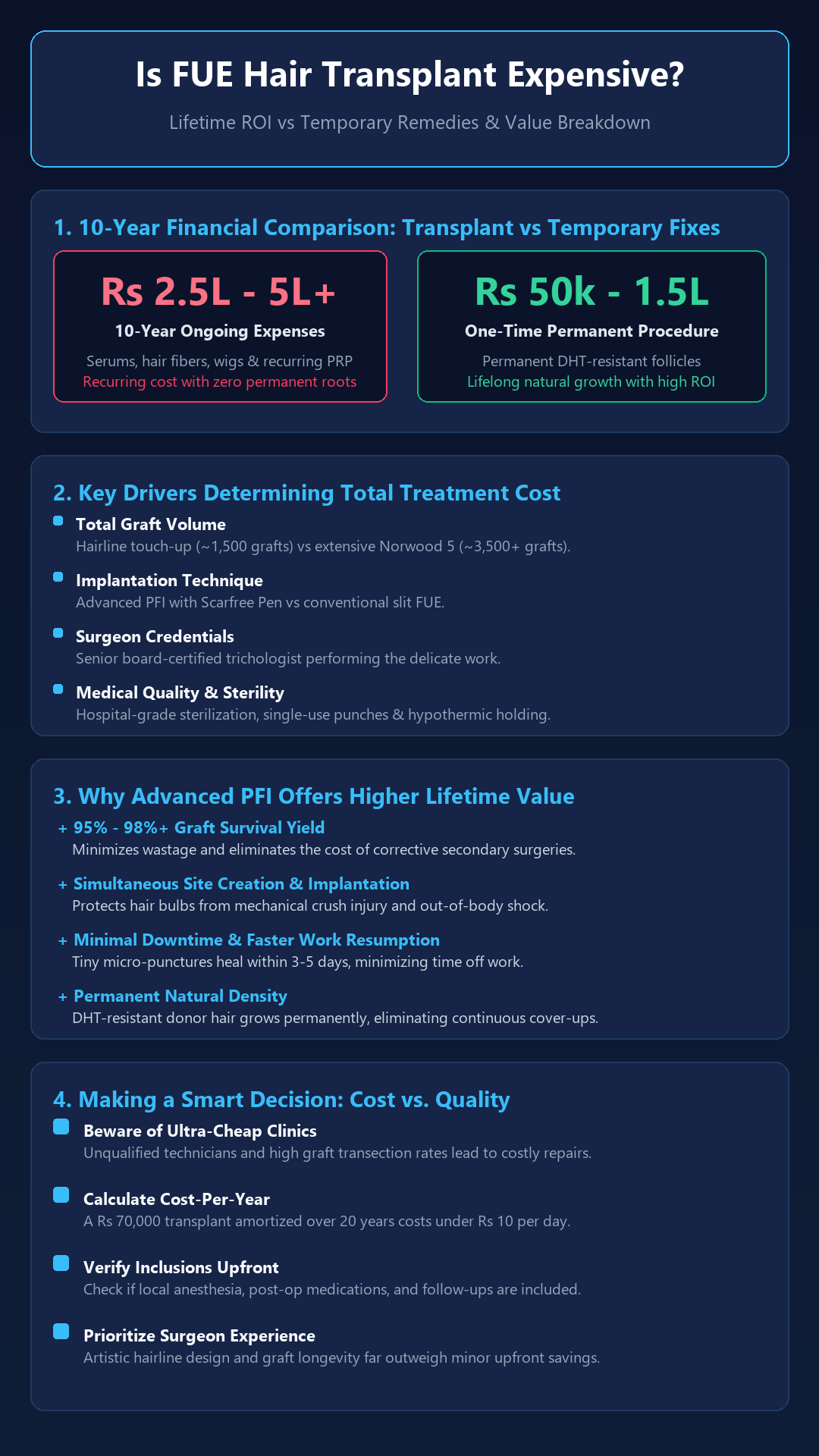
Table of Contents
- Upfront Cost vs. Long-Term Value: The Financial Reality
- 10-Year Cost Comparison: Transplant vs. Temporary Treatments
- What Factors Make an FUE Hair Transplant More or Less Expensive?
- Global vs. Indian Pricing: Why India Offers Unmatched Value
- Why Advanced PFI with the Scarfree Pen Delivers Greater Value
- The Hidden Dangers of “Budget” Hair Transplants
- Personalized Assessment at Elite Dermadent
- Frequently Asked Questions (FAQs)
Upfront Cost vs. Long-Term Value: The Financial Reality
The perception of an FUE hair transplant being “expensive” arises because surgical fees are paid upfront rather than in small monthly increments. However, analyzing the expenditure through an amortized lens tells a completely different financial story.
A quality hair transplant in India typically ranges from ₹45,000 to ₹1,50,000 depending on the number of follicular units required. When amortized over 20 years, a ₹75,000 procedure costs approximately ₹10 per day—less than the price of a daily cup of tea. In contrast to temporary remedies that stop working the moment you discontinue spending, transplanted follicles from the safe donor zone remain genetically immune to DHT and continue growing for life.
10-Year Cost Comparison: Transplant vs. Temporary Treatments
To evaluate whether FUE is genuinely expensive, consider this 10-year cumulative expenditure breakdown:
| Hair Loss Solution | Typical Monthly / Annual Cost | 10-Year Estimated Expense | Permanence & Outcome |
|---|---|---|---|
| Prescription Serums & Medications | ₹1,500 – ₹3,000 / month | ₹1,80,000 – ₹3,60,000 | Temporary; hair sheds once stopped |
| Hair Systems / Wigs & Maintenance | ₹25,000 – ₹40,000 / year | ₹2,50,000 – ₹4,00,000+ | Artificial appearance, frequent refitting |
| Regular PRP / GFC Maintenance Sessions | ₹15,000 – ₹30,000 / year | ₹1,50,000 – ₹3,00,000 | Improves native hair; cannot grow new follicles |
| One-Time FUE / PFI Hair Transplant | One-time surgical fee | ₹50,000 – ₹1,50,000 | 100% permanent, natural living hair |
What Factors Make an FUE Hair Transplant More or Less Expensive?
The total pricing of an FUE hair restoration surgery is governed by several core medical variables:
- Number of Grafts Required: The extent of hair loss on the Norwood Scale directly impacts surgical duration. Restoring a receding frontal hairline (1,500 grafts) costs substantially less than treating an advanced Norwood Stage 5 or 6 (3,500+ grafts).
- Surgical Technique Used: Basic automated FUE using manual forceps costs less than cutting-edge Precise Follicle Implantation (PFI) utilizing the Scarfree Pen, which provides superior density, faster healing, and near-zero scarring.
- Surgeon Qualifications: Having the entire procedure personally performed or directly overseen by an experienced trichologist ensures higher graft survival and natural hairline aesthetics compared to commercial clinics that rely on unlicensed technicians.
- Operating Standards & Technology: Single-use titanium micro-punches, specialized hypothermic holding solutions (like HypoThermosol), and surgical stereo microscopes add to operational costs but guarantee maximum follicle take.
Global vs. Indian Pricing: Why India Offers Unmatched Value
Internationally, hair transplantation can indeed be prohibitively expensive. In the United States, Canada, and the United Kingdom, an FUE procedure typically costs between $6,000 and $18,000 (₹5,00,000 to ₹15,00,000+) due to exorbitant clinic overheads and surgical billing practices.
In contrast, reputable Indian clinics in Mumbai and Thane offer equivalent or superior surgical precision for a fraction of the cost—typically between ₹45,000 and ₹1,50,000. This dramatic cost advantage makes India one of the premier global destinations for medical hair restoration.
Why Advanced PFI with the Scarfree Pen Delivers Greater Value
Investing in higher-tier implantation technology directly impacts your financial return. In traditional FUE, pre-made slit incisions can cause trauma, and forceps placement risks crushing delicate follicle roots, potentially resulting in lower survival rates (80%–85% in budget settings).
At Elite Dermadent, the Precise Follicle Implantation (PFI) technique with the Scarfree Pen ensures:
- 95% to 98%+ Graft Survival: Eliminates wasted grafts and the future expense of revision or corrective surgeries.
- No Pre-Made Channel Incisions: Simultaneous site creation and graft insertion reduces scalp trauma, bleeding, and downtime.
- Permanent Natural Hairline: Custom control over angle and depth guarantees undetectable results that last a lifetime.
The Hidden Dangers of “Budget” Hair Transplants
While exploring pricing, patients often encounter commercial centers advertising unrealistically cheap rates (e.g., ₹10–₹15 per graft). Proceeding with extreme caution is critical:
- Overharvesting & Donor Depletion: Inexperienced technicians frequently over-extract follicles, leaving the back of your head permanently patchy, thin, and scarred.
- High Follicle Transection: Careless punch extraction slices the hair bulb, meaning hundreds of paid-for grafts die before implantation.
- Unnatural “Doll-Like” Hairlines: Incorrect angulation and failure to use single-hair grafts creates harsh, artificial hairlines that are costly and difficult to repair.
Personalized Assessment at Elite Dermadent
Determining your exact investment requires a personalized trichological evaluation. Under the care of Dr Arefa Patel, Trichologist and Skin Specialist, Elite Dermadent provides transparent, comprehensive evaluations for state-of-the-art Hair Transplant treatments.
During your consultation, digital trichoscopy maps your donor density and establishes the exact graft count needed to restore your hairline permanently, safely, and affordably.
Frequently Asked Questions (FAQs)
1. Is an FUE hair transplant worth the money?
Yes. An FUE hair transplant is widely regarded as a high-value investment because it delivers permanent living hair that grows naturally for life. Over 10 to 15 years, it is significantly less expensive than recurring expenses on temporary concealers, medications, and non-surgical maintenance treatments.
2. What is the average cost of an FUE hair transplant in India?
In India, the cost of an FUE hair transplant typically ranges from ₹45,000 to ₹1,50,000, depending on the number of grafts required (usually between 1,500 and 4,000 grafts), the surgeon’s expertise, and the technique used (standard FUE vs. advanced PFI).
3. Why are some hair transplant clinics so much cheaper?
Budget clinics cut costs by employing unlicensed or junior technicians instead of experienced doctors, reusing disposable micro-punches, skipping specialized graft holding solutions, and rushing procedures. This significantly increases graft transection rates and donor zone depletion.
4. Does health insurance cover the cost of an FUE hair transplant?
Generally, hair transplants for male or female pattern baldness (androgenetic alopecia) are considered aesthetic elective procedures and are not covered by standard health insurance. However, many clinics offer flexible EMI installment options.
5. Can one FUE hair transplant last a lifetime?
Yes. Follicles harvested from the safe donor zone at the back and sides of the scalp are genetically resistant to DHT. When extracted and transplanted correctly using techniques like PFI, these follicles retain their genetic programming and continue growing permanently for life.
No responses yet