
If you are struggling with a receding hairline, widening crown, or progressive male or female pattern hair loss, choosing to undergo hair restoration is a transformative decision. However, with multiple techniques available today—from FUT and FUE to direct implanter methods—the central question prospective patients ask is: which hair transplant treatment is best?
The definitive answer depends on your stage of hair loss, donor hair quality, and personal lifestyle. In modern clinical dermatology, direct follicle implantation techniques—most notably Precise Follicle Implantation (PFI) using the Scarfree Pen—are considered the gold standard. While traditional FUT (strip surgery) remains an option for severe baldness requiring massive graft counts in a single sitting, and standard FUE offers individual extraction, PFI represents the latest evolution by eliminating manual scalpel incisions, achieving up to 95%+ graft survival, and leaving virtually undetectable scarring.
Key Takeaways: Finding Your Best Hair Restoration Option
- FUT (Strip Method): Best for extensive, advanced baldness where maximum grafts are needed at a lower per-graft cost, but leaves a permanent linear donor scar.
- Standard FUE: Great for wearing hair short with tiny dot scars, but traditional forceps insertion can cause graft trauma and lower survival rates.
- PFI (Precise Follicle Implantation): The top-tier, minimally invasive treatment. Grafts are placed directly into the scalp using the Scarfree Pen without pre-made slit incisions, providing pinpoint density and natural growth angles.
- Doctor Expertise Over Tools: No matter the technique, surgical outcome is dictated by the trichologist’s diagnostic accuracy, hairline artistry, and donor preservation strategy.
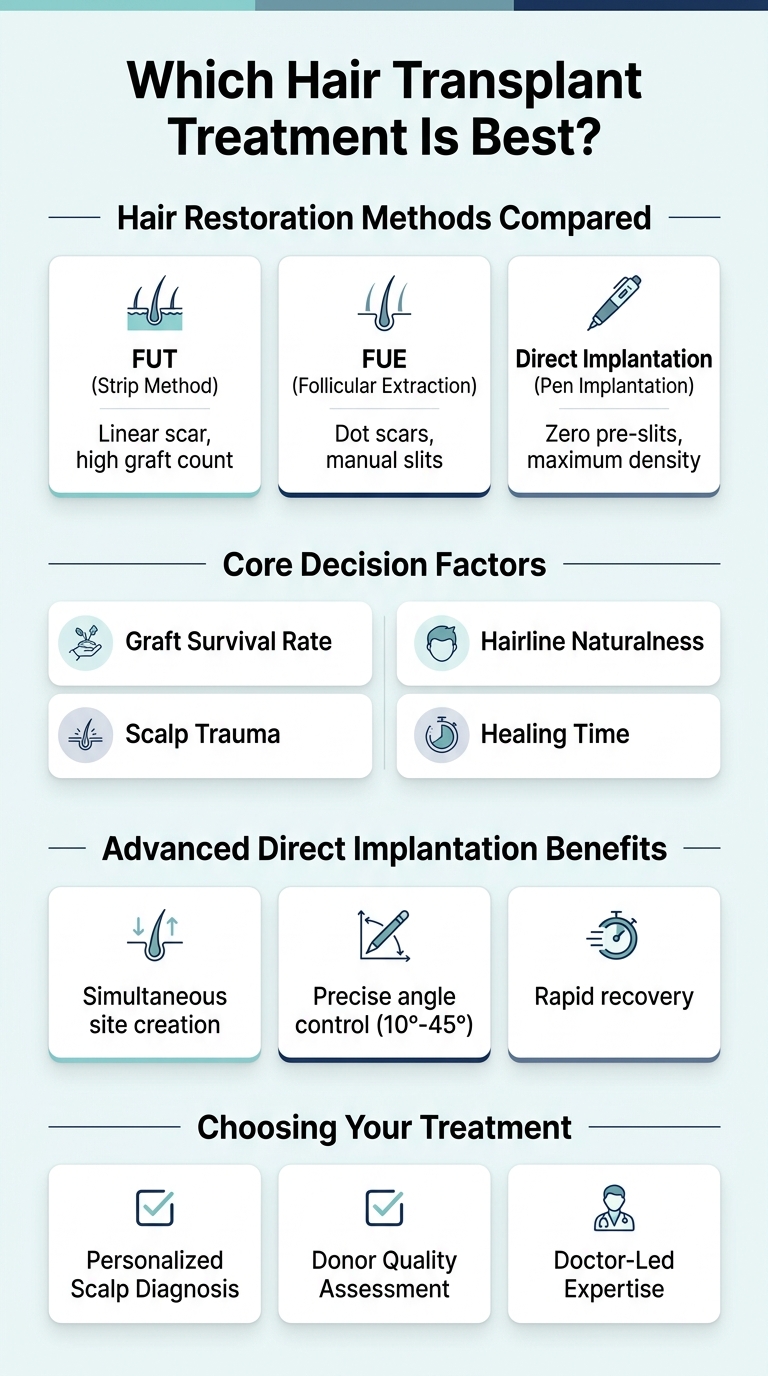
Table of Contents
- Overview of Major Hair Transplant Techniques
- Comprehensive Comparison: FUT vs. FUE vs. PFI
- Key Factors That Determine the Best Treatment for You
- Why PFI with the Scarfree Pen Is the Gold Standard
- Surgical vs. Non-Surgical Therapies: Can They Be Combined?
- How to Choose the Right Hair Restoration Specialist
- Frequently Asked Questions
Overview of Major Hair Transplant Techniques
To evaluate which hair transplant treatment is best for your specific case, it helps to understand how the primary surgical restoration modalities differ in methodology, extraction, and implantation:
1. FUT (Follicular Unit Transplantation / Strip Surgery)
FUT is the traditional surgical approach where a narrow horizontal strip of scalp tissue is surgically excised from the permanent donor zone at the back of the head. The strip is dissected under stereoscopic microscopes into individual 1- to 4-hair follicular units, while the donor wound is closed with sutures or staples.
- Advantages: Enables the harvest of large graft numbers (3,500 to 4,500+ grafts) in a single session without requiring the donor area to be shaved.
- Disadvantages: Leaves a permanent linear scar across the back of the scalp, requires 2 to 3 weeks of recovery, carries higher post-op tightness or discomfort, and prevents patients from wearing short or faded hairstyles.
2. Standard FUE (Follicular Unit Extraction)
Developed to eliminate the linear scar of FUT, standard FUE extracts follicular units individually from the donor area using circular motorized or manual micro-punches (ranging from 0.75mm to 1.0mm in diameter). After harvesting, the surgeon creates recipient slit channels using needles or micro-scalpels, and assistants manually insert the grafts using forceps.
- Advantages: No linear scar; leaves only microscopic circular dot scars easily hidden even with short buzz cuts. Healing time is notably faster (5 to 7 days).
- Disadvantages: Requires extensive shaving of the donor area. Manually squeezing fragile graft roots with forceps into pre-slit channels can cause mechanical crushing, graft dehydration, and variable follicle survival rates (75%–85%).
3. Direct Implantation: PFI (Precise Follicle Implantation) with the Scarfree Pen
PFI is the latest technological leap in follicular unit restoration. Follicles are harvested using ultra-fine micro-punches and immediately loaded into a specialized implanter device known as the Scarfree Pen. The pen simultaneously creates the microscopic recipient puncture and seats the follicle at the exact intended depth and angle in a single fluid motion—completely bypassing pre-made scalpel incisions.
- Advantages: Zero forceps handling of the follicle bulb, no pre-cut slit trauma, minimal bleeding and swelling, undetectable scarring, precise directional control (10° to 45°), and the highest documented graft survival rates (95%+).
- Disadvantages: Requires advanced trichological training, dedicated implanter instruments, and higher surgical precision per graft.
Comprehensive Comparison: FUT vs. FUE vs. PFI
The table below provides a detailed clinical comparison to help you understand which treatment aligns best with your expectations, hair characteristics, and lifestyle:
| Evaluation Metric | FUT (Strip Method) | Standard FUE | PFI (Scarfree Pen) |
|---|---|---|---|
| Harvesting Technique | Surgical strip excision of scalp skin | Individual punch extraction (0.8–1.0mm) | Ultra-fine micro-punch extraction (0.6–0.8mm) |
| Recipient Site Creation | Pre-cut slit incisions with scalpel/blade | Pre-cut slit incisions or sapphire blades | Simultaneous puncture & placement (Zero pre-slits) |
| Implantation Tool | Manual micro-forceps | Manual micro-forceps | Precision Scarfree Pen Implanter |
| Donor Scarring | Noticeable linear scar across donor scalp | Tiny scattered circular dot scars | Virtually invisible micro-punches |
| Graft Survival Rate | 80% – 90% | 80% – 88% | 92% – 97%+ |
| Angle & Depth Control | Moderate (limited by pre-cut slits) | Moderate to Good | Superior (exact 10°–45° dynamic adjustment) |
| Recovery & Social Downtime | 14 to 21 days (suture removal required) | 7 to 10 days | 3 to 5 days (rapid scabbing resolution) |
| Ideal Candidate Profile | Severe baldness (Norwood 5–7), long hair | Moderate hair loss, preference for buzz cuts | Patients demanding maximum density & naturalness |
Key Factors That Determine the Best Treatment for You
When asking which hair transplant treatment is best, keep in mind that there is no universal “one-size-fits-all” answer. A specialist will evaluate several biological and lifestyle factors:
- Degree of Hair Loss (Norwood Scale):
Patients with minor frontal recession or crown thinning (Norwood 2 to 4) achieve phenomenal results with PFI or FUE, as high graft density can be placed without surgical trauma. Conversely, patients with extreme baldness (Norwood 6 or 7) may require a staged combination treatment or body hair harvesting.
- Donor Density and Scalp Laxity:
Patients with thick, dense follicular units in the occipital region are exceptional candidates for follicular extraction methods (PFI/FUE). If scalp tissue is tight and donor supply is sparse, precision implanter techniques prevent wasteful graft transection.
- Preferred Hairstyle:
If you prefer wearing your hair short, faded, or shaved at the sides, FUT strip surgery is strongly discouraged due to the visible horizontal scar. PFI and FUE allow complete freedom in hair styling.
- Downtime and Professional Demands:
If your career requires an immediate return to public appearances or active meetings, PFI offers the fastest healing profile, with recipient redness subsiding within 48 to 72 hours.
Why PFI with the Scarfree Pen Is the Gold Standard
Among all contemporary hair restoration options, Precise Follicle Implantation (PFI) using the cutting-edge Scarfree Pen stands out for its technological elegance and clinical superiority.
At Elite Dermadent, our hair restoration procedures are led by Dr Arefa Patel, Trichologist and Skin Specialist. Dr. Patel specializes in the PFI technique, utilizing the Scarfree Pen to deliver natural hairline architecture with exceptional graft survival.
How the Scarfree Pen Elevates Treatment Outcomes:
Unlike conventional FUE—where slits are made in advance and bleeding can obscure placement—the Scarfree Pen houses the extracted graft inside a hollow, medical-grade micro-needle. As the physician guides the pen into the recipient scalp, the needle creates the micro-site while simultaneously setting the root in position.
- Protected Follicular Bulb: Because the bulb is shielded inside the pen during insertion, delicate dermal papilla cells are never pinched, twisted, or traumatized by manual forceps.
- Tailored Direction & Aesthetic Realism: Human hair does not grow perpendicular to the scalp; it emerges at subtle angles ranging from 10 to 15 degrees at the frontal temporal points to 35 to 45 degrees across the mid-scalp. PFI allows the doctor to replicate these exact natural angles seamlessly.
- Maximum Packing Density: Eliminating pre-cut incisions allows the physician to place grafts closely together without compromising local blood supply, creating a lush, dense hairline.
- Minimal Visible Scarring: Micro-punctures seal and heal with extraordinary speed, allowing patients to enjoy virtually scar-free results.
To learn more about how PFI compares to other options for your hair loss pattern, explore our comprehensive hair transplant procedure details.
Surgical vs. Non-Surgical Therapies: Can They Be Combined?
While surgical hair restoration is the only proven method to repopulate areas where follicles have completely miniaturized or scarred over, combining surgery with medical and regenerative therapies yields the most resilient, long-term results:
- PRP (Platelet-Rich Plasma) & GFC (Growth Factor Concentrate): Concentrated autologous growth factors injected into the scalp stimulate angiogenesis, accelerate post-surgical healing, and awaken dormant native follicles.
- Medical DHT Blockers (Finasteride/Dutasteride): While transplanted follicles are genetically resistant to DHT, untreated native hair surrounding the transplant remains susceptible to genetic thinning. Medical therapy preserves your existing hair to prevent future gaps.
- Topical Formulations (Minoxidil): Enhances microvascular blood flow to both transplanted and native hair shafts, expediting graft emergence after the temporary shock-loss phase.
How to Choose the Right Hair Restoration Specialist
Ultimately, a hair transplant is not simply about the machine or gadget used—it is an intricate microsurgical art. The best treatment is only as good as the specialist performing it.
When selecting your hair restoration provider, verify that:
- Your doctor holds recognized medical and trichological credentials.
- The primary physician performs the critical stages of surgery, including graft harvesting and implantation.
- The clinic provides clear macro photographic documentation of past clinical cases.
- The clinic conducts a computerized trichoscopic donor assessment before providing a realistic graft estimate.
Frequently Asked Questions
Which hair transplant treatment is best for a receding hairline?
For a receding hairline, Precise Follicle Implantation (PFI) with the Scarfree Pen is considered the best treatment. Hairline restoration requires acute implantation angles (10° to 15°), single-hair graft refinement, and high density without visible scarring—all of which PFI delivers with superior control compared to traditional methods.
Is FUE better than FUT?
For the vast majority of modern patients, FUE (and advanced direct implanter variants like PFI) is superior to FUT because it avoids a noticeable linear donor scar, causes significantly less post-operative pain, and allows for rapid healing. However, FUT may still be recommended for patients with extensive baldness who need a very large number of grafts in a single session.
What is the success rate of modern hair transplants?
When performed by experienced trichologists using direct implantation techniques like PFI, hair transplant success rates (graft survival) typically exceed 92% to 97%. In contrast, older techniques involving manual forceps handling often yield survival rates between 80% and 88%.
Does a hair transplant hurt during or after surgery?
The procedure is virtually painless because local anesthesia is administered to numb both donor and recipient areas. Following the procedure, advanced minimally invasive techniques like PFI cause minimal soreness or swelling, which can easily be managed with mild over-the-counter pain medication for 1 to 2 days.
How long do results from a hair transplant last?
Hair transplant results are permanent. Follicles extracted from the occipital donor zone are genetically programmed to resist dihydrotestosterone (DHT), allowing them to continue their natural growth cycle permanently in their new location.
No responses yet