
When deciding to restore thinning or receding hair, the question most patients face is: which hair transplant is best, FUE or FUT? Both Follicular Unit Extraction (FUE) and Follicular Unit Transplantation (FUT, also known as the strip procedure) are clinically proven, permanent surgical solutions for androgenetic alopecia. However, they differ fundamentally in how hair follicles are harvested, the type of scarring they leave, downtime, and long-term hairstyle flexibility. According to the International Society of Hair Restoration Surgery (ISHRS) 2025/2026 Practice Census, FUE now accounts for over 76% of all hair restoration surgeries performed worldwide, cementing its position as the preferred modern standard. However, FUT continues to hold specific surgical utility for high-volume graft requirements in patients who wear longer hair. Understanding the clinical distinctions between both methods—as well as modern advancements like Precise Follicle Implantation (PFI)—will help you choose the best procedure for your scalp and goals.
Key Takeaways
- Core Difference: FUE extracts individual hair follicular units one by one using micro-punches (0.7–0.9 mm), whereas FUT excises a linear strip of skin from the donor area, which is dissected into grafts under stereoscopic microscopes.
- Scarring: FUE leaves microscopic, pinpoint circular scars that are virtually undetectable even with short buzz cuts or skin fades. FUT leaves a permanent linear scar across the back of the scalp that requires medium-to-long hair to conceal.
- Recovery Time: FUE offers rapid healing within 3 to 7 days with minimal postoperative soreness. FUT requires 10 to 14 days for wound closure and suture or staple removal.
- Graft Survival: In experienced surgical clinics, both techniques yield survival rates between 90% and 95%+.
- Next-Level Innovation: Advanced FUE techniques, such as Precise Follicle Implantation (PFI) with the Scarfree Pen, bypass pre-made recipient incisions entirely, achieving maximum follicle density, natural hairline angles, and rapid healing.
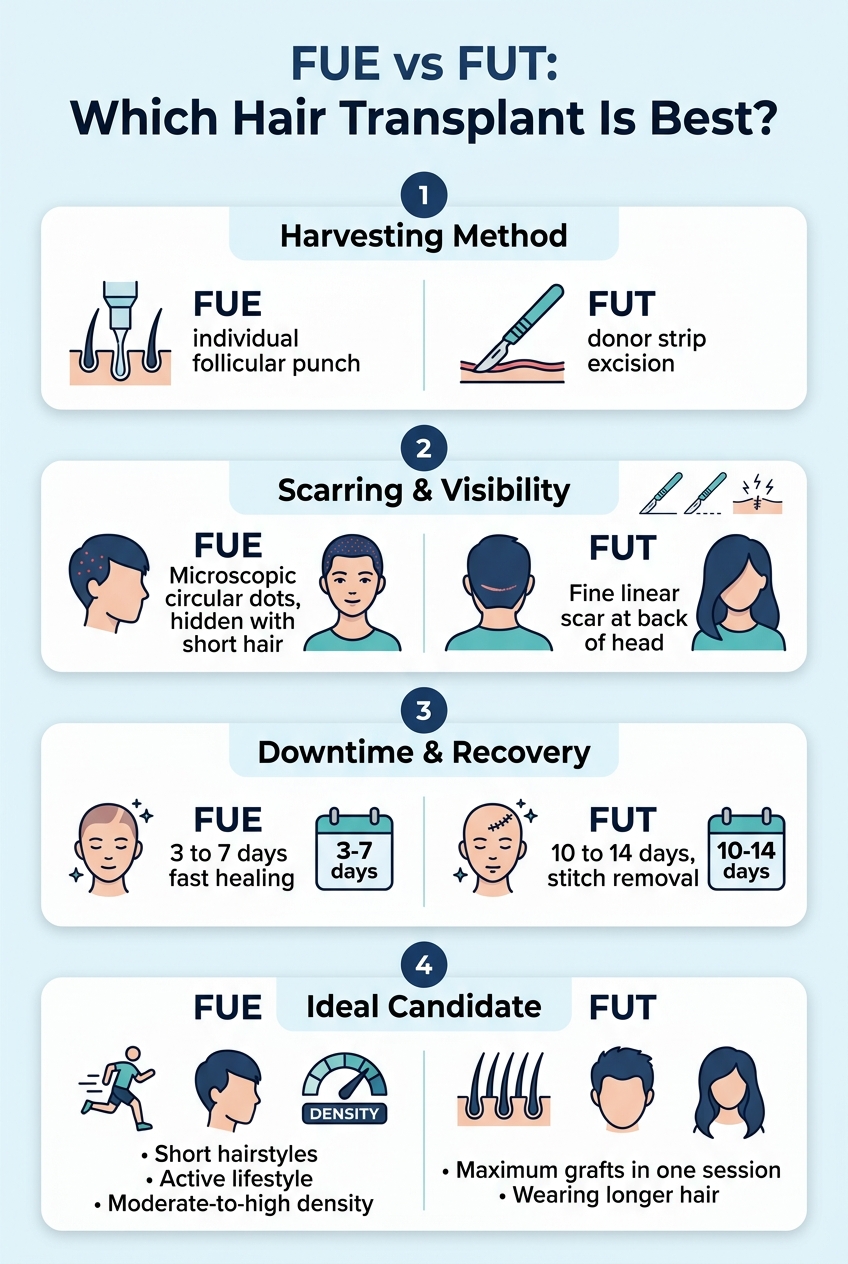
Table of Contents
- What Is the Core Difference Between FUE and FUT Hair Transplants?
- FUE vs. FUT: Head-to-Head Comparison Table
- Follicular Unit Extraction (FUE): Pros and Cons
- Follicular Unit Transplantation (FUT): Pros and Cons
- The Modern Evolution: PFI Hair Transplant with the Scarfree Pen
- Which Technique Is Best for You? Clinical Decision Factors
- Recovery and Healing Timeline: FUE vs. FUT
- Consult Hair Restoration Specialists at Elite Dermadent
- Frequently Asked Questions (FAQs)
- Sources & Clinical References
What Is the Core Difference Between FUE and FUT Hair Transplants?
The primary distinction between FUE and FUT lies exclusively in the donor harvesting technique. Once the grafts are harvested and prepared, the implantation phase into the recipient balding area follows similar restorative principles.
How Follicular Unit Extraction (FUE) Works
In Follicular Unit Extraction (FUE), the surgeon uses a specialized handheld or motorized micro-punch instrument—ranging from 0.7 mm to 0.9 mm in diameter—to extract follicular units (clusters of 1 to 4 hairs) directly from the safe donor zone at the back and sides of the scalp. Because each follicle is harvested individually, there is no scalpel incision and no need for surgical stitches. The tiny circular donor punch sites heal naturally by secondary intention, forming microscopic white dots that are easily hidden by surrounding hair follicles.
How Follicular Unit Transplantation (FUT) Works
Follicular Unit Transplantation (FUT), frequently termed the “strip method,” involves surgically removing a narrow horizontal strip of scalp tissue from the permanent donor zone. The surgeon then closes the donor defect using trichophytic sutures or surgical staples. Medical technicians place the excised strip under high-powered stereoscopic microscopes to dissect individual follicular units before implantation. While FUT produces high yields from a concentrated area, it leaves a permanent linear scar across the donor scalp.
FUE vs. FUT: Head-to-Head Comparison Table
To help you compare both modalities across practical surgical metrics, the clinical breakdown below contrasts standard FUE, traditional FUT, and cutting-edge PFI (an advanced FUE evolution):
| Surgical Feature | FUE (Follicular Unit Extraction) | FUT (Strip Harvesting) | Advanced PFI (Scarfree Pen) |
|---|---|---|---|
| Donor Extraction | Individual follicle micro-punch (0.7–0.9mm) | Surgical strip excision with scalpel | Ultra-fine micro-punch harvesting |
| Visible Scarring | Tiny, dispersed micro-dots (scarcely visible) | Permanent linear scar across donor scalp | Virtually undetectable micro-punctures |
| Sutures / Stitches | No sutures required | Trichophytic sutures or surgical staples | No sutures required |
| Post-Op Downtime | 3 to 7 days | 10 to 14 days (suture removal required) | 2 to 5 days rapid re-epithelialization |
| Hairstyle Flexibility | Excellent (suitable for short hair & fades) | Limited (requires grade 3–4+ length to cover scar) | Maximum flexibility across all lengths |
| Implantation Control | Forceps insertion into pre-made slits | Forceps insertion into pre-made slits | Simultaneous incision & placement via Scarfree Pen |
| Graft Survival Rate | 90% – 95% | 92% – 96% | 95% – 98%+ (minimized out-of-body time) |
Follicular Unit Extraction (FUE): Pros and Cons
FUE has revolutionized restorative trichology over the last two decades. Understanding both its advantages and its surgical considerations provides clear expectations:
Key Advantages of FUE:
- Minimal Invasiveness: No scalp incisions, no linear cutting, and no need for staples or stitch removal appointments.
- Zero Linear Scarring: Dispersed micro-punctures heal into faint dots that remain invisible even when hair is cut to a number 1 or 2 clipper guard.
- Rapid Recovery: Most patients return to light desk work within 48 to 72 hours, and strenuous fitness routines can typically resume after 10 to 14 days.
- Alternative Donor Options: If scalp donor reserves are limited, FUE allows harvesting from secondary androgen-resistant body zones, such as beard hair.
- Reduced Postoperative Neuralgia: By preserving the integrity of major occipital nerves and vascular networks, postoperative numbness and tightness are significantly minimized.
Considerations & Limitations of FUE:
- Donor Shaving: Standard FUE procedures generally require shaving the donor region at the back and sides of the head to ensure precise punch alignment.
- Longer Procedure Time: Because follicles are harvested individually, large sessions of 2,500 to 3,000+ grafts may take 6 to 8 hours or span two consecutive days.
Follicular Unit Transplantation (FUT): Pros and Cons
FUT was the dominant hair restoration technique from the mid-1990s through the 2010s. While it has largely been superseded by modern FUE, it remains relevant in specific clinical circumstances.
Key Advantages of FUT:
- High Single-Session Graft Yield: For individuals with severe advanced balding (Norwood stages 5 through 7), a strip excision can harvest up to 3,500–4,000 grafts in a single compact operative session.
- No Donor Shaving Required: The surgeon only clips hair from the narrow strip being excised; the surrounding hair above falls down to cover the incision immediately after surgery.
- Lower Procedure Cost per Graft: Due to reduced operative physician time during harvesting, traditional FUT is often priced lower than FUE in some markets.
Considerations & Limitations of FUT:
- Permanent Linear Scar: Even with advanced closure methods like trichophytic closure, a horizontal linear scar remains across the occipital scalp. If hair is worn short, this scar is clearly noticeable.
- Prolonged Recovery & Soreness: Tension along the suture line frequently causes scalp tightness, soreness, and throbbing during the first 7 to 10 days. Patients must visit the clinic at day 10–14 for staple or stitch removal.
- Risk of Scar Stretching: In patients with high scalp tension, the scar may stretch over months or years, becoming broader and more conspicuous.
The Modern Evolution: PFI Hair Transplant with the Scarfree Pen
While the debate between traditional FUE and FUT has traditionally centered on scarring versus yield, modern hair restoration has leaped forward. The most refined technique practiced today is Precise Follicle Implantation (PFI), an advanced evolution of FUE utilizing specialized implanter technology known as the Scarfree Pen.
In standard FUE or FUT procedures, the physician uses surgical blades or needles to create hundreds of tiny recipient incisions (“channels”) before medical assistants manually push grafts into the holes using forceps. This conventional method involves mechanical trauma, risks graft crush injury, and can result in uneven follicular depth.
In contrast, the PFI technique using the Scarfree Pen eliminates pre-made recipient slits altogether:
- Direct, Simultaneous Implantation: The follicle is loaded into the hollow needle of the Scarfree Pen. With a single gentle click, the instrument creates the microscopic micro-site and seats the follicle at the exact therapeutic depth simultaneously.
- Controlled 3D Angulation & Direction: The surgeon controls the acute angle (10–15 degrees at the frontal hairline, 30–45 degrees at the mid-scalp) and directional swirl to replicate natural hair growth seamlessly.
- Minimal Tissue Trauma & Zero Scalpel Incisions: Because no wide incisions or scalpel cuts are made, vascular disruption is drastically reduced, leading to faster wound healing and virtually zero visible scarring.
- Elevated Graft Survival: By minimizing handling and reducing the time follicles spend outside the body, graft viability frequently exceeds 95% to 98%.
At Elite Dermadent, Dr. Arefa Patel, Trichologist and Skin Specialist, specializes in the Precise Follicle Implantation (PFI) technique with the Scarfree Pen. Through meticulous extraction and artistic placement, Dr. Patel ensures undetectable hairlines and maximum cosmetic density tailored to each patient’s facial profile.
Which Technique Is Best for You? Clinical Decision Factors
Deciding whether FUE (or advanced PFI) or FUT is best depends on several key anatomical and lifestyle factors:
1. Preferred Hairstyle and Grooming Habits
If you prefer wearing your hair short, enjoy fades, buzz cuts, or short athletic hairstyles, FUE is undeniably the superior choice. FUT creates a linear line that is exposed whenever hair is shaved shorter than a grade 3 or 4 guard. Conversely, FUE’s micro-punctures blend imperceptibly into the surrounding scalp.
2. Scalp Elasticity and Laxity
FUT requires adequate scalp laxity (looseness) so the surgeon can excise a strip and close the wound edges without excessive tension. Patients with tight, rigid scalps are poor candidates for FUT due to high risks of wound dehiscence and stretched scarring. For these patients, FUE is the clinically indicated solution.
3. Extent of Hair Loss (Norwood Scale)
For patients with Norwood stages 2 through 5, FUE provides ample graft volume (1,500 to 3,000 grafts) to rebuild the frontal hairline, temporal peaks, and crown without invasive strip surgery. For extensive hair loss (Norwood 6 or 7) where maximum lifetime donor harvesting is required, some surgeons combine an initial FUT strip with subsequent FUE procedures to maximize lifetime donor yield.
4. Downtime Tolerance and Lifestyle
Active individuals, athletes, and professionals who cannot afford extensive downtime strongly favor FUE and PFI. With FUE, there is no risk of suture tearing during gym workouts or physical exercise after the initial 10-day healing phase.
Recovery and Healing Timeline: FUE vs. FUT
The post-procedure recovery journey illustrates the distinct experiences of both techniques:
- Days 1–3: With FUE and PFI, tiny crusts form over donor puncture sites and begin drying; soreness is minimal and controlled with mild over-the-counter analgesics. With FUT, localized donor tightness and throbbing are more pronounced around the suture line.
- Days 4–7: FUE donor punctures close completely, redness subsides, and gentle scalp washing washes away epidermal crusts. FUT patients must continue protecting the incision line from friction and tension.
- Days 10–14: FUE and PFI donor zones appear fully healed, and patients resume full physical training. FUT patients visit the clinic for suture or staple extraction.
- Weeks 3–8 (Shock Loss Phase): In both techniques, transplanted hair shafts temporarily shed as follicles transition into the telogen resting phase. This is normal and expected.
- Months 3–4: New, permanent hair fibers begin emerging from the scalp as fine baby hairs.
- Months 6–12: Hair matures, thickens, and increases in caliber, revealing full density and natural texture by month 12.
Consult Hair Restoration Specialists at Elite Dermadent
Every scalp, donor reserve, and hairline design is distinct. Selecting between FUE, FUT, or state-of-the-art PFI requires a clinical trichological evaluation that examines your follicular unit density, miniaturization percentage, and future hair loss trajectory.
If you are exploring surgical restoration, schedule a comprehensive trichology consultation with Dr. Arefa Patel at Elite Dermadent. Learn more about personalized hairline design and advanced surgical protocols on our dedicated hair transplant service page.
Frequently Asked Questions (FAQs)
1. Which hair transplant is better, FUE or FUT?
For the vast majority of patients, FUE (especially advanced PFI with the Scarfree Pen) is considered superior because it avoids a permanent linear scar, involves minimal postoperative pain, and allows for rapid 3-to-7 day recovery. FUT remains beneficial primarily for patients requiring extensive graft counts (over 3,500) who plan to maintain longer hair to cover the linear incision.
2. Does FUE or FUT have a higher graft survival rate?
When performed by experienced hair restoration specialists, both FUE and FUT achieve comparable follicle survival rates between 90% and 95%+. Advanced FUE techniques like PFI (Precise Follicle Implantation) can push survival beyond 95% to 98% because the Scarfree Pen minimizes graft handling and out-of-body dehydration time.
3. Can you get an FUE hair transplant after having an FUT procedure?
Yes. Many patients who previously underwent FUT and are left with a visible linear scar choose FUE later in life. FUE can be used to harvest individual follicles and implant them directly into the old FUT scar tissue to camouflage it, or to add density to thinning areas elsewhere on the scalp.
4. Why do some surgeons still recommend FUT over FUE?
Surgeons occasionally recommend FUT when a patient has advanced baldness (Norwood stage 6 or 7), excellent scalp laxity, limited budget, and intends to wear their hair medium to long. In such cases, FUT allows the surgical team to harvest a large number of grafts in a single sitting without thinning out the surrounding donor area.
5. Is the recovery from an FUE hair transplant painful?
No. FUE is performed under local anesthesia, making the surgery pain-free. Following surgery, patients report mild soreness or a sunburn-like sensation for 24 to 48 hours, which is easily managed with mild pain relievers. Unlike FUT, there is no pulling sensation, tight stitches, or suture removal required.
Sources & Clinical References
- International Society of Hair Restoration Surgery (ISHRS), 2025/2026 Practice Census Statistics Report, https://ishrs.org/
- Journal of Cutaneous and Aesthetic Surgery, Follicular Unit Extraction Hair Transplant: Technical Evolution & Comparative Outcomes, https://www.ncbi.nlm.nih.gov/pmc/articles/PMC2938571/
- American Academy of Dermatology (AAD), Hair Loss: Types, Treatments, and Surgical Restoration Protocols, https://www.aad.org/
- Dermatologic Surgery Journal, Comparison of Patient Satisfaction, Postoperative Pain, and Scarring Between FUE and FUT, https://journals.lww.com/dermatologicsurgery/
No responses yet