
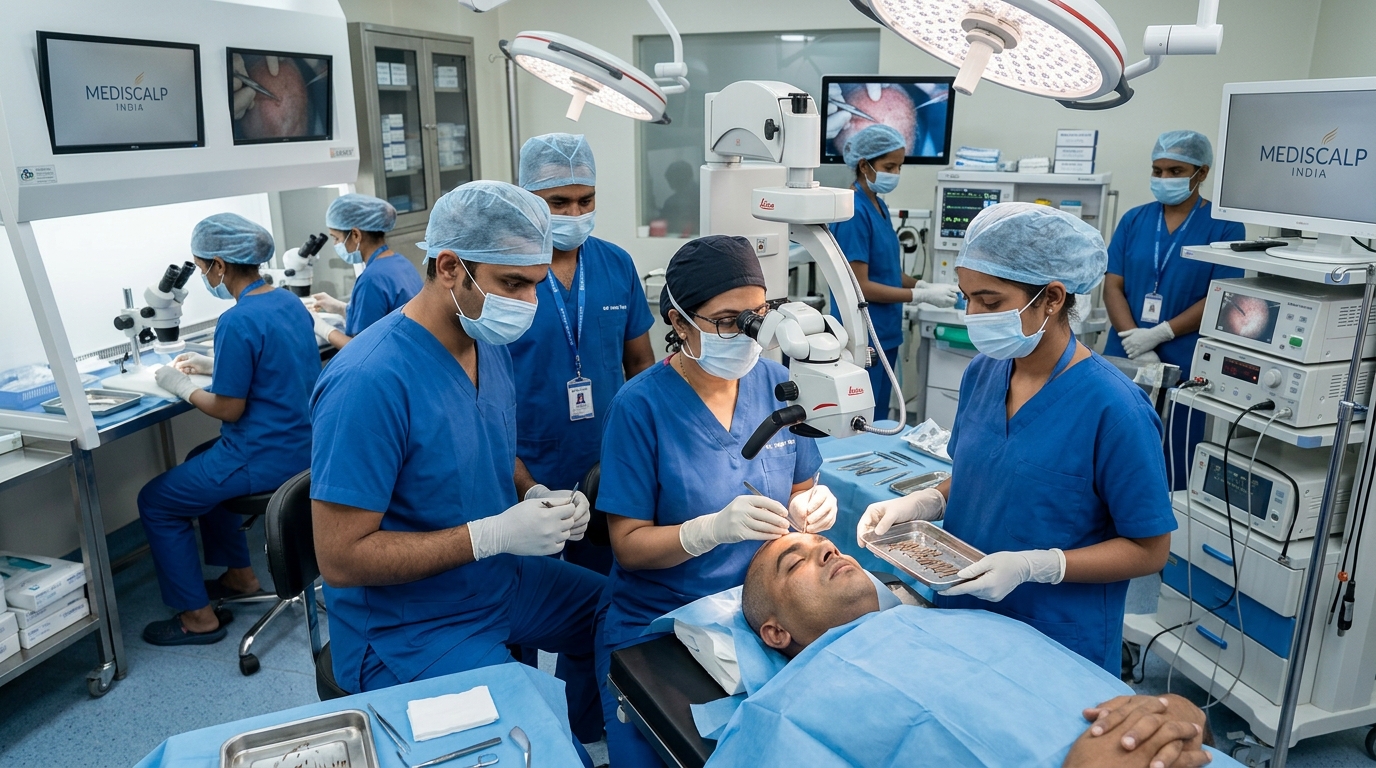
If you are experiencing androgenetic alopecia, a receding hairline, or thinning crown, deciding to restore your hair is a major step. Naturally, one of the most vital questions prospective patients ask is: who transplant hair, and what medical credentials should you look for to guarantee a safe, natural, and permanent result?
A hair transplant is a delicate microsurgical procedure that should exclusively be performed by qualified medical physicians—specifically dermatologists, trichologists, and certified hair restoration surgeons. While dedicated surgical technicians play a crucial supportive role in sorting and hydrating harvested grafts, all critical medical phases—including scalp evaluation, hairline design, local anesthesia administration, follicle extraction, and recipient site creation—must be led by a certified specialist.
Key Takeaways: Who Can Perform a Hair Transplant?
- Physician-Led Surgery: Hair restoration is a medical procedure requiring in-depth knowledge of scalp anatomy, dermatological pathology, and facial aesthetics.
- Doctor vs. Technician Roles: Technicians handle graft preparation under microscopes, but should never perform surgical incisions or independent graft placement.
- Beware of Unregulated Clinics: Low-cost “black market” clinics often delegate the entire surgery to uncertified technicians, risking graft necrosis, scarring, and donor depletion.
- Next-Gen PFI Implantation: Advanced methods such as Precise Follicle Implantation (PFI) with the Scarfree Pen eliminate manual scalpel incisions, allowing doctors to place grafts at custom angles and depths for maximum density and undetectable scarring.
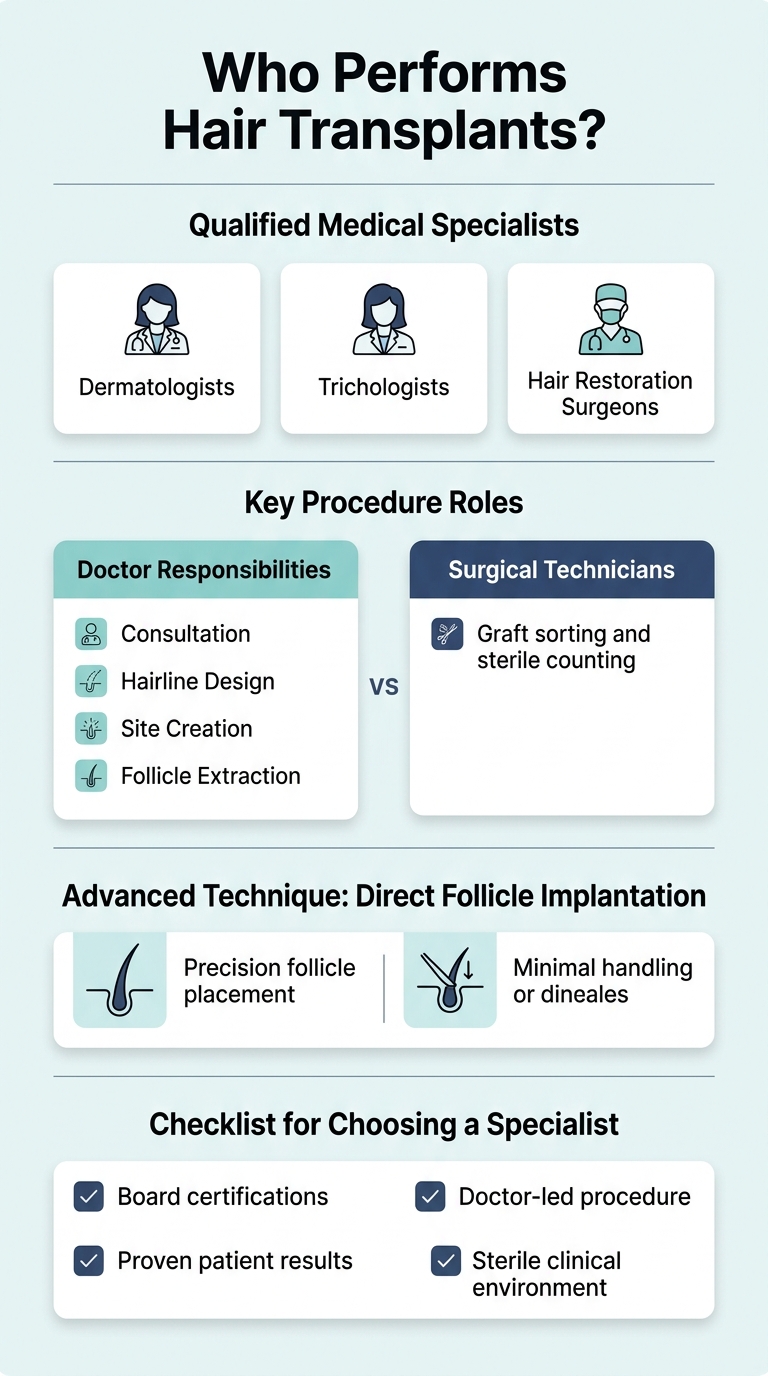
Table of Contents
- Who Is Legally and Medically Qualified to Transplant Hair?
- Medical Specialists: Dermatologists, Trichologists & Surgeons
- Surgical Team Roles: Doctor Responsibilities vs. Technicians
- The Hidden Dangers of “Technician-Only” Clinics
- Essential Credentials and Criteria When Choosing a Specialist
- Advanced Technology: PFI Hair Restoration with the Scarfree Pen
- Questions to Ask During Your Hair Transplant Consultation
- Frequently Asked Questions
Who Is Legally and Medically Qualified to Transplant Hair?
Hair transplantation involves relocating follicular units from permanent donor areas (typically the occipital region at the back of the scalp) into balding recipient zones. Because the procedure involves local anesthesia, micro-incisions, sterile surgical fields, and physiological tissue management, international medical boards and dermatological societies strictly mandate that only licensed medical doctors can carry out surgical hair restoration.
When searching for who transplant hair, patients often encounter a range of professional titles. Understanding what each title means helps you select a qualified, ethical expert:
Medical Specialists: Dermatologists, Trichologists & Surgeons
1. Dermatologists
Dermatologists are medical doctors specializing in the skin, scalp, and hair follicles. They are uniquely trained to diagnose various etiologies of alopecia (such as androgenetic alopecia, alopecia areata, telogen effluvium, or scarring cicatricial alopecia). A dermatologist ensures that your underlying scalp health is thoroughly stabilized before any surgical intervention is planned.
2. Certified Trichologists with Medical Training
Trichology is the specialized branch of dermatology dealing exclusively with the scientific study of human hair and scalp disorders. Medical trichologists possess deep expertise in hair biology, follicle cycle dynamics, donor capacity mapping, and miniaturization patterns, making them exceptional specialists for designing tailored hair restoration treatments.
3. Hair Restoration & Plastic/Cosmetic Surgeons
Surgeons trained in aesthetic and reconstructive plastic surgery bring meticulous microsurgical handling, spatial symmetry, and refined hairline contouring skills to the operating room. They understand how natural hairlines flow with facial bone structure to avoid artificial, pluggy appearances.
Surgical Team Roles: Doctor Responsibilities vs. Technicians
A successful hair restoration procedure is a synchronized team effort. However, there is a clear, inviolable line between what a physician must execute and what supportive surgical technicians do.
| Procedure Step | Physician / Specialist Role | Surgical Technician Role |
|---|---|---|
| Initial Consultation & Diagnosis | Evaluates scalp, diagnoses hair loss pattern, determines donor density and long-term viability. | Assists with patient intake, medical history charting, and photo documentation. |
| Hairline Design & Aesthetics | Draws and customizes the natural frontal hairline, temporal angles, and crown whorls. | Not involved in surgical design decisions. |
| Local Anesthesia Administration | Calculates exact dosage and administers tumescent local anesthesia safely. | Monitors vital signs and assists in maintaining patient comfort. |
| Graft Harvesting / Extraction | Performs micro-motor or manual FUE punches, ensuring safe donor margins without overharvesting. | Gently retrieves loosened follicular units and places them into chilled holding solutions. |
| Graft Inspection & Dissection | Oversees quality control, viability checks, and single vs. multi-hair graft distribution. | Sorts, trims excess tissue under stereoscopic microscopes, and tallies graft counts. |
| Recipient Channel Creation / Implantation | Controls implantation depth, acute angulation (10° to 45°), and follicle density. | Loads follicular units into implanter pens under sterile magnification. |
The Hidden Dangers of “Technician-Only” Clinics
As hair transplants have grown in popularity worldwide, so has the proliferation of unlicensed commercial clinics—often dubbed the “black market” of hair restoration. In these facilities, doctors merely lend their names to marketing materials while unlicensed assistants and technicians perform the entire surgical procedure.
Undergoing a procedure without direct physician execution carries substantial medical and aesthetic hazards:
- Permanent Donor Depletion: Inexperienced operators often harvest too many follicles from a concentrated area, creating an irreversible patchy or “moth-eaten” appearance on the back of your head.
- Transection of Grafts: Poor hand-eye coordination and blunt instruments cut through follicle roots, destroying them before they can even be implanted.
- Unnatural “Doll Hair” Appearance: Implantation at unnatural 90-degree angles, incorrect hair grouping (putting 3-hair grafts on the front hairline instead of soft single hairs), and linear rows create obvious surgical markers.
- Infection and Tissue Necrosis: Excessive epinephrine, overly dense incisions, or improper sterile protocols can restrict vascular blood supply, leading to skin necrosis and permanent scarring.
Essential Credentials and Criteria When Choosing a Specialist
To ensure your procedure is carried out with medical excellence, verify that your hair restoration doctor meets the following criteria:
- Medical Degree and Active Licensing: Confirm that the primary provider is a licensed physician (MBBS/MD/equivalent) registered with recognized medical and dermatological boards.
- Trichology and Aesthetic Dermatology Focus: Look for clinicians who focus their daily practice on hair biology, scalp pathology, and advanced restorative techniques rather than treating hair transplants as an occasional side procedure.
- Direct Doctor Involvement: Ask explicitly: Who will make the incisions, and who will implant the grafts? An ethical clinic will confirm that a certified doctor executes or directly supervises every surgical step.
- Verifiable Portfolio: Request clear, high-resolution before-and-after photographs showcasing macro views of both the hairline and the donor healing area.
Advanced Technology: PFI Hair Restoration with the Scarfree Pen
Beyond finding a qualified physician, the specific implantation technique utilized by your doctor plays a decisive role in follicle survival, density, and invisible healing.
Traditional techniques like FUT (Follicular Unit Transplantation) leave a linear scar across the back of the scalp. While standard FUE improved upon this by extracting individual follicles, conventional FUE still requires the surgeon to create hundreds of pre-made recipient slits with scalpels or needles before forceps are used to manually push grafts into the cuts.
At Elite Dermadent, advanced hair restoration is led by Dr Arefa Patel, Trichologist and Skin Specialist, who specializes in the revolutionary Precise Follicle Implantation (PFI) technique utilizing the specialized Scarfree Pen.
How PFI with the Scarfree Pen Works:
The Scarfree Pen is a sophisticated micro-implanter equipped with a fine hollow needle that houses each delicate follicular unit. Instead of pre-cutting incisions and pushing roots with forceps, the Scarfree Pen enables simultaneous channel creation and graft insertion in a single motion.
- Zero Pre-Made Channel Trauma: Eliminates excessive bleeding and swelling because no separate scalpel cuts are made.
- Micro-Engineered Angle & Depth Control: Enables the specialist to dynamically adjust graft depth, direction, and exit angles (from 10° to 45°) to mimic your natural hair growth perfectly.
- Higher Graft Survival (Up to 95%+): The follicle bulb is protected inside the hollow needle during insertion, preventing root bending, crushing, or dehydration.
- Virtually Undetectable Healing: Because micro-punctures contract immediately around the graft, redness subsides rapidly and visible scarring is non-existent.
Explore our tailored hair transplant procedure options to discover how modern PFI restoration can help you regain thick, natural hair safely.
Questions to Ask During Your Hair Transplant Consultation
Before committing to surgery, schedule an in-depth consultation and ask the following vital questions:
- “What medical qualifications and dermatological training do you hold?”
- “What percentage of the procedure will be handled directly by you versus your technicians?”
- “Do you use pre-made slit incisions or direct implanter pen (PFI) technology?”
- “How do you calculate safe donor harvesting limits to protect my donor area for the future?”
- “What medical therapy (such as PRP, minoxidil, or DHT blockers) do you prescribe to preserve native non-transplanted hair?”
Frequently Asked Questions
Who is the best doctor to perform a hair transplant?
The best doctor for a hair transplant is a qualified dermatologist, trichologist, or board-certified hair restoration surgeon who specializes in follicular unit extraction (FUE) and direct implantation techniques, possesses a proven track record of natural hairline designs, and personally performs the surgical phases of the procedure.
Can technicians do hair transplant surgery on their own?
No. By law and medical safety standards, surgical technicians cannot independently diagnose hair loss, administer local anesthesia, extract hair follicles, or make surgical incisions. Technicians are trained assistants who support the doctor by preparing and sorting grafts under microscopes.
What is the difference between a dermatologist and a trichologist?
A dermatologist is a medical doctor specializing in diseases of the skin, hair, and nails. A trichologist specializes specifically in the science of hair and scalp health. When a medical doctor has dedicated trichological expertise, they provide the highest level of diagnostic precision and surgical planning for hair loss conditions.
How does PFI with the Scarfree Pen differ from regular FUE?
While regular FUE requires cutting incisions first and manually inserting grafts using forceps (which can traumatize the delicate follicle root), PFI utilizes the Scarfree Pen to create the site and implant the graft simultaneously. This minimizes tissue trauma, reduces recovery time, and provides superior control over hair angle, density, and natural aesthetics.
Are hair transplant results permanent?
Yes. Grafts harvested from the permanent donor zone (the back and sides of your head) are genetically resistant to dihydrotestosterone (DHT), the hormone responsible for male pattern baldness. Once successfully integrated, these follicles continue growing naturally for a lifetime.
Comments are closed